If you’re living in the United States, building a business, raising a family, or crossing the border regularly from Canada, citizenship can feel like the final step that makes everything more stable. It often means voting rights, a U.S. passport, and less anxiety about maintaining immigration status.
At Mayo Law’s U.S. immigration insights, we often see the same pattern. Someone has spent years doing everything properly, then gets stuck on one practical question about how to get us citizenship. The process is achievable, but it rewards precision.
That point matters because 818,500 people were naturalized by USCIS in Fiscal Year 2024, according to Clearbox Legal’s summary of USCIS naturalization data. Citizenship isn’t rare. But successful cases usually involve good timing, accurate records, and a realistic understanding of what USCIS is reviewing.
Your Journey to Becoming a US Citizen
For many applicants, the turning point isn’t emotional. It’s administrative. A Canadian executive on a long-running U.S. assignment may realize that constant travel needs to be documented carefully. A founder who first entered on a work-authorized pathway may need to confirm when permanent residence began. A spouse of a U.S. citizen may discover that the shorter route still has strict eligibility rules.
Citizenship is a legal status, but the road to it is built on paperwork, consistency, and credibility. USCIS looks closely at residence, physical presence, identity documents, travel history, tax compliance, and whether your application lines up with prior filings.
Practical rule: The strongest citizenship applications usually look boring. Dates match, travel is explained, addresses are consistent, and nothing on Form N-400 surprises the officer.
That is what makes preparation so important. Many people are eligible in principle, but not yet ready in practice.
The Primary Pathways to US Citizenship
Before you prepare forms, you need to identify the right legal route. Many applicants use the phrase “apply for citizenship” when they may already be citizens, or when citizenship may come through a parent rather than through naturalization.
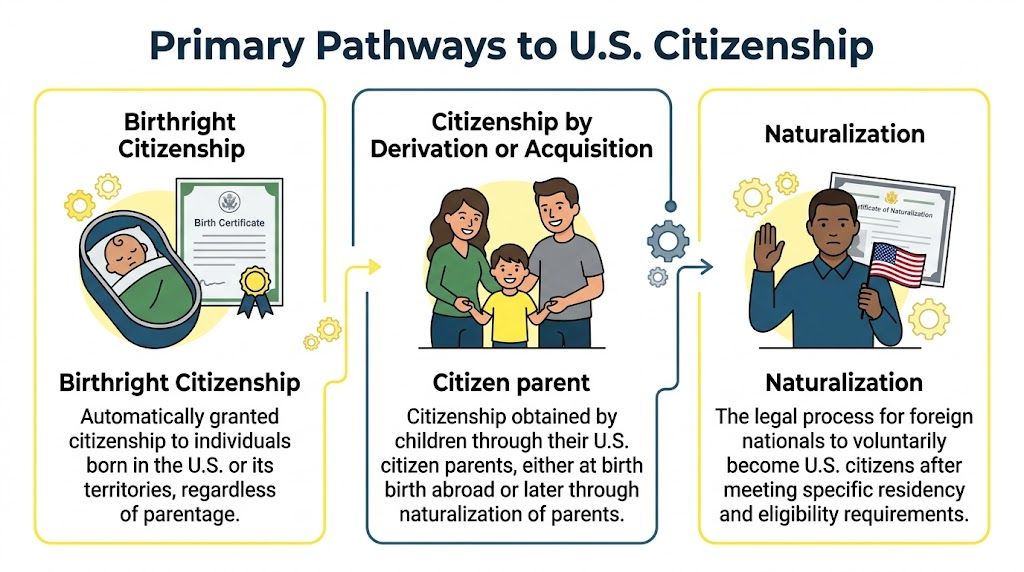
Birthright citizenship
If you were born in the United States, citizenship may have been acquired automatically at birth. In that situation, the issue is usually proof, not eligibility. People often need to sort out documentary questions such as a birth certificate, passport application, or related records.
This path is straightforward in concept. The challenge is that many adults spend years assuming they need to naturalize when they should first confirm whether they already hold citizenship.
Citizenship through parents
Some people acquire or derive citizenship through a U.S. citizen parent. That can happen at birth abroad or later in childhood, depending on the family facts and the law that applied at the relevant time.
These cases are detail-heavy. Parentage, the parent’s citizenship status, the child’s age, custody arrangements, and residence history all matter. If your family moved between Canada and the United States, this analysis can become document intensive very quickly.
Naturalization after a green card
For most adult immigrants, naturalization is the path. This is the formal process of becoming a U.S. citizen after first becoming a lawful permanent resident.
That distinction matters for professionals and investors. A visa, even a long-term one, is not citizenship. Neither is work authorization. Business owners sometimes focus on temporary options first, then later compare longer-term planning choices such as E-2 and EB-5 visa strategies because the route into permanent residence affects when naturalization becomes possible.
A simple comparison
| Pathway | Typical applicant | Main issue |
|---|---|---|
| Birth in the U.S. | Person born in the U.S. | Proving status |
| Through parents | Child of a U.S. citizen | Matching facts to the correct law |
| Naturalization | Green card holder | Meeting residence, presence, and eligibility rules |
As of recent data, 7.4 million non-citizen immigrants are likely eligible to naturalize but have not yet applied, according to the American Immigration Council’s naturalization fact sheet. In practice, that tells you something important. Many people wait because they are unsure which pathway fits, or because they sense there may be a hidden issue in their record.
The Naturalization Process A Detailed Roadmap
A common Canadian scenario looks straightforward on paper. You have held a green card for years, built your career in the United States, and still cross the border often for family, property, or business. Then the citizenship timeline turns on details such as a six-month stay in Toronto, inconsistent trip dates, or tax filings that do not match the residence story in the application.

Start with the residence clock
Naturalization usually requires 5 years of continuous residence as a lawful permanent resident, or 3 years if you are applying based on marriage to a U.S. citizen, plus physical presence for at least half of the required period. You may file up to 90 days early, but only if the eligibility calculation is correct. Filing too early wastes time and filing fees, and it can be avoided with a careful date review.
For Canadians, this is often the first real pressure point. Frequent trips home, remote work for a Canadian company, caring for parents across the border, or keeping an active business presence in both countries can all raise questions about whether U.S. residence remained continuous. A long absence does not always ruin a case, but it should never be treated casually.
Build the application around proof
Form N-400 works best when it is prepared like an audit file. USCIS checks what you submit against prior immigration records, entry and exit history, tax information, and background results.
A strong document set often includes:
- Green card evidence: Front and back copy, including the correct "Resident Since" date.
- Travel history: A complete trip list, especially for applicants who cross the U.S.-Canada border often.
- Address and employment records: Exact dates matter. Guesses create avoidable discrepancies.
- Tax documents: These help support both residence and compliance.
- Marriage or divorce records: Important if you are using the three-year rule through marriage to a U.S. citizen.
- Selective Service or court records, if relevant: These should be addressed directly, with supporting documents ready before filing.
I often tell cross-border clients to pull their CBP travel history, passport stamps, calendars, and old emails before touching the form. Reconstructing trips after filing is harder than doing it properly at the start.
Review earlier immigration filings before submitting N-400. Small contradictions often become the focus of the interview.
Fill out Form N-400 like a legal record
Applicants sometimes try to make the form read smoothly. Accuracy matters more.
Use the same names, dates, employers, and addresses that appear in your prior filings unless you are correcting an error. If you are correcting one, do it clearly and consistently. For Canadians who started in TN status or another temporary work category, this point deserves extra care. Old visa applications, border admissions, and later green card filings should fit together in a way that makes sense on paper.
Handle filing costs and fee-waiver requests carefully
Naturalization has filing costs, and those costs cause some eligible applicants to wait. USCIS fee rules also change from time to time, so the right question is not what the fee used to be. The right question is what applies on the day you file.
A fee waiver or reduced fee may be available in some cases, but the request should be supported properly and considered as part of the larger strategy. If your case already has travel issues, prior citations, or record inconsistencies, a rushed filing to save time usually creates more work later.
What tends to help, and what causes problems
What usually helps:
- Checking the eligibility date before preparing the packet
- Creating a travel log before starting N-400
- Making sure tax filings support the residence history
- Answering hard questions directly, including arrests, citations, and prior immigration issues
What often causes problems:
- Filing based on an estimated eligibility date
- Guessing at border-crossing dates
- Forgetting that USCIS can compare the N-400 to older applications
- Assuming a long stay in Canada can be explained informally at the interview
Good naturalization cases are rarely about one perfect document. They are about consistency across the full record. For Canadian applicants, that usually means treating travel, tax, and immigration history as one file, not three separate issues.
Mastering the Citizenship Tests and Interview
Most applicants worry most about the test. In practice, the interview is usually where preparation matters more.

Biometrics and background review
After filing, USCIS may schedule a biometrics appointment. This is part of the agency's identity and background screening process. Treat it as routine, but take every notice seriously and keep copies of everything you receive.
English and civics preparation
The citizenship test usually includes English and civics components unless an exception or accommodation applies. The best study approach is practical, not academic.
- Use USCIS materials: Study the official civics questions and sample English exercises.
- Practice aloud: The speaking portion often feels easier when you've rehearsed ordinary answers about your application.
- Review your own N-400: Many interview questions come directly from what you submitted.
The interview itself
The officer will often confirm your identity, review your application, ask about updates, and test whether your written form reflects real facts. If your case involves frequent travel, old immigration changes, or business activity in Canada and the United States, expect questions that check continuity and credibility.
Bring a clean, organized set of documents. Good preparation often changes the tone of the interview from defensive to efficient.
A calm interview doesn't mean casual. Listen carefully, answer what was asked, and don't volunteer extra facts that create confusion. If you don't understand a question, ask for clarification rather than guessing.
Navigating Common Hurdles and Special Circumstances
The biggest naturalization mistakes are usually not dramatic. They are unresolved issues that the applicant underestimated.
Good moral character and truthful disclosure
USCIS reviews whether you meet the legal standard of good moral character. That can involve criminal matters, tax issues, false statements, unpaid support obligations, or patterns that raise concern about honesty and compliance.
Even minor incidents can matter if they were omitted, minimized, or answered inconsistently. A clean explanation is usually stronger than an incomplete one. This is especially true if an applicant has prior status complications, including periods that might connect with broader immigration concerns such as those discussed in Mayo Law's article on visa overstay myths, facts, and practical consequences.
Medical disability exceptions
Some applicants cannot meet the English and civics requirements because of a qualifying condition. In those cases, Form N-648 may be available. Applicants with a physical or developmental disability or mental impairment that prevents them from meeting the English and civics requirements may be eligible for a waiver by filing Form N-648, Medical Certification for Disability Exceptions, certified by a licensed medical professional, as described by Washington LawHelp's guidance on disability exceptions.
This is not a shortcut. It is a formal medical submission, and it needs to be complete, credible, and consistent with the rest of the case.
If USCIS raises concerns
A difficult case doesn't always end with a denial. Sometimes USCIS asks for more evidence. Sometimes the issue is a fixable discrepancy. Sometimes the better course is to pause, gather records, and respond strategically.
Consider these warning signs before filing:
- Extended time abroad: Long trips may affect continuous residence.
- Any criminal history: Even old or seemingly minor records should be reviewed first.
- Tax irregularities: Filing choices should align with your residence position.
- Prior immigration inconsistencies: Different versions of the facts can become a serious problem at naturalization.
Hard cases often become harder because they were filed too early, not because they were impossible.
Dual Citizenship and Cross-Border Considerations for Canadians
For Canadians, citizenship planning usually isn't just about immigration status. It's also about mobility, business structure, family ties, and tax reporting on both sides of the border.

Dual citizenship is legally possible, but it still needs planning
Many Canadians ask whether becoming a U.S. citizen means giving up Canadian citizenship. In many cases, people hold both. The legal answer, however, is only the beginning.
Cross-border citizens may need to think through:
- Tax filing obligations: U.S. citizenship can affect ongoing reporting, even if assets or income remain tied to Canada.
- Retirement accounts and investments: RRSPs, TFSAs, 401(k)s, and corporate holdings can create planning questions.
- Family movement: Spouses and children may not share the same immigration or citizenship posture.
- Travel patterns: Once citizenship is in view, your recent travel history still matters for the application itself.
Canadians on TN, L-1, or other temporary status
A common mistake is assuming that a long and successful U.S. work history automatically creates a direct road to citizenship. It doesn't. A temporary visa is not permanent residence, and permanent residence is not citizenship.
That is why long-term strategy matters for executives, founders, and professionals. If you are in the U.S. on TN status, for example, green card planning should be approached carefully because the transition from temporary status to immigrant intent can affect timing, travel, and documentation.
A special note for physicians
Canadian physicians sometimes have a more strategic route. Physicians who commit to work for 5 years in a designated underserved area can use a National Interest Waiver to obtain a green card, bypassing labor certification, according to this explanation of the physician NIW pathway. For some medical professionals, that can create a more direct long-term path toward naturalization.
Citizenship planning also intersects with Canadian nationality questions for family members. In some households, one person is moving toward U.S. citizenship while another is confirming status north of the border through routes discussed in Mayo Law's guide on how to become a Canadian citizen. Families often need both analyses at the same time.
Why and When to Consult an Immigration Attorney
Some citizenship applications are straightforward. Others only look straightforward until someone checks the travel history, prior filings, or criminal records.
You may want to consider professional guidance if any of these apply:
- Frequent border travel: Especially common for Canadians who live business lives in both countries.
- A prior arrest, charge, or conviction: The legal impact often depends on the exact record, not the label you remember.
- A previous visa or green card issue: Old inconsistencies have a way of resurfacing at naturalization.
- A business immigration history: Investor, founder, or executive cases often involve layered records and strategic timing.
- A long-term residence plan: Some applicants need to decide whether the green card stage itself should be built through family, employment, or investment options such as those discussed in relation to an EB-5 immigration pathway.
An attorney isn't only for emergencies. In many cases, legal review is most useful before filing, when there is still time to correct the record, organize evidence, and avoid turning a manageable issue into a denial.
Ready to Start Your Journey to US Citizenship?
If you're weighing how to get us citizenship and your life crosses the U.S.-Canada border, careful planning may save time, cost, and frustration. Mayo Law assists clients in New York and Ontario with cross-border immigration strategy. You can schedule a consultation to discuss your pathway and your specific facts.
LEGAL DISCLAIMER
LEGAL DISCLAIMER: The information provided in this article is for general informational and educational purposes only and does not constitute legal advice. Reading this article, visiting mayo.law, or contacting Mayo Law does not create an attorney-client relationship. The content of this article should not be relied upon as a substitute for professional legal counsel suited for your specific circumstances. Legal outcomes depend on the particular facts and circumstances of each individual case, and no attorney can guarantee a specific result. Laws, regulations, and legal procedures are subject to change and may vary by jurisdiction. If you require legal assistance, you should consult with a qualified attorney licensed to practice in the relevant jurisdiction. Mayo Law expressly disclaims any and all liability with respect to actions taken or not taken based on the contents of this article.
If you need help assessing your citizenship timeline, green card strategy, or cross-border considerations, Mayo Law may be able to help. Schedule a consultation to discuss your circumstances.