For years, a frustrating rule in Canadian citizenship law created a group of people known as “Lost Canadians.” Bill C-3, a recent and critical amendment to Canada’s Citizenship Act, is designed to fix this. If you have Canadian heritage but were previously denied citizenship because of where you or your parents were born, this change in legislation could be the key to reconnecting your family to its Canadian roots. At Mayo Law, our attorneys guide clients through complex cross-border matters, and we understand what Bill C-3 means for you.
This new law gets rid of the old “first-generation limit,” a rule that stopped Canadian parents who were themselves born abroad from passing on their citizenship to their children if they were also born outside of Canada. Think of it as a broken link in a chain. It didn’t matter how strong your family’s connection to Canada was; that one technicality could sever your claim to citizenship. The Bill C-3 legislation repairs that link, opening up new pathways for thousands, particularly those with ties across the U.S.-Canada border.
What Is a “Lost Canadian”?

The term “Lost Canadians” describes people who, often unexpectedly, lost or were denied Canadian citizenship because of technicalities in the law. The biggest culprit was a 2009 legal change that established the first-generation limit.
Put simply, if your Canadian parent was also born outside Canada, you were automatically barred from inheriting citizenship. This rigid rule failed to consider a family’s deep, ongoing ties to the country.
This rule could create heartbreaking scenarios. For example, the child of a Canadian professor on a temporary assignment in the U.S. or an executive working abroad could be denied citizenship, even though their family identified as Canadian and planned to return.
How Bill C-3 Fixes the Issue
Bill C-3 directly tackles this long-standing problem with a few key changes. Getting a handle on these updates is the first step in figuring out if your own status has changed.
Here’s what the new law does:
- Restores Citizenship Retroactively: The law grants citizenship back to people born before its enactment who were shut out by the old first-generation rule.
- Eliminates the First-Generation Limit: The old, strict cutoff is gone. This is a massive shift that opens the door for many who were previously told they didn’t qualify.
- Creates a New Path Forward: For children born after the law’s passage, a new “substantial connection” test will be used.
For anyone who has felt the frustration of Canada’s past citizenship laws, Bill C-3 in Canada is a welcome and significant moment. As you read on, you may also find our other Canadian legal insights useful for understanding your cross-border rights and opportunities.
The Legal Journey That Created Bill C-3
The significant changes we see in Bill C-3 didn’t just appear out of thin air. They were the hard-won result of years of passionate legal battles fought for the “Lost Canadians”—people who, despite having undeniable family ties to Canada, were shut out of citizenship by confusing and overly restrictive laws.
This was a journey marked by determined advocates, emotional court cases, and ultimately, a landmark legal decision that forced the government’s hand.
A Court Ruling Sparks Legislative Change
The real turning point came on December 19, 2023. On that day, the Ontario Superior Court of Justice delivered a decisive blow, ruling that the “first-generation limit” on citizenship was unconstitutional. The court found the rule was discriminatory, unfairly stripping people of their rights even when they had deep, meaningful connections to Canada.
Faced with such a clear constitutional rebuke, the Canadian government had a choice to make. Instead of digging in for a lengthy appeal, it wisely chose to accept the court’s ruling and rewrite the law. This decision set the stage for brand-new legislation to bring the Citizenship Act back into alignment with the Charter.
The result was the bill we now know as Bill C-3. It moved through the House of Commons and the Senate, gaining momentum as a direct, necessary response to the court’s order and the tireless advocacy of countless families.
At its heart, the principle was simple: Canadian citizenship shouldn’t be an accident of geography. The new law was designed to replace a rigid, arbitrary cutoff with a more reasonable system that acknowledges a person’s substantive connection to the country.
From Bill to Law: A New Era for Citizenship
This legislative marathon finally crossed the finish line in late 2025, marking a historic moment for Lost Canadians and their families. Bill C-3, An Act to amend the Citizenship Act (2025), received Royal Assent on November 20, 2025, and officially came into force on December 15, 2025.
With that, the old first-generation limit, which had been in place since 2009, was officially off the books. Knowing the legal path that led us here is crucial—it explains not just what the law says, but why it was so desperately needed.
Understanding this history is the foundation for figuring out what rights might now be available to you or your family. It shows a fundamental shift from automatic exclusion to a system that finally recognizes a genuine connection to Canada. This context is key as we dive into the specifics of who is now eligible under these new rules.
Who Is Now Eligible For Citizenship Under The New Rules?
Figuring out who actually qualifies under Bill C-3 can feel like trying to solve a puzzle, but it boils down to one major change. At its heart, this new law is about correcting a long-standing issue that cut many people off from their Canadian roots.
The old system had a strict “first-generation limit,” which meant that if you were a Canadian born abroad, you couldn’t automatically pass your citizenship on to your own children if they were also born outside of Canada. Bill C-3 throws that rule out the window, and it does so retroactively. This is a huge deal—it means the law reaches back in time to grant citizenship to those who should have had it all along.
Common Scenarios Under Bill C-3
So, what does this look like in the real world? Let’s walk through a couple of common situations that our attorneys often encounter. These are the kinds of “Lost Canadians” who now have a clear path to citizenship.
- The Descendant of a Canadian Service Member: Say your mother was born in Germany because her father, your grandfather, was a Canadian soldier stationed there. Because your mom was a Canadian born abroad, the old rules blocked her from passing citizenship to you when you were born in New York. Bill C-3 removes that barrier, and you are very likely eligible for citizenship now.
- The Child of a Canadian Professional Abroad: Or perhaps your father was born in the U.S. to Canadian parents, making him a citizen by descent. He then built a career in London, where you were born. Under the previous law, you would have been denied citizenship. Thanks to the new rules, you are almost certainly recognized as a Canadian.
These stories highlight the fundamental shift. The law has stopped penalizing the second generation born abroad for where their parents happened to be living.
What truly matters now is your parent’s Canadian status when you were born. Bill C-3 validates that connection, no matter where your Canadian parent was born.
Citizenship by Descent and the Second-Generation Fix
The concept at the center of this change is citizenship by descent. Before 2009, citizenship could often flow down through several generations born outside of Canada. The law that was in place from 2009-2025 created a hard stop after just one generation, but Bill C-3 has finally reopened that pathway. To make this crystal clear, let’s compare the old system with the new reality.
| Scenario | Rule Before Bill C-3 (2009-2025) | Rule After Bill C-3 (Post-Dec 15, 2025) |
|---|---|---|
| First generation born abroad to a Canadian parent born in Canada. | Eligible for citizenship by descent. | Eligible for citizenship by descent. |
| Second generation born abroad to a Canadian parent who was also born abroad. | Not Eligible due to the first-generation limit. | Eligible for citizenship retroactively. The limit is removed. |
| Future children born abroad to a parent who is Canadian by descent. | Not Eligible without a complex process. | Eligible if the parent meets the new “substantial connection” test. |
This retroactive change is a monumental victory for families with deep cross-border histories. If you think this might apply to you, understanding your potential eligibility is the critical first step toward reclaiming your Canadian identity. Many people in these situations have ties to both Canada and the U.S. and are often looking to understand their full range of options. You can learn more about how we help clients navigate these complex cross-border matters, including various business immigration pathways.
Understanding The Substantial Connection Test
While Bill C-3 rightly restores citizenship to many who lost it, it also sets a new standard for future generations born abroad. The old, rigid first-generation cutoff is gone. In its place, we now have a far more practical measure: the substantial connection test.
This new test is specifically for Canadians by descent—that is, anyone born outside Canada to a Canadian parent. If you’re in this group and want to pass on citizenship to your own children born abroad, you’ll first need to show you have a tangible, physical connection to Canada.
This flowchart breaks down the difference between the old rules and the new reality under Bill C-3.
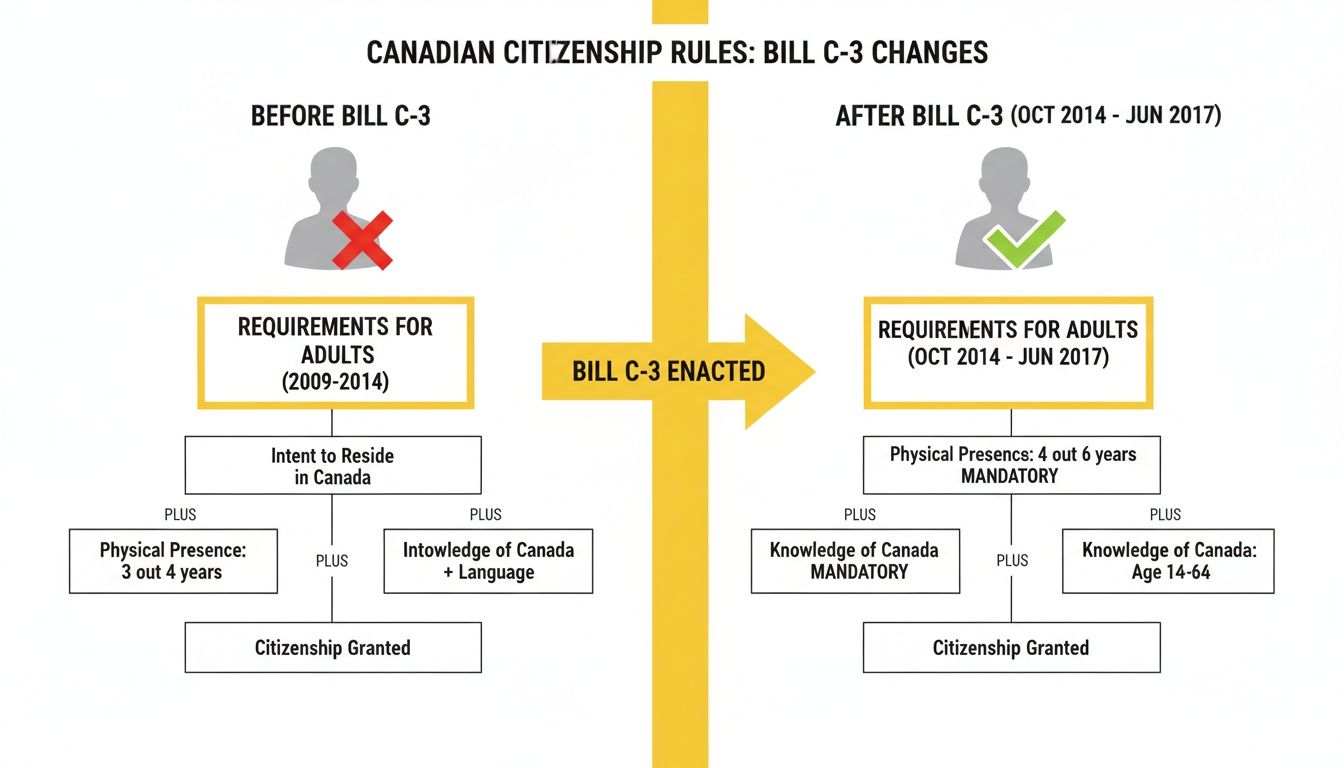
As you can see, the law has moved from a hard “no” for the second generation born abroad to a conditional “yes.” That condition hinges entirely on the parent’s physical time spent in Canada.
The 1,095-Day Requirement Explained
So, what does a “substantial connection” actually look like? The law is crystal clear on this point. It’s not about owning property or having family here; it’s about your physical footprint in the country.
A Canadian parent born abroad must have spent a cumulative total of at least 1,095 days physically present in Canada before their child is born. That’s the equivalent of three full years. Think of it as “banking” your time in Canada. Every day you spend here—whether for work, school, or visiting family—counts toward that total. Once you hit the 1,095-day threshold, you’ve unlocked the ability to pass citizenship to your children, no matter where they are born.
Documenting Your Physical Presence
When you apply for your child’s citizenship certificate, the burden of proof will be on you to show you’ve met the 1,095-day rule. Meticulous record-keeping isn’t just a good idea; it’s essential.
Start gathering documents that can prove your time in Canada. Helpful records include:
- Travel Records: Passport stamps showing entry and exit dates are your primary evidence.
- Employment or School Records: Official letters from employers or transcripts from educational institutions are powerful proof of presence.
- Rental Agreements or Property Records: Leases or deeds can help establish your residency during specific periods.
- Other Official Documents: Tax records, provincial health card statements, and other official correspondence can also support your timeline.
Keeping these documents organized will save you a world of headaches later. For those dealing with documents from different jurisdictions, proper authentication is another key step. If you need help getting your documents in order, you can learn more about our notary services.
Your Practical Next Steps for Claiming Citizenship

If you have read this far and think the new rules under Bill C-3 might apply to you, you’re probably wondering, “What now?” Let’s get practical.
You are not applying to become a citizen. You’re asking the Canadian government to officially recognize the citizenship you may already have by law. The entire process hinges on one key application: the one for your Proof of Citizenship, often called a citizenship certificate. This certificate is the official document that unlocks your ability to get a Canadian passport and access all the rights that come with being a citizen. To get there, you’ll need to build a rock-solid case with clear documentation.
Gathering Your Core Documents
Your main job is to create a paper trail that leaves no doubt about your connection to a Canadian parent. Start by collecting the foundational documents that will anchor your application.
Here’s an initial checklist:
- Your Canadian Parent’s Proof of Citizenship: This is the cornerstone of your claim. It can be their own citizenship certificate, a birth certificate from a Canadian province, or even an old Canadian passport.
- Your Original Birth Certificate: This is crucial because it must list your Canadian parent by name. If the name on your birth certificate is different from their citizenship document (due to marriage, for instance), you’ll need a paper trail, like a marriage certificate, to connect the two.
- Your Own Proof of Identity: You’ll need to include copies of your valid government-issued ID, like a passport or driver’s license.
Remember, the burden of proof is on you. The most common reason applications get delayed or even rejected is due to missing documents or inconsistencies. Taking the time to be thorough now could save you a world of headaches later.
Navigating Potential Complications
Of course, family histories can be messy, and documents—especially older ones—can be lost. You might run into roadblocks if your Canadian parent has passed away and their citizenship papers are nowhere to be found. In these cases, you could be looking at genealogical research or digging through government archives.
If your situation has any of these tricky elements, or if you simply want the peace of mind that comes with getting it right the first time, this is often the point where professional guidance becomes invaluable. The attorneys at Mayo Law have experience navigating complex Bill C-3 Canada citizenship claims. We can help you pinpoint exactly what evidence you need, strategize how to find it, and present your case in the clearest possible light.
Key Considerations for Cross-Border Life
Confirming your Canadian citizenship through Bill C-3 Canada is about much more than just getting a passport. For anyone living or working between the United States and Canada, this change can dramatically alter your personal and professional landscape.
Easing U.S. Visa Pathways
A Canadian passport has always been a powerful tool for cross-border mobility. For example, Canada is a treaty country for the E-2 Treaty Investor visa, and confirming your Canadian citizenship can clarify the path for starting or acquiring a business in the U.S. The same goes for TN visas under the USMCA (CUSMA), which offer a direct route for qualified Canadian professionals to work in the States.
Securing Your Family’s Future
For many people, the most meaningful impact of this legislation is what it does for their children. Resolving your citizenship status could provide the next generation with a lifetime of security and opportunity.
With a Canadian citizenship certificate, your children may unlock:
- Affordable Education: They could attend Canadian universities and colleges paying domestic tuition fees.
- Reliable Healthcare: They may gain access to Canada’s public healthcare system.
- Freedom of Movement: They have the unconditional right to live, work, and study anywhere in Canada.
Expanding Business and Talent Opportunities
If you run a business with a foot in both countries, like a startup operating between Ontario and New York, the changes from Bill C-3 are a game-changer for your talent strategy. It essentially broadens the pool of skilled people you can hire and deploy across the border. This legislative fix directly supports a more integrated North American workforce. For guidance on scaling your business effectively, you can learn more about how we help with international business structuring and compliance.
Questions About Your Canadian Citizenship Rights?
The rules of the Citizenship Act, especially after Bill C-3, are complicated. You don’t have to navigate them on your own. Mayo Law’s immigration team guides clients through Citizenship Act complexities. Schedule a consultation with Mayo Law today.
LEGAL DISCLAIMER: The information provided in this article is for general informational and educational purposes only and does not constitute legal advice. Reading this article, visiting mayo.law, or contacting Mayo Law does not create an attorney-client relationship. The content of this article should not be relied upon as a substitute for professional legal counsel tailored to your specific circumstances. Legal outcomes depend on the particular facts and circumstances of each individual case, and no attorney can guarantee a specific result. Laws, regulations, and legal procedures are subject to change and may vary by jurisdiction. If you require legal assistance, you should consult with a qualified attorney licensed to practice in the relevant jurisdiction. Mayo Law expressly disclaims any and all liability with respect to actions taken or not taken based on the contents of this article.