You found the right candidate. They have the degree, the experience, and the business fit. Then the usual H-1B lottery gets in the way.
For many employers in New York and Ontario, that’s the moment the hiring plan stalls. A startup may need an engineer now. A research venture may need a specialized scientist for a live project. Waiting on a lottery, then waiting again for an October start date, often doesn’t fit how real businesses operate.
Mayo Law works with cross-border employers and professionals who run into exactly this problem. In plain terms, a cap exempt h1b isn’t a separate visa category. It’s a way certain employers may file H-1B petitions without entering the annual cap lottery. If your organization qualifies, that can change the hiring timeline, risk profile, and workforce planning strategy in a real way.
Introduction
Most confusion starts with one basic mistake. Employers often assume the H-1B problem is about the worker. Usually, the first question is about the employer.
A cap exempt h1b depends on who is filing the petition and how the role connects to that organization’s educational or research mission. That matters for universities, affiliated nonprofits, nonprofit research organizations, government research organizations, and some collaborative work arrangements that became more flexible under the modernization rule.
For cross-border organizations, this can be useful. A Canadian company partnering with a U.S. university, or a New York nonprofit research affiliate hiring specialized talent from Canada, may have options that a standard private employer doesn’t.
Practical rule: Think of cap-exempt status like a special entrance to the same H-1B building. The worker still needs an H-1B-qualifying job and credentials. The difference is that some employers don’t have to stand in the annual lottery line.
Understanding the H1B Cap and the Exemption
The standard H-1B process is built around a hard annual limit. The program has an annual cap of 85,000 visas, made up of 65,000 regular cap numbers and 20,000 for beneficiaries with U.S. master’s degrees or higher according to this explanation of cap exempt H-1B rules. That same source notes that for fiscal year 2026, USCIS selected only about one-third of interested beneficiaries through the lottery.
That helps explain why employers feel the process is unstable. You may have a valid role, a qualified worker, and business urgency, yet still miss out because the filing track is cap-subject.
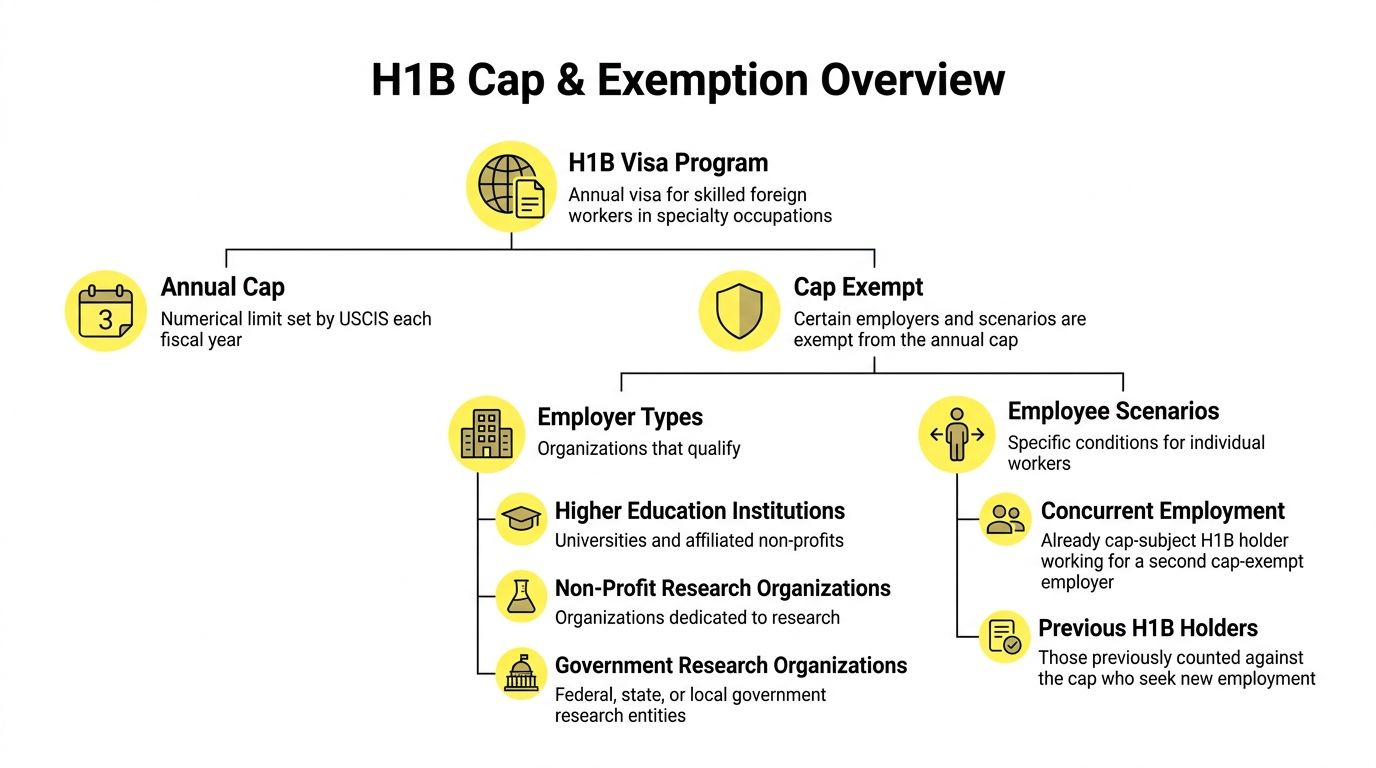
Cap-subject and cap-exempt are different filing tracks
A cap exempt h1b isn’t a lighter version of H-1B. It’s still an H-1B petition for a specialty occupation. The exemption changes whether the petition is subject to the numerical limit and lottery.
Here’s the practical difference:
| Track | Main issue | Filing timing |
|---|---|---|
| Cap-subject H-1B | Must compete for limited numbers | Tied to the annual registration cycle |
| Cap-exempt H-1B | No lottery participation for qualifying petitions | May be filed year-round |
That year-round filing flexibility often matters as much as the exemption itself. A business doesn't always hire on a fiscal-year calendar.
Why employers care
For HR teams, the annual cap creates two kinds of risk:
- Timing risk because hiring may need to wait for the annual cycle
- Selection risk because registration doesn't mean the worker gets chosen
A cap exempt h1b may reduce both if the employer fits the legal categories. It can also make workforce planning more realistic for organizations with grant timelines, academic calendars, or project-based staffing needs.
If your team is comparing U.S. immigration pathways more broadly, Mayo Law's U.S. immigration resources may help frame where H-1B fits.
The exemption exists under the Immigration and Nationality Act and 8 CFR 214.2(h)(8)(ii)(F). In practice, that means some qualifying employers can hire skilled foreign workers without waiting on the cap lottery.
Who Qualifies to Sponsor a Cap Exempt H1B Visa
The key legal categories come from INA Section 214(g)(5) and 8 CFR 214.2(h)(8)(ii)(F). Under the modernization rule effective 2025, nonprofit affiliation and worksite structure became more flexible in important ways, as described in this discussion of cap-exempt eligibility and the modernization rule.

Institutions of higher education
Institutions of higher education represent the clearest category. Colleges and universities generally sit at the center of the cap-exempt framework.
If the petitioning employer is a qualifying institution of higher education, the exemption analysis is more straightforward than it is for adjacent nonprofits or commercial collaborators.
Nonprofit entities affiliated with institutions of higher education
Many employers find this point challenging. A nonprofit can't say, "We work with a university." The affiliation usually needs to be formal and documented.
The modernization rule matters here. A nonprofit may qualify through a formal written affiliation agreement for research or education, and it needs only one fundamental activity contributing to the institution's mission rather than being primarily engaged in that activity.
That change is important for hospital systems, incubators, specialized labs, and mission-driven affiliates that do more than one thing.
Nonprofit research organizations
These organizations may qualify when their research function fits the statutory and regulatory framework. The strongest cases usually show that research isn't incidental. It's central to the organization's purpose and operations.
Employers should be ready to show mission documents, organizational materials, and a role description that ties the offered job to the research purpose.
Government research organizations
Federal, state, and local government research organizations may also sponsor cap exempt h1b petitions. The analysis often focuses on the organization's legal status and the research character of the role.
This category can be useful for public-sector collaborations, especially where scientific, technical, or policy research depends on specialized hires.
The 50 percent work-allocation rule
One of the most useful developments is the rule for workers who are not directly employed by the exempt entity. The modernization rule expanded eligibility where the beneficiary spends at least half of work time at qualifying sites or advancing the core mission remotely.
That opens the door for arrangements that look more like modern business reality. A worker might be employed by one organization but perform a substantial part of the job in service of a university or research mission.
Examples include:
- A software engineer employed by an affiliated nonprofit but assigned to a university lab project for at least half of work time
- A data scientist whose remote duties directly further a qualifying research mission
- A specialist clinician or researcher working through an affiliated entity under documented educational or research ties
The proof matters. Detailed job descriptions and affiliation documents are often the difference between a clean petition and a difficult one.
For founders thinking about how U.S. operations should be structured before immigration filing begins, this overview on choosing the right entity for your U.S. business may help.
Navigating Concurrent Employment and Transfers
Mobility under a cap exempt h1b can be more flexible than many employers assume. The rules still need careful handling, but the path isn't always all-or-nothing.

Moving from cap-subject to cap-exempt
Start with a common example. A software professional works for a private employer in cap-subject H-1B status, then gets an offer from a university research center.
That move may allow the new employer to file a cap-exempt petition without going through the annual lottery. The person's H-1B history still matters, but the new filing track may avoid the cap issue for the exempt role.
Moving between cap-exempt employers
This is often cleaner. If the worker remains in qualifying cap-exempt employment, the transfer analysis usually focuses on the new employer's exempt status and the specialty occupation role rather than lottery eligibility.
Concurrent employment
Concurrent employment means two H-1B jobs at the same time. Strategic planning can significantly aid in these situations.
According to Duane Morris on cap exemptions and the modernization rule, cap-exempt filings can support concurrent employment, and the modernization rule expanded exemption concepts for people spending at least half their time at cap-exempt entities even if not directly employed by them. That "at" employment model can support collaborative roles that further the mission of a university or research organization. The same source also notes that cap-exempt filings occur year-round and that premium processing is available.
A useful way to think about concurrency is this. One worker can sometimes wear two legally separate hats, as long as each employer has its own valid H-1B basis and the filing history supports it.
This matters for cross-border ventures. A founder may want a specialist to support a private commercial venture while also contributing to a university-linked research initiative. Those arrangements can work, but the job descriptions, supervision structure, and work allocation need to be drafted carefully.
For organizations building operations across multiple jurisdictions, this primer on international business can help align immigration planning with broader entity and contract decisions.
Required Documentation and Filing Strategy
A strong cap exempt h1b filing reads like a well-organized business record, not a pile of forms. USCIS wants to understand who the employer is, why the employer qualifies, what the worker will do, and how the job fits the exempt framework.

Core documents employers usually need
Some evidence goes to the employer's identity. Some goes to the exempt relationship. Some goes to the role itself.
A practical checklist often includes:
- Organizational proof such as formation documents, mission materials, and records showing the nature of the institution or research body
- Nonprofit evidence such as the IRS determination letter if the employer claims nonprofit status
- Affiliation records such as a formal written agreement, MOU, or other contract tying the nonprofit to a university for research or education
- Role description that explains the specialty occupation and connects duties to the exempt mission
- Work allocation evidence where needed, including timesheets, project logs, or org charts showing how the worker spends the required portion of time at the qualifying entity or furthering its mission
- Form I-129 support including the filing sections where the exemption basis is claimed
Wage documentation matters
For cap-exempt positions, the Department of Labor requires a minimum wage of $60,000 per calendar year under 20 CFR 655.731, as explained in this cap-exempt wage and documentation overview. That same source notes the modernization rule's tie to work allocation of at least 50% at an exempt entity or directly furthering its mission, and it identifies timesheets, project logs, or org charts as supporting evidence.
Employers often get confused here because H-1B wage analysis already feels technical. The cap-exempt minimum doesn't replace the need to document the offered wage carefully. It means the filing has a specific wage floor that must be respected.
Filing strategy is about narrative, not just paperwork
The best petitions usually answer these questions clearly:
- Why is this employer cap-exempt
- Why is this role a specialty occupation
- How does the worker's time and duties fit the exempt structure
- What records back up each point
"If the affiliation story takes three separate emails to explain internally, it's probably not documented clearly enough for a petition packet."
Filing Timelines and Common Compliance Risks
A cap exempt h1b can usually be filed year-round. That's one of its biggest operational advantages. Employers don't have to build hiring around one narrow annual registration season.
Premium processing may also be available. In urgent hiring situations, that can make the timeline more manageable, especially where a project launch, grant deadline, or academic assignment can't wait for standard processing.
Where petitions often run into trouble
The hardest cases aren't about the worker's degree. They're about the employer's status or the structure of the job.
Common risk areas include:
- Weak affiliation records when a nonprofit claims university affiliation but has little more than a loose collaboration
- Mismatched job descriptions where the role sounds commercial in practice but the petition describes a mission-driven research function
- Worksite inconsistency when the employee is said to work at or for a qualifying entity, but internal records point somewhere else
- Status mistakes during transitions when a worker changes employers or adds concurrent work without checking how the move affects H-1B history
- Public access file gaps if wage and notice documentation isn't maintained properly
Compliance is an ongoing project
Approval is only the first checkpoint. Employers should keep records that match the petition story over time.
That may include updated org charts, supervisor records, project descriptions, and time-allocation records where the exemption depends on where and how the worker performs services. If the role changes materially, the immigration consequences should be reviewed before the business treats it as a routine internal update.
Businesses also need to watch status issues that arise when a worker's circumstances change. While this article focuses on cap-exempt planning, employers dealing with broader status questions may find this discussion of visa overstay in the U.S. myths, facts, and what you need to know useful background.
Cross-Border Strategies for US and Canadian Organizations
A generic H-1B guide misses the fundamental planning question for U.S.-Canada businesses. The issue isn't only "Can we file?" It's "How should we structure the organization and role so immigration, operations, and compliance fit together?"
A Canadian company with a U.S. research footprint
Suppose an Ontario company collaborates with a U.S. university on applied research. If the U.S. side includes a qualifying nonprofit or affiliated research structure, a cap exempt h1b may become part of the staffing plan for technical hires who support that mission.
That doesn't mean every Canadian business can create a paper affiliation and use the exemption. The relationship has to be real, documented, and operationally consistent.
A U.S. institution hiring from Canada
A university or research organization in New York may want to hire a Canadian national who lives in Ontario or is moving from Ontario. In those cases, the cap exempt h1b may reduce lottery uncertainty, but employers still need to coordinate onboarding, border travel planning, payroll setup, and job-location documentation.
Cross-border hiring works best when immigration planning and business planning happen at the same time. If those conversations happen in separate silos, small inconsistencies can become big filing problems.
Why this matters for startups and SMEs
Large institutions have internal compliance teams. Smaller organizations often don't. That makes cap-exempt strategy valuable for startups and SMEs that need a reliable hiring path but can't absorb repeated lottery uncertainty.
Cross-border founders should ask practical questions early:
- Is the U.S. entity itself the right petitioner?
- Is there a qualifying nonprofit or university affiliation?
- Does the role support education or research objectives?
- Could a concurrent structure make more sense than a direct move?
Entity planning often starts long before immigration filing. If you're still setting up the Canadian side of the operation, this guide to an Ontario incorporation checklist may help frame the wider expansion process.
Key Considerations and When to Consult Counsel
Before pursuing a cap exempt h1b, employers may want to pressure-test the case internally.
Key considerations
- Confirm the petitioner's category. Is the organization clearly an institution of higher education, an affiliated nonprofit, a nonprofit research organization, or a government research organization?
- Review the affiliation evidence. If the exemption depends on a university connection, the written agreement should be specific, current, and consistent with daily operations.
- Check the role design. The job should fit a specialty occupation and align with the employer's qualifying mission.
- Map the worker's time. If eligibility depends on the 50 percent rule, your records should show where the employee works and what work they perform.
- Verify wage compliance. The offered compensation and LCA records should match the role and filing position.
- Think beyond approval. Supervision, reporting lines, remote work, and future role changes all matter after filing.
When counsel becomes important
Some filings are straightforward. Others aren't.
You may want to consult experienced immigration counsel when the organization relies on a newer affiliation model, when the worker will split duties across exempt and non-exempt settings, when a transfer or concurrent employment plan is involved, or when the business is operating across both the U.S. and Canada and needs the immigration strategy to match the corporate structure.
Ready to Explore Your U.S. Business Immigration Options?
Mayo Law can help evaluate your E-2, EB-5, or other pathway. Contact Mayo Law to schedule a consultation.
LEGAL DISCLAIMER
LEGAL DISCLAIMER: The information provided in this article is for general informational and educational purposes only and does not constitute legal advice. Reading this article, visiting mayo.law, or contacting Mayo Law does not create an attorney-client relationship. The content of this article should not be relied upon as a substitute for professional legal counsel suited to your specific circumstances. Legal outcomes depend on the particular facts and circumstances of each individual case, and no attorney can guarantee a specific result. Laws, regulations, and legal procedures are subject to change and may vary by jurisdiction. If you require legal assistance, you should consult with a qualified attorney licensed to practice in the relevant jurisdiction. Mayo Law expressly disclaims any and all liability with respect to actions taken or not taken based on the contents of this article.
If you're assessing a cap exempt h1b strategy or another cross-border immigration pathway, Mayo Law may help you evaluate the structure, timing, and compliance issues involved. Schedule a consultation to discuss your circumstances.