A Canadian founder reaches the same moment. The U.S. customer pipeline is real, the New York or Florida expansion plan is ready, and the immigration question becomes the gating issue. At Mayo Law, this question drives the conversation. Do you need a fast operating visa so you can get into the U.S. and run the business, or are you trying to buy a long-term immigration outcome from day one?
That is the core question when considering E-2 visa vs EB-5 visa which is better. These are both investor pathways, but they solve different problems. One is built for speed and active business operation. The other is built for permanent residence and comes with a much heavier capital and compliance burden.
Your U.S. Expansion The E-2 and EB-5 Investor Pathways
A common Canadian expansion path starts with a practical question, not a legal one. You have U.S. customers, a lease under review, maybe a Delaware or New York entity formed, and you need to know how you can legally direct the operation on the ground.
The confusion comes from the fact that both the E-2 and EB-5 involve investing money into a U.S. business. That similarity hides the bigger distinction. The E-2 is about entering quickly and running the company yourself. The EB-5 is about pursuing permanent residence through investment.
Early on, the better choice depends on four things:
| Issue | E-2 visa | EB-5 visa |
|---|---|---|
| Core purpose | Run a U.S. business | Pursue permanent residence |
| Investor role | Active management | Can be active or more passive |
| Capital structure | Flexible, business-based | Fixed statutory threshold |
| Best fit | Founders testing or building operations | Investors focused on a green card |
If your first priority is opening the U.S. operation and leading it, the E-2 fits better. If your first priority is immigration permanence, the EB-5 deserves a harder look.
E-2 and EB-5 Visas A High-Level Overview
A Canadian founder reaches this point after the U.S. plan is in motion. The company is formed, money is being committed, and the primary question is not whether to invest, but which immigration path matches what you are trying to accomplish in the next 12 to 36 months.
The E-2 Treaty Investor visa is a nonimmigrant option for Canadians who will invest in and direct a U.S. business. It is built for operators. You are expected to be actively involved in developing and directing the company, and the status can be renewed if the business continues to qualify. For a practical overview of eligibility, investment structure, and operating requirements, see Mayo Law’s E-2 visa guide for investing and building your business in the U.S..
The EB-5 Immigrant Investor Program serves a different objective. It is an immigrant category tied to a qualifying investment, job creation, and a path to permanent residence for the investor, spouse, and qualifying children.
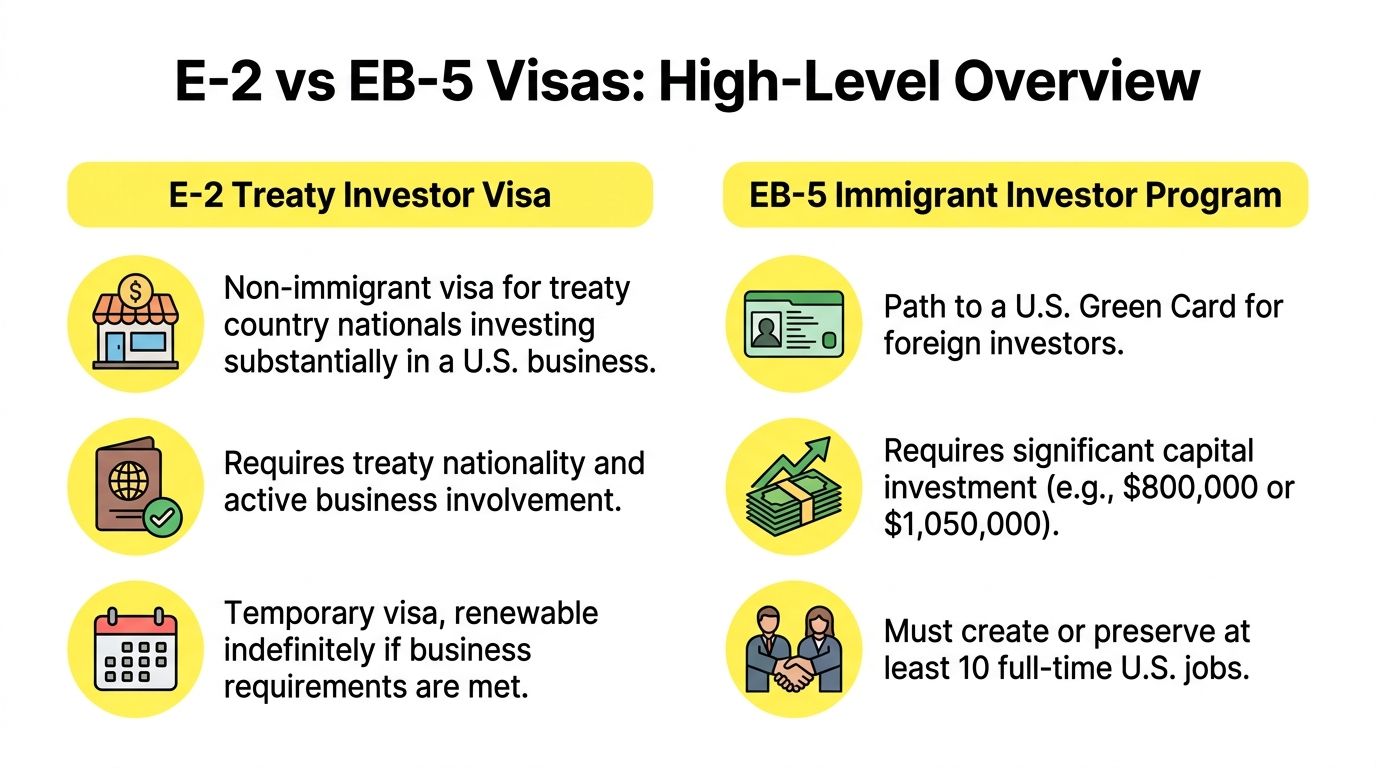
What the overview tells you
The E-2 is a common visa category in practice. The U.S. Department of State’s Report of the Visa Office shows tens of thousands of E-2 visas issued globally in pre-pandemic years, including principal investors and family members. For Canadian entrepreneurs, that matters because it confirms what we see in practice. The E-2 is a workable entry tool for owners who need to get into the U.S. market and run the business themselves.
The EB-5 solves a different problem. It is the better fit for an investor whose primary goal is permanent residence, even if that means more capital committed up front and less operational flexibility in how the investment is structured.
That difference is why many Canadians do not treat this as a one-time either-or decision. They start with E-2 status to open the U.S. operation, validate demand, and put management in place. If the business gains traction and the family wants a green card strategy, they then examine whether an EB-5 filing makes sense. That transition can work, but only if the initial E-2 investment, source of funds, and business records are set up with that later option in mind.
Comparing Investment Thresholds and Financial Risk

A Canadian founder opening in the U.S. feels the E-2 versus EB-5 decision first in the capital stack, not in the immigration theory.
For an E-2, there is no statutory minimum investment. The question is whether the amount is substantial for the specific business and already committed to getting the U.S. operation off the ground. In practice, that means the investment has to match the actual startup cost of the model you are presenting. A service business, distribution company, franchise, or light manufacturing operation will each be judged differently. The government is not looking for a token transfer. It wants to see real commercial commitment.
That flexibility is the main advantage. It is also the trap. Some founders undercapitalize the U.S. business, hoping to qualify first and sort out operations later. That approach creates problems on both sides. The visa case looks weak, and the business may not have enough cash to survive its first year. If you are still shaping the operating model, Mayo Law’s resource on E-2 visa business plan requirements is a useful reference for what officers expect to see.
For an EB-5, the investment threshold is fixed by statute. The minimum is $800,000 in a Targeted Employment Area or $1,050,000 otherwise, and the funds generally must remain at risk for 4 to 6 years, as described in this comparison of E-2 and EB-5 investor pathways.
The practical difference is control over risk.
With an E-2, you are putting money into a business you own and operate. You can adjust hiring, marketing, pricing, location, and management as the U.S. launch develops. If the first model does not work, you may still have room to correct course. That makes the E-2 a testing tool for Canadian entrepreneurs who want proof of concept before making a larger immigration-driven commitment.
With an EB-5, the capital commitment is heavier and the compliance structure is stricter. The immigration case depends not only on investing the required amount, but on keeping the investment structured properly for the green card process. That can be the right trade if permanent residence is the primary objective from day one.
For many families, the smarter question is not which option is universally better. It is whether the U.S. business is mature enough to justify an EB-5 now, or whether an E-2 should come first so the company can establish revenue, document lawful source and path of funds, and build a cleaner record for a later EB-5 filing.
The E-2 fits a market-entry budget and founder-led launch. The EB-5 fits a permanent residence plan backed by materially higher capital and a longer risk horizon.
Understanding Processing Times and Speed to Market

A Canadian founder signs a U.S. lease, starts recruiting, and lines up first customers. The business is ready. The immigration timeline may not be.
That timing gap decides the strategy.
The E-2 is the faster route if you need to enter the U.S. and run the business in the near term. Processing can be measured in months, depending on consular workload and how well the application is prepared. The EB-5 is slower by design because it is an immigrant process with heavier review, more documentation, and more moving parts. USCIS publishes EB-5 form processing data, and the agency's own Immigration and Citizenship Data page reflects the longer timeline investors should expect.
For an operating company, speed is not a convenience. It affects execution. If the founder cannot get on the ground, hiring slows, vendor relationships are harder to control, and early sales activity gets delegated before the U.S. model is stable.
That is why many Canadian entrepreneurs start with E-2.
It gives the business a chance to launch, prove demand, and produce real U.S. operating history while the founder remains directly involved. If the company performs well and the family later decides that permanent residence is the actual objective, that record can help shape a cleaner EB-5 plan. Source of funds still needs to be documented, and the EB-5 investment still has to stand on its own terms, but the entrepreneur is no longer making that larger commitment before the U.S. business has been tested.
EB-5 still fits some cases. If the family can tolerate a longer runway and the immigration result matters more than immediate market entry, the slower timeline may be acceptable. But for founders who need speed to market first and permanent residence second, E-2 is a practical first move, with EB-5 evaluated after the U.S. operation has traction.
Evaluating Residency Outcomes and Long-Term Goals
At this point, the two options cease to resemble each other.
If your goal is to operate
The E-2 is temporary by design. It may be renewed as long as the business remains eligible, but it does not create a direct green card path. For some Canadians, that is acceptable. They want the right to run the U.S. company, grow revenue, and preserve the option of returning to Canada later.
That can be a sensible cross-border structure. Not every entrepreneur wants U.S. permanent residence, U.S. tax residency, or a long-term relocation commitment.
If your goal is to immigrate
The EB-5 is built for permanence. It is the better fit when the family’s objective is to live in the United States on a long-term basis and pursue permanent resident status through investment.
This difference affects more than paperwork. It changes how you plan your family life, schooling, travel, business ownership, and eventual exit. A founder who only needs an operating platform may overbuy by choosing EB-5 too early. A family that wants a durable immigration result may underplan by relying on E-2 alone for too long.
Ask the immigration question bluntly. Are you building a U.S. business, or are you building a U.S. life? The answer points to the right category.
Operational Control and Personal Flexibility for Your Family
The day-to-day experience under each route is very different.
E-2 is hands-on
The E-2 requires you to develop and direct the business. In plain terms, you need control and involvement. This is why the category suits founders, owner-operators, and executives who intend to stay close to the operation.
That structure can be attractive. You retain decision-making authority. You shape hiring, sales, and product execution. It also means your immigration status stays strongly tied to the enterprise itself.
A related planning issue frequently missed appears at the corporate level. Ownership, management rights, and governance all matter. That is one reason entity planning should happen early. Mayo Law discusses that in choosing the right entity for your U.S. business.
EB-5 gives a family more freedom
A major family issue is missed at the start. E-2 children age out at 21 with no automatic path to a green card, while EB-5 grants immediate EAD/AP for any U.S. employment post-filing and a clearer green card path for the family, as discussed in this discussion of family flexibility and investor pathways.
That matters if your children are approaching university age, or if your spouse wants broad career flexibility rather than being tied to the family business structure.
In practical terms:
- E-2 fits founder families who are comfortable with the business remaining central to the family’s U.S. status.
- EB-5 fits relocation-focused families who want broader long-term flexibility.
- Age-out risk matters more than many founders realize until a child is close to 21.
The E-2 to EB-5 Transition A Strategic Pathway

For Canadian entrepreneurs, the smartest answer is sometimes not choosing one forever. It is choosing them in sequence.
The E-2 to EB-5 bridge strategy works like this. You use the E-2 to enter the U.S. faster, launch the company, and test whether the U.S. market justifies a larger long-term commitment. If the business gains traction and the family decides permanence matters, the EB-5 may become the second-stage move.
Why the bridge strategy gets attention
According to this discussion of E-2 to EB-5 transition trends, 20 to 30 percent of E-2 renewals now pivot to EB-5 within 3 to 5 years, and certain rural and high-unemployment EB-5 applications have been accelerated to under 12 months after recent reforms.
What can go wrong
This path needs careful planning. The E-2 is a non-immigrant category, so timing and filing strategy matter. Poorly handled facts around intent, travel, or business continuity may create avoidable problems.
Used, though, the sequence makes commercial sense. You validate the U.S. operation before locking in a much larger immigration investment.
For many founders, E-2 first and EB-5 later is not indecision. It is disciplined risk management.
Key Decision Criteria for Canadian Entrepreneurs
Use these questions to pressure-test the choice:
-
What is your main goal?
If you need to operate a U.S. business soon, the E-2 fits better. If your main objective is permanent residence, the EB-5 may be the stronger route. -
How fast do you need to move?
A fast-moving expansion favors E-2. A longer-term family immigration plan may justify the slower EB-5 track. -
How much capital do you want exposed early?
Some founders prefer a lower initial commitment while they validate the market. -
Do you want to run the business personally?
If yes, E-2 aligns naturally. If not, EB-5 may offer more flexibility depending on structure. -
Is family planning part of the decision?
Children nearing adulthood can significantly change the analysis.
Cross-border families weigh more than immigration alone. Status, tax posture, and citizenship planning all intersect. For readers navigating broader nationality issues on the Canadian side, Mayo Law also covers Bill C-3 and Canadian citizenship questions.
Ready to Explore Your U.S. Business Immigration Options?
Canadian founders perform optimally when immigration strategy is built alongside entity structure, investment planning, and the actual launch timeline. For official program information, review USCIS information on E visas and USCIS information on EB-5 immigrant investors.
If you want to discuss your facts, your timing, and whether E-2, EB-5, or a staged strategy makes more sense, you may schedule a consultation.
LEGAL DISCLAIMER
LEGAL DISCLAIMER: The information provided in this article is for general informational and educational purposes only and does not constitute legal advice. Reading this article, visiting mayo.law, or contacting Mayo Law does not create an attorney-client relationship. The content of this article should not be relied upon as a substitute for professional legal counsel appropriate for your specific circumstances. Legal outcomes depend on the particular facts and circumstances of each individual case, and no attorney can guarantee a specific result. Laws, regulations, and legal procedures are subject to change and may vary by jurisdiction. If you require legal assistance, you should consult with a qualified attorney licensed to practice in the relevant jurisdiction. Mayo Law disclaims any and all liability with respect to actions taken or not taken based on the contents of this article.
If you are weighing E-2 visa vs EB-5 visa which is better for your business, family, and long-term U.S. plans, Mayo Law can help you assess the trade-offs and map a practical cross-border strategy.