
Contents
- Why the E-2 doesn’t lead directly to a green card
- Pathway 1: EB-5 Immigrant Investor Program (for scaled E-2 businesses)
- Pathway 2: EB-1C Multinational Manager or Executive (for branch-and-subsidiary structures)
- Pathway 3: EB-2 National Interest Waiver (for high-skill E-2 founders)
- Pathway 4: Family-based green card (the cleanest exit)
- The intent-to-depart problem (and how to avoid it)
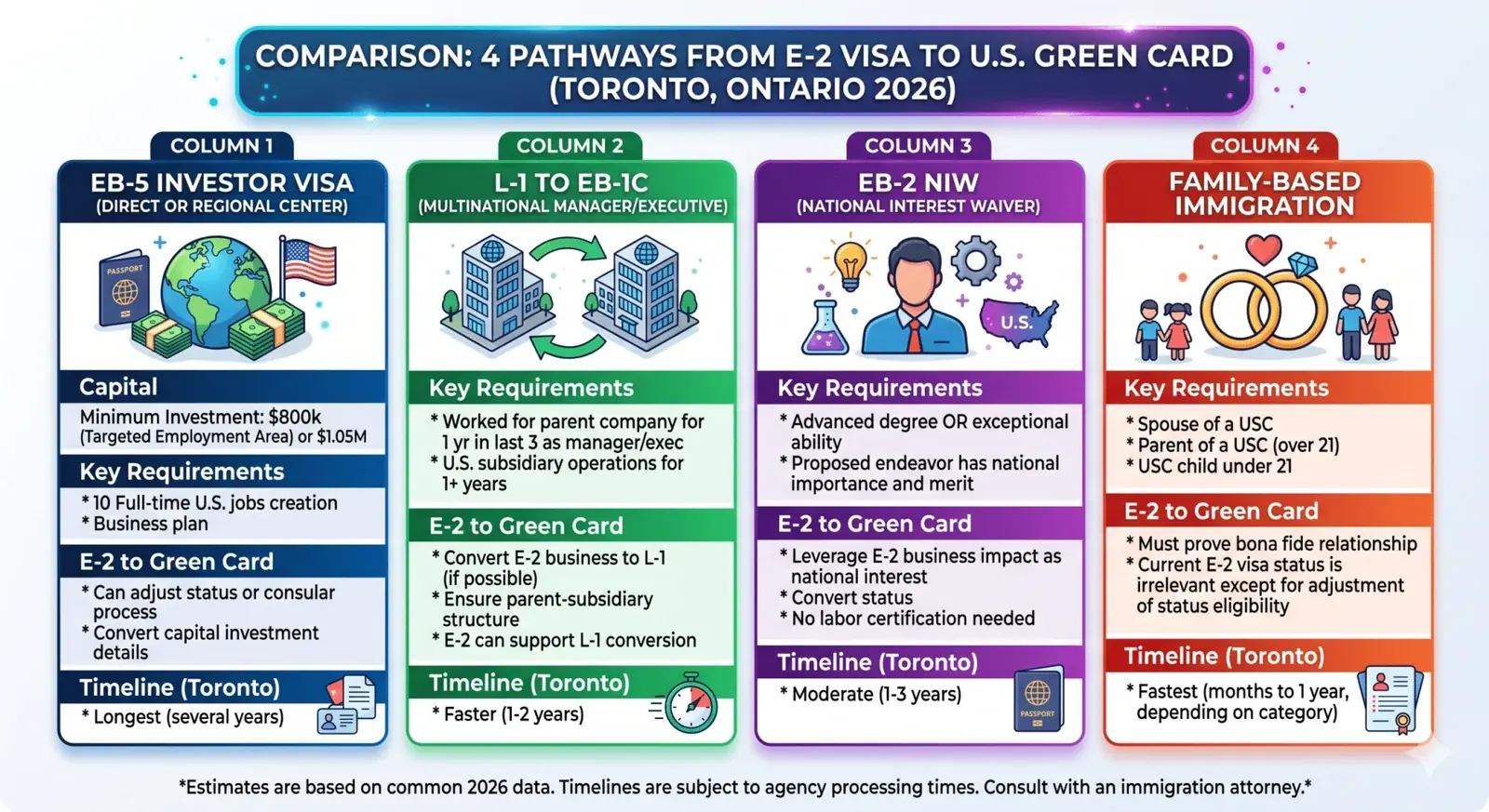
- Comparison: Which E-2 to green card pathway is right for you?
- How Long Does It Take to Go From E-2 Visa to Green Card?
- What about the “Gold Card” or other 2026 policy changes?
- Frequently asked questions
- Plan the transition before you file

The E-2 visa to green card transition is one of the most misunderstood corners of U.S. immigration. The E-2 is a non-immigrant visa with no direct path to permanent residency, but that doesn’t mean E-2 holders are stuck renewing forever. In 2026, four legal pathways let treaty investors transition from E-2 to a U.S. green card, each with different capital requirements, timelines, and risks to your existing status.
This guide walks through all four pathways (EB-5 immigrant investor, EB-1C multinational manager, EB-2 National Interest Waiver, and family-based sponsorship) and the single biggest landmine that derails E-2 holders pursuing residency: the intent to depart problem. If you’re already on E-2 and ready to plan the green card move, Mayo Law’s E-2 visa attorneys structure these transitions to protect your E-2 renewals while the immigrant petition runs.
Why the E-2 doesn’t lead directly to a green card
Under 8 CFR 214.2(e)(5) and the USCIS Policy Manual, every E-2 nonimmigrant “shall maintain an intention to depart the United States upon the expiration or termination of E-1 or E-2 status.” This is the non-dual-intent rule. At the consulate, the State Department’s Foreign Affairs Manual treats an applicant’s expression of an unequivocal intent to depart as normally sufficient (9 FAM 402.9-4(C)). Unlike the H-1B or L-1, which are dual-intent visas where pursuing a green card doesn’t undermine your nonimmigrant status, the E-2 treats clear immigrant intent as a status disqualifier.
The practical effect for 2026: you can still pursue a green card as an E-2 holder, but the timing and visibility of that pursuit matters enormously. Filing certain immigrant petitions while in E-2 status, and especially traveling abroad and applying for E-2 renewal while an I-485 adjustment of status is pending, can result in the consular officer refusing the renewal on intent grounds. The regulation also sets a limit: an application for initial admission, change of status or extension of stay in E classification may not be denied solely because of an approved permanent labor certification request or a filed or approved immigrant visa preference petition (8 CFR 214.2(e)(5)). The risk comes from how intent is shown at a renewal, not from the filing alone.
The four pathways below differ not just in capital and merit requirements, but in how cleanly they can be executed without triggering an intent problem.
Pathway 1: EB-5 Immigrant Investor Program (for scaled E-2 businesses)
The EB-5 is the most direct E-2 to green card pathway when your E-2 business has grown enough (or you have additional capital) to meet EB-5 thresholds. Per the USCIS EB-5 program, the 2026 requirements are:
- Minimum investment: $1,050,000 (standard) or $800,000 if the business is in a Targeted Employment Area (TEA: rural or high-unemployment area)
- Create 10 full-time jobs for qualifying U.S. workers within roughly 2 years
- Source of funds fully documented and traceable
- Active or passive investment (regional center option available)
E-2 to EB-5 conversion strategy. If your E-2 business has grown to meet the investment threshold (or you can top up the investment), you can file an EB-5 I-526E petition using the same business. The big advantage: you’ve already proven the source of funds, the business operates, and you have a credibility track record at USCIS.
Key 2026 considerations:
- TEA designations are updated based on census data. Verify before filing
- I-526E processing times currently run 12–48 months depending on country of birth and backlog
- After approval, conditional 2-year green cards; conditions removed via I-829 after demonstrating job creation
- Country-of-birth backlogs affect China and India primarily
Best for: E-2 investors whose business has scaled to $1M+ revenue with multiple employees, who can clear the 10-job test, and who are from countries without EB-5 backlogs (most of Europe, Canada, the U.K., Australia).
Pathway 2: EB-1C Multinational Manager or Executive (for branch-and-subsidiary structures)
The EB-1C is the green card category for executives and managers transferred from a qualifying foreign company to a U.S. branch, subsidiary, affiliate, or parent. It’s often described as the L-1A green card track, but it’s equally available to E-2 holders whose E-2 enterprise is part of a multinational group.
Per USCIS EB-1C guidance, the 2026 requirements are:
- The petitioner must have been employed abroad in a managerial or executive capacity for at least 1 year out of the 3 years preceding the U.S. transfer
- The U.S. and foreign companies must have a qualifying relationship (parent/subsidiary/affiliate/branch)
- The U.S. company must have been doing business for at least 1 year
- The petitioner must be coming to a U.S. managerial or executive role
- No PERM labor certification required: major timeline advantage
E-2 to EB-1C conversion strategy. If your E-2 enterprise is structured as a U.S. subsidiary of a foreign company you previously managed, and you held a manager/executive role abroad for 1+ years, the EB-1C is often the fastest E-2-to-green-card route. No PERM means the timeline is essentially I-140 processing (often 8–15 months, with premium processing available) plus I-485 adjustment.
Key 2026 considerations:
- “Function manager” cases face heavier scrutiny in 2025–2026; small E-2 businesses with only the investor and one assistant rarely qualify
- The foreign parent must remain active during the petition
- Documentation of the qualifying relationship between foreign parent and U.S. E-2 subsidiary is heavily reviewed
- In the October 2026 Visa Bulletin, EB-1 is current for Canada and most countries. Mainland China (July 1, 2023) and India (February 1, 2023) have final action dates
Best for: E-2 investors whose U.S. business is owned by or affiliated with a foreign company they managed, with a real management team (5–10+ employees) in the U.S. entity.
Pathway 3: EB-2 National Interest Waiver (for high-skill E-2 founders)
The EB-2 National Interest Waiver (NIW) is a self-petition green card route for individuals whose work has “substantial merit and national importance” to the United States. Under the Matter of Dhanasar standard, three prongs must be satisfied:
- The proposed endeavor has substantial merit and national importance
- The petitioner is well-positioned to advance the endeavor
- On balance, it would be beneficial to the U.S. to waive the job offer and labor certification requirements
E-2 to EB-2 NIW conversion strategy. If your E-2 business sits in a strategically important sector (STEM, healthcare, advanced manufacturing, AI, clean energy, critical supply chains) and you bring documented expertise or qualifications (typically an advanced degree or exceptional ability in your field), the NIW can be filed without an employer sponsor. No PERM, no employer needed, you self-petition.
Key 2026 considerations:
- NIW approval rates dropped to about 55% in FY2025 (down from about 96% in FY2022), as calculated from the approval and denial counts in USCIS’s Form I-140 report by fiscal year, quarter and case status. Adjudicators are scrutinizing the “proposed endeavor” much more rigorously
- The petition must clearly articulate the specific endeavor (not just “build my business”) and tie it to national-level outcomes
- Letters of recommendation from independent experts carry weight
- Premium processing available at $2,965 for I-140 stage (45-business-day window)
- In the October 2026 Visa Bulletin, EB-2 has a final action date for every country: January 1, 2025 for Canada and most others, October 1, 2021 for mainland China and November 1, 2013 for India
Best for: E-2 founders with advanced degrees, published work, IP, awards, or industry recognition, particularly in technology, healthcare, or research-driven sectors.
Pathway 4: Family-based green card (the cleanest exit)
If you marry a U.S. citizen, or have a U.S. citizen parent or child who is at least 21 years old willing to sponsor you, family-based sponsorship is often the simplest E-2-to-green-card route:
- Immediate relatives of U.S. citizens (spouses, parents of adult U.S. citizens, unmarried children under 21): No annual visa cap, no waiting line. Processing typically 12–24 months for I-130 + I-485 combined.
- Other family categories (siblings, married adult children): Subject to per-country annual caps and multi-year waits.
E-2 to family green card strategy. Unlike the E-2’s strict non-immigrant intent rule, marriage to a U.S. citizen is a recognized basis for adjustment of status. You can file an I-130 marriage petition and a concurrent I-485 adjustment of status from within the U.S. while in E-2 status, but you should generally stop traveling abroad (since I-485 pending + E-2 renewal abroad creates the intent problem).
Key 2026 considerations:
- A bona fide marriage is required: USCIS aggressively investigates marriage fraud
- The 90-day rule: filing for adjustment within 90 days of last U.S. entry can trigger misrepresentation findings
- Combined I-130/I-485 filings take ~12–24 months in 2026
- Work authorization and travel parole are typically available within a few months of filing
Best for: E-2 investors who are married to or planning to marry a U.S. citizen, or who have U.S. citizen parents or adult children.
The intent-to-depart problem (and how to avoid it)
Here is where most E-2 holders trip themselves:
The E-2 is non-dual-intent. The H-1B and L-1 are. That means you cannot simultaneously hold valid E-2 status and have demonstrable intent to immigrate. Filing an I-130 family petition or an I-140 immigrant petition does not automatically invalidate E-2 status. But here’s what gets you in trouble:
- Filing I-485 adjustment of status while in E-2: generally still permitted, but you’ve put your intent in the record
- Traveling abroad while I-485 is pending: you may need advance parole to re-enter, and the E-2 visa stamp renewal may be denied
- Applying for an E-2 renewal at a consulate abroad with a pending I-140 or I-485 of record: consular officers will scrutinize intent and can refuse renewal
- Large U.S. real estate purchases or other “settling-in” signals: used as circumstantial evidence of immigrant intent
The cleanest playbook for E-2 to green card in 2026:
- Plan the timeline before filing. Sequence the immigrant petition, AOS filing, and any E-2 renewal travel together. Don’t file reactively.
- Use change of status from within the U.S. when possible. Avoid international travel during the pendency of I-485.
- Maintain E-2 compliance throughout: keep the business operating, keep employees, file extensions on time. Even if the green card track fails, the underlying E-2 should remain valid.
- Time the I-485 filing to coincide with a moment when you don’t need to travel and your E-2 has at least 18 months of validity remaining.
- Consult an experienced attorney before you file anything immigrant-side. This is the highest-stakes transition in nonimmigrant immigration and the area where DIY mistakes are costliest.
Our E-2 visa lawyers at Mayo Law handle this sequencing for E-2 clients pursuing all four pathways above, including coordination with our broader business immigration practice for EB-5, EB-1C, and NIW filings.
Comparison: Which E-2 to green card pathway is right for you?
| Pathway | Capital required | Typical timeline | Best for | Risk to E-2 |
|---|---|---|---|---|
| EB-5 (TEA) | $800K | 24–60 months | Scaled E-2 businesses, non-backlogged countries | Moderate |
| EB-5 (standard) | $1.05M | 24–60 months | Scaled E-2 businesses, non-backlogged countries | Moderate |
| EB-1C | — (no investment minimum) | 12–24 months | Multinational structure with foreign parent | Moderate |
| EB-2 NIW | — (no investment minimum) | 18–36 months | High-skill founders, STEM/healthcare, advanced degree | Higher (visible intent) |
| Family-based (IR) | — | 12–24 months | Spouse/parent/child of U.S. citizen | Lower (recognized AOS path) |
How Long Does It Take to Go From E-2 Visa to Green Card?
Moving from an E-2 visa to a US green card typically takes 12 to 60 months as of July 2026, depending on the route. Marriage-based sponsorship and EB-1C are the fastest at 12 to 24 months, EB-2 NIW runs 18 to 36 months, and EB-5 investor cases take 24 to 60 months.
| Route | Typical total time | Capital or key requirement |
|---|---|---|
| EB-5 immigrant investor (US) | 24–60 months | $800,000 minimum in a Targeted Employment Area, $1,050,000 standard, as of July 2026 |
| EB-1C multinational manager (US) | 12–24 months | At least 1 year of managerial or executive employment abroad within the 3 years before the US transfer, plus a qualifying corporate relationship |
| EB-2 National Interest Waiver (US) | 18–36 months | No investment minimum; about 55% of FY2025 NIW decisions were approvals, calculated from USCIS I-140 counts |
| Marriage to a US citizen (immediate relative) | 12–24 months | Bona fide marriage; no annual visa cap or waiting line for immediate relatives |
These ranges reflect USCIS processing as of July 2026. They shift with agency workload, so check current times before you commit to a filing strategy.
What about the “Gold Card” or other 2026 policy changes?
One new route now exists. Executive Order 14351 of September 19, 2025 created the Gold Card, which treats a gift of $1 million to the Department of Commerce ($2 million when a company gives on your behalf) as evidence of EB-1 or EB-2 eligibility. USCIS takes these petitions on Form I-140G, filed online only after registration at trumpcard.gov, with a filing fee of $15,000 per person as of October 2026. It is a separate green card route, not a conversion of E-2 status, and for most E-2 owners the four pathways above remain the plan.
Since September 6, 2025, the State Department has told visa applicants to apply in their country of nationality or residence. E-2 visa stamp renewals still require travel abroad to a consulate. For a Canadian E-2 holder, that means a U.S. post in Canada, and the Toronto consulate whenever the company’s E-visa registration has to be renewed.
Frequently asked questions
Can an E-2 visa lead directly to a green card?
No. The E-2 is a non-immigrant visa with no direct path to permanent residency. However, E-2 holders can transition to a green card through four separate pathways: the EB-5 immigrant investor program, the EB-1C multinational manager category, the EB-2 National Interest Waiver, or family-based sponsorship by a U.S. citizen relative.
Will filing for a green card invalidate my E-2 visa?
Not automatically, but it can. The E-2 is non-dual-intent, meaning you must maintain intent to depart the U.S. when E-2 status ends. Filing an immigrant petition creates visible intent that can complicate E-2 renewals, particularly if you travel abroad and apply for a new E-2 visa stamp while an I-485 adjustment of status is pending.
Which E-2 to green card pathway is fastest?
For most E-2 holders, the family-based pathway through marriage to a U.S. citizen is the fastest (12–24 months). The EB-1C is the fastest employment-based route (12–24 months) because it requires no PERM labor certification. The EB-2 NIW typically runs 18–36 months. EB-5 is the slowest at 24–60+ months due to processing backlogs.
How much do I need to invest to go from E-2 to EB-5?
EB-5 requires a minimum investment of $1,050,000 in standard areas or $800,000 in a designated Targeted Employment Area (TEA: rural or high-unemployment). The investment must be at risk and you must create 10 full-time jobs for qualifying U.S. workers within roughly 2 years.
Can I keep my E-2 visa while my green card application is pending?
Generally yes, but with caveats. You should avoid international travel during the pendency of an I-485 adjustment of status unless you have advance parole. Applying for an E-2 renewal stamp abroad while a green card petition is on file invites consular scrutiny on intent grounds and can result in renewal denial.
What is the 90-day rule and does it affect E-2 holders?
The 90-day rule comes from the State Department’s Foreign Affairs Manual (9 FAM 302.9-4(B)(3)(g)(2)): if someone engages in conduct inconsistent with their nonimmigrant status within 90 days of a visa application or admission, a consular officer may presume a willful misrepresentation. If you entered on E-2 status declaring intent to depart, then filed an I-485 within 90 days, the consular or USCIS officer may infer you misrepresented your nonimmigrant intent. Waiting beyond 90 days reduces (but doesn’t eliminate) this risk.
Does the E-2 spouse have to apply for the green card separately?
The principal applicant files the immigrant petition. The spouse and unmarried children under 21 file derivative adjustment of status applications (I-485) that follow the principal’s case. If the principal qualifies, the family qualifies together. They don’t need independent immigrant petitions.
Can an E-2 visa holder get a green card through marriage?
Yes. An E-2 visa holder who marries a US citizen can file an I-130 petition and a concurrent I-485 adjustment of status from inside the United States. Spouses of US citizens count as immediate relatives under US immigration law, so there is no annual visa cap and no waiting line. Combined I-130 and I-485 filings take roughly 12 to 24 months as of July 2026. Two cautions apply. Stop traveling abroad once the I-485 is pending, because departures can create an immigrant intent problem for your E-2 status, and be prepared for USCIS to examine closely whether the marriage is bona fide.
Can I convert my E-2 investment into an EB-5 investment?
Yes, an E-2 business can become the foundation of a US EB-5 petition, and for many owners it is the most natural conversion route. One real advantage is that you already documented your source of funds during the E-2 process, which shortens the heaviest part of EB-5 preparation. The total investment still has to reach the EB-5 minimum, which as of July 2026 is $800,000 in a Targeted Employment Area or $1,050,000 elsewhere. Whether capital you have already put into the business counts toward that threshold needs case-by-case review, so have counsel confirm your numbers before filing the I-526E.
Plan the transition before you file

The E-2 to green card transition is the single highest-leverage decision an E-2 investor makes. Done well, it converts a renewable nonimmigrant status into permanent residency without losing your business or your ability to travel. Done poorly, it can cost you both the green card and the E-2.
Mayo Law’s E-2 visa attorneys handle these transitions for treaty investors across all four pathways. We’ll assess which route fits your business stage, capital availability, and family situation, and sequence the filings to protect your E-2 throughout. With offices in Toronto and New York and admission in both Ontario and New York, we serve cross-border investors at every stage from initial E-2 filing through green card adjudication.
Book a strategy session before you file any immigrant petition. Sequencing is everything. The strategy session is a paid one-hour consultation, in which a lawyer reviews your E-2 company, your family situation and your timeline in depth before anything is filed.