A founder launches a software product in Ontario, starts selling into New York, and then gets a letter from a competitor claiming patent infringement. The letter demands that sales stop, records be preserved, and a response be sent by counsel. Most business owners don’t know whether the claim is serious, tactical, or defective. They just know the problem can disrupt funding, customer deals, and product planning.
At Mayo Law, we regularly see how patent disputes become business disputes very quickly. For companies operating across New York and Ontario, the pressure is higher because product development, licensing, manufacturing, and distribution often cross the border even when the lawsuit doesn’t. Between mid-2017 and mid-2022, U.S. district courts handled over 18,000 patent infringement cases involving more than 20,000 companies and 17,000 attorneys according to district court litigation data summarized by IPWatchdog.
If you’re still sorting out your company setup, your legal structure may affect ownership and enforcement issues later. That’s one reason founders often review basics like Ontario business structures before an IP dispute lands on their desk.
An Introduction to Patent Infringement for Your Business
Patent infringement usually isn’t about someone copying a product line by line. It’s about whether a product, process, component, or method falls within the legal scope of a patent’s claims. That difference matters because businesses often think, “We built this ourselves, so we must be safe.” In patent law, independent development may not end the dispute.
For a startup or SME, the first real risk is often commercial. A supplier may hesitate. An investor may ask for indemnities. A buyer in an acquisition may push harder on representations and warranties.
Why the issue escalates fast
A patent claim can affect more than one part of the business at once:
- Product roadmap: Engineering may need to pause a feature or consider a redesign.
- Revenue risk: Key customers may ask whether the company can still deliver.
- Transaction pressure: Investors and acquirers often scrutinize unresolved IP disputes.
- Document preservation: Once a dispute is reasonably anticipated, internal handling of emails, code, and design records becomes important.
Practical rule: Treat the first demand letter as a business event, not just a legal event.
What smart owners should ask first
Before reacting, business owners usually need answers to a few basic questions. Is the patent still enforceable? Does the accused product map to the patent claims? Is the sender a direct competitor, a licensing entity, or part of a larger campaign? The answers shape the response.
What a Patent Infringement Attorney Does
A patent infringement attorney doesn’t just file lawsuits or send threatening letters. In practice, the job is part technical analyst, part strategist, part litigator, and part risk manager.

On the enforcement side
If you own the patent, counsel typically starts by testing the case before making noise. That includes reviewing the patent file history, comparing the claims to the accused product, and looking for weaknesses the other side may attack.
A strong enforcement lawyer also asks a harder question clients sometimes resist. Is this the right patent to assert, or is it better employed to strengthen a position in licensing or settlement?
On the defense side
If your company is accused, the attorney’s work often starts with narrowing the problem. Not every letter deserves the same response. Some should be answered firmly and quickly. Others require technical review before anyone writes back.
Core tasks often include:
-
Claim analysis
The attorney studies the patent claims, because claims define the legal boundary of the invention. -
Validity review
Even a granted patent can be challenged. Prior art, prosecution history, and overbroad claim language may matter. -
Non-infringement positions
Counsel works with engineers or product leads to see whether one or more claim elements are missing. -
Forum and procedure planning
The right response may be negotiation, licensing, motion practice, or a parallel challenge to the patent. -
Business coordination
Good counsel aligns legal positions with product, investor, and contract realities.
Some founders first encounter these issues while cleaning up governance and ownership problems, which is why disputes sometimes intersect with early-stage matters like founder vesting and internal business protections.
A useful patent attorney translates engineering detail into litigation choices you can act on.
When to Engage Counsel for Your Startup or SME
Many companies wait too long. They contact counsel after a complaint is filed, after a distributor forwards an alarming letter, or after a deal counterparty raises diligence questions. By then, options may be narrower and internal records may already be messy.
In the U.S., patent owners have a historical success rate of only 32% in district court cases, and litigation costs averaged $1.5 million in 2023, according to this overview of recent patent litigation trends. That combination tells business owners something important. Patent cases are hard, expensive, and rarely improved by delay.
Good times to engage counsel before a lawsuit
The best time to speak with a patent infringement attorney is often before anyone accuses you of anything.
Consider getting help when:
- You’re launching a new product in both countries: Cross-border sales create cross-border exposure.
- You’re entering an M&A process: Buyers often focus on hidden IP liabilities.
- You receive a vague notice letter: A short letter can still signal a serious campaign.
- Your engineers identify a competitor patent: Early review may support redesign or licensing discussions.
- You’re raising capital: Investors may want clarity on freedom to operate and infringement risk.
Why early review changes the conversation
Early review doesn’t make risk disappear. It may, however, improve your bargaining position. If counsel can identify a weak patent, a narrow claim scope, or a non-infringement position before the other side files, your response becomes more disciplined.
For newer businesses, that review often overlaps with broader setup questions, including ownership chains, subsidiary structure, and contracting. Those issues are often easier to address before conflict hardens, especially if you’re still working through an Ontario incorporation checklist for startup planning.
The Patent Enforcement and Defense Process
Patent litigation feels opaque until you break it into stages. The legal labels are technical, but the underlying rhythm is familiar. Investigate, position, exchange information, pressure test, and then resolve or try the case.
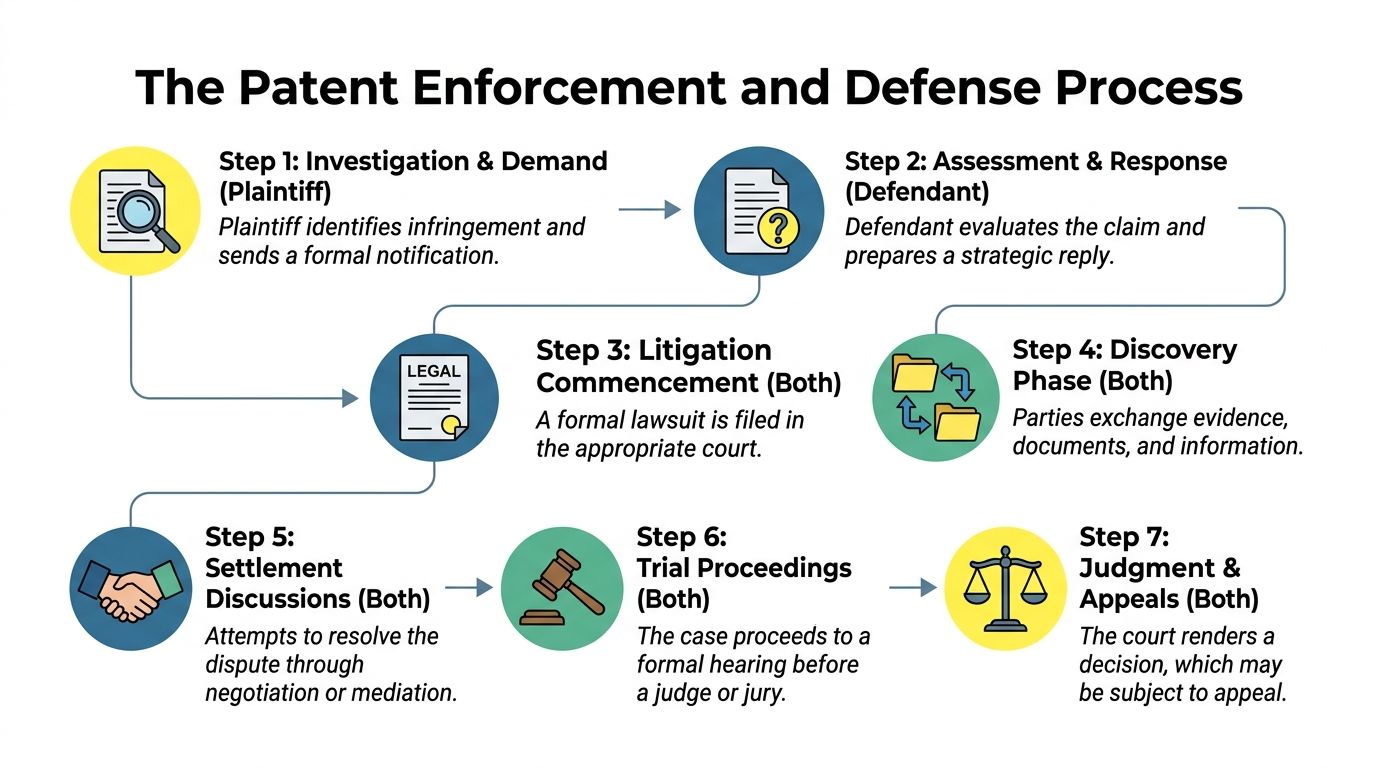
A simplified timeline
| Stage | Plaintiff focus | Defendant focus |
|---|---|---|
| Pre-suit | Investigate products and maintain strategic advantage | Assess exposure and preserve documents |
| Initial exchange | Send demand or file complaint | Evaluate response strategy |
| Pleadings | Frame infringement theories | Challenge sufficiency where appropriate |
| Discovery | Seek product and damages evidence | Test patent scope and factual support |
| Claim construction | Argue how patent terms should be read | Push for narrower readings |
| Motions or settlement | Increase pressure or narrow issues | Limit claims or negotiate resolution |
| Trial or appeal | Prove infringement and defend validity | Contest infringement, validity, and damages |
What usually surprises business owners
Discovery is often more disruptive than the complaint itself. Product documents, technical diagrams, emails, source materials, and witness interviews can consume time from engineers and executives.
Claim construction is another major moment. That's the stage where the court interprets disputed patent terms. Small wording differences can reshape the case.
Settlement talks often become serious only after each side sees how the judge is reading the patent.
Some disputes also branch into arbitration, contract claims, or licensing fights depending on the underlying commercial relationship. In cross-border supply or technology deals, issues can overlap with broader dispute resolution planning, including arbitration in Canada and related enforcement questions.
Critical US-Canada Cross-Border Considerations
Here, generic U.S. guidance often stops being enough. A company can hold rights, sell products, store data, contract with distributors, and employ engineers in both countries, but the patent analysis still changes by jurisdiction.

Existing legal content often misses binational enforcement problems, including how differing claim construction standards between the USPTO and CIPO can affect validity, even as U.S.-Canada patent filings rose 28% in recent years, as described in this discussion of cross-border patent defenses.
Where cross-border cases get complicated
A few pressure points come up often:
- Different legal standards: A position that helps in one country may not carry over cleanly into the other.
- Different procedural advantage: Venue, timing, and available remedies may push parties toward one forum.
- Different business footprints: The key witnesses may be in Toronto while the sales records sit in New York.
- Different deal documents: Distribution, licensing, and acquisition papers may allocate IP risk unevenly.
What works better than a siloed approach
A siloed response usually wastes time. U.S. counsel may focus tightly on district court procedure while Canadian counsel looks at local validity and enforcement issues. If those strategies aren't coordinated, the business can end up making inconsistent statements across borders.
A more disciplined approach ties the patent analysis to the company's structure and transactions. That often includes reviewing assignment chains, licensing rights, and acquisition documents such as stock purchase agreements, because ownership and indemnity terms can decide who carries the economic risk of the dispute.
Understanding Costs and Pre-Litigation Options
For most startups and SMEs, the first cost question is blunt. Can we afford to fight this? That's a fair question. With litigation costs exceeding $1 million, 65% of SMEs cannot afford a patent defense, according to the USPTO blog on the patent pro bono program expansion.
Options short of full litigation
Not every dispute should head straight to court. Depending on the facts, businesses may want to consider:
- A negotiated license: Sometimes paying for certainty is cheaper than fighting over principle.
- A design-around: Engineering changes may reduce risk if the patent claims are narrow enough.
- A targeted response letter: A careful reply can expose weaknesses without escalating too fast.
- A business resolution: Supply, distribution, or commercial terms sometimes solve what looks like a pure IP fight.
- A validity challenge: In the right case, attacking the patent early may alter the balance of power.
Fee structure trade-offs
Patent work is usually billed hourly, but some pre-litigation projects can be scoped more predictably. Early case assessment, claim chart review, and response-letter strategy are often easier to budget than full discovery and trial preparation.
One practical option for cross-border businesses is to use a firm that can coordinate business law and dispute analysis in the same workflow. Mayo Law does that for companies operating between Ontario and New York, particularly when patent risk overlaps with contracts, transactions, or market entry planning.
How to Choose the Right Cross-Border Counsel
The right fit isn't just "someone who handles IP." Patent disputes turn on technical detail, procedural judgment, and the ability to tie legal choices back to the business.
In the U.S., a registered patent attorney typically needs a bachelor's degree in a recognized scientific or technical field and must pass the USPTO registration exam, as noted by UnitedLex's discussion of technical analysis in patent matters. That matters because infringement analysis often turns on whether counsel can follow the technology closely enough to challenge assumptions.
Questions worth asking before you hire
- How do you work with technical material? Ask who reviews code, schematics, or product architecture.
- Have you handled cross-border business facts? A New York-only or Ontario-only view may miss key exposure.
- What's your first-week plan? Good counsel should be able to explain the initial triage clearly.
- How do you coordinate with commercial counsel? Patent disputes often touch contracts, indemnities, and M&A terms.
- What decisions need management now? You need a practical map, not just a legal memo.
If your business operates on both sides of the border, your counsel should understand both the patent problem and the business structure carrying that risk.
If your company is dealing with a patent demand, a product launch risk review, or a cross-border IP dispute, schedule a consultation with Mayo Law. Our attorneys advise startups and SMEs in Ontario and New York on practical risk management, dispute response, and cross-border business strategy.
LEGAL DISCLAIMER: The information provided in this article is for general informational and educational purposes only and does not constitute legal advice. Reading this article, visiting mayo.law, or contacting Mayo Law does not create an attorney-client relationship. The content of this article should not be relied upon as a substitute for professional legal counsel customized to your specific circumstances. Legal outcomes depend on the particular facts and circumstances of each individual case, and no attorney can guarantee a specific result. Laws, regulations, and legal procedures are subject to change and may vary by jurisdiction. If you require legal assistance, you should consult with a qualified attorney licensed to practice in the relevant jurisdiction. Mayo Law expressly disclaims any and all liability with respect to actions taken or not taken based on the contents of this article.