A final judgment in U.S. federal court often feels like the case is over. For many businesses, especially Canadian companies operating in the United States, that assumption can be expensive. Sometimes the problem appears after judgment. A judge may have made a legal error, critical evidence may surface late, or misconduct may only become clear once the case is closed.
That’s where federal rule of civil procedure 60 b matters. It creates a narrow path to ask the same court to reopen a final judgment, order, or proceeding. For cross-border litigants, this rule can affect contract disputes, arbitration strategy, fraud claims, and post-judgment risk. At Mayo Law, these issues come up in serious federal matters where timing, record-building, and strategic restraint matter as much as the merits.
Introduction: After the Gavel Falls
When judgment enters against your company, the first question is usually whether to appeal. That may be the right move, but it isn’t the only one. In some cases, the better question is whether the district court itself has authority to revisit what happened.
Federal rule of civil procedure 60 b is that mechanism. It is not a second trial, and it is not a way to reargue points the court already rejected. It is a limited post-judgment remedy for specific circumstances.
For well-informed businesses, the practical value is straightforward. If the judgment rests on mistake, hidden misconduct, or material facts that could not reasonably have been presented earlier, Rule 60(b) may provide a route back into court. Used well, it can correct a serious procedural or substantive problem. Used poorly, it can waste time, increase cost, and damage credibility with the judge who already decided the case.
The Purpose of Rule 60(b) Balancing Finality and Justice

Federal litigation depends on finality. Parties need to know when a judgment is settled so they can price risk, close transactions, enforce rights, and move on. Courts protect that interest aggressively because endless reopening would undermine the point of judgment itself.
But finality has limits. A system that never corrects a tainted or flawed judgment creates a different problem. Rule 60(b) exists to manage that tension.
Why the rule exists
The modern rule is the product of a major procedural shift. Rule 60(b) was significantly amended in 1948 to codify and replace older common law writs and equitable remedies, including audita querela and coram nobis, and to establish the six grounds for relief and the time limits that still largely govern today, as explained in this historical analysis of the 1948 amendment.
That change mattered because the older system was fragmented and technical. The current rule is still demanding, but at least the categories are defined. A business client can ask a practical question: does the problem fit one of the six grounds, and can it be raised on time?
What courts are trying to prevent
Courts do not want Rule 60(b) to become a disguised appeal or a routine response to losing. That is why judges usually focus on three issues early:
- Fit: Does the motion fall within one of the listed grounds?
- Timing: Was it filed within the applicable deadline?
- Equity: Would reopening the judgment be fair in light of the delay, the record, and the conduct of both sides?
Practical rule: Rule 60(b) is strongest when the motion identifies a specific defect in the judgment process, not just disagreement with the result.
What works and what does not
What works is precision. A narrowly framed motion, supported by a clean factual record, gives a court something it can act on. What usually fails is a broad complaint that the case was handled unfairly in some general sense.
For corporate parties, that distinction matters. Management often sees several problems after judgment at once. The legal task is to separate frustration from an actual Rule 60(b) ground. The court is not looking for a fresh presentation. It is looking for a recognized basis to disturb a final ruling.
The Six Grounds for Relief Under Rule 60(b)
The rule lists six grounds. Every motion has to fit one of them. If it doesn’t, the court usually won’t stretch the rule to help.
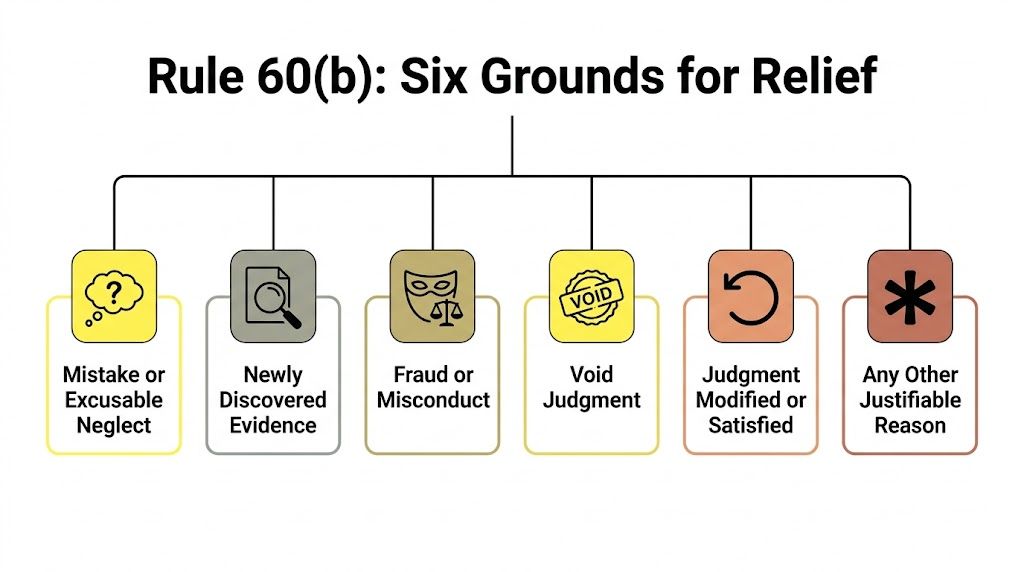
The six categories at a glance
| Ground | Description | Timing Deadline |
|---|---|---|
| 60(b)(1) | Mistake, inadvertence, surprise, or excusable neglect | One year |
| 60(b)(2) | Newly discovered evidence | One year |
| 60(b)(3) | Fraud, misrepresentation, or misconduct by an opposing party | One year |
| 60(b)(4) | Void judgment | Reasonable time |
| 60(b)(5) | Judgment satisfied, released, discharged, or no longer equitable in prospective application | Reasonable time |
| 60(b)(6) | Any other reason justifying relief | Reasonable time |
Mistake under Rule 60(b)(1)
This subsection deserves close attention because the Supreme Court broadened its practical reach. In Kemp v. United States, an 8-1 decision held that Rule 60(b)(1) includes all judicial errors of law as “mistakes”, not just obvious ones, as discussed in this analysis of Kemp v. United States.
That matters in real litigation. Before Kemp, parties sometimes faced an argument that legal mistakes by the court belonged only on appeal. Now, if the issue fits Rule 60(b)(1) and the motion is timely, a district court may correct its own legal error.
This does not make Rule 60(b)(1) a substitute for appeal. It does mean counsel should evaluate post-judgment legal mistakes quickly, especially when the judgment affects valuation, deal structure, licensing rights, or injunctive exposure.
A legal error by the judge may be a Rule 60(b)(1) issue. It is not automatically limited to the appellate track.
Newly discovered evidence and fraud
Subsections (b)(2) and (b)(3) often arise in commercial disputes. Newly discovered evidence is not merely evidence you found late. The moving party usually needs to show that the material evidence could not reasonably have been obtained earlier.
Fraud or misconduct is also narrower than many clients expect. The fact that the other side argued aggressively is not enough. The motion has to be anchored in specific conduct that affected the judgment process.
In cross-border disputes, these grounds can become important where documents, accounting records, or communications were held abroad or surfaced only after enforcement activity began. They also intersect with arbitration strategy. In some cases, parties move between litigation and arbitration with an expectation of finality. That assumption needs careful testing, especially in light of shifting federal doctrine. Businesses dealing with arbitral outcomes should also consider how court proceedings interact with broader dispute design, including international arbitration and enforcement issues.
Void judgments, satisfied judgments, and the catchall
Subsection (b)(4) addresses judgments that are void. That usually points to a fundamental defect, not a routine legal error. Subsection (b)(5) applies where the judgment has been satisfied, released, discharged, or where prospective application is no longer equitable.
Then there is (b)(6), the catchall. It is powerful in theory and difficult in practice. Courts treat it as a narrow residual category, not a fallback for arguments that don’t fit elsewhere.
Three practical observations help:
- Don’t stack weak theories. A court notices when every subsection is thrown in at once.
- Match the evidence to the ground. A fraud theory needs proof of misconduct. A mistake theory needs a defined error.
- Respect the internal logic of the rule. If a claim fits (b)(1) through (b)(5), courts are often reluctant to let it migrate into (b)(6).
Timing Is Everything Deadlines for a Rule 60(b) Motion

A strong Rule 60(b) theory can still fail on timing. It is often at this point that companies make avoidable mistakes. Internal investigations take time, boards want options memos, and parallel settlement talks create delay. The clock does not pause for any of that unless a rule or order says so.
Two timing buckets
The rule divides timing into two groups:
- One-year deadline: Motions under 60(b)(1), (2), and (3) must be filed within one year.
- Reasonable time standard: Motions under 60(b)(4), (5), and (6) must be filed within a reasonable time.
That distinction sounds simple, but the strategic consequences are not. The one-year limit is the easier deadline to identify and the harder one to salvage. If your theory falls under mistake, newly discovered evidence, or fraud, delay can effectively eliminate the motion.
What “reasonable time” means in practice
“Reasonable time” is flexible, but that flexibility is not generous by default. Courts typically look at why the issue was not raised earlier, when the moving party learned of the basis for relief, and whether delay prejudices the other side.
That is especially important in technical business disputes, including patent matters, where a post-judgment strategy has to align with broader enforcement and defense objectives. If the underlying case involves technology rights or infringement exposure, a party may also want to assess how a Rule 60(b) motion fits with guidance from a patent infringement attorney.
Deadline discipline: The legal team should identify the likely subsection first. The filing deadline often follows from that classification.
A timing checklist for business clients
- Pin down the entry date. Use the actual judgment or order date, not the date management first focused on the issue.
- Identify the likely subsection. That determines whether the one-year cap applies.
- Document discovery of the problem. Preserve emails, notices, internal reports, and other records showing when the issue became known.
- Move before the narrative hardens. Delay makes every explanation harder and every prejudice argument stronger.
The Mechanics of Filing Your Motion for Relief
A Rule 60(b) motion is filed in the same district court that entered the judgment, often before the same judge. That affects tone and strategy. You are asking the court to revisit its own work, not asking a new audience for a fresh opinion.
What the motion must contain
At minimum, the motion should do four things clearly:
- Identify the judgment, order, or proceeding at issue.
- State the specific Rule 60(b) ground being invoked.
- Describe the requested relief with precision.
- Support the motion with evidence, not just argument.
Evidence usually means declarations, affidavits, documentary exhibits, docket materials, and, where appropriate, a proposed order. If the theory is newly discovered evidence, attach it and explain why it could not earlier have been obtained. If the theory is fraud, identify the misconduct and show its connection to the judgment.
Why record-building matters
Judges rarely grant extraordinary relief on accusation alone. They want a disciplined record. That means dates, exhibits, witness statements, and a coherent explanation of cause and effect.
Weak Rule 60(b) motions often share the same defect. They tell a story, but they don’t prove one. Courts respond poorly to indignation unsupported by documents.
The motion should read like a targeted corrective filing, not a post-loss brief written out of frustration.
Procedure is part of the merits
Local rules, page limits, exhibit formatting, sealing procedures, and service requirements can all matter. In sensitive corporate cases, especially those involving internal investigations or regulated industries, confidentiality issues may shape what gets filed publicly and what may require a sealing application.
A strong filing is usually narrow, evidenced, and careful about remedy. Sometimes the best request is not sweeping vacatur. It may be a limited reopening tied to a specific issue the court can address cleanly.
Strategic Uses in Cross-Border and Corporate Litigation

Rule 60(b) becomes especially important when litigation is only one piece of a broader business problem. Cross-border companies often face overlapping contracts, foreign evidence, arbitration clauses, regulatory questions, and parallel proceedings. A final judgment may look clean on the docket while the underlying dispute remains operationally messy.
Where it matters most for business clients
In practice, the rule may surface in settings like these:
- Cross-border M&A disputes: Post-closing litigation may change if concealed liabilities or misrepresentations emerge after judgment.
- White-collar matters: A company or executive may need to revisit a judgment or order if material facts come to light later.
- IP and commercial litigation: A legal mistake in the judgment may affect injunctions, licensing advantage, or settlement posture.
- Arbitration-related strategy: A prior dismissal may not be as final as the parties assumed.
The impact of Waetzig
The Supreme Court’s 2025 decision in Waetzig v. Halliburton Energy Services, Inc. held that a voluntary dismissal without prejudice under Rule 41(a) qualifies as a “final proceeding” subject to reopening under Rule 60(b), as summarized in this discussion of Waetzig and arbitration-related implications.
That has real strategic consequences. Businesses sometimes dismiss federal actions voluntarily to pursue arbitration, preserve resources, or reset the forum. After Waetzig, a dismissal without prejudice may still leave room for a Rule 60(b) motion later.
For defendants, that means a docket closure may not end the risk. For plaintiffs, it may create an advantage where arbitration or another follow-on process goes badly. Corporate counsel should now review dismissal language with more caution and treat voluntary dismissals as strategic documents, not mere housekeeping.
A “without prejudice” dismissal may remove a case from the docket without eliminating future Rule 60(b) exposure.
Cross-border lessons
Canadian businesses entering U.S. litigation often focus on the merits and underestimate procedure. Rule 60(b) shows why procedure can become outcome-shaping. The question is not only whether you were right. The question is whether the post-judgment problem fits a recognized procedural route and whether the record supports reopening.
For companies dealing with recurring disputes, this should be part of larger business litigation strategy. Judgment language, dismissal choices, arbitration sequencing, and internal document preservation all affect what options remain later.
Rule 60(b) Motion vs. Direct Appeal Choosing the Right Path
Clients often ask whether Rule 60(b) is “basically an appeal.” It isn’t. These are different tools aimed at different problems.
Side-by-side comparison
| Issue | Rule 60(b) motion | Direct appeal |
|---|---|---|
| Filed in | Same district court | Court of appeals |
| Audience | Usually the same trial judge | Appellate judges |
| Main focus | Relief from judgment based on listed grounds | Review of alleged legal or factual error on the existing record |
| Typical record | May include new supporting material | Usually limited to record below |
| Standard posture | Extraordinary post-judgment relief | Appellate review of trial-court decision |
The strategic trade-off
An appeal is usually the cleaner vehicle when the core complaint is that the district court got the law wrong on the record before it. A Rule 60(b) motion is often stronger when something material sits outside that original record, or when a recognized post-judgment ground has emerged.
The complication is timing. A Rule 60(b) motion does not automatically protect the deadline to file a notice of appeal. If appellate rights are in play, counsel has to manage both tracks carefully.
When the wrong choice causes harm
The most common mistake is treating Rule 60(b) as a fallback after the appeal window has become a problem. Courts can see that move for what it is. If the motion looks like an untimely appeal in disguise, it usually struggles.
The opposite error also happens. A party races to appeal without considering whether the district court could correct a narrow but decisive issue more efficiently. In some matters, especially those involving sensitive business relationships, a targeted post-judgment motion may be the more useful first step. Strategic questions like that are central to broader litigation strategy decisions.
Key Considerations Before Seeking Relief
Before filing, pressure-test the motion as if you were opposing it.
- Ground fit: Does the problem clearly fit one subsection?
- Evidence quality: Can you prove the factual basis with admissible materials?
- Timing exposure: Are you inside the hard deadline or able to justify the delay?
- Business objective: Do you want to reopen the case, improve settlement position, protect a parallel proceeding, or preserve a larger commercial interest?
Also keep the remedy in perspective. Even if the court grants relief, that usually means the case reopens. It does not mean you’ve won the underlying dispute.
A disciplined assessment at the outset often saves a client from an expensive motion that was never procedurally suited to Rule 60(b) in the first place.
Experienced Counsel for Complex Federal Matters
Post-judgment litigation in federal court is technical, fast-moving, and unforgiving. A Rule 60(b) motion may involve appellate considerations, evidentiary issues, arbitration consequences, or collateral business risk all at once.
If your company is assessing a final judgment, investigating newly surfaced evidence, or dealing with a reopened federal dispute, experienced counsel may help you evaluate the available paths. For matters tied to investigations or fraud-related exposure, that analysis may also overlap with white collar crimes defense.
LEGAL DISCLAIMER
LEGAL DISCLAIMER: The information provided in this article is for general informational and educational purposes only and does not constitute legal advice. Reading this article, visiting mayo.law, or contacting Mayo Law does not create an attorney-client relationship. The content of this article should not be relied upon as a substitute for professional legal counsel suited to your specific circumstances. Legal outcomes depend on the particular facts and circumstances of each individual case, and no attorney can guarantee a specific result. Laws, regulations, and legal procedures are subject to change and may vary by jurisdiction. If you require legal assistance, you should consult with a qualified attorney licensed to practice in the relevant jurisdiction. Mayo Law expressly disclaims any and all liability with respect to actions taken or not taken based on the contents of this article.
If you're dealing with a final judgment, a voluntary dismissal, or a cross-border federal dispute, Mayo Law may help you assess whether Rule 60(b), an appeal, or another procedural response fits your situation. Schedule a consultation with Mayo Law to discuss your matter confidentially.