You’re negotiating a distribution deal in New York, opening sales in Ontario, and a potential partner suddenly says, “Let’s avoid anything that looks like price coordination.” Then you see a headline about an antitrust lawsuit against a major company. What felt like a problem for giant corporations now feels uncomfortably close.
At Mayo Law, we often hear this from founders, boards, and SME owners operating across the U.S.-Canada border. They aren’t trying to rig markets. They’re trying to grow. But ordinary business conversations about pricing, exclusivity, bundling, market share, or acquisitions can raise real competition-law questions. If you’ve wondered what is an antitrust lawsuit, the short answer is this: it’s a legal action claiming that a business engaged in conduct that unlawfully harmed competition. For cross-border companies, that risk may arise in contracts, joint ventures, platform practices, or M&A work, including deals documented through instruments like stock purchase agreements.
Understanding Your Risk in a Competitive Marketplace
A typical trigger isn’t dramatic. It might be a sales executive who joins an industry call and hears competitors discussing pricing trends a little too comfortably. It might be a supplier asking for exclusivity in both Ontario and New York. It might be a planned acquisition that looks efficient internally but raises concerns outside the company.
For an SME, the confusion usually starts here. You assume antitrust law punishes size. It doesn’t. In most cases, it punishes conduct that harms the competitive process.
That distinction matters. A successful business can compete aggressively, cut prices, improve products, and win market share. Problems begin when a company coordinates with rivals, blocks access unfairly, ties products in a coercive way, or uses dominance to shut out competition rather than outperform it.
Practical rule: Antitrust risk usually comes from how you compete, not from the fact that you compete well.
The Core Purpose of Antitrust and Competition Law
A good product launch can create legal questions that have nothing to do with fraud or breach of contract. A New York manufacturer may win new accounts in Ontario because its pricing is sharper and its service is faster. That is normal competition. The legal problem starts if the market is being shaped by side deals, coordinated pressure, or contract terms that shut rivals out for reasons unrelated to performance.
Why these laws exist
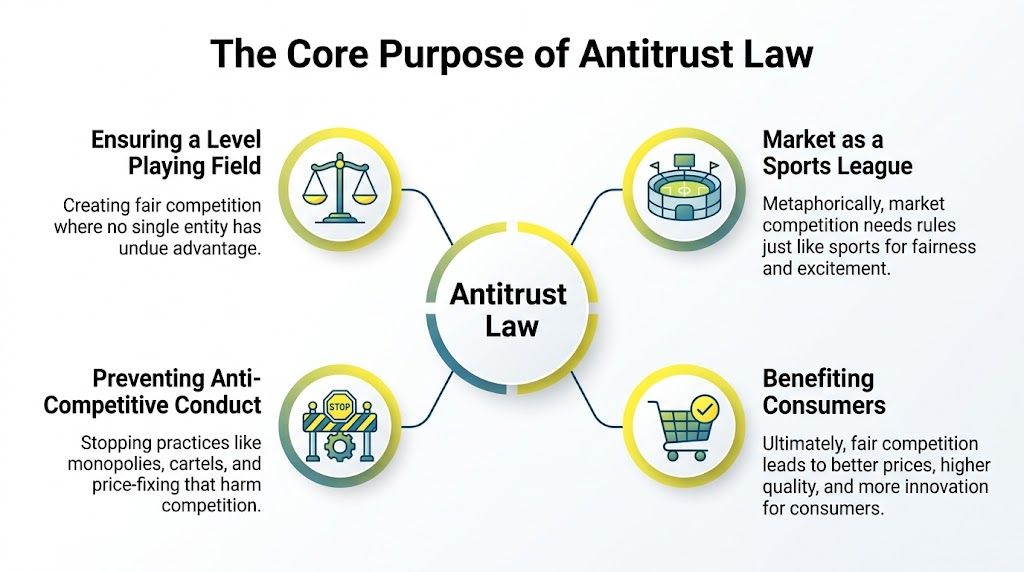
Antitrust law and Canadian competition law are designed to protect the competitive process. The idea is simple. Businesses should win customers by offering better prices, stronger quality, better service, or genuine innovation. Markets stop working properly when outcomes are driven by collusion, coercive restrictions, or conduct that blocks a rival from competing on fair terms.
That purpose is easy to miss because many headlines focus on giant technology companies. For smaller firms, the same rules often appear in ordinary commercial arrangements: distributor appointments, resale policies, joint purchasing discussions, shared logistics, and exclusivity clauses. A term that looks efficient in one contract can become risky if it limits market access across both sides of the border.
What the law protects
The law protects competition itself. That sounds abstract, so use a practical test. Ask whether the market remains open enough for customers, suppliers, and new entrants to make real choices.
If your Ontario competitor loses business because your delivery times are better, that is the market doing its job. If that competitor loses business because key channels are tied up through exclusionary agreements or because rivals have coordinated pricing, the market is no longer rewarding merit in the usual way.
Three ideas sit at the center of this analysis:
- Independent decision-making: Competitors are expected to set prices, output, territories, and strategy on their own.
- Open market access: Powerful firms can negotiate hard, but they face risk when they use contracts or distribution control to block rivals unfairly.
- Consumer and business choice: The law cares about whether buyers still have meaningful options, not just whether one firm feels pressure.
This is why contract structure matters. An exclusivity provision, preferred-supplier clause, or a right of first offer in a commercial deal may be lawful in one setting and problematic in another, depending on market power, duration, geographic reach, and practical effect.
Why this matters in cross-border business
For SMEs operating between New York and Ontario, the cross-border point is where theory turns into risk management.
A business owner may view the U.S. and Canada as two sales territories under one strategy. Regulators and private plaintiffs often look at effects more closely. If your distribution network covers Buffalo, Rochester, Toronto, and Ottawa, a single policy on pricing, supply, online resale, or dealer exclusivity can affect competition in more than one jurisdiction at the same time.
That does not mean every aggressive contract term is unlawful. It means the legal question is rarely answered by asking whether the company is “small.” A modest-sized firm can still face scrutiny if it plays a gatekeeper role in a narrow product category, controls access to a key customer base, or enters arrangements that reduce independent rivalry across the border.
For business owners, the practical lesson is clear. Antitrust law is less about punishing success than about preserving a market where success is earned through competition on the merits, in New York, in Ontario, and in the commercial space between them.
Prohibited Conduct What Triggers an Antitrust Lawsuit
A manufacturer in Ontario tells two dealers, one serving Toronto and one selling into western New York, to stay in their own lanes. Nobody writes “do not compete” in the contract. The message is delivered in calls, follow-up texts, and a sales meeting. From the owner’s perspective, that can feel like ordinary channel management. From an antitrust perspective, it may look like rivals or market participants reducing independent competition.

Most antitrust lawsuits start with one of two theories. Either competitors coordinated when they were supposed to act independently, or a firm with meaningful market power used business practices that shut out competition instead of winning customers on the merits.
Collusion between competitors
This is the more straightforward category.
If competitors agree on the terms of competition, courts and regulators tend to view the conduct with immediate suspicion because the market is supposed to work through independent decision-making. In practical terms, each business must choose its own pricing, output, customers, and bidding strategy.
Common examples include:
- Price-fixing: Competitors align prices, discounts, surcharges, credit terms, or minimum pricing.
- Market allocation: Rivals divide territories, customer accounts, or product segments.
- Bid-rigging: Participants in a tender or RFP process coordinate who will win, who will submit a losing bid, or whether someone will bid at all.
- Output restrictions: Firms agree to limit supply or capacity to affect price or availability.
For SMEs operating between New York and Ontario, the risk often appears in ordinary distribution activity. A cross-border supplier might ask resellers not to pursue each other’s accounts. Two dealers may “respect” a border region to avoid conflict. Competitors at a trade show may exchange future pricing plans in a way that sounds casual but helps them coordinate. Those facts can matter more than whether anyone used legal language or signed a separate side agreement.
Monopolization and exclusionary conduct
The second category is harder because size alone does not create liability. A business can be successful, even dominant in a niche, without violating the law. The problem begins when market power is maintained or extended through conduct that blocks rivals for reasons other than better price, better product, or better service.
A useful way to picture it is a hockey rink. Winning because your team skates faster and shoots better is competition. Winning by removing the other team’s skates before the game is exclusion. Antitrust law focuses on that difference.
As summarized in this discussion of antitrust litigation, monopolization claims generally turn on two questions. Does the firm have substantial market power in a properly defined market, and did it maintain that power through exclusionary conduct rather than legitimate competition? In the U.S., successful private claims can also lead to treble damages, which means three times the proven loss.
Conduct that raises red flags
Exclusion cases are fact-specific, but several patterns appear repeatedly:
- Tying or bundling with coercive effect: A customer must take one product to get access to another product it really wants.
- Exclusive arrangements that foreclose rivals: A supplier, platform, or distributor locks up so much of the channel that competitors have too few realistic paths to market.
- Refusals to deal or cutoffs: Access is withdrawn in a way that harms competition, not just a single commercial relationship.
- Predatory pricing theories: Prices are set so low that a rival cannot compete, with a later plan to recover losses after the rival weakens or exits.
- Control of a key input or channel: Competitors are denied access to something they reasonably need to compete effectively.
Contract drafting often sits at the center of this analysis. A restraint that seems efficient internally may look very different once a court asks how it affects actual alternatives in Buffalo, Rochester, Toronto, or Ottawa. That is why firms should review exclusivity clauses, bundling terms, and access rights carefully, including a right of first offer in a commercial agreement that may limit who can enter a channel or acquire a strategic asset.
One practical test helps. If a disappointed distributor, dealer, or rival explained your policy to a regulator in one paragraph, would it sound like product improvement and fair competition, or would it sound like a plan to block market access?
Where business owners often get confused
Business owners often assume the legal question is whether conduct was aggressive. It usually is not. Instead, the question is whether the conduct harmed the competitive process in a meaningful way.
That is why the same clause can be lawful in one setting and risky in another. Exclusive dealing may be harmless where buyers have many alternatives and switching is easy. The same term can create exposure where one supplier controls a narrow but important channel. Bundling can reduce transaction costs, or it can pressure customers into taking products they would not otherwise buy. The answer depends on market definition, available substitutes, the firm’s position in that market, and the business justification the company can prove with documents and consistent conduct.
For cross-border firms, that analysis rarely stops at the border. A policy written once for North American distribution can create different competitive effects in U.S. and Canadian sales channels, even when the commercial team sees it as one program.
Meet the Referees Enforcement Bodies in the US and Canada
If antitrust law is the rulebook, enforcement agencies are the referees. For cross-border businesses, the challenge is that there isn’t just one referee.
Comparison of U.S. and Canadian Antitrust Enforcement Agencies
| Attribute | U.S. Department of Justice (DOJ) | U.S. Federal Trade Commission (FTC) | Competition Bureau Canada |
|---|---|---|---|
| Primary role | Federal antitrust enforcement, including criminal matters | Federal civil antitrust and consumer protection enforcement | Canadian competition law enforcement |
| Can investigate mergers | Yes | Yes | Yes |
| Can bring criminal cases | Yes | No | Canadian process differs by matter and statute |
| Focus areas | Cartels, monopolization, merger enforcement | Unfair methods of competition, mergers, platform conduct | Anti-competitive conduct, deceptive marketing, mergers |
| Why SMEs should care | Criminal exposure can involve executives personally | Civil investigations can reshape business practices | Cross-border conduct may still draw scrutiny in Canada |
How jurisdiction works in practice
A New York company doing business in Ontario may face U.S. review, Canadian review, or both. A Canadian company that doesn’t have a U.S. office can still face U.S. scrutiny if its conduct affects U.S. commerce. That’s one reason antitrust analysis can’t stop at incorporation documents or office locations.
The agencies also don’t look only at giant public companies. SMEs can face scrutiny in niche markets where a small number of participants control access, pricing, or supply.
Why this matters for boards and executives
Enforcement isn’t just a business issue. It can become a governance issue. Directors and officers may need to address document preservation, employee interviews, internal investigations, and communications strategy quickly if an inquiry begins.
Cross-border enforcement risk often shows up first as an information request, not a courtroom battle.
For that reason, antitrust readiness overlaps with compliance, records management, and white-collar defense planning.
Anatomy of an Antitrust Case Procedure and Timeline
A common New York and Ontario scenario often begins in an unassuming manner. A sales manager receives a customer complaint about pricing. Then outside counsel asks to preserve emails, Teams chats, bid files, and call notes. Weeks later, the business is answering questions from a regulator, a private plaintiff, or both.
That early period matters because antitrust cases usually begin as an information problem before they become a courtroom problem. The first fight is often over documents, data, and how the market is defined.
The usual path
A typical matter moves through several stages, although the order can shift when regulators and private plaintiffs are active at the same time:
-
Investigation begins
The process may start with subpoenas, civil investigative demands, interviews, or requests for sales records, pricing files, and internal communications. -
Complaint or enforcement action
A government agency or private plaintiff files allegations and explains the theory of harm. In plain terms, they tell the court what market they believe exists, who has power in it, and how the challenged conduct harmed competition. -
Class certification, if applicable
If many customers or businesses claim the same injury, the court decides whether the case can proceed as a class action. For a smaller company, this step can change the economics of the dispute very quickly. -
Discovery
This is often the longest and most expensive stage. The parties exchange documents, data sets, expert reports, and testimony. For cross-border firms, discovery can also raise practical questions about where records sit, which employees hold them, and how U.S. and Canadian privacy obligations affect collection. -
Settlement, dismissal, or trial
Many cases end before trial. Some resolve through negotiated conduct changes, supply commitments, or other business terms rather than a final ruling on liability. -
Appeal
Significant decisions on class issues, liability, or remedies may go up on appeal, which can extend the life of the case and the business disruption that comes with it.
How long and how expensive
The timeline is usually measured in years, not months. According to this antitrust class action overview, 85% of cases settle before trial, class certification often takes 6 to 18 months, discovery commonly lasts 1 to 2 years, and a case that reaches trial may take 3 to 5 years in total. The same source notes that defense costs for SMEs can be severe.
For an owner-manager, that timeline works like a second operating budget running in the background. Even if the company ultimately wins, leadership time, document collection, employee interviews, and expert work can pull attention away from customers and growth.
A cross-border business can feel this pressure more sharply. Records may be split between Buffalo and Toronto. Key employees may sit in Ontario while the lawsuit proceeds in New York. Pricing decisions may be lawful in one commercial context yet look problematic when pulled into an antitrust narrative built around market allocation, exclusivity, or information sharing.
Why early strategy matters
The first impulse is often to defend the business decision on the merits right away. A better first step is usually narrower and more disciplined. Preserve documents. Stop casual speculation in email and chat. Identify the products, customers, and geographic areas that may define the market. Determine who spoke with competitors, distributors, or trade associations, and when.
Those steps sound procedural, but they shape the substance of the case. In antitrust litigation, a poorly worded internal message can become the shorthand for intent. A vague market definition can turn ordinary commercial pressure into a monopoly allegation.
Some disputes also raise forum and process issues alongside the antitrust claims. In supply contracts and distribution agreements, businesses may need to assess whether related contract claims belong in court or under Ontario and international arbitration enforcement rules, even if the core competition issues remain with a court or regulator.
Operational advice: Assume your emails, slide decks, text messages, and chat threads may be read by opposing counsel, regulators, and a judge.
Consequences and Case Studies Penalties and Notable Lawsuits
A cross-border SME often feels the impact of an antitrust case long before any final ruling. A distributor freezes a renewal. A lender asks new questions. Management spends weeks collecting records instead of serving customers in Buffalo, Toronto, or Mississauga.

The legal consequences can be severe as well. In the United States, antitrust exposure may include criminal fines for companies, prison exposure for individuals in cartel cases, private claims for three times the proven loss, court orders stopping certain conduct, and, in unusual matters, remedies that force a business to sell assets or change its structure. Canada also permits serious penalties and court orders under its competition regime, even though the terminology and enforcement path differ.
For an owner-manager, the better comparison is a serious product liability claim. The direct penalty matters, but so do the side effects. Insurance questions arise. Planned acquisitions can stall. Key employees become witnesses. Cross-border customers may ask whether they should keep buying from you while the case is pending.
Microsoft as a practical example
A well-known illustration is United States v. Microsoft Corp. The government alleged that Microsoft used its position in PC operating systems to restrict browser competition, including through the way Internet Explorer was tied to Windows. A summary of that litigation appears in this review of major antitrust cases.
The case is useful because the remedy changed over time. The trial court initially ordered a breakup, but the final outcome focused on conduct rules instead. Microsoft had to change how it dealt with interoperability, licensing, and related business practices.
That point matters for smaller firms. Many owners hear "antitrust penalties" and picture a company being dismantled. More often, the result is a court order or settlement that rewrites how the business sells, contracts, shares information, or works with channels.
Why this matters to New York and Ontario SMEs
The same legal theory can appear far from Silicon Valley. A specialized software vendor serving logistics companies on both sides of the border may control access to a platform that customers depend on. A manufacturer in Ontario may pressure dealers in New York not to carry a rival line. A group of competitors at a trade association meeting may exchange pricing or territory plans that later look like coordination.
Those facts are smaller in scale, but the risk pattern is familiar. If your company controls a choke point, a must-have input, or a dealer network, the issue is usually not size alone. The issue is whether your conduct makes it harder for customers or rivals to choose alternatives.
That is why many firms benefit from a documented competition compliance program for cross-border businesses before a dispute starts. Good compliance will not make aggressive conduct lawful, but it does reduce the chance that ordinary commercial decisions are carried out in a way that creates avoidable antitrust exposure.
Key Considerations Proactive Compliance for Cross-Border Firms
A New York distributor and an Ontario supplier can agree on a deal in one afternoon. The antitrust risk often appears later, when sales teams start discussing reseller limits, exclusivity, shared customer lists, or what can be said at an industry meeting. By the time a regulator asks questions, the actual problem is often not a single bad clause. It is a pattern of ordinary decisions that, taken together, looks like coordination or foreclosure.
That is why cross-border firms should treat competition compliance as an operating discipline, not a file to open only during litigation.
Why the border changes the analysis
A business can be based in Ontario and still face U.S. antitrust exposure if its conduct affects U.S. commerce. For SMEs, that issue comes up most often in distribution design, joint ventures, acquisitions, platform access, and dealer restrictions. A practice that seems commercially sensible from a Canadian business seat may draw scrutiny if its effects are felt in New York customers, channels, or competitors.
The reverse is also true in practical terms. U.S. executives sometimes assume a domestic policy will travel cleanly into Canada. It may not. The two systems are related, but they are not identical, and a cross-border company needs a method for checking both before a sales strategy or transaction hardens into habit.
Compliance habits that help in the real world
Good antitrust compliance works like a customs checklist for business conduct. It slows the team down at the right moments, before a routine call or draft agreement creates a record that is hard to explain later.
A useful program usually includes:
- Focused training for revenue-facing teams: Sales, procurement, channel leaders, and executives should know which competitor discussions are off-limits and when to stop a conversation.
- Rules for competitor contact: Trade associations, benchmarking groups, and informal industry calls should have agendas, attendance controls, and a clear process for leaving improper discussions.
- Review of exclusivity, bundling, and rebates: These terms are not automatically unlawful, but they deserve review when your firm has strong channel influence or controls access customers need.
- Early review of deals and investments: Mergers, minority stakes, and joint ventures can create competition issues before closing documents are drafted.
- Clear business records: If a practice improves quality, integration, service, or efficiency, record that reason at the time the decision is made.
For many New York and Ontario firms, the practical goal is consistency. The sales team should not be improvising antitrust judgment on a call with a rival, and the business team should not be the first group to notice competition issues in a proposed acquisition.
Questions to ask before expansion, contracting, or an acquisition
A short internal screen can catch problems early:
| Question | Why it matters |
|---|---|
| Are we discussing prices, customers, bids, output, or territories with a competitor? | Those topics can create collusion risk quickly. |
| Do we control a distribution route, platform feature, or supplier relationship that others need to compete? | That can raise exclusion concerns even for a mid-sized firm. |
| Are we requiring customers or dealers to take one product to get another? | Tying and bundling issues often turn on coercion and market power. |
| Will this arrangement affect customers or commerce in the United States or Canada? | Cross-border effects can trigger review on either side of the border. |
A stronger program may also include written escalation steps, periodic audits, and a documented business compliance review for cross-border firms.
Good antitrust compliance helps a company compete with discipline. It reduces the chance that a normal commercial strategy becomes evidence of something more serious.
Experienced Counsel for Complex Antitrust Matters
Antitrust issues can intersect with contracts, internal investigations, government inquiries, and executive risk. That’s especially true for startups and SMEs operating across Ontario and New York. When concerns arise, early legal analysis may help you understand exposure, preserve options, and respond in a more disciplined way.
If your company is reviewing a deal, reassessing pricing practices, or facing questions from regulators or a counterparty, you may also want counsel familiar with related white-collar crimes defense issues that can develop alongside competition matters.
LEGAL DISCLAIMER
LEGAL DISCLAIMER: The information provided in this article is for general informational and educational purposes only and does not constitute legal advice. Reading this article, visiting mayo.law, or contacting Mayo Law does not create an attorney-client relationship. The content of this article should not be relied upon as a substitute for professional legal counsel relevant to your specific circumstances. Legal outcomes depend on the particular facts and circumstances of each individual case, and no attorney can guarantee a specific result. Laws, regulations, and legal procedures are subject to change and may vary by jurisdiction. If you require legal assistance, you should consult with a qualified attorney licensed to practice in the relevant jurisdiction. Mayo Law expressly disclaims any and all liability with respect to actions taken or not taken based on the contents of this article.
Build Your Business on Solid Legal Ground. Mayo Law advises startups and SMEs in Ontario and New York on cross-border business risk, compliance, and investigations. If you have questions about what is an antitrust lawsuit or how competition rules may affect your company, schedule a consultation with Mayo Law.