If you’re trying to use a New York document in another country, a plain copy usually isn’t enough. Founders expanding into Ontario, families handling overseas adoptions, and individuals proving lineage for citizenship claims often hit the same roadblock. The foreign authority wants proof that the New York document is real.
For individuals and businesses navigating cross-border matters, understanding this process is critical. At Mayo Law, our work with clients on U.S.-Canada immigration and business law frequently involves authenticating documents, and we’ve seen firsthand how a missing or incorrect apostille can derail important plans.
An apostille is a specialized certificate attached to a document so it can be accepted in Hague Convention countries. It authenticates the document’s origin, not the truth of its contents. If you’re dealing with New York records abroad, this is often the first serious checkpoint. For related updates and practical guidance, see Mayo Law’s apostille services articles.
Introduction
You have a closing in Toronto next week, or a consular appointment for a family file, and the receiving office asks for an apostille on a New York document. The delay usually does not happen at the New York Department of State. It starts earlier, when the document was issued in the wrong form, notarized incorrectly, or sent through the wrong county step.
That problem shows up constantly in U.S.-Canada business and immigration work. A New York City birth or marriage record can follow a different preparation path than a notarized document signed in Westchester, Erie, or Suffolk. If you treat the whole state as one procedure, you can lose days, and sometimes you have to start over with a fresh certified copy.
The core point is simple. New York issues apostilles only for New York-originated documents, but many documents are not apostille-ready when you first receive them. New York City is where that catches people off guard most often, especially with vital records and documents that require an extra authentication step before the state will touch them.
I tell clients the same thing every time: the apostille certificate is usually the shortest part of the job. Preparing the document correctly is what decides whether the filing moves cleanly or gets rejected.
For more practical guidance on document authentication and related filing issues, see Mayo Law’s apostille services articles.
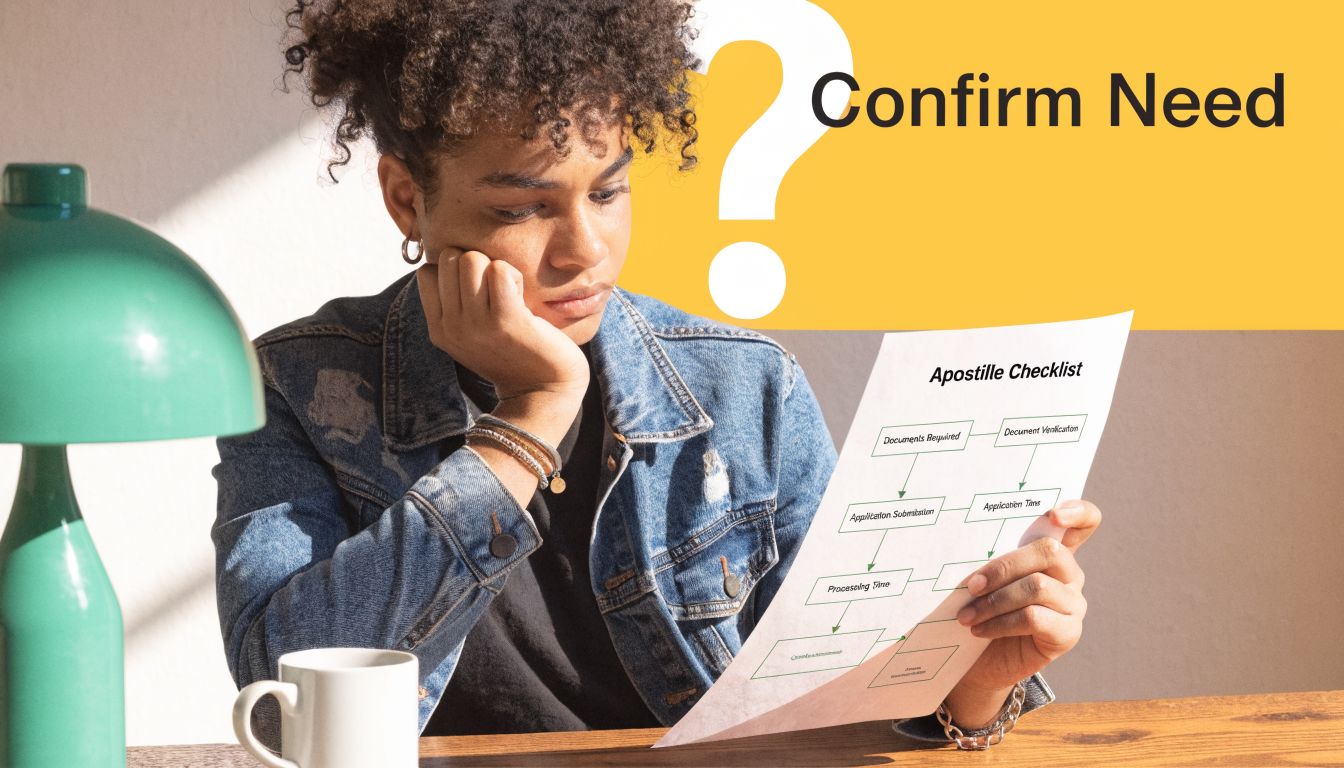
First Steps Is an Apostille What You Really Need
Start with the receiving country and the document’s origin. That sounds obvious, but it is where New York apostille files go off course. A Toronto closing package, a Canadian work permit file, and an Italian dual-citizenship application can all involve New York documents, but they do not always follow the same authentication path.
State documents and federal documents
New York can apostille only documents that fall under New York authority. That usually means New York public records and documents notarized by a New York notary.
Federal documents are a different lane. FBI background checks, USCIS records, and other federal agency documents do not go through the New York Department of State for apostille purposes. If you send a federal record to Albany, the file does not get fixed there. It gets rejected, and your timing problem gets worse.
That distinction comes up often in cross-border hiring, immigration screening, and corporate expansion into Canada. A business may need a New York certificate of incorporation apostilled for use in Ontario, while the employee’s federal background record follows a separate federal process. Anyone dealing with visas, status issues, or supporting records for cross-border moves should also review guidance from a New York immigration lawyer for business and family matters.
Hague Convention countries and non-Hague countries
The next question is whether the destination country accepts an apostille at all. If the country participates in the Hague Apostille Convention, the apostille is usually the correct certification. If it does not, you may need a longer authentication and legalization chain instead.
That matters now more than ever for U.S.-Canada files because Canada accepts apostilles. In practice, that has changed the workflow for New York documents used in Canadian real estate, corporate registration, probate, school enrollment, and immigration matters. The benefit is speed. The trap is assuming every foreign filing works the same way.
The county clerk issue most people miss
For notarized documents, the hard question is rarely, “Do I need an apostille?” The hard question is, “What has to happen before New York will issue it?”
In New York, many notarized documents need County Clerk authentication before the Department of State will issue the apostille. The county is tied to the notary who signed the acknowledgment or jurat, not necessarily where the signer lives or where the document will be used.
This is also where New York City trips people up. A document notarized in Manhattan may need a New York County Clerk step first. A document notarized in Brooklyn points you to Kings County. Outside the city, the same rule applies, but the logistics are often easier because parties assume from the start that a county-level step is part of the job. In NYC, people often skip it because they expect a single state-office filing.
That extra step is not paperwork for its own sake. It is the verification that allows the state to confirm the notary’s authority before it certifies the document for use abroad.
Preparing Your Documents for the Apostille
A file can look complete on a conference room table in Manhattan and still fail at the apostille counter that afternoon. The problem is usually not the apostille request itself. It is the document underneath it.
Preparation starts by sorting the document into the correct lane. New York treats public records differently from privately signed documents, and the difference matters even more on cross-border files headed to Canada, where timing is often tied to a closing, work permit package, probate deadline, or corporate filing.
Public records and notarized documents
Public records need certified copies from the agency or court that issued them. That usually includes birth, death, marriage, and court records. Plain photocopies and scans are a common dead end, even if the underlying record is genuine.
Privately signed documents follow a different chain. Powers of attorney, affidavits, corporate resolutions, consent letters, and many contract-related documents usually need a New York notarization before they can move forward. If the signing has not happened yet, get the execution right the first time. In practice, rejected files often trace back to simple defects such as an incomplete acknowledgment, a missing signature, or a notary block that does not match what the document requires. If that step still needs to be handled, review Mayo Law’s New York notary services.
One practical warning for U.S.-Canada matters. Canadian recipients are often less concerned with the substance of a routine supporting document than with whether the certification chain is clean. A well-drafted document with a defective notarization still stalls the file.
What to verify before you submit
Check the document itself before you worry about the state filing window.
For a public record, confirm that the certified copy comes from the proper office and is in a form New York can authenticate. For a notarized document, confirm the notary completed the certificate fully, signed in the correct capacity, and used a current New York commission. If the document has attachments, make sure the signed and notarized version is the one you intend to send abroad. Last-minute substitutions create avoidable mismatch problems.
Dates also matter. Some receiving authorities, especially in business and immigration settings, expect recently issued records even if New York would authenticate an older one. I tell clients to verify the foreign end before ordering the apostille, not after.
County Clerk authentication in practice
County Clerk authentication is where preparation tends to break down.
For many notarized documents, the county step has to match the county of the notary who took the acknowledgment or jurat. In New York City, that creates a real logistical split. A Manhattan notary points to New York County. A Brooklyn notary points to Kings County. The signer’s home address, the law firm’s office, and the destination country do not control that step.
Outside NYC, the same rule applies, but the process is usually easier to spot because parties expect some county-level handling. In the city, clients often assume every document can go straight to a state office. That assumption costs time, especially on same-week business filings and Canadian immigration packages.
If the county authentication does not line up with the notary’s county, expect a rejection or a delay.
In-person preparation versus mail preparation
The preparation standard also changes depending on how you plan to file.
| Submission path | Best when | Trade-off |
|---|---|---|
| In person | You need speed and can appear at a DOS office | More travel, more hands-on coordination |
| By mail | You can wait and want to avoid an office visit | Slower return, no real-time correction if something is missing |
For walk-in matters, I prepare the file as if there will be no chance to explain anything at the counter. Every signature, certificate, and county-level prerequisite should already be in place. Mail filings require the same discipline, but the penalty for a mistake is worse because the document loses time in transit before anyone spots the problem.
That is the practical divide. A correct document moves quickly. A nearly correct document often goes nowhere.
The Official New York Apostille Submission Process
A client with a Friday filing deadline in Toronto does not need theory. They need to know which New York office will accept the packet, whether mail will miss the deadline, and whether an NYC-issued document can even go straight to the Department of State.
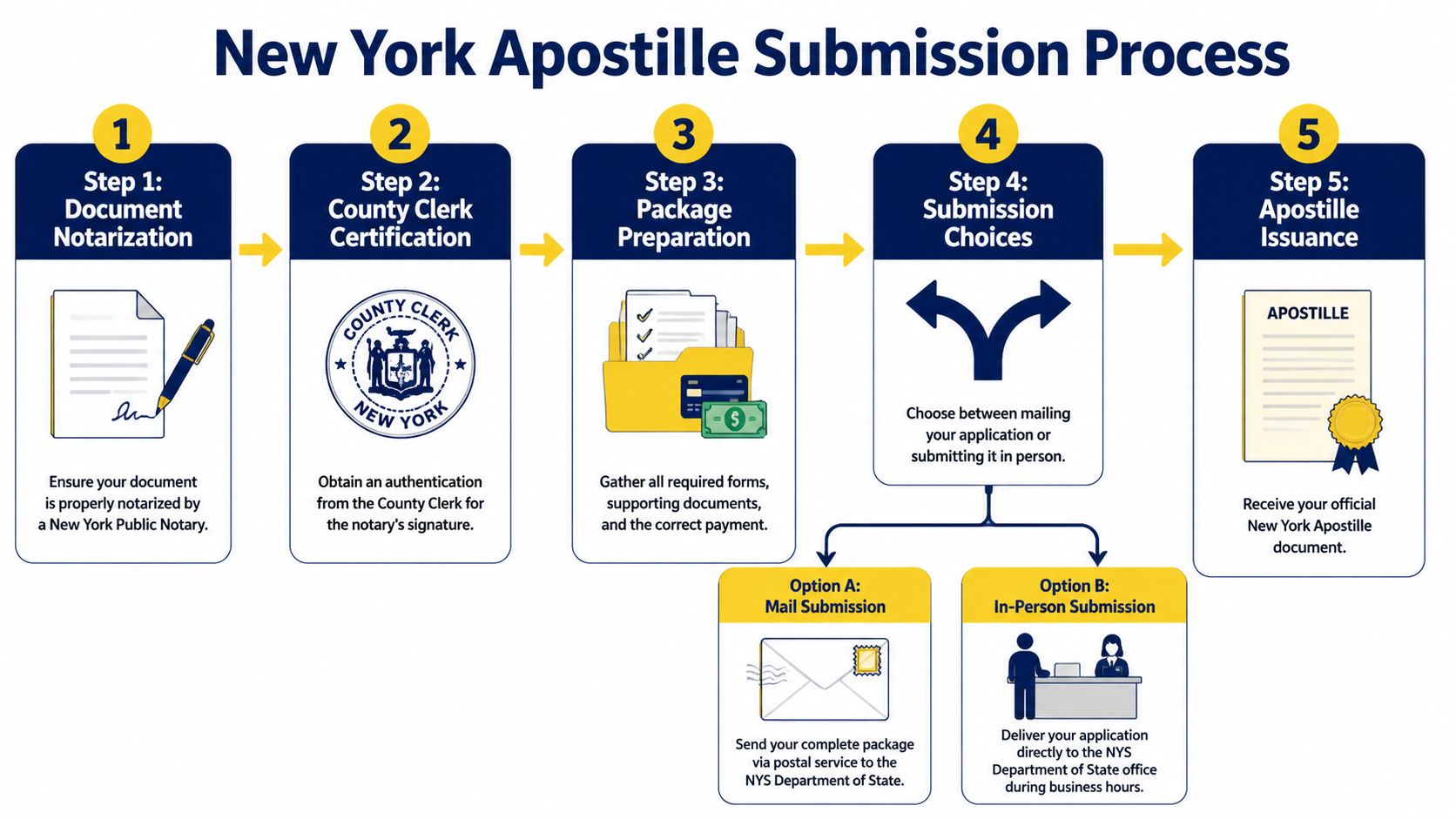
The final certification step is handled by the New York Department of State, but the filing path depends on how fast you need the document back and whether the document originated in New York City or elsewhere in the state. For cross-border business closings, Canadian immigration submissions, and time-sensitive corporate record use, that distinction matters more than applicants expect.
Walk-in service
Walk-in filing is the faster option if the document is already in proper form. New York accepts in-person apostille requests at Department of State offices in Albany, New York City, Buffalo, and Utica. The practical advantage is simple. You find out the same day whether the packet is acceptable, instead of losing time in transit and learning about a defect later.
That speed comes with a trade-off. Counter staff process what is presented. They do not repair a missing county certification, an incomplete notarial certificate, or a document that should have gone through a city or county office first.
For business and immigration matters, I usually recommend walk-in filing when a Canadian employer, border agency, bank, or registry has given a hard deadline. It costs more in coordination and travel, but it avoids the bigger cost of having a signed deal package or immigration file stall over a preventable paperwork defect.
Mail-in service
Mail filing is usually the better fit when timing is flexible and the document has already been checked carefully. New York routes mail apostille submissions through Albany, so the process is slower and less forgiving of mistakes.
A clean mail package generally includes:
- The original document requiring the apostille
- The Department of State request form
- Payment in an accepted form
- A self-addressed return envelope
The destination country should be listed clearly on the request. That point gets overlooked. If the receiving country is not part of the Hague Apostille Convention, you may need authentication and consular legalization instead of an apostille. In that situation, the better starting point is understanding when a document goes to an embassy or consulate for legalization.
Mail works well for lower-pressure matters. It works poorly for NYC documents with extra preliminary steps, or for any file where a rejection would disrupt a closing, start date, or immigration appointment.
The state-office trap in New York City
The most common filing error I see in NYC is sending a document to the Department of State before confirming whether a city or county step is still outstanding.
The Department of State is the final certifying office. It is not a cure for a document that was prepared on the wrong path. That problem shows up often with city-issued records, documents notarized in one county but routed through another, and packets assembled by out-of-state parties who assume New York uses one statewide shortcut.
Outside New York City, applicants still need to match the filing path to the document type, but the route is usually easier to identify. In the city, the procedural split between agency-issued records, county clerk handling, and the state office creates more room for error. That is why NYC apostille work tends to fail at the handoff points, not at the final state counter.
Apostille delays are often preparation delays that surface late. The document reaches the right office only after it has already missed the right sequence.
Navigating Special Cases and Document Types
A founder in Toronto needs New York formation papers for a bank review. A couple in Manhattan needs a birth record for a Canadian immigration file. Both are asking for "an apostille," but the document path is different from the first step. That is where timing problems start.
New York City vital records
NYC birth and death records are their own category. A city-issued vital record often needs more than the certified copy itself before the Department of State can issue the apostille.
For a NYC birth certificate, applicants often order the record and assume it is ready to submit. It often is not. The common failure point is skipping the city-specific supporting paperwork or the county-level certification step that applies before the state office sees the file. In practice, this is one of the clearest differences between NYC and the rest of New York State. Outside the city, the route for a vital record is usually easier to identify from the issuing office alone.
The practical rule is simple. If the record was issued by New York City, confirm the exact city and county sequence before you spend time on the state submission.
Educational documents
School records raise a different problem. The issue usually is not the Department of State. It is whether the school issued the document in a form that can be authenticated at all.
Transcripts, diplomas, enrollment letters, and registrar certifications do not all move on the same track. Some institutions will provide a notarized certification. Others issue a school letter that still needs a proper notarial act before county authentication. For cross-border hiring and licensing matters, especially with Canadian employers or professional regulators, small defects matter. An unsigned registrar letter, an incomplete jurat, or a notary block that does not match county records can force you to start over.
Ask the school one narrow question first: who signs apostille-bound records, and in what form? That usually saves more time than asking for "a certified transcript" in general terms.
Canada-bound files
Canada-bound matters are often business or immigration matters with a real deadline attached. Corporate expansions, intra-company transfers, proof of status, civil records for family sponsorship, and university records for work authorization all show up on short timelines.
For those files, the first decision is whether the receiving party wants an apostille or a different legalization path. Some cross-border matters still involve consular handling, and the document package may split into two tracks. If that issue is in play, review the difference between apostilles and embassy or consular legalization for international documents before you prepare the wrong packet.
Business documents
Business records fail for ordinary reasons. The signer lacked visible authority. The notarization was defective. The copy came from the wrong source.
Certificates of incorporation, good standing documents, board resolutions, powers of attorney, and operating agreements each need their own check. A filed state record may be easier to apostille than an internally created corporate document because the state-issued version already carries the official certification the apostille office expects. By contrast, a resolution signed in-house may depend entirely on a clean notarization and a county clerk step tied to the notary's county.
That distinction matters in US-Canada transactions. If a lender, registry, or immigration counsel in Canada needs proof of corporate authority, do not assume any signed company paper will do. Use the version of the document that fits the authentication path, not just the version that looks most complete.
Common Mistakes That Will Get Your Application Rejected
A typical rejection looks like this. The document itself is fine, the deadline is tight, and the problem is procedural. A Manhattan notary was used, but no County Clerk authentication was added. Or the client sends a New York City birth certificate without the extra certification the state expects. In cross-border matters, especially for Canada filings tied to work permits, corporate registrations, or estate administration, that kind of miss costs time you usually do not have.
Did I get the correct county authentication
For many notarized New York documents, the Department of State expects the County Clerk to authenticate the notary first. The county must match the notary's commissioning county or the county tied to the notarial record. If those details do not line up, the file can be rejected without much explanation.
In New York City, people often lose time. They assume "NYC" is one filing location. It is not. A notarization tied to Kings County follows a different clerk path than one tied to New York County or Queens County. Outside the city, the same rule applies, but the mistake shows up less often because the county is usually clearer on the face of the record.
NYC vital records create a separate trap. A birth or death certificate issued by the city often needs the additional certification step before the state will issue the apostille. Sending the certificate straight to Albany without that supporting piece is one of the fastest ways to get the package bounced back.
Am I submitting the right kind of document
New York does not treat originals, certified copies, and photocopies as interchangeable. Public records usually need the certified version from the issuing office. Privately created documents usually rise or fall on the quality of the notarization.
I see this often with corporate papers used in US-Canada transactions. A company sends a signed resolution or power of attorney because it has the right substance, but the notarization is incomplete or the signer’s title is unclear. The better choice may be a state-issued filing, a certified organizational record, or a freshly executed document with a clean New York notarization. The right document is the one that fits the authentication path, not the one that reads best internally.
Am I sending it to the right authority
New York can apostille New York documents. It cannot fix a federal record or a document issued by another state.
That sounds obvious, but mixed document sets create problems. A Canadian immigration package might include an FBI record, a New Jersey marriage certificate, and a New York power of attorney. Those do not belong in one New York apostille submission. Each document has to go back to the authority with jurisdiction over that record.
Is the package complete
Rejections also come from small omissions that the state treats as material. Before filing, confirm these points:
- The destination country is listed on the request form
- The payment matches the filing method
- A return envelope is included for mail submissions
- The supporting certification chain is complete, especially for NYC records
- Names, dates, and signatures are consistent across the document and notarial certificate
One missing step can stall the whole matter. In practice, the New York apostille process is less about legal complexity than document discipline.
Your New York Apostille Checklist
Treat this as a set of practical considerations, not legal advice.
- Is the destination country within the Hague system? If not, you may need legalization rather than an apostille.
- Is the document a New York document? If it's federal or from another state, New York may not be the right place to file.
- For public records, do you have the right certified copy? A plain copy often won't work.
- For notarized documents, was the notarization done correctly in New York? If not, the file may fail before it reaches the final state review.
- Have you completed any required County Clerk step? This is often mandatory and easy to overlook.
- If it's an NYC vital record, do you have the Letter of Exemplification? That single missing item commonly stops the process.
- Have you chosen the right filing method? In-person is usually better for urgent matters. Mail is better for convenience when timing is flexible.
- Is your submission package complete? Check the request form, payment, return envelope, and destination country before sending anything.
When clients are under time pressure, this checklist usually matters more than any broader explanation of the Hague Convention. The process is workable. The details are what matter.
Build Your Business on Solid Legal Ground
Apostilles are often just one part of a larger cross-border file. The same matter may also involve corporate structuring, immigration strategy, contract review, or internal approvals. If one document in that chain is mishandled, the rest of the project may stall.
Mayo Law advises startups and SMEs in Ontario and New York on practical cross-border issues, from business formation to international documentation. If you're also working through entity setup or governance questions, Mayo Law's guide on what company bylaws are and why they matter is a useful companion. If you need personalized guidance, you may want to schedule a consultation.
LEGAL DISCLAIMER
LEGAL DISCLAIMER: The information provided in this article is for general informational and educational purposes only and does not constitute legal advice. Reading this article, visiting mayo.law, or contacting Mayo Law does not create an attorney-client relationship. The content of this article should not be relied upon as a substitute for professional legal counsel suited to your specific circumstances. Legal outcomes depend on the particular facts and circumstances of each individual case, and no attorney can guarantee a specific result. Laws, regulations, and legal procedures are subject to change and may vary by jurisdiction. If you require legal assistance, you should consult with a qualified attorney licensed to practice in the relevant jurisdiction. Mayo Law expressly disclaims any and all liability with respect to actions taken or not taken based on the contents of this article.
If you're handling cross-border business, immigration, or document authentication issues, Mayo Law may be able to help you assess the process, spot avoidable filing problems, and coordinate the legal steps around your broader matter. Build your business on solid legal ground and schedule a consultation with Mayo Law.