You’re hiring in Toronto, selling into the U.S., and suddenly immigration stops being an HR side task. A founder needs to enter for diligence meetings. A Canadian engineer needs U.S. work authorization. A manager splits time between Ontario and New York. That’s usually the point where companies learn that cross-border movement is a business risk issue, not just a form-filing issue.
At Mayo Law, we help founders, employers, and executives in Toronto and across the border handle business immigration with legal advice grounded in both Ontario and New York practice. If you’re looking for a cross-border lawyer for Canada US business immigration, the practical question isn’t just which visa fits. It’s whether your hiring plan, travel plan, tax setup, compliance process, and deal timeline work together.
Published: May 27, 2026 | Updated: May 27, 2026 | Read time: 16 minutes
What Are the Main Canada-US Business Immigration Pathways?
The main Canada-U.S. business immigration pathways are TN, L-1, E-2, H-1B, O-1, and limited business visitor travel for activities that don’t cross into unauthorized work. The right option depends on the person’s role, ownership, credentials, corporate structure, and what they’ll do after entry.
- TN status fits qualifying Canadian professionals in listed occupations, often where a U.S. employer needs a fast work-authorized option.
- L-1 works for intracompany transfers, usually executives, managers, or specialized knowledge staff moving from a Canadian company to a related U.S. entity.
- E-2 is for treaty investors and certain essential employees where there is a qualifying investment and a real operating business.
- H-1B may fit specialty occupation roles, but it is less predictable because it often depends on timing and quota issues.
- O-1 can suit founders, researchers, creatives, and senior operators with strong evidence of distinction in their field.
- B-1 business visitor travel can cover some meetings, negotiations, and limited commercial activity, but it is not a substitute for work authorization.
- Permanent residence strategies sometimes need to be planned early, especially when a temporary category does not align with long-term retention.
If your company is building structure on both sides of the border, starting a business in both Canada and the US often needs to be planned alongside immigration, not after incorporation documents are signed.
What is the difference between a visa and status?
For Canadians, this distinction matters. A visa is typically the travel document placed in a passport by a U.S. consulate, while status is the legal classification that authorizes what someone may do after admission. Many Canadians can apply directly at a port of entry for certain classifications, so they may hold lawful status without a visa foil in the passport.
Practical rule: Always define the activity first, then choose the category. Companies get into trouble when they start with the travel date and work backward.
A Deep Dive into Key US Business Visas for Canadians
Some visa categories are legally strong on paper but weak in practice for a startup. Others look narrow but work well if the company builds the record properly. The right answer usually comes from matching the business model to the category, then stress-testing the evidence.
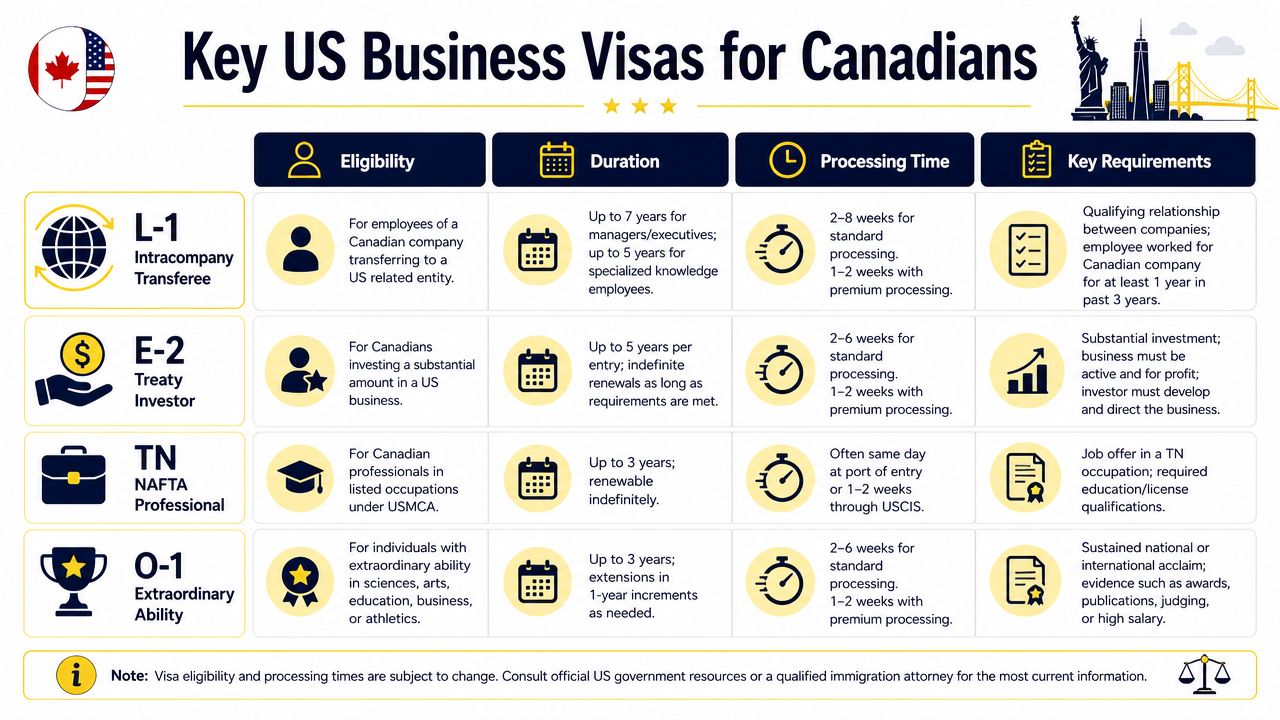
A useful way to sort options is by asking four questions: Is the person an employee, owner, or both? Is there a related company on each side of the border? Does the role fit a treaty occupation or a specialty role? Does the business need speed, long-term continuity, or investor flexibility?
Canada-US Business Visa Comparison
| Visa | Best For | Key Requirement | Typical Processing Time (Post-Filing) |
|---|---|---|---|
| TN | Canadian professionals | Role must fit a listed professional category and the candidate must qualify | Often faster than petition-based categories, especially when eligible for border application |
| L-1 | Transfers from Canadian to U.S. affiliate, parent, subsidiary, or branch | Qualifying corporate relationship and prior employment with the related company | Varies by filing route and evidence quality |
| E-2 | Investors and certain essential employees | Treaty nationality, qualifying investment, and real operating enterprise | Varies by consular scheduling and application strength |
| O-1 | High-achieving individuals | Strong evidence of distinction and role alignment | Varies depending on filing strategy |
| H-1B | Specialty occupation hires | Specialty occupation role and qualifying candidate | Often slower and less predictable because timing can control access |
TN status for professionals
For many Canadian employers and employees, TN status is the most practical work-authorized route when the role clearly fits. It was created under NAFTA in 1994 and preserved in the United States-Mexico-Canada Agreement, which entered into force on July 1, 2020, keeping temporary professional mobility central to North American business operations, as noted by Phillips Lytle's discussion of the Canada-U.S. framework.
TN works best when the role is professional and the evidence is clean. Engineers, accountants, lawyers, and certain scientific roles are common examples. Problems start when a company tries to force a startup generalist role into a treaty occupation that doesn't really fit.
Three things usually matter most:
- Occupation match: The job title alone doesn't control. The actual duties must align with a listed profession.
- Credential match: Degrees, licenses, and experience should support the specific occupation.
- Employer letter quality: Border applications often succeed or fail based on whether the support letter describes a lawful, precise role.
A common startup mistake is describing one person as part sales lead, part product manager, part operations executive, and then trying to present that person as a TN professional. That kind of mixed role can create avoidable friction.
L-1 for founders and expanding companies
L-1 is often the right category when a Canadian company is opening or scaling a related U.S. entity and wants to move a founder, executive, manager, or specialized employee. The attraction is obvious. It tracks how companies expand in practice.
But L-1 is evidence-heavy. You need a real qualifying relationship between the Canadian and U.S. entities, and the employee's prior role and future U.S. role both need to be documented carefully. Startup founders often find this surprising. Owning the company doesn't remove the need to prove organizational structure and role legitimacy.
L-1 usually works well when the company can show:
- Corporate linkage: Parent, subsidiary, affiliate, or branch relationship.
- Operational substance: The Canadian business is real, active, and documented.
- Role clarity: The U.S. position is managerial, executive, or specialized knowledge based.
- Business plan support: Especially for newer U.S. operations, the file should explain how the U.S. entity will function and grow.
If you're weighing investor-based options too, it helps to compare L-1 with whether a Canadian can get an E-2 visa before you commit to one structure.
E-2 for owner-operators and essential employees
E-2 can be a strong fit where a Canadian owner is actively investing in and directing a U.S. business. It can also work for some employees of an E-2 company if they share the treaty nationality and hold executive, supervisory, or essential-skills roles.
What works in E-2 cases is not just proving that money moved. The record has to show a real business, lawful source and path of funds, and a credible operating plan. Passive ownership is usually a weak fact pattern. Active management is much stronger.
In practice, E-2 is often attractive for:
- A Canadian founder opening a U.S. consulting, logistics, retail, or services business
- An existing Canadian company sending a national of the same treaty country to develop U.S. operations
- A business that needs flexibility and renewability, rather than waiting on a more rigid route
The strongest E-2 files read like business records, not like immigration templates.
A weak E-2 file often has a thin business plan, vague capitalization history, and no clear operational story. A strong one shows leases, contracts, payroll planning, ownership records, and a coherent explanation of who will do what after entry.
O-1 for exceptional founders and senior talent
O-1 is underused in cross-border startup planning. Many people assume it's only for celebrities. It isn't. It can work for founders, research leaders, technical specialists, and public-facing executives if the evidence shows sustained distinction and a role that requires that level of ability.
The challenge is proof. You need a documented record, not just a strong résumé. That may include major press, judging, scholarly work, significant commercial impact, high-level roles, awards, or original contributions. The category can be excellent for the right profile, but it doesn't reward casual presentation.
O-1 tends to work best when:
- The candidate has an unusually developed public or industry profile
- The company can explain why this role requires that individual's level of distinction
- The evidence is organized into a narrative, not dumped into exhibits
H-1B for specialty occupations
H-1B remains important, but it isn't always the first recommendation for Canadian startups. The role must be a specialty occupation, the candidate must qualify, and timing can drive the strategy more than the merits do.
This category can still make sense for established employers with structured hiring, internal compliance support, and enough lead time. It is less attractive when a company needs someone on short notice, especially if other categories are available.
A lot of employers overfocus on the category name and underfocus on operational fit. If the hiring date is fixed, the worker is Canadian, and the role fits TN cleanly, TN may be more practical. If the person is a founder with a related Canadian company, L-1 may be stronger. If the person is investing and directing, E-2 may be cleaner.
Do I need a lawyer for a TN or L-1 application?
Not always, but many companies benefit from one because the legal issue is rarely the form itself. The harder questions are role definition, activity limits, entity structure, and whether the evidence says the same thing across corporate, tax, payroll, and immigration records. Inconsistent records create avoidable entry problems.
Can a founder use a business visa if they own the company?
Sometimes, yes. Ownership does not automatically block work authorization, but it changes the analysis. Founders often fit L-1, E-2, or O-1 more naturally than TN or ordinary business visitor travel. The key is whether the category supports both the ownership structure and the day-to-day activities after entry.
Employer Responsibilities in Canada-US Business Immigration
The employee may hold the status, but the company usually holds the risk. That's why employer-side planning matters. Once someone starts working across the border, immigration, onboarding, recordkeeping, and audit exposure all move onto the company's desk.
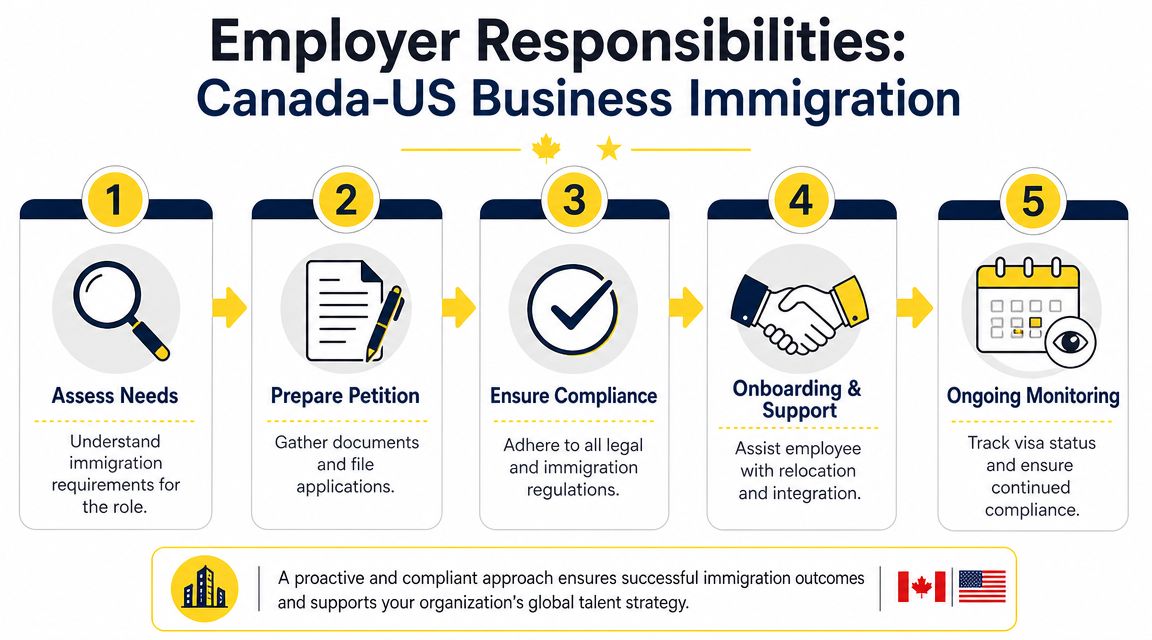
Cross-border employers often treat immigration as an isolated legal file. That's a mistake. Dickinson Wright notes that business immigration work can involve tax, employee benefits, and government audits, which reflects a broader reality that immigration compliance is an operations and audit issue, especially for remote and hybrid teams with staff moving between Canada and the U.S., as described on its immigration services page.
What does the employer actually need to do?
Start with a practical checklist:
- Define the role accurately: Job title, duties, reporting line, and work location should match across offer letters and immigration documents.
- Choose the right category early: Don't wait until a flight is booked.
- Coordinate onboarding records: U.S. work authorization, identity verification, and related HR records should be consistent.
- Review tax and payroll assumptions: A legal immigration plan can still create business problems if payroll or benefits teams are left out.
- Track expiries and changes: Promotions, remote work shifts, acquisitions, and title changes can affect immigration strategy.
A growing software company might send one Canadian founder on E-2, hire a finance professional on TN, and transfer a product lead on L-1. Those are not three separate legal errands. They are one workforce strategy with three different legal paths.
How much does Canada-US business immigration cost?
Government filing costs depend on the category and the filing route. For accurate current fees and procedures, employers should check the relevant government pages before budgeting, including USCIS forms and filing fees, U.S. Department of State visa information, and IRCC immigration information where Canadian processes are part of the staffing plan.
Legal fees vary by category, urgency, evidence complexity, and whether the employer also needs help with entity setup, compliance, or consular preparation. The practical point is this: ask for a scope-based fee quote tied to the exact pathway, and ask what triggers extra charges. That's where fee opacity usually shows up.
What records should HR and legal keep?
The safest file is one that can survive later scrutiny. That means keeping a reusable set of documents rather than rebuilding the case every time the person travels, extends status, or changes roles.
Good employer files usually include:
- Corporate documents proving the business structure
- Employment records showing title, duties, salary, and reporting line
- Travel-purpose records for short-term trips
- Support letters and filing copies from prior applications
- Change logs for promotions, relocations, and remote-work arrangements
A company that wants a stronger internal process can also build immigration controls into broader compliance officer responsibilities, especially when multiple departments touch the same cross-border worker.
Keep one source of truth. If legal, HR, payroll, and the employee all describe the role differently, border scrutiny gets harder fast.
Can remote or hybrid work create immigration issues?
Yes. Employers often assume remote work softens immigration rules. It doesn't. It can complicate them. If an employee is physically present in a country and performing work there, the legal analysis can change even if the team thinks the person is “just logging in remotely.”
That's why distributed teams need role mapping by location, not just by department. The operational question is where work is being performed, under whose direction, and with what authorization.
Avoiding Common Pitfalls in Cross-Border Moves
The most expensive immigration errors usually don't start with a denial. They start with assumptions. A founder thinks a few U.S. meetings are harmless. A technical employee says they're only “visiting clients.” HR copies an old support letter that described a different job. Then the person reaches the border and the story unravels.
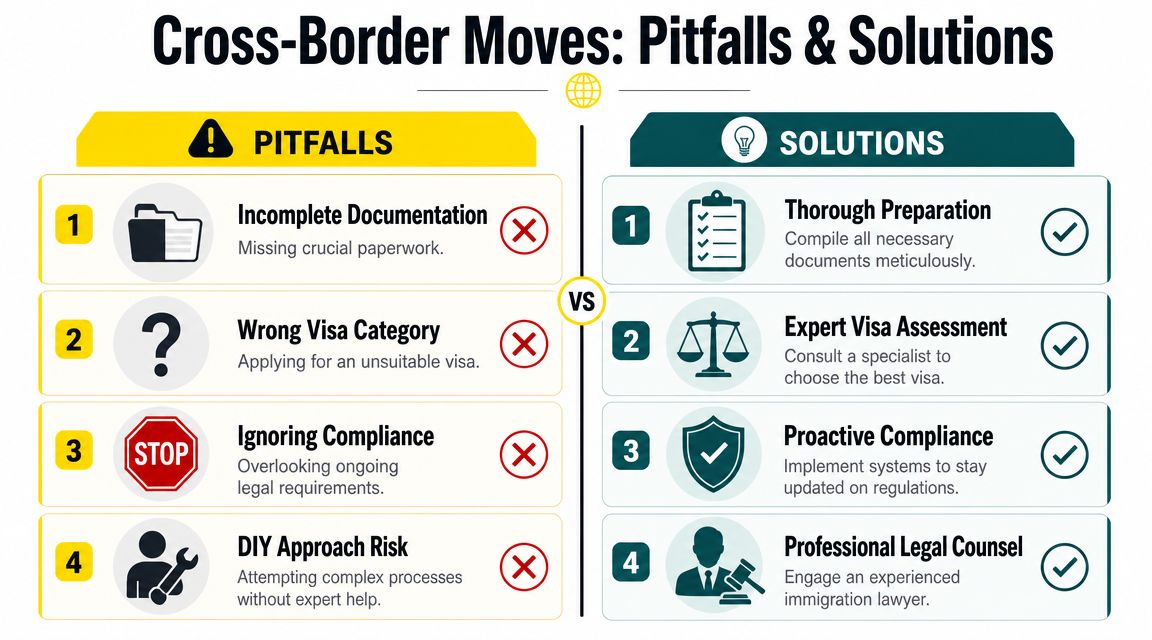
One of the biggest blind spots is the line between short-term business travel and work authorization. A Canadian Lawyer report highlighted a warning from a U.S. immigration lawyer that poor planning and stricter border enforcement can derail site visits and deals, underscoring that risk often lies in day-to-day travel management, not just formal visa selection, as discussed in this Canadian Lawyer article on cross-border business travel risks.
The business visitor trap
Here's the pattern. A Canadian founder enters the U.S. for investor meetings, customer calls, and launch preparation. So far, that may sound manageable. But if the actual plan is to perform productive work in the U.S., direct U.S. staff day to day, or provide hands-on services on site, the business visitor story may no longer fit.
A border officer doesn't just hear labels. They test facts. What will you do? Who pays you? Where is the client? Will you produce work while in the U.S.? If the answers drift into labor for the U.S. market, the company may be using the wrong category.
An anonymized example
A Toronto founder built a U.S. sales pipeline and flew down repeatedly for “meetings.” On one trip, the founder carried draft service schedules, onboarding materials, and a laptop full of implementation plans for U.S. customers. The officer focused on actual activities, not the meeting label. Entry became a problem because the documentation suggested work that should have been matched to a proper work-authorized pathway.
That result was avoidable. The company had a viable immigration route. It just wasn't aligned with the travel pattern.
What works and what doesn't
What works:
- Pre-cleared travel purpose: Every trip has a lawful purpose tied to a reviewed category.
- Consistent records: The invitation letter, support letter, calendar, and oral explanation all line up.
- Role-specific planning: Founders, executives, and technical staff rarely fit the same border script.
- Clean device and document management: Carry what supports the trip, not what contradicts it.
What doesn't:
- Recycling old letters from a different role or company stage
- Using “business meetings” as a catch-all for productive work
- Letting the employee explain the legal theory without preparation
- Treating immigration separately from confidentiality and IP risk, especially where cross-border teams are handling sensitive materials tied to product or customer development
That last point matters more than many startups expect. Cross-border moves often overlap with disputes over confidential information, customer lists, or code ownership. If your company is already dealing with trade secret misappropriation, immigration planning should be coordinated with the broader risk file.
Mayo Law works with founders, SMEs, and employers across the GTA and on cross-border matters. Joseph Mayo is licensed in Ontario and New York, so clients with U.S. ties coordinate their legal work in one place rather than juggling two firms.
What happens after a refusal or request for more evidence?
A refusal at the border or a request for evidence in a petition case is not the same thing as “you can never apply again.” But it does mean the record needs to be rebuilt carefully. The wrong reaction is to rush back with slightly revised papers and no strategy.
If the first filing framed the role badly, fix the role narrative first. Don't just add more documents.
Usually the next step is to identify exactly what the officer or adjudicator doubted. Was it the category? The duties? The employer relationship? The source of funds? The travel purpose? Once that issue is isolated, the company can decide whether to supplement, refile, change categories, or pause travel until the facts are stronger.
How to Choose the Right Cross-Border Immigration Lawyer
A founder calls after a border issue, not before. The engineer was told to turn around. The sales lead was admitted for a narrower purpose than the company expected. Payroll is already set up, customer meetings are booked, and the internal story about the role does not match the travel record. At that point, the problem is no longer just immigration. It is an operations problem.

Choose counsel with that risk in mind. The right cross-border immigration lawyer should be able to assess the visa strategy, the employer record, and the business consequences together. If your lawyer only talks about forms and filing fees, you may get an approval path without a workable compliance plan.
What should you look for first?
Start by asking how the lawyer evaluates the company, not just the worker. A strong advisor will want to see the org chart, ownership structure, job duties, reporting lines, compensation model, travel purpose, and where the person will perform services. That review often exposes the underlying issue early. Sometimes the category is fine, but the offer letter is wrong. Sometimes the role can work, but only if payroll, supervision, or entity relationships are cleaned up first.
Three things matter most:
- Cross-border legal judgment: The lawyer should understand how the same facts will be examined by U.S. immigration authorities and how those facts are documented on the Canadian side.
- Employer-side compliance focus: Ask whether they advise on payroll coordination, work location, recordkeeping, travel protocols, and future extensions.
- Role discipline: Good counsel tests the role against the legal category. Titles do not carry a case. Duties, reporting structure, and business need do.
Do you need one dually licensed lawyer or two firms?
Sometimes two firms are the right setup. If the matter is narrow and clearly split by jurisdiction, separate counsel can work well. But where the immigration strategy depends on Canadian corporate records, U.S. entity planning, founder control, employment terms, or pre-entry travel advice, a dually licensed lawyer can reduce inconsistency and delay.
That matters for startups. Early-stage companies often have fast-changing roles, cap table complexity, related entities, and imperfect documentation. Those facts can be manageable. They become risky when corporate, employment, and immigration advice are siloed and each advisor assumes someone else checked the underlying record.
Questions worth asking before you hire
Ask practical questions that reveal how the lawyer works under real business pressure:
- How do you assess business visitor versus work-authorized activity before travel?
- What documents do you want to review before recommending a category?
- Have you handled founder, owner-operator, or affiliate-transfer cases?
- Who checks consistency across support letters, HR records, and corporate documents?
- How do you advise if the role changes after funding, restructuring, or an acquisition?
- What employer compliance steps do you expect us to complete after approval?
A useful benchmark is whether the lawyer can discuss immigration as part of business operations. Companies looking for business immigration counsel for employers usually need advice that covers hiring plans, border activity, internal documentation, and longer-term compliance, not just one filing.
What's a warning sign?
Be cautious with advice that depends on optimism instead of facts. Common examples include treating business visitor status as a catch-all, assuming a job title will carry the application, or suggesting the company can sort out inconsistencies after entry.
Another warning sign is a lawyer who never asks how the employer will support the case over time. Extensions, amended filings, border questions, payroll records, and manager changes all flow from the original record. If no one is testing that record at the start, the company is taking on avoidable risk.
Frequently Asked Questions
Can a Canadian startup founder work in the U.S. without a visa stamp?
Sometimes. Canadian citizens can apply for certain U.S. work-authorized classifications directly at the border or airport preclearance, depending on the category and the facts.
The business risk is assuming that no visa stamp means no immigration issue. A key question is whether the planned U.S. activity matches the status requested and whether the company can support that position with consistent records if CBP asks questions.
What usually costs more, the visa filing or the compliance work?
For many employers, the larger cost sits outside the filing itself. Internal review of payroll setup, entity relationships, job duties, reporting lines, travel plans, and future extension strategy often takes more time than expected.
That is especially true for startups. Titles change fast, founders wear multiple hats, and corporate records are not always drafted with immigration in mind. A low legal fee on the front end can become expensive if the company has to correct documents later or defend an avoidable inconsistency at the border.
How long should we plan before moving a worker across the border?
Start earlier than the business team wants to start.
Even fast-moving cases can stall because the employer is not ready. Offer letters may need revision. Stock ownership or control documents may need to be organized. U.S. and Canadian records may describe the role differently. If flights are booked before legal review, the company usually has fewer workable options and more pressure to force a weak position.
Do I need a U.S. lawyer, a Canadian lawyer, or both?
That depends on what is driving the case. If the issue is limited to U.S. admission strategy, U.S. immigration counsel may be enough. If the case depends on Canadian corporate records, employment terms, founder ownership, tax treatment, or affiliate structure, advice from only one side of the border can leave gaps.
Integrated cross-border counsel helps the employer. The immigration category may be U.S., but the evidence often comes from Canadian documents and business decisions. If those pieces are not aligned, the company carries the risk, not just the traveler.
What is the single biggest risk in Canada-US business immigration?
An inaccurate description of the person's actual work after entry.
That problem shows up in different ways. A founder is presented as providing high-level oversight but is really stepping into day-to-day delivery. A trip is framed as meetings and planning, but the employee is coming to perform productive client work. Once the facts on paper drift from the facts on the ground, admission, extensions, and future filings all become harder to defend.
Can family members come with the principal worker?
Often, yes, depending on the category.
For employers, the practical issue is timing. Spousal work authorization, school enrollment, housing, and cross-border tax residence questions can affect the employee's start date and willingness to relocate. Companies that treat family planning as an afterthought often end up with delayed onboarding or shortened assignments.
If your company is expanding across the border, moving staff on short timelines, or trying to reduce travel and compliance risk, Mayo Law can help assess the legal path and the employer-side operational impact together.
How Mayo Law Can Help
Cross-border hiring problems rarely stay inside one file. A U.S. immigration strategy can fail because the Canadian corporate records, payroll setup, contractor terms, or reporting lines do not match the role described at the border or in a petition.
Mayo Law advises on those connected issues for companies in Toronto, the GTA, and across Canada-U.S. operations. The work often involves founders entering the U.S. before the company structure is fully settled, Canadian employers transferring staff into related U.S. entities, or businesses trying to support work authorization without creating avoidable tax, payroll, or compliance exposure.
The practical goal is to align the immigration case with how the business runs. That includes reviewing the proposed role, entity relationships, compensation flow, management structure, and supporting records on both sides of the border so the company is not solving one problem while creating another.
If your matter involves U.S. work authorization, founder mobility, employer compliance, or a Canada-U.S. business structure that affects immigration strategy, Mayo Law can assess the legal and operational fit.
Disclaimer
This article is for informational purposes only and does not constitute legal advice. Every situation is different. Consult a licensed lawyer about your specific circumstances. Mayo Law provides legal services through Mayo Law PC in Ontario and Joseph Mayo PLLC in New York.
Related Articles