

Contents
- Quick answer
- What are the Canadian citizenship requirements for permanent residents?
- How is the 1,095-day physical presence requirement calculated?
- Why does the five-year window need at least 730 days as a permanent resident?
- Which tax years does the Citizenship Act actually require?
- Who has to prove language skills and take the citizenship test?
- What can make a permanent resident ineligible?
- What does a citizenship application cost in 2026?
- How do these requirements differ from citizenship by descent?
- Frequently asked questions
- Conclusion
- How Mayo Law Can Help
- Disclaimer
It is easy to approach the Canadian citizenship requirements for permanent residents in the wrong order. Applicants count three years on a calendar, book a language test, and only later find out that the days they spent in Canada as a student before landing were worth half as much, or that two of the years they were counting fall outside the window entirely. The application is refused or returned, and the clock effectively restarts.
The rules themselves are not complicated. They are arithmetic rules with a statutory basis, and almost every problem comes from counting the wrong days rather than from any question of judgment.
Quick answer
To apply for Canadian citizenship, a permanent resident must have been physically in Canada for at least 1,095 days in the five years before signing the application, including at least 730 days as a permanent resident, have met any tax filing obligations for three of those years, and not be under a prohibition.
What are the Canadian citizenship requirements for permanent residents?
The grant of citizenship for adults comes from section 5(1) of the Citizenship Act, R.S.C. 1985, c. C-29. The Act is current to 17 June 2026 and was last amended on 15 December 2025. Section 5(1) says the Minister shall grant citizenship to a person who meets the listed conditions, which is worth noticing: this is not a discretionary decision if the conditions are met.
The conditions in the statute are these:
- Application. The person makes an application for citizenship, under paragraph 5(1)(a).
- Permanent resident status. The person is a permanent resident within the meaning of subsection 2(1) of the Immigration and Refugee Protection Act, with no unfulfilled conditions relating to that status, under paragraph 5(1)(c).
- Physical presence. The person has “been physically present in Canada for at least 1,095 days during the five years immediately before the date of his or her application”, under subparagraph 5(1)(c)(i).
- Income tax filing. The person has “met any applicable requirement under the Income Tax Act to file a return of income in respect of three taxation years that are fully or partially within the five years immediately before the date of his or her application”, under subparagraph 5(1)(c)(iii).
- Language. If aged 18 or more but less than 55 at the date of application, the person has an adequate knowledge of one of the official languages, under paragraph 5(1)(d).
- Knowledge of Canada. If aged 18 or more but less than 55 at the date of application, the person demonstrates, in one of the official languages, an adequate knowledge of Canada and of the responsibilities and privileges of citizenship, under paragraph 5(1)(e).
- No removal order. The person is not under a removal order and is not the subject of a declaration by the Governor in Council under section 20, under paragraph 5(1)(f).
The age brackets come from the statute itself, not from departmental practice. Paragraphs 5(1)(d) and (e) both read “18 years of age or more but less than 55 years of age at the date of his or her application”. IRCC describes the same bracket in plain language as 18 to 54. The two are equivalent, and the age that matters is the age on the application date, not on the test date or the ceremony date.
How is the 1,095-day physical presence requirement calculated?
The 1,095 days are counted inside a five-year eligibility period that ends on the day the application is signed. Only days inside that window count at all. A year spent in Canada six years ago is worth nothing.
Within the window, days are weighted:
- Each day in Canada as a permanent resident counts as one full day.
- Each day in Canada as a temporary resident or protected person before becoming a permanent resident counts as half a day, to a maximum credit of 365 days. Reaching that maximum takes 730 calendar days of pre-PR presence, because 730 multiplied by 0.5 is 365.
- Each day spent outside Canada as a Crown servant, or as the spouse, common law partner or child of one, counts as one full day. A locally engaged employee hired abroad by the Canadian government is not a Crown servant for this purpose.
- Time in prison, on parole, on probation, or spent waiting for a decision on a refugee claim, does not count.
A temporary resident here means someone with valid status as a visitor, student, worker or temporary resident permit holder. A protected person means someone whose refugee or asylum claim, or pre-removal risk assessment, was approved, and that time counts only from the approval until the day before permanent residence began.
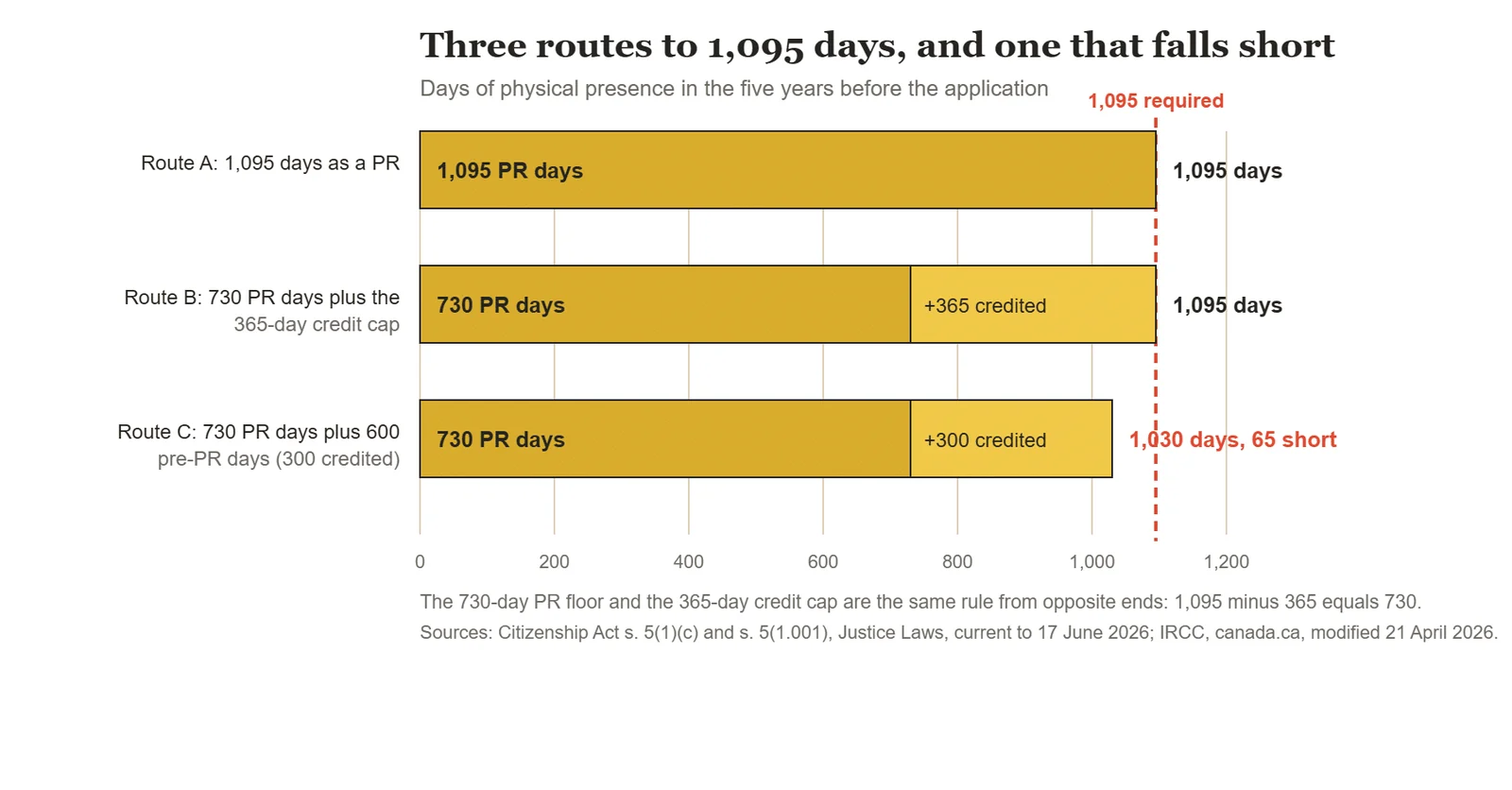
IRCC advises applying with more than 1,095 days in case there is a problem with the calculation. That is sensible rather than legalistic. A single misremembered border crossing can move a file from eligible to refused, and the department publishes a physical presence calculator, linked from its own eligibility pages, that produces the figure it will work from.
Why does the five-year window need at least 730 days as a permanent resident?
This is the requirement most commonly missed, and it is the one that catches people who spent years in Canada on a work or study permit before landing.
IRCC states that the five-year eligibility period “must include at least 730 days as a permanent resident”. The 365-day cap on pre-PR credit is the mirror image of that floor. Subtract the maximum credit from the total and the arithmetic closes exactly: 1,095 minus 365 equals 730. The two rules are the same rule stated from opposite ends.
The practical effect is that no amount of pre-landing time can shorten the post-landing wait below two years. Someone who studied in Canada for four years, then worked for three, then became a permanent resident, still cannot apply until roughly two years after landing. The extra pre-PR years beyond 730 calendar days are simply not counted.
Route C in Figure 1 shows a failure mode that is easy to miss. The applicant has cleared the 730-day permanent resident floor and still falls 65 days short of the total, because only 600 calendar days of pre-PR presence were available and 600 multiplied by 0.5 is 300, not 365.
Which tax years does the Citizenship Act actually require?
The statutory wording is narrower than the way it is usually summarised, and the difference matters.
Subparagraph 5(1)(c)(iii) requires that the applicant has met any applicable requirement under the Income Tax Act to file a return for three taxation years that are fully or partially within the five-year period. Two points follow.
First, the obligation is conditional. If no filing requirement applied in a given year, there is nothing to have met for that year. The Act does not require three years of filed returns from a person who was not required to file.
Second, the years may be fully or partially within the window. A taxation year that overlaps the five-year period at all can qualify, which quietly makes the requirement easier to satisfy than a reading of “three full years inside the window” would suggest.
The application asks two separate questions for each year: whether the person was required to file, and whether they in fact filed. Answering the first question wrongly is a misrepresentation risk, and a citizenship application refused for misrepresentation carries a five-year bar on becoming a citizen.
Who has to prove language skills and take the citizenship test?
Both requirements attach to the same age bracket, and both fall away outside it.
Applicants aged 18 to 54 on the day they sign must show speaking and listening ability at level 4 of the Canadian Language Benchmarks in English, or the Niveaux de compétence linguistique canadiens in French. IRCC assesses language in three ways: the documentary proof filed with the application, how the applicant speaks to a citizenship official at any point in the process, and, if needed, an assessment during the citizenship test.
The same 18 to 54 group must pass the citizenship test, which covers the rights and responsibilities of citizenship and Canada’s history, geography, economy, government, laws and symbols. The invitation to the test comes after the application is submitted.
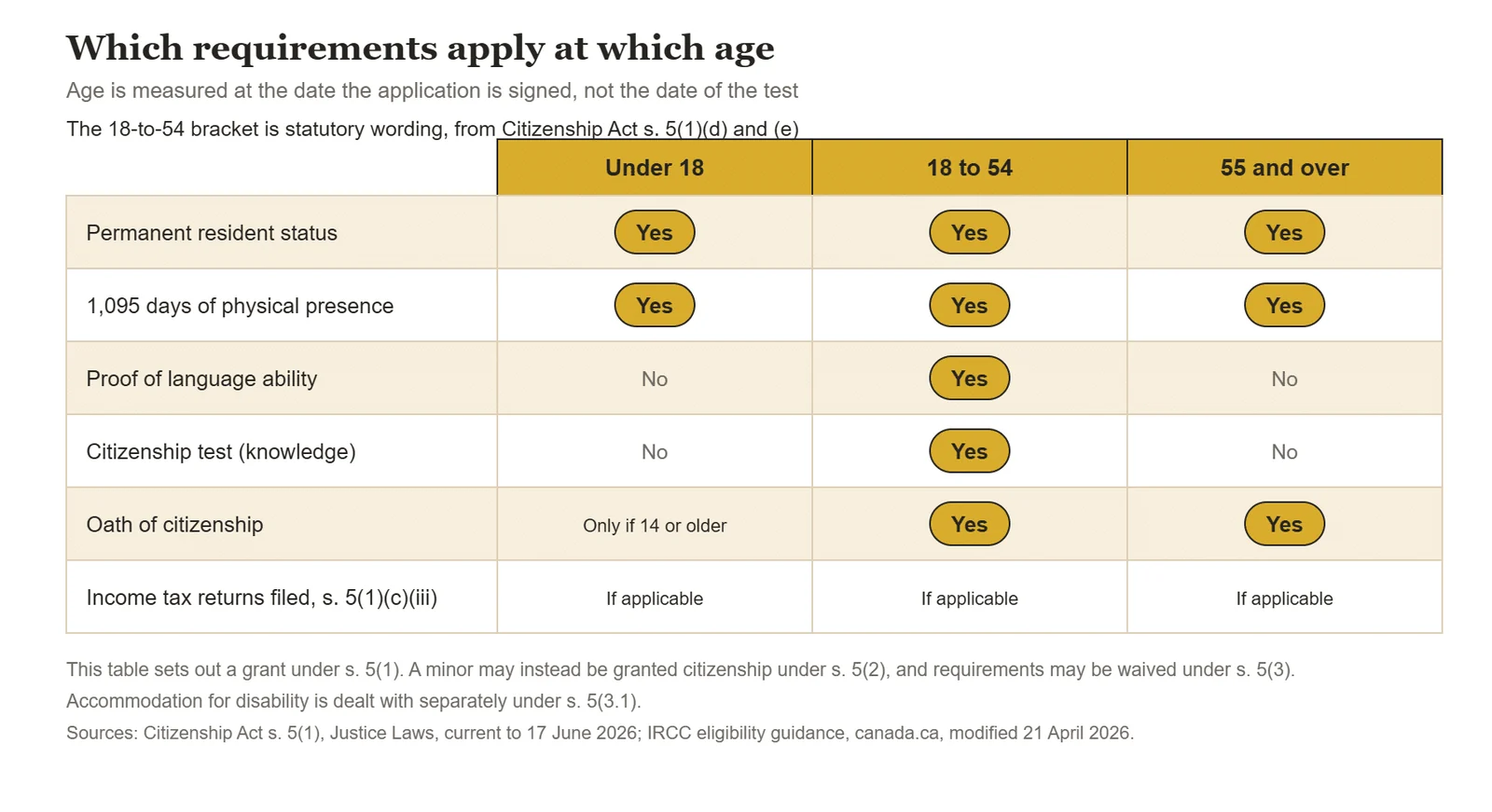
Two distinctions in Figure 2 are worth separating carefully, because they are often merged.
An automatic exemption requires no request. Adults aged 55 and over do not prove language or take the test. Minors under 18 do not either. Minors under 14 do not take the oath.
A waiver must be requested and is granted at the Minister’s discretion on compassionate grounds under subsection 5(3) of the Act. Adults may request a waiver of the language requirement, the test, or the oath, and nothing else. Minors aged 14 to 17 may request a waiver of the oath only. Subsection 5(3.1) separately requires the Minister to consider reasonable accommodation for applicants with a disability, which is a different thing from a waiver: an accommodation is help meeting a requirement, such as a Braille or oral test, while a waiver removes the requirement.
What can make a permanent resident ineligible?
Prohibitions are mostly criminal and security based, and most of them are time limited rather than permanent.
- Serving a term of imprisonment, on parole or on probation in Canada, or serving a sentence outside Canada.
- Being charged with, on trial for, or appealing an offence under the Citizenship Act, an indictable offence in Canada, or an equivalent offence committed abroad.
- Being investigated for, charged with, on trial for, appealing or convicted of a war crime or crime against humanity.
- A citizenship application refused for misrepresentation in the past five years.
- Citizenship revoked for fraud in the past ten years.
- Conviction of an indictable offence in Canada, an offence under the Citizenship Act, or an equivalent offence abroad, in the last four years. This applies even where a pardon or amnesty was granted abroad.
A narrow category is permanent rather than temporary. A person convicted while a permanent resident of terrorism and sentenced to at least five years, or of treason, high treason or spying and sentenced to life, is barred, as is someone who served in an armed force or organised armed group engaged in armed conflict with Canada.
Status problems are separate from criminal ones. Permanent resident status must be valid and not in question, which means no removal order and no unfulfilled landing conditions such as an outstanding medical screening. An expired permanent resident card is not itself a problem: IRCC states that a person may apply with a valid or an expired card. A person under review for immigration or fraud reasons may apply, but the application may be suspended while the review runs.
What does a citizenship application cost in 2026?
IRCC’s published fee list, last modified 2 July 2026, sets these amounts in Canadian dollars:
| Application | Fee (CAD) |
|---|---|
| Adult, 18 and over (processing plus right of citizenship) | 653.00 |
| Minor, under 18 (processing only) | 100.00 |
| Right of citizenship, charged separately | 123.00 |
| Citizenship certificate (proof of citizenship) | 75.00 |
| Resume citizenship, 18 and over | 530.00 |
The adult figure of $653 is a combined amount. Separating the published right of citizenship fee of $123 from it leaves a processing fee of $530, which is a calculation from the two published figures rather than a separately listed number. Fees are stated as of August 2026 and change from time to time, so confirm the current amount on the IRCC fee list before paying.
Processing time is a separate question, and it is one where a fixed number should be treated with suspicion. IRCC publishes a current estimate through its live processing times tool, updates it periodically, and states that the figure is neither a maximum nor a guarantee. Check the tool rather than relying on a number quoted in an article, including this one.
How do these requirements differ from citizenship by descent?
This is the fork that decides which body of law applies, and getting it wrong wastes months.
Everything above concerns a grant of citizenship to someone who is already a permanent resident. It is an application to become a citizen. Citizenship by descent is different: a person born abroad to a Canadian parent may already be a citizen by operation of law, in which case the application is for a citizenship certificate proving a status that already exists, at a fee of $75 rather than $653.
Bill C-3, An Act to amend the Citizenship Act (2025), received royal assent on 20 November 2025 as S.C. 2025, c. 5, and came into force on 15 December 2025. It removed the first-generation limit for many families and introduced a substantial connection test for certain later births abroad. Our guide to what Bill C-3 means for families covers that route, as does our explanation of citizenship by descent beyond the first generation. Anyone told years ago that their family line stopped at the border should read those before assuming the grant route is the only option, and anyone whose status lapsed under older rules should look at restoring lost Canadian citizenship.
Two further points matter for cross-border families. Marriage to a Canadian citizen confers nothing automatically: a spouse must meet the same requirements as any other permanent resident. And Canada permits dual citizenship while other countries do not, so the consequences under the other country’s law need checking before the oath. For Americans weighing the whole picture, our overview of how to get Canadian citizenship from the US sets the routes side by side, and the tax consequences of moving between the two countries run on a separate track from immigration status entirely.
Frequently asked questions
Does time spent outside Canada as a permanent resident count toward the 1,095 days?
No. The test in subparagraph 5(1)(c)(i) is physical presence in Canada, not maintenance of residence or ties. Days abroad are simply not counted, with the narrow exception of Crown servants and their family members, whose days outside Canada count as full days. This differs from the permanent resident residency obligation, which is a separate rule with its own arithmetic and is not what a citizenship officer applies.
Can time as a student or worker before permanent residence count?
Yes, at half value and subject to a cap. Each day in Canada as a temporary resident or protected person during the five-year window counts as 0.5 days, to a maximum credit of 365 days of physical presence. That maximum requires 730 calendar days of such presence inside the window. Time as a temporary resident that falls outside the five-year window is not counted at all, no matter how long it was.
What happens if a permanent resident applies with exactly 1,095 days?
The application can be accepted, but the margin for error is zero. Any day the department counts differently, such as a travel date recorded on a different side of midnight or an unreported short trip, puts the applicant below the threshold. IRCC’s own guidance encourages applying with more than the minimum, and a refusal on this ground means reapplying with a new five-year window measured from the new signature date.
Do both spouses have to apply separately?
Yes. Each applicant is assessed on their own physical presence, tax filing, language ability and prohibitions. Marrying a Canadian citizen does not create citizenship and does not reduce any requirement. Spouses often apply at the same time for convenience, and a minor child with a Canadian parent, or with a parent applying at the same time, applies through the separate minor process.
Is the citizenship test required for an applicant who is 54 at signing but 55 by the test date?
The statute fixes the age at the date of the application. Paragraphs 5(1)(d) and (e) both apply to a person “18 years of age or more but less than 55 years of age at the date of his or her application”, so an applicant who was 54 on the signature date remains subject to the language and knowledge requirements even if a birthday intervenes before the test.
Does an unfiled tax return automatically end a citizenship application?
Not automatically, because the requirement is to have met any applicable filing obligation for three taxation years fully or partially inside the window. If no obligation applied in a given year, there is nothing to have failed. Where an obligation did apply and the return was not filed, the requirement in subparagraph 5(1)(c)(iii) is not met, and the accurate step is to resolve the filing position with the Canada Revenue Agency before applying rather than to answer the application question optimistically.
Can a prohibition be waited out?
Most can. The bars for misrepresentation, revocation and indictable convictions run for five, ten and four years respectively, measured from the relevant date, and the file becomes eligible again once the period passes. The terrorism, treason and armed conflict prohibitions at the serious end are not time limited. Time spent serving a sentence also does not count toward physical presence, so a conviction can push the eligibility date out twice over.
Conclusion
The Canadian citizenship requirements for permanent residents that decide most files are almost never the ones people worry about. The language test and the knowledge test are passable and are waived or exempt for a large share of applicants. What decides most files is the day count: which days fall inside the five-year window, which are worth a full day and which are worth half, and whether at least 730 of them were spent as a permanent resident.
Build that count first, from records rather than memory, before booking a test or paying a fee. Section 5(1) says the Minister shall grant citizenship to a person who meets the conditions, and the work is in demonstrating that the conditions are met.
How Mayo Law Can Help
Mayo Law is a cross-border firm with offices in Toronto and New York. Joseph Mayo, the firm’s principal attorney, is licensed in Ontario and in New York.
Citizenship questions rarely arrive alone. They tend to surface alongside a corporate move, a transfer, or a family’s decision about which side of the border to build on, and the immigration answer often interacts with tax and corporate questions that sit in a different area of law. The firm advises on business immigration for companies and individuals moving between Canada and the United States, and works with clients who need one file handled across both systems rather than split between counsel, which is what having a lawyer licensed in both Ontario and New York is for. If you are working through the Canadian citizenship requirements for permanent residents and are unsure whether your day count qualifies, or which of the citizenship routes applies to your family, a US and Canada immigration lawyer can review the timeline with you.
Disclaimer
This article is provided for general information only. It is not legal advice, and reading it does not create a solicitor-client or attorney-client relationship with Mayo Law. Immigration rules, fees and processing times change. The statutory provisions, requirements and fees described here are stated as of August 2026 based on the sources named, being the Citizenship Act as current to 17 June 2026 and IRCC guidance and fee information published on canada.ca. Anyone relying on these rules for an application should confirm the current position with Immigration, Refugees and Citizenship Canada, and anyone with a specific citizenship or immigration question should obtain advice on their own circumstances.