
Contents
- Introduction
- IP Assignment vs License What's the Difference
- Key Clauses in an IP Assignment Agreement
- Who Owns the IP Employee vs Contractor vs Founder
- Drafting and Negotiating Your Agreement Practical Tips
- Recording Your IP Assignment in the US and Canada
- Frequently Asked Questions
- How Mayo Law Can Help
- Disclaimer
- Related Articles
You hire a developer in New York to build product features for your Toronto startup. You pay every invoice on time. The code ships. Then an investor asks a simple question during diligence: who owns the code?
If your answer is “the company, of course, we paid for it,” you may have a problem. Payment and performance alone do not transfer IP ownership. A properly signed intellectual property assignment agreement is what moves title from the creator to the business. At Mayo Law, we help founders and growing companies in Toronto and across the border handle business risk that touches both Ontario and New York when one missing document can affect financing, M&A, immigration planning, and enforcement later.
The risk gets worse in cross-border startups. Founders often use U.S. templates, Canadian assumptions, or contractor agreements that say “client owns work product” without transferring legal title.
Introduction
The early version of this problem is usually quiet. A founder uses personal code written before incorporation. A friend designs the logo. A U.S. contractor builds the app under a statement of work. Everyone assumes ownership will “sort itself out.”
It usually doesn't. Under the rule summarized by Triumph Law's discussion of IP assignment agreements, IP rights do not transfer by default upon payment or work performance, and courts in major markets including the U.S. and Canada reject the idea that an employment or contractor relationship automatically conveys title.
That's why startups should treat an assignment agreement as a core formation document, not cleanup work. If you need counsel focused on this area, intellectual property counsel should be involved before product launch, not after diligence turns up gaps.
IP Assignment vs License What's the Difference
An IP assignment is a transfer of ownership. An IP license is permission to use the IP under stated terms. If the asset is central to your company's value, an assignment usually makes more sense than a bare license because title stays with the assignor under a license.
| Attribute | IP Assignment (Sale) | IP License (Rental) |
|---|---|---|
| Ownership | Transfers legal title to the assignee | Ownership stays with the licensor |
| Duration | Usually permanent if drafted that way | Limited by term, scope, or termination rights |
| Exclusivity | Assignee becomes owner | Can be exclusive or non-exclusive only as contracted |
| Revocability | Not ordinarily revocable once validly transferred | May end under contract terms |
| Business valuation | Cleaner chain of title for diligence and enforcement | Can leave key assets outside the company |
A lot of template mistakes come from mixing these two concepts. If a contract says the company may “use” the software, artwork, or brand assets, that may create a license, not a transfer. That may be fine for stock photos or third-party SaaS integrations. It is usually not fine for your core product.
If the company needs to sell the asset, enforce it, or prove ownership to investors, use assignment language, not permission language.
Another practical point matters in patent work. The distinction between a present assignment and a mere agreement to assign later affects chain of title. For patent ownership records, present-tense transfer language is the safer drafting choice because it better supports clear title documentation. If your business depends on software commercialization, platform ownership, or a later acquisition, assignment language should align with that reality.
If your deal is intentionally structured as permission rather than transfer, technology licensing counsel can help separate what the company owns from what it only uses.
Key Clauses in an IP Assignment Agreement
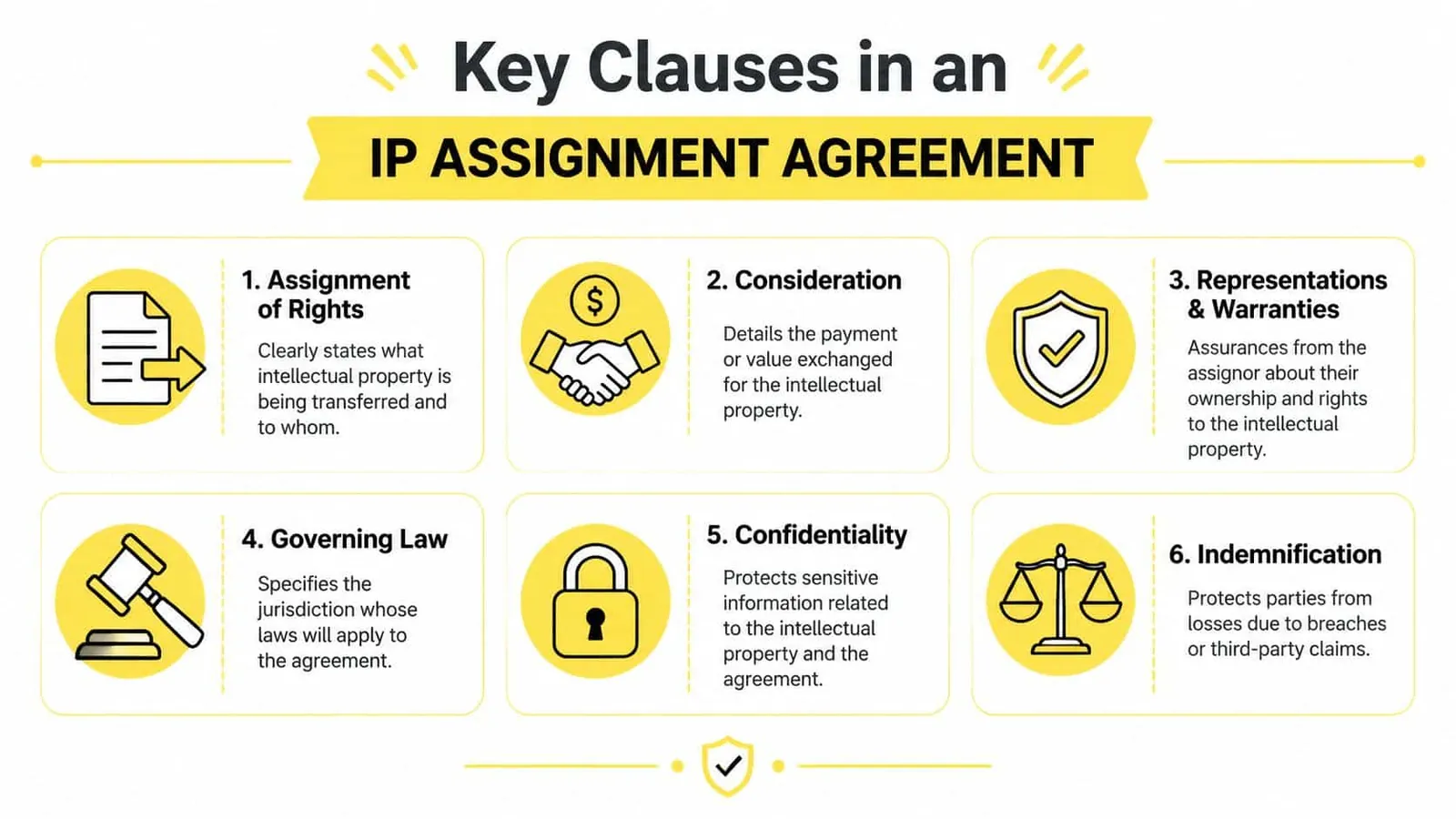
A usable assignment agreement does more than say “assignor transfers IP.” The document has to match the asset, the relationship, and the jurisdictions involved. Bad templates are usually too short, too vague, or too late.
The assignment language
The transfer clause is the center of the deal. It should identify who assigns, who receives, and whether the transfer applies to existing IP, future IP, or both. If future works are involved, the scope has to be stated with precision.
Practical rule: “Will assign” is weaker than “hereby assigns” when the goal is present transfer.
For startups, I generally want the contract to deal with three buckets separately: pre-existing IP, IP created during the relationship, and derivative or improvement work built on company materials.
The assignor hereby assigns to the company all right, title, and interest in the works listed in Schedule A, together with all related intellectual property rights.
Consideration
Every assignment should say what value is being exchanged. In some files, that's cash. In others, it's equity, employment, consulting fees, or a combination. The point isn't just economics. Courts may examine whether there was meaningful consideration, especially when the document is signed after the relationship has already started.
A weak template often skips this or uses generic recitals without tying them to the actual transaction.
In consideration of the compensation paid under the consulting agreement and other good and valuable consideration, receipt of which is acknowledged, the assignor transfers the assigned IP to the assignee.
Specific identification of the IP
Vagueness causes avoidable fights. A sound agreement should attach a schedule or exhibit listing each specific work by title, registration number if applicable, creation date, and current ownership status, rather than generic wording like “all software developed,” as noted in Daeryun's discussion of IP assignment drafting.
That matters even more when the founder created assets before incorporation. Source code repositories, domain names, logos, datasets, pitch decks, and trademark applications should be named, not implied.
- Use titles: Product modules, design files, and brand assets should be individually listed.
- Add dates: Creation dates help separate pre-formation IP from later company work.
- Note ownership status: Identify whether the item is personally owned, jointly created, or already registered.
- Define future scope carefully: If future works are included, say exactly which works and during what period.
Representations and warranties
The assignor confirms they own what they're transferring and that no third-party rights block the transfer. This confirmation proves especially important in contractor chains and founder transitions, where prior employers, open-source use, or side collaborators may create competing claims.
The assignor represents that they own the assigned IP, have authority to transfer it, and have not granted rights inconsistent with this assignment.
Without these statements, you may still have a contract, but you've lost one of the best early tools for flushing out hidden risk.
Moral rights waiver
In Canada and parts of Europe, moral rights can survive even where economic rights are transferred. That can limit editing, attribution decisions, or later commercial use unless the agreement handles it properly. According to Ironclad's summary of IP assignment clauses, the agreement should include a moral rights waiver so the assignee has full commercial control where those rights may otherwise persist.
This clause matters more than founders often realize. If your company plans to rebrand, modify creative works, localize content, or use designs in a different context, a waiver can prevent later objections.
To the extent permitted by law, the assignor waives and agrees not to assert any moral rights in the assigned works.
Further assurances and power of attorney
People disappear. Contractors change emails. Founders leave on bad terms. Registered filings still need signatures months later. That's why the same source emphasizes a further assurances clause and, where appropriate, a power of attorney mechanism to let the assignee complete follow-up steps if the assignor stops cooperating.
The assignor will execute further documents reasonably requested to confirm or perfect the transfer, and appoints the assignee as attorney-in-fact for that limited purpose if the assignor fails to do so.
Governing law and dispute mechanics
Cross-border deals often fail here because the parties focus only on ownership language. You still need to say which law governs, where disputes will be heard, and whether urgent injunctive relief is available. A Toronto startup using a New York contractor agreement without thinking through forum and enforcement can create cost before the merits are even reached.
Who Owns the IP Employee vs Contractor vs Founder
Default ownership depends on the relationship. That's where many founders get trapped. They assume “we hired them” answers the ownership question. It doesn't.

Employees
Employees create the most confusion because founders hear shorthand like “work for hire” and assume the company automatically owns everything. In practice, that assumption is too broad. Employment status helps, but a written inventions and assignment clause is still the safer route, especially where Canadian provincial law and U.S. state law handle edge cases differently.
Cross-border payroll, remote work, and founder-employees make this harder. Someone may be employed by a Canadian affiliate while building product for a U.S. parent. If the documents don't match the corporate structure, chain of title can split.
Independent contractors
Contractors are where the cleanest misconception lives. Under U.S. copyright law, independent contractors retain ownership unless a written assignment is executed, and a software development agreement without an explicit IP assignment clause does not transfer title, as explained in Chaindoc's discussion of developer IP assignments.
If you hired a freelance developer, designer, or branding consultant, check the actual wording. “Client owns deliverables” may sound fine, but if the assignment language is missing or weak, diligence may still flag it.
A common scenario looks like this: a startup pays a contractor to build an MVP, then raises money based on that MVP. During diligence, counsel asks for signed assignments from every contributor. One missing signature can delay the round while everyone scrambles to locate someone who moved on years ago.
Founders
This is the most neglected category. A founder often starts building before the company exists. They register the domain personally, code the first version at home, create the logo, and file early materials under their own name. When the company is incorporated, they assume those assets “become company property.” They don't unless transferred.
That is the chain of title gap. According to Steingard Financial's discussion of founder IP assignments, 70% of startup due diligence failures stem from missing founder IP assignments. That problem often appears in U.S.-Canada deals where founders rely on assumptions from one side of the border that don't hold on the other.
Mayo Law works with founders and companies across the GTA and on cross-border matters. Joseph Mayo is licensed in Ontario and New York, so clients with U.S. ties coordinate their legal work in one place rather than juggling two firms.
A co-founder dispute can make this issue expensive fast. If one founder leaves and still personally owns pre-incorporation code or branding, the company may face a hold-up at the exact moment it needs clean title for funding, licensing, or sale. The same practical discipline that helps with equity disputes also helps here. Founder vesting planning and founder IP assignments should usually be handled together.
Drafting and Negotiating Your Agreement Practical Tips
Most assignment disputes aren't caused by exotic law. They come from rushed drafting and bad intake. A practical review catches most of them early.
Be specific from day one
Use schedules and exhibits. If the agreement covers existing assets, list them. If it covers future works, define the scope precisely. Generic phrases create room for later arguments about whether a specific repository, brand asset, or design file was included.
Sign before work starts
The worst time to negotiate ownership is after value has already been created. Once a contractor has built something useful, or a founder relationship sours, bargaining power changes. Cleanup work costs more because the legal issue has become a commercial advantage.
If the signature comes after launch, ask what happened to every asset created before that date.
Match the paper to the jurisdiction
A U.S. form may ignore Canadian moral rights issues. A Canadian form may not deal cleanly with U.S. patent assignment wording. Cross-border deals need matching definitions, governing law, and execution steps. They also need practical coordination with immigration and compliance files if the same people are crossing the border for work.
Check authority and chain
Don't just verify the signer. Verify whether they own the IP being assigned. That means asking about prior employers, side projects, co-authors, inherited repositories, and third-party materials. A clean signature from the wrong owner solves nothing.
Don't hide assignment language in an invoice
An invoice note or purchase order reference is a poor substitute for a full assignment. It usually won't address representations, future works, moral rights, further assurances, or pre-existing materials. If you're negotiating the main agreement anyway, that's where ownership should be nailed down. For higher-value deals, contract negotiation support can save a much bigger repair bill later.
Recording Your IP Assignment in the US and Canada
A founder signs a clean assignment the night before diligence. The problem shows up the next morning. The company's internal file says one thing, the public register says another, and no one can clearly explain who owned the code, patent rights, or marks before the company existed. That gap is where deals slow down.
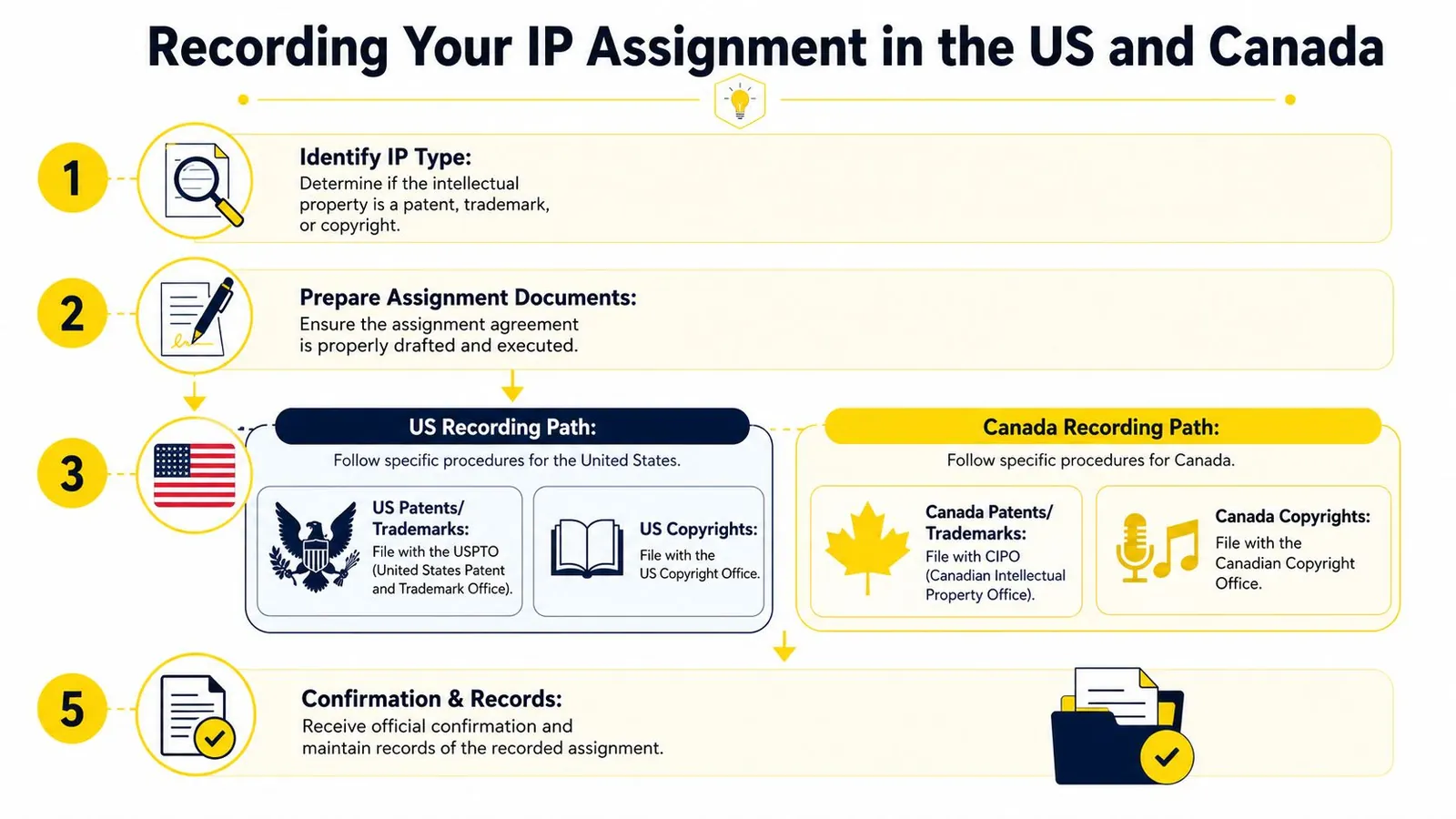
Signing and recording do different jobs. The agreement transfers rights between the parties if it is drafted and signed properly. Recording helps prove chain of title to investors, buyers, lenders, and courts. In a US-Canada structure, that record also needs to match the actual corporate path of ownership, especially where founders built the IP before incorporation and later moved it into a Canadian corporation, a Delaware parent, or both.
United States filings
For U.S. patents and trademarks, recording is handled through the USPTO assignment recordation system. For U.S. copyrights, recordation issues run through the U.S. Copyright Office.
The practical issue is usually not whether a filing system exists. It is whether the assignment being recorded matches the company's real history. If a founder created the asset before the company was formed, the record should show that founder-to-company transfer clearly. If a Canadian founder first assigned to a Canadian corporation and the business later inserted a U.S. parent, the paperwork should reflect each step. Diligence teams often spot the missing middle link.
Canada filings
In Canada, recordation issues typically run through the Canadian Intellectual Property Office. For copyright-related government information, review the relevant federal materials through Government of Canada copyright resources.
Cross-border startups often miss a simple point here. The registered owner, the signing entity, and the entity shown in financing documents should line up. If they do not, you get avoidable questions about beneficial ownership, tax treatment, licensing flows, and enforcement standing. Those questions are much harder to answer after a financing process has started.
Do I need to notarize my IP assignment
For validity, U.S. federal law generally requires written assignments for patents and copyrights, but notarization is usually not required. The harder question is acceptance by third parties.
A valid assignment can still cause delay if the document will be used outside the core IP filing itself, such as corporate record updates, cross-border evidence packages, apostille or authentication steps, or immigration-related support files tied to the same founder or executive. In Canada, practice can also vary by province and by the institution reviewing the document. I usually tell founders to decide early whether the assignment may need to travel, not just whether it is enforceable at home.
Validity answers whether the assignment works between the parties. Acceptance answers whether another authority will accept the document without objection.
If the file may be used across borders, plan the signing format, witness requirements, and authentication path before signatures are collected. Document authentication services for cross-border legal filings can help when a valid assignment also needs to be accepted by other authorities.
Frequently Asked Questions
How much does an IP assignment agreement cost?
Cost follows risk. A short founder assignment signed at incorporation is usually inexpensive. A cleanup exercise involving pre-formation code, side projects, Canadian and U.S. entities, and missing contractor paperwork costs much more because counsel has to rebuild the chain of title, not just draft a document.
For startups, the fundamental cost question is timing. Fixing ownership before a financing or acquisition is routine. Fixing it after diligence has started is slower, more expensive, and more likely to expose gaps you cannot paper over quickly.
What happens if we never signed an IP assignment agreement?
Then ownership may sit with the individual who created the work, not the company using it.
That problem is common with founders. A company may have been formed after the product was designed, the first code repository opened, the domain registered, or the patent concept developed. In a U.S.-Canada startup, that gap often gets missed because everyone assumes the founders "obviously meant" for the company to own the IP. Diligence does not run on assumptions. Buyers and investors look for signed documents showing each transfer from the creator to the correct entity, in the correct order.
The fix may involve a present assignment, a confirmation of prior transfer, board approvals, and supporting records that tie the asset back to the original creator and creation date. If a founder or contractor is unavailable, refuses to cooperate, or has assigned rights elsewhere, the issue can delay financing, reduce valuation, or block enforcement.
Are there tax implications for assigning IP?
Yes. Tax treatment depends on where the parties are, what kind of IP is being transferred, whether the transfer is between related parties, and how payment is structured.
For U.S. and Canadian companies, the main practical point is simple. Do not treat tax as an afterthought. An assignment can trigger income recognition, transfer-pricing questions, withholding issues, sales tax concerns, or a valuation dispute if the asset moves across the border or between founder and company. The agreement should state the consideration clearly, and tax advice should match the legal papering before signatures are collected.
Can an IP assignment be part of an employment contract?
Yes, and that is often the cleanest approach if it is drafted properly.
The contract should say what is assigned, when the assignment takes effect, and whether prior inventions are excluded. That last point matters in founder-led companies because early employees often bring code libraries, know-how, or prototype materials from earlier work. If those items are not listed and carved out with care, the company may assume it owns more than it does, or the employee may later claim the company took rights it never paid for.
How do you enforce an IP assignment agreement?
Enforcement starts with paper, dates, and signatures. If those are weak, the legal claim is weaker than many founders expect.
A company may seek an order requiring signature of confirmatory documents, a declaration of ownership, damages, or other contractual remedies. Governing law and forum matter, especially if the assignor is in Canada and the operating company, investors, or IP filings are in the U.S., or the reverse. Cross-border enforcement gets harder when the agreement is vague about the asset being transferred, the timing of the transfer, or the party that owned the IP at the time.
Clear schedules help. So do further-assurances clauses, moral rights waivers where permitted, and records showing who created the asset and under what relationship. In practice, the best enforcement strategy is prevention. Signed assignments at the right time are far cheaper than litigating ownership later.
If your startup is expanding between Canada and the U.S., an IP assignment should not be treated as a formality. Mayo Law advises founders, SMEs, and cross-border businesses on ownership chains, contract drafting, notarization needs, and related business risk before those issues surface in diligence or dispute.
How Mayo Law Can Help
Mayo Law serves clients across Toronto, the GTA, and on cross-border matters. When a founder, employee, or contractor relationship leaves ownership unclear, the firm helps structure and document the transfer so the company can move forward with cleaner title and fewer diligence problems. To discuss your matter, visit international business counsel.
Disclaimer
This article is for informational purposes only and does not constitute legal advice. Every situation is different. Consult a licensed lawyer about your specific circumstances. Mayo Law provides legal services in Ontario and New York.