Published: June 23, 2026
Updated: June 23, 2026
Read time: 11 minutes
You read a headline about a major court ruling that could affect your contracts, privacy program, hiring model, or regulatory exposure. The article focuses on who won. What often matters just as much for future planning is the losing opinion. If a respected judge writes a forceful disagreement, that can signal where the law may be contested next.
That is why a clear dissenting opinion definition matters to business leaders, not just litigators or law professors. A dissent can mark a pressure point in the law long before the pressure shows up in your next dispute, audit, financing round, or board memo.
At Mayo Law, we help businesses in Toronto, the GTA, and across the border manage evolving legal frameworks, with experience licensed in both Ontario and New York on processes that often span both sides of the border. Understanding concepts like dissenting opinions is key to proactive risk management, especially in regulatory compliance.
What Is a Dissenting Opinion?
A dissenting opinion is a written opinion by one or more judges expressing disagreement with the majority opinion of the court that gives rise to its judgment. It explains why the dissenting judge believes the result or reasoning is legally or factually wrong, often through a different reading of statutes, constitutional text, or prior case law, as described in Wikipedia's overview of dissenting opinions.
A business client should think of a dissent as the part of the judgment that says, “the court decided this case one way, but there is a serious competing view on the record.” That competing view is not binding law. It can still matter a great deal.
| Opinion Type | Who Writes It | Purpose | Legal Effect |
|---|---|---|---|
| Majority | The judges who form the controlling bloc | States the court’s ruling and core reasoning | Binding precedent within the relevant court structure |
| Concurring | A judge who agrees with the outcome, but not fully with the reasoning | Adds a different path to the same result | Usually not binding on its own, but may be persuasive |
| Dissenting | A judge who disagrees with the outcome or core reasoning | Records why the majority got it wrong | Not binding, but can be influential in later cases |
In practice, lawyers don't read only the majority. They also read the concurrence and the dissent to understand how stable the result really is. That becomes especially important in contract drafting, appellate strategy, and forum planning, including questions around a forum selection clause.
A dissent doesn't change today's outcome. It can change tomorrow's litigation posture.
The Anatomy of a Judicial Ruling
A court decision is often treated as if it speaks with one voice. Sometimes it does. Often it doesn't. For practical legal analysis, you need to separate the ruling into its moving parts.
The majority is the rulebook
The majority opinion is the part that controls. If you're advising a board, revising a compliance policy, or assessing deal risk, the majority tells you what the law is for now.
But even here, business readers need to be careful. The controlling rule may be narrower than the headlines suggest. A majority can win on technical grounds, leave key questions open, or avoid broader issues the dissent addresses directly.
The concurrence is the yes but
A concurring opinion agrees with the result but not entirely with the route taken to get there. Concurring judges often say, in effect, “I agree we end up here, but I would reason differently.”
That matters because future courts may prefer the concurrence's logic. If the majority is narrow and the concurrence is cleaner or more commercially workable, litigants may build later arguments around it.
The dissent is the protest memo
A dissenting opinion is the formal protest memo. It identifies what the dissenting judge sees as the majority's error. Sometimes that error is about text. Sometimes it is about precedent. Sometimes it is about practical consequences the majority underestimates.
For business planning, dissents are useful because they expose fault lines. They tell you where judges disagree over how a statute, a regulation, or a contractual doctrine should operate in real life.
Practical rule: If your industry depends on long-term regulatory stability, read the dissent before assuming the issue is settled.
Why courts moved toward a single voice
The structure of appellate opinions changed over time. According to the Supreme Court Historical Society's account of early Court practice, the U.S. Supreme Court originally followed the English seriatim model, where each justice wrote separately. Under Chief Justice John Marshall, from 1801 to 1835, the Court shifted toward a unified majority opinion to strengthen institutional unity. In the pre-Marshall period, up to half of decisions contained multiple opinions.
That history matters because it shows dissent is not just a stylistic choice. It reflects how openly a court displays disagreement. A unified opinion projects certainty. Separate writings reveal strain.
For companies dealing with litigation exposure, that distinction can affect how aggressively to rely on a case. The more fractured the decision, the less confidence you should place in a broad reading of it. That issue often appears again when parties seek post-judgment relief or try to reopen parts of a case under doctrines lawyers analyze in contexts such as Federal Rule of Civil Procedure 60(b).
What Is the Legal Weight of a Dissenting Opinion?
A dissenting opinion is not binding precedent. If the majority says your arbitration clause is enforceable, or your statutory interpretation loses, the dissent does not reverse that result.
That said, treating a dissent as irrelevant is a mistake. In practice, dissents often carry persuasive weight. They give later litigants a developed argument for why the majority rule should be limited, distinguished, or eventually overturned.
Why lawyers still care about a losing opinion
A good dissent does three things that matter in later disputes:
- It identifies vulnerability: The dissent pinpoints the weak parts of the majority's reasoning.
- It preserves an alternative framework: Future courts don't have to build a new argument from scratch.
- It signals instability: A split court tells everyone that the issue is contested.
According to Study.com's summary of court opinion types, empirical studies of U.S. federal courts show that the presence of a dissent correlates with a higher likelihood of rehearing en banc or Supreme Court review. For a business client, that means a dissent can be a clue that the current rule may face renewed challenge.
What works and what doesn't
What works is using a dissent as a risk indicator. If you are entering a long-term technology licensing deal, launching a regulated product, or choosing a dispute forum, a strong dissent may justify more conservative drafting.
What doesn't work is acting as if the dissent already states the law. Courts and regulators still apply the majority rule unless and until it changes.
If you cite a dissent in a board memo, frame it as a signal of legal pressure, not as a substitute for precedent.
This distinction often matters in dispute resolution strategy. A dissent may affect how parties evaluate appeal risk, enforcement risk, or the durability of a ruling in later proceedings, including where parties compare court litigation with arbitration in Canada and cross-border enforcement.
How Businesses Use Dissents for Strategic Forecasting
For discerning companies, dissents are not academic side notes. They are part of legal forecasting. They help management assess where current law may fray under commercial pressure.
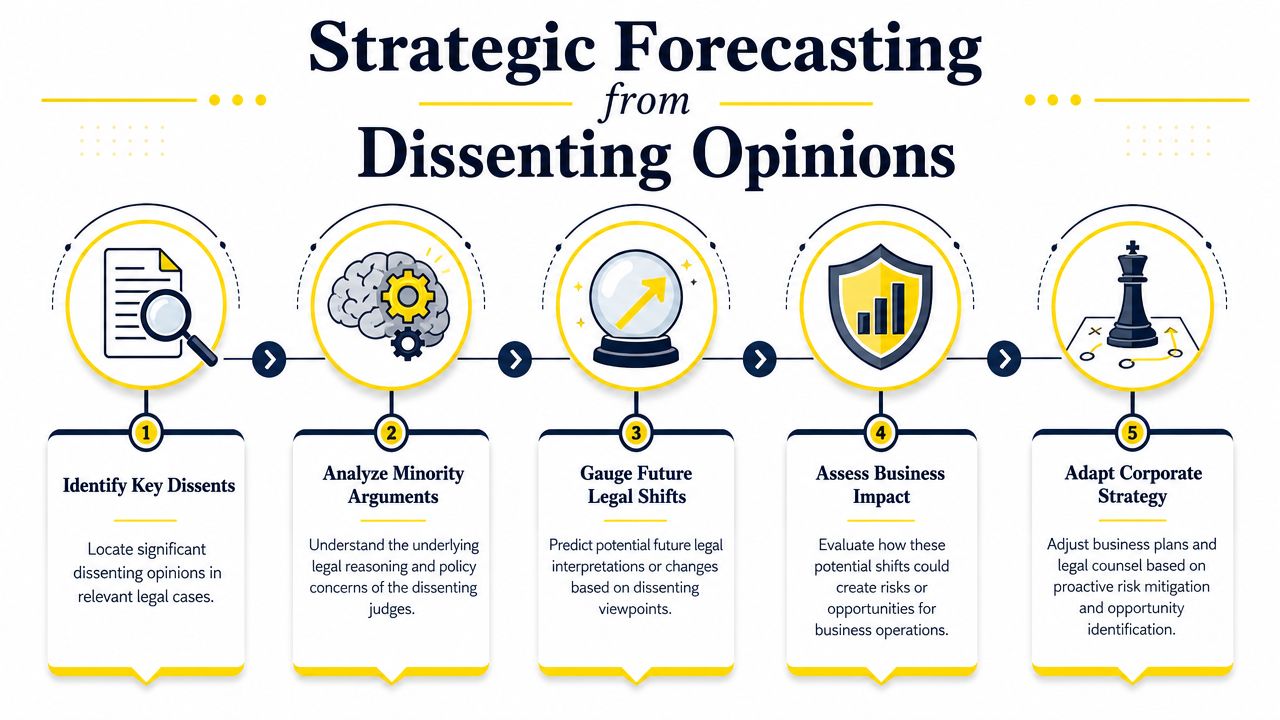
A dissent can function as an early warning system
If a dissent attacks the majority's reading of a privacy statute, securities rule, employment test, or administrative power, it may preview the next round of litigation. This is especially important when your business model relies on repeatability across jurisdictions.
The comparative angle matters. As Cornell Wex notes on dissenting opinions, for cross-border businesses, dissents in one country can signal future divergence in apparently harmonized areas such as securities regulation or data privacy. That is the part many standard definitions miss.
Where this shows up in real business decisions
An in-house team or outside counsel may use dissents when deciding:
- Contract duration: Long contracts are more exposed to doctrinal change.
- Forum selection: A jurisdiction with active disagreement may create more appeal risk.
- Compliance investment: If the law is unstable, front-loading compliance may be cheaper than defending later.
- Disclosure: Public companies and investors may need to describe uncertainty carefully.
- Board reporting: Directors should understand where legal certainty is only partial.
Scenario one
A Toronto software company licenses analytics tools to U.S. customers and stores some data in both countries. It reads a U.S. appellate decision that favors a narrower view of privacy liability. The majority helps in the short term. The dissent argues that the majority undervalues statutory purpose and modern data practices.
For the business, the wrong response is to treat the case as a green light. The better response is to ask whether the dissent could gain traction with another panel, a higher court, or a Canadian regulator looking at similar issues through a different statutory lens. That may justify revising retention practices now rather than after an investigation begins.
Scenario two
A manufacturing group structures a distribution relationship around a favorable ruling on contractual interpretation. The dissent focuses on unequal bargaining power and commercial unfairness. That language may not control the case, but it can still shape how future courts react to similar clauses, especially if facts later look more one-sided.
In practice, legal review becomes strategic forecasting. You are not asking only, “Did we win this issue today?” You are asking, “How durable is this position if markets, facts, or judges shift?”
Strong dissents often become the language later litigants use when they ask a court to move the law.
Mayo Law works with client businesses across the GTA and on cross-border matters. Joseph Mayo is licensed in Ontario and New York, so clients with U.S. ties coordinate their legal work in one place rather than juggling two firms. That matters when legal risk is tied not just to one judgment, but to how a U.S. dissent may affect future Canadian analysis, or the reverse.
A practical review method
When advising on a major decision with cross-border impact, a disciplined review usually looks like this:
- Read the holding carefully and isolate the exact legal rule.
- Read the dissent for fault lines, not rhetoric.
- Check the business horizon. A short campaign and a ten-year investment need different tolerance levels.
- Map the issue across jurisdictions. A U.S. win may not travel cleanly into Canada.
- Adjust contracts, policies, and disclosure before a new challenge turns theory into cost.
This same forecasting mindset also overlaps with broader reputational risk management, because legal instability often becomes public-facing before it becomes final.
Notable Dissents That Shaped the Law
The fastest way to understand why dissents matter is to look at the ones that outlived the majority.
Harlan in Plessy
Justice John Marshall Harlan's dissent in Plessy v. Ferguson rejected the logic of racial segregation. At the time, it lost. Later, the moral and legal force of Harlan's reasoning became central to how lawyers and judges understood the constitutional failure of “separate but equal.”
For business readers, the point is simple. The dissent preserved an argument that the majority could not bury permanently.
Ginsburg in Ledbetter
Justice Ruth Bader Ginsburg's dissent in Ledbetter v. Goodyear Tire & Rubber Co. criticized the majority's approach to pay discrimination timing rules. Her dissent did not itself change the law, but it sharpened the policy and statutory problem in a way lawmakers could act on. That is a concrete example of a dissent influencing change outside the courtroom as well as inside it.
Why these examples matter to companies
These examples are not useful because every dissent becomes law. Most do not. They are useful because they show how dissents can:
- Preserve a future theory
- Influence legislators and regulators
- Reframe public and judicial debate
- Change how risk should be priced today
A board does not need to become a constitutional historian. It does need to understand that a carefully reasoned dissent may become tomorrow's majority argument, tomorrow's legislation, or tomorrow's enforcement posture.
You don't monitor dissents because they always win later. You monitor them because they sometimes do, and the cost of ignoring the right one can be high.
How to Find and Cite Dissenting Opinions
You don't need a law degree to locate a dissent. You do need to read the full judgment, not a news summary.
Where to look
For U.S. Supreme Court decisions, the Court publishes opinions on the Supreme Court of the United States website. For Canadian cases, courts and legal databases such as CanLII commonly publish the full reasons, including separate opinions. The Supreme Court of Canada also publishes judgments on the Supreme Court of Canada website.
When you open a case, look for labels such as “majority,” “concurring,” “dissenting,” or “concurring in part and dissenting in part.” Those labels matter because a judge may agree with one issue and disagree with another.
How lawyers cite them
In ordinary legal writing, a dissent is identified by the judge and the status of the opinion. You may see a reference such as “Smith J., dissenting” or “Brown J., concurring in part and dissenting in part.”
For business use, the safest approach is not to cite a dissent casually in commercial materials. Use it in internal legal analysis, risk memos, and strategy papers with a clear note that it is non-binding but potentially persuasive.
A good habit is to save the full decision with all opinions attached. That is the same discipline companies should use with cross-border corporate records and legalization chains, where document integrity matters from the start, much like it does in processes discussed in getting an apostille in New York.
Frequently Asked Questions
How many judges are needed for a dissenting opinion?
A dissent can be written by one judge or by more than one judge who disagrees with the majority. The key point is not the number by itself, but whether the dissent exposes a serious disagreement over reasoning, statutory interpretation, or case outcome. Even a lone dissent can become influential later.
Can a judge both concur and dissent in the same case?
Yes. A judge can agree with part of the result and disagree with another part. You will often see this described as “concurring in part and dissenting in part.” For business readers, that usually means the decision is more fractured than the headline suggests, so the rule may be narrower or less stable than it first appears.
How often do dissents appear in modern Supreme Court cases?
Dissents are far more common than they once were. According to EBSCO's research starter on dissents and the Supreme Court, dissenting opinions appeared in roughly 20 to 30 percent of U.S. Supreme Court cases in the early twentieth century and in over 60 to 70 percent of many recent terms. That makes dissent a regular structural feature of appellate law, not a rarity.
Does a dissent matter if my company is not in court?
Yes. A dissent can still affect transaction planning, compliance budgeting, contract drafting, and board reporting. If your company operates in an area where courts, agencies, and counterparties are testing the edges of the law, a dissent can signal where legal assumptions deserve a second look before a dispute arises.
Are dissents used the same way in the United States and Canada?
Not exactly. In both systems, dissents are non-binding. In cross-border work, however, the practical question is how a dissent may influence future judicial or regulatory interpretation in the other country. That is especially relevant where legal regimes appear aligned on paper but may diverge in application over time.
Conclusion
If you are making decisions on the assumption that only the majority matters, you are missing part of the legal picture. A dissenting opinion does not control the case today, but it can reveal where the law is weak, where appeals may develop, and where future change may come from. For companies operating between the United States and Canada, that makes dissent part of risk planning, not just legal theory.
If a court decision affects your contracts, compliance program, expansion plans, or dispute strategy, Mayo Law can help you assess not just the holding, but the practical cross-border risk behind it. For businesses operating between Canada and the United States, that often means reviewing how legal uncertainty in one jurisdiction may affect operations in the other. To discuss your situation, visit Mayo Law.
How Mayo Law Can Help
Cross-border businesses often need more than a case summary. They need advice on how a contested ruling could affect contracts, compliance design, regulatory exposure, or dispute planning in both countries. Mayo Law serves clients across Toronto, the GTA, and on cross-border matters. To discuss your matter, visit international business counsel.
Disclaimer
This article is for informational purposes only and does not constitute legal advice. Every situation is different. Consult a licensed lawyer about your specific circumstances. Mayo Law provides legal services through Mayo Law PC in Ontario and Joseph Mayo PLLC in New York.
Related Articles
- International business legal services
- Regulatory compliance legal services
- White collar legal services