If you’re considering EB-5 now, you are not entering the same program investors discussed a few years ago. The rules, filing posture, and risk profile changed after the 2022 reforms. For Canadian investors and business owners, the process can get more complex because immigration strategy, source-of-funds evidence, and cross-border structuring intersect.
At Mayo Law, we work on cross-border U.S. and Canadian matters involving business immigration, compliance, and documentation issues that discerning investors care about before they wire funds. An eb-5 immigration attorney should do more than prepare forms. The right counsel helps you test the project, pressure-test your source-of-funds story, and identify issues early enough to fix them before USCIS does it for you in an RFE or denial.
Understanding the Modern EB-5 Environment After the RIA
A Canadian investor agrees to subscribe to a Regional Center project, wires funds, and assumes the legal work is mostly paperwork. A few months later, USCIS questions the source trail, the project file does not line up cleanly with the offering documents, and timing assumptions around U.S. residence no longer hold. Post-RIA EB-5 cases turn on preparation early, not damage control later.
The EB-5 Reform and Integrity Act of 2022 changed the operating environment for investors, especially in Regional Center filings on Form I-526E. For Canadian applicants, the change is more than procedural. It affects how counsel should review cross-border funds movement, business sale proceeds, tax records, gifts, and corporate distributions before the petition is filed.

What changed in real terms
Post-RIA filings have generally performed better than many legacy-era cases, as noted in Wolfsdorf’s discussion of post-RIA EB-5 outcomes and RIA thresholds. The practical takeaway is narrower than the headline. USCIS is not being lenient. The current framework rewards petitions that match the revised compliance structure and punishes gaps more predictably.
That matters for investors who are comparing projects on speed, pricing, and immigration reliability. A cleaner statutory framework helps, but it does not cure weak documentation or poor project selection.
Why the RIA changed outcomes
The RIA imposed tighter controls on Regional Centers, project reporting, fund administration, and investor protection. Those changes affect the petition record from the start.
A serious investor should understand four points:
- Regional Center investors file Form I-526E. The petition has its own structure and requires a record that fits the post-2022 model.
- Investment thresholds still drive case design. TEA qualification changes the required capital amount, so counsel should confirm whether the project’s TEA claim is supportable before funds are committed.
- Priority treatment can shape project choice. Rural and certain high-unemployment TEA cases may offer strategic advantages, but faster adjudication does not fix a weak source-of-funds file or a poorly documented project.
- Compliance review is front and center. USCIS now expects tighter alignment across the private placement memorandum, business plan, economic analysis, subscription package, and investor funds path.
For Canadian investors, source-of-funds analysis often requires a cross-border lens. I regularly see issues around retained earnings from owner-managed businesses, intercompany transfers, trust distributions, and gifts from family members in Canada that were documented adequately for tax or banking purposes, but not for U.S. immigration review. Those are fixable problems if addressed before filing. They become expensive problems once USCIS asks the questions.
Practical rule: A strong EB-5 case is a compliance file first and an immigration petition second.
What an investor should take from this
Higher approval trends should not create false comfort. EB-5 remains a regulated investment process tied to immigration eligibility, job creation methodology, and document consistency. Investors who focus only on the project brochure or the promised timeline miss where many cases fail.
Counsel should review the immigration file and the transaction around it. That means examining the offering set, testing whether the source-of-funds narrative will survive scrutiny, and coordinating the U.S. and Canadian record where needed. Our cross-border business immigration practice is built around that kind of review for clients with assets, entities, and tax history on both sides of the border.
If you are still deciding between investor categories, this comparison of E-2 visa vs. EB-5 visa options may help frame the business and residency trade-offs.
Vetting Criteria for Your EB-5 Immigration Attorney
Choosing an eb-5 immigration attorney is a procurement decision. Treat it that way. Credentials matter, but the better question is whether the attorney can manage the exact failure points that sink petitions.
Look for post-RIA experience, not just EB-5 history
Experience in old EB-5 practice is useful, but it is not enough by itself. You want to hear how the attorney handles post-March 2022 Regional Center filings, not whether they “do EB-5.”
The strongest practitioners in the market are often recognized for deep specialization. The 2025 EB5 Investors Magazine Top 25 list includes attorneys with 17 to 33 years of experience, and the same source notes 97 percent approval rates for post-RIA petitions handled by experienced counsel (EB5 Investors Magazine Top 25 immigration attorneys).
That does not mean you should hire based on awards. It means specialization in this field is often visible.
What to test in the interview
Ask for specifics about the attorney’s workflow, not marketing language. Useful screening points include:
- RIA fluency: Can they explain the filing logic of I-526E without speaking in generalities?
- I-829 experience: Do they understand removal of conditions and job creation proof at the back end?
- Source-of-funds depth: Can they handle proceeds from business ownership, gifts, loans, retained earnings, or multi-jurisdiction transfers?
- Team structure: Who drafts, who reviews, and who answers when documents from your accountant or bank raise questions?
- Cross-discipline coordination: How do they work with securities counsel, economists, and tax advisors?
What works and what doesn’t
A strong EB-5 attorney speaks in records, timelines, dependencies, and documentary standards. A weak one often speaks in broad confidence.
| What to look for | What should concern you |
|---|---|
| Clear explanation of document strategy | Vague statements that “USCIS accepts this” |
| Comfort with complex fund tracing | Assumption that a bank letter alone is enough |
| Willingness to discuss project red flags | Overfocus on filing speed |
| Defined coordination with other advisors | No process for economist or securities review |
The right attorney does not ask where the money is now. They ask where it started, how it moved, who documented it, and whether every step can be proved cleanly.
If you are evaluating broader investor and founder options at the same time, this overview of business immigration pathways helps put EB-5 in context.
Key Questions to Ask During Your Consultation
Most consultations fail because the investor asks for a price before asking about process. Fees matter, but poor scope is often more expensive than a higher fee.
Questions that reveal real capability
Start with questions that force the attorney to explain how they think:
-
How do you structure an I-526E case from intake to filing?
You want to hear a sequence, not a slogan. -
What documents do you request first for source of funds?
This shows whether the attorney knows how to build the file backward from the original source. -
How do you review a Regional Center project for immigration risk?
A credible answer should mention the business plan, economic analysis, offering materials, and consistency across the record. -
How do you handle RFEs?
The answer should sound disciplined. Not defensive.
Questions that fit a Canadian investor profile
Generic consultation checklists miss the cross-border details. If your funds or records are tied to Canada, ask more pointed questions:
- How do you document funds coming from a Canadian corporation or privately held business?
- How do you handle records issued in Ontario when USCIS wants a clean, traceable chain of evidence?
- What issues do you watch for when a client has prior U.S. visa refusals or travel complications?
- How do you coordinate notarization, sworn statements, and related document formalities across borders?
Questions about scope and communication
Regarding scope and communication, expectations either become clear or become a future problem.
Ask who you will hear from after engagement. If the answer is unclear in the consultation, it often stays unclear after you pay.
Use a short checklist:
- Scope of work: Does the fee include source-of-funds review, project document review, and RFE response?
- Communication rhythm: Do they schedule milestone updates, or do you need to chase them?
- Escalation path: If a tax, securities, or admissibility issue appears, who handles it?
- Parallel planning: If EB-5 is not the best immediate fit, can they discuss related investor options?
Some investors also compare EB-5 preparation standards with what they already know from treaty investor filings. This guide to E-2 visa business plan requirements is useful because it highlights how business documentation quality often shapes immigration outcomes across categories.
Navigating Project Due Diligence and Common Risks
Your attorney's job is not to sell you a project. It is to help you identify where immigration risk sits inside the project record and where financial risk sits outside it.
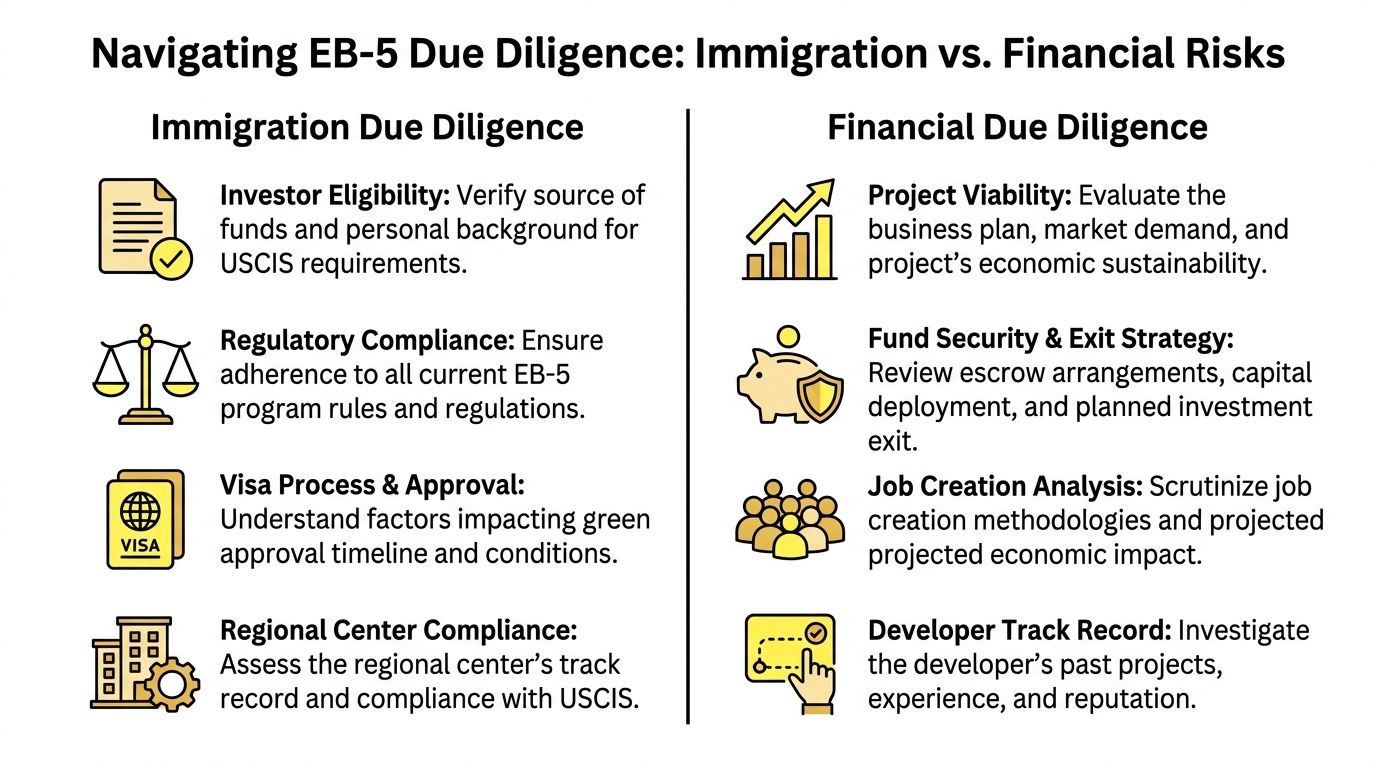
Immigration due diligence is not financial due diligence
Investors blur the two. They are not the same.
Immigration due diligence asks whether the project and your filing are structured to satisfy USCIS. Financial due diligence asks whether the investment itself is commercially sensible. You need both, and they should inform each other.
Why job creation becomes the pressure point
A primary hurdle in EB-5 is proving job creation. Denials often stem from inadequate economic models, and post-RIA I-526E approvals reached 97 percent, compared with 70 percent for direct I-526s, where the investor carries the full job creation burden (EB5 Investors Q&A on common applicant problems).
That distinction matters in practice. Direct investments can work, but the evidence burden is heavier and less standardized.
Red flags your attorney should catch
A disciplined review focuses on mismatches across documents. Common concerns include:
- Business plan gaps: Revenue assumptions, timelines, or deployment schedules do not align with the economic report.
- Thin job creation logic: The model depends heavily on assumptions that are not grounded in the project's actual market or spending plan.
- Escrow and at-risk concerns: The funds must be at risk. Redemption features or overly protective structures can create immigration problems.
- Regional Center compliance issues: If the center's controls and reporting look weak, that should slow the conversation down.
What a good review process looks like
A careful EB-5 attorney approaches project review in layers:
| Review layer | Main question |
|---|---|
| Investor file | Can the investor prove lawful source and path of funds? |
| Project documents | Do the offering materials, business plan, and economics align? |
| Job creation methodology | Is the employment model reasonable and defensible? |
| Exit and fund flow | Does the structure preserve at-risk treatment without adding avoidable immigration issues? |
A project may be financially attractive and still be poorly documented for EB-5 purposes. USCIS only adjudicates the record in front of it.
If you are trying to understand the broader compliance framework around this category, this tag page on EB-5 visa requirements is a useful starting point.
If you want an evaluation of whether a specific project fits your immigration goals, a focused consultation before subscription documents are signed may save substantial time and rework later.
The U.S.-Canada Cross-Border Advantage
Canadian investors assume EB-5 should be simpler for them because of proximity, familiar banking systems, and frequent travel to the U.S. In practice, the opposite can happen. Cross-border facts create extra moving parts.

Where Canadian files get complicated
The underserved issue in EB-5 is cross-border execution. AILA notes that a significant share of EB-5 inquiries comes from Canada, and those investors face challenges involving dual tax structuring, Ontario source-of-funds records, and concerns that can trigger scrutiny around money laundering if the documentation chain is not clean (AILA on why attorneys should understand EB-5 and cross-border issues).
That is not a reason to avoid EB-5. It is a reason to prepare the record correctly.
The practical advantage of cross-border counsel
For a Canadian investor, the best legal strategy sits at the intersection of immigration, business records, and document execution. The attorney should understand how Canadian corporate records, shareholder distributions, property proceeds, tax filings, affidavits, and notarized materials will appear when translated into a USCIS evidentiary record.
That can matter when:
- Funds came from a Canadian company
- Assets were sold in Canada
- Documents require apostille coordination or sworn declarations
- You need consistency between your U.S. immigration filing and your existing Canadian legal or tax posture
EB-5 versus E-2 for Canadians
Many Canadians first look at E-2 because it can fit an active business plan. EB-5 may be more attractive when the long-term objective is permanent residence rather than a renewable nonimmigrant route.
The better path depends on your facts. If you already operate through a Canadian entity or are refining your U.S. expansion structure, even a business formation checklist such as this Ontario incorporation guide can be useful context because corporate history and ownership records often become part of the source-of-funds story.
Cross-border strategy works best when the immigration file and the business record tell the same story.
Your Key Considerations When Hiring Counsel
A good hiring decision comes down to judgment, not branding.
Consider these points as you compare options:
- Prioritize post-RIA experience: General immigration experience is not the same as current EB-5 fluency.
- Test source-of-funds capability early: If your funds moved through companies, property sales, family transfers, or multiple jurisdictions, that issue belongs at the front of the conversation.
- Do not separate petition work from project review: Immigration due diligence and investment due diligence serve different functions, but both matter.
- Treat communication style as a risk factor: If you cannot get a clear answer in consultation, the file may become harder to manage later.
- For Canadian investors, choose counsel that understands cross-border records: Your evidence may be lawful and straightforward in Canada but difficult to present persuasively to USCIS without the right framing.
The best eb-5 immigration attorney for you might not be the cheapest, the largest, or the most visible. The best fit is the attorney who can identify your real pressure points, coordinate the right supporting professionals, and build a record that matches how USCIS reviews modern EB-5 cases.
If you are evaluating EB-5 as part of a broader U.S. expansion or residence strategy, Mayo Law may help you assess the immigration, documentation, and cross-border considerations involved. Schedule a consultation with Mayo Law to discuss your circumstances.
LEGAL DISCLAIMER: The information provided in this article is for general informational and educational purposes only and does not constitute legal advice. Reading this article, visiting mayo.law, or contacting Mayo Law does not create an attorney-client relationship. The content of this article should not be relied upon as a substitute for professional legal counsel suited to your specific circumstances. Legal outcomes depend on the particular facts and circumstances of each individual case, and no attorney can guarantee a specific result. Laws, regulations, and legal procedures are subject to change and may vary by jurisdiction. If you require legal assistance, you should consult with a qualified attorney licensed to practice in the relevant jurisdiction. Mayo Law expressly disclaims any and all liability with respect to actions taken or not taken based on the contents of this article.