


If you’re asking about the E-2 visa minimum investment amount 2026, you’re already asking a better question than most investors. The main issue isn’t whether U.S. law sets a fixed number. It doesn’t. The issue is whether your budget, business model, and filing strategy fit the substantial investment standard that officers apply.
At Mayo Law, many cross-border founders, especially Canadian business owners and startup operators, particularly need clarity. A consulting company, a franchise, and a restaurant don’t face the same scrutiny. A USCIS change of status case and a consular filing abroad don’t either. If you treat the E-2 like a flat-price visa category, you may overinvest in the wrong places or underinvest where the file needs visible commitment.
What Is the Real E-2 Visa Investment Amount for 2026
How much do you need to invest for an E-2 visa in 2026?
U.S. law does not set a fixed minimum. The legal standard asks a different question. Is the investment substantial for this specific business, and has the money been committed in a way that shows real commercial risk?
That is why the same dollar amount can work for one case and fail in another.
A solo consulting firm, a managed e-commerce brand, and a full-service restaurant do not get reviewed the same way. The amount must fit the startup budget, the operating model, and the evidence showing the business can open and function as presented. Investors who want a broader overview of E-2 case strategy can start with this guide to investing in and building a business in the United States under the E-2 visa.
In practice, 2026 planning starts with business type and filing path. Low-overhead service businesses often enter the discussion at a much lower range than restaurants, franchises, or other capital-heavy operations. Just as important, a case filed with USCIS from inside the United States may face a different level of scrutiny on investment presentation than a consular case abroad. That difference affects how conservative the budget should be.
The strongest E-2 budget is not the smallest one. It is the one that matches the actual cost to launch, staff, and operate the business, with funds already spent or irrevocably committed.
Investors run into trouble when they chase a supposed magic number instead of building a file that makes business sense. A strong E-2 case connects the investment to startup costs, lease obligations, equipment, payroll planning, and a credible plan for growth beyond supporting only the investor and family.
The Substantial Investment Standard Explained
The core E-2 rule is easier to understand if you stop thinking in terms of visa thresholds and start thinking like a business buyer.
Proportionality drives the analysis
The government uses a proportionality test. It compares what you’ve invested against what the business costs to start or buy. If the business is inexpensive, officers generally expect you to fund a large share of it. If the business is more expensive, a lower percentage may still qualify if the dollar amount is meaningfully committed.
A shed and a skyscraper don’t require the same ratio of upfront capital. The E-2 analysis works the same way.
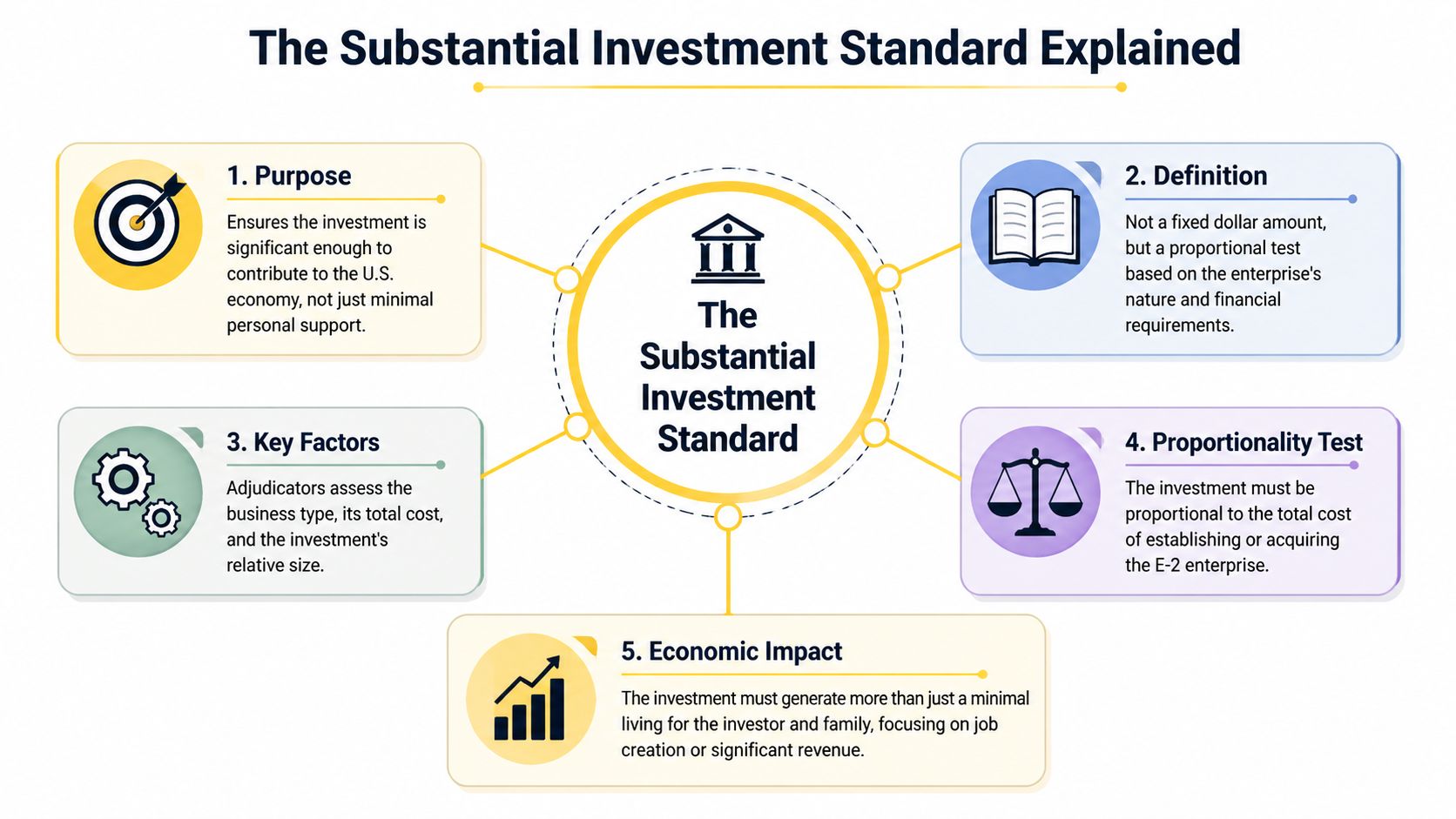
Verified 2026 guidance states that there is no fixed minimum, and that substantiality turns on proportionality, operational sufficiency, and whether funds are committed and at risk. That same guidance gives practical ranges by business type and is consistent with how many practitioners frame viable E-2 budgeting in current filings, as discussed in this E-2 visa guide on investing and building a business in the U.S..
At risk means real exposure
Funds must be at risk. In plain terms, that means the money is exposed to ordinary business gain or loss. Cash sitting safely in your personal account usually doesn’t prove enough. Money spent on equipment, inventory, lease obligations, launch costs, or other business expenses is much more persuasive.
Irrevocably committed means more than good intentions
Funds also need to be irrevocably committed. Officers want to see that the enterprise is not just an idea on paper. Wire transfers, vendor payments, signed leases, and binding commitments help show that the business is moving forward.
A weak file says, “I can invest if approved.”
A stronger file says:
- The company is formed: the legal entity exists and is ready to operate.
- The money is traceable: transfers can be followed from source to use.
- The spending matches the plan: equipment, space, software, or inventory fit the business model.
- The commitment is credible: the case shows real execution, not tentative planning.
Practical rule: Officers don’t just count dollars. They look for business reality.
Practical Investment Ranges for 2026 by Business Type
How much should an investor plan to spend in 2026? The answer depends less on the visa category and more on the economics of the business you are trying to launch.
I advise clients to start with total startup cost, then ask whether the planned E-2 investment will look credible for that model. A lean consulting firm and a restaurant are judged under the same legal standard, but they are not judged against the same budget reality.
Service businesses and consulting models
Service businesses usually present the lowest entry point because the operating model does not require major equipment purchases, a build-out, or large opening inventory. In practice, these cases are often easier to support once the file shows meaningful spending on the items that make the company operational.
For a consulting, agency, coaching, or other professional services business, that usually means committed funds for:
- payroll or contractor support tied to early operations
- software, devices, and implementation costs
- marketing, branding, and client acquisition
- office space, coworking, or another setup that fits the business plan
A service business can work with a lower investment than a retail or food-service case. It still needs to look like a real company, not a solo self-employment concept with minimal overhead.
Retail and e-commerce operations
Retail and e-commerce cases usually need a thicker capital base. Officers expect to see inventory planning, fulfillment logistics, platform costs, and enough working capital to get through launch.
The main issue is visibility. A retail file with modest inventory, no warehousing solution, and little marketing support often looks underfunded even if the business concept is sound. A stronger case ties spending to the sales model, customer acquisition plan, and operational timeline.
Franchises and restaurants
Restaurants, cafes, and many franchise businesses face a tougher review because startup costs are easier to measure and undercapitalization is easier to spot. If the concept requires leasehold improvements, equipment, permits, staff, and opening cash reserves, the investment has to match that reality.
Investors make expensive mistakes when they focus on the franchise fee or initial deposit and ignore the full cost to open and operate. For broader examples of business models that tend to fit E-2 planning well, see best businesses for E-2 visa approval.
A restaurant budget often fails because too little of the total cost has been committed. A franchise can run into the same problem if the investor has paid for the brand but not for the location, equipment, staffing, and launch expenses that make the business viable.
Manufacturing and asset-heavy businesses
Manufacturing, production, and other asset-heavy businesses usually need the highest level of capital commitment. Machinery, space, utilities, compliance costs, and operating infrastructure add up quickly.
These cases rarely succeed with a thin initial spend. If the model depends on specialized equipment or a facility build-out, officers will expect the investment to reflect those hard costs in a serious way.
E-2 investment ranges by business type
| Business Type | Typical Investment Range | Primary Cost Drivers |
|---|---|---|
| Consulting or professional services | $70,000 to $120,000 | Payroll, software, marketing, office setup |
| Retail or e-commerce | $100,000 to $150,000+ | Inventory, platform costs, warehousing, lease expenses |
| Restaurants and cafes | $300,000 to $700,000 | Build-out, permits, equipment, staffing, working capital |
| Franchises | $150,000 to $350,000 | Franchise fees, equipment, leasehold improvements, launch costs |
| Manufacturing | $350,000+ | Machinery, facilities, operational infrastructure |
The range should fit the business model. Low-cost service companies can justify lower numbers. Asset-heavy businesses usually cannot.
USCIS vs Consulate Filing A Critical Investment Difference
Many investors assume the E-2 standard is applied the same way everywhere. In practice, filing venue may change how your investment is perceived.
Why the venue matters
Verified 2026 practitioner guidance notes that consulate processing often demands higher amounts, with $100,000+ commonly viewed as a stronger floor for approval odds, while USCIS may accept $50,000 for smaller businesses in some change-of-status filings. The same guidance reports that consulate approvals often favor $150,000 to $300,000 for retail and franchise models, while USCIS may show more leniency for services around $80,000, as explained in this discussion of E-2 investor visa practice differences.
That doesn't create two different laws. It reflects two different review environments.
What works better in each setting
A USCIS filing from inside the United States may give a lean service business more room if the file is tightly documented and the startup costs are modest. A consular filing often benefits from a more visible capital commitment, especially where the business includes inventory, customer-facing space, or franchise obligations.
For Canadian and other cross-border investors, this becomes a strategic budgeting question. If you may later need consular processing, it often makes sense to prepare the case at a level that can survive that scrutiny from the start.
Passing the Marginality and Proportionality Tests
Most E-2 denials don't turn on one missing receipt. They turn on whether the full record shows a business that is funded realistically and built to grow.

Proportionality is a sliding scale
The proportionality test becomes stricter as total business cost goes down. If the enterprise is lean, officers expect a larger share of the full startup budget to be committed by the investor. If the enterprise is expensive, the ratio may be lower, but the dollar commitment still needs to be credible for that industry.
This is why a thinly funded low-cost startup can fail just as easily as an undercapitalized restaurant.
Marginality asks a different question
The marginality test looks at whether the business does more than provide a minimal living for the investor and family. A file with no meaningful hiring plan, no growth story, and no reason to believe the company will expand can look marginal even when the investment amount itself seems reasonable.
A stronger case usually shows:
- A hiring plan: credible staffing over time matters.
- Commercial purpose: the enterprise serves a real market and isn't just self-employment in disguise.
- Operational scale: the business has room to grow beyond one person's income.
- Financial coherence: projections align with what the business has funded.
Multi-investor cases need extra care
Verified 2026 guidance on shared E-2 ventures stresses that each investor is assessed individually. Lower per-investor amounts may still work, but they generally require stronger ownership positions and a business plan that shows non-marginal growth, including 2 to 5 jobs per year in the model where appropriate, as described in this analysis of multi-investor E-2 substantiality.
In group-funded businesses, officers don't evaluate the pool first. They evaluate each principal investor's stake, role, and proportional commitment.
That point is often missed in startup partnerships. A shared venture can be viable, but the ownership structure and business plan need to support each applicant separately.
Building Your E-2 Investment Evidence Checklist
A persuasive E-2 file usually tells one financial story from beginning to end. The source of funds, movement of funds, and business use of funds should line up cleanly.
Proof of lawful source
Start with documents that explain where the money came from.
- Savings records: bank statements can show accumulated personal funds.
- Sale documents: if funds came from a property or business sale, closing records help establish the source.
- Gift or inheritance records: supporting paperwork should connect the transfer to a lawful origin.
- Loan records: if financing is involved, the documents should make the structure clear.
Proof of transfer
Next, show how the money moved from you to the U.S. business.
- Wire confirmations: these help trace the path of funds.
- Business bank statements: they show receipt into the company account.
- Currency conversion records: useful where funds originated outside the United States.
Proof of spending or commitment
Many files become persuasive or fall flat at this point. For practical planning support, review E-2 visa business plan requirements.
Use documents such as:
- Vendor invoices and paid receipts: equipment, software, inventory, and setup costs.
- Signed lease and deposit evidence: useful where premises matter to operations.
- Franchise agreements or purchase agreements: these often anchor cost structure.
- Payroll setup documents: they help show the enterprise is preparing to operate.
- Launch contracts: branding, website development, or marketing services can support a service-based business if they fit the model.
Clean tracing matters. If an officer can't follow the money from source to business use, the case may look weaker than it should.
Key Considerations Beyond the Investment Amount
The investment amount is only one part of a successful E-2 strategy. Several surrounding decisions can strengthen or weaken the filing.
Business plan quality
A business plan shouldn't read like a sales pitch. It should explain how the company operates, where the money goes, and why the business can grow beyond a minimal-living model. In E-2 practice, a weak plan can make a decent investment look thin.
Entity structure and control
Ownership and control matter. The legal structure needs to reflect who is directing the business and how decision-making works. In multi-owner setups, this point becomes especially important because the immigration analysis follows the actual ownership and operating arrangement.
Passive investment problems
The E-2 category is for developing and directing an enterprise. Passive holdings usually create trouble. If the investor's role looks detached from day-to-day direction, the case may not fit the category well.
Long-term immigration fit
Some investors start with E-2 because it offers flexibility. Others may need to compare it with a different strategy depending on long-term goals, capital level, or permanent residence plans. A useful starting point is E-2 visa vs EB-5 visa which is better.
Ready to Explore Your U.S. Business Immigration Options?
The E-2 visa minimum investment amount 2026 isn't a single number. It's a legal and business judgment based on proportionality, operational realism, filing venue, and proof that your capital is committed.
For founders expanding between Canada and the United States, that usually means more than choosing a budget. It means choosing the right business model, ownership structure, evidence package, and filing path. If you're comparing E-2 with another option, or trying to determine whether your current business plan is fundable and approvable, you may want to evaluate the entire strategy together. Mayo Law provides cross-border immigration support through its business immigration practice.
LEGAL DISCLAIMER: The information provided in this article is for general informational and educational purposes only and does not constitute legal advice. Reading this article, visiting mayo.law, or contacting Mayo Law does not create an attorney-client relationship. The content of this article should not be relied upon as a substitute for professional legal counsel suited to your specific circumstances. Legal outcomes depend on the particular facts and circumstances of each individual case, and no attorney can guarantee a specific result. Laws, regulations, and legal procedures are subject to change and may vary by jurisdiction. If you require legal assistance, you should consult with a qualified attorney licensed to practice in the relevant jurisdiction. Mayo Law expressly disclaims any and all liability with respect to actions taken or not taken based on the contents of this article.
Ready to explore your U.S. business immigration options? Mayo Law can help evaluate your E-2, EB-5, or other pathway. Contact Mayo Law to schedule a consultation.




![Yellow decorative banner with a maple leaf and city skyline; title reads 'Employment Immigration Attorney Guide for US-Canada Business'.] ,](https://mayo.law/wp-content/uploads/2026/06/employment-immigration-attorney-business-guide-1024x569.jpg "employment-immigration-attorney-business-guide - Mayo Law")