You hire your first software engineer in New York, then a sales lead in Toronto. Both sign offer letters. A dispute clause seems like a routine HR detail until someone raises a wage claim, a harassment complaint, or a disagreement tied to a work visa or confidentiality obligations. At that point, the question gets very practical. Are you going to court, or into a private dispute process?
At Mayo Law, this is the kind of cross-border contract issue business owners run into early and often. A clause that may look standard in a U.S. template can create real problems when the worker sits in Ontario, reports to a New York entity, or moves between the two. That’s why founders and HR teams need to understand arbitration agreements in employment contracts before they drop them into onboarding packets. For more on related hiring issues, see cross-border employment.
Arbitration can be useful. It can also fail badly if the clause is one-sided, vague, or imported from the wrong jurisdiction. The hard part isn’t adding an arbitration paragraph. The hard part is drafting one that matches your workforce, your risk profile, and the legal realities on both sides of the border.
Introduction Navigating Cross-Border Employment
A startup usually reaches this issue by accident. Someone copies an employment agreement from prior counsel, an investor data room, or a U.S. HR platform. The clause says all disputes go to binding arbitration in New York under a provider’s rules. It sounds efficient and well-crafted.
Then the business hires in Ontario. Now the same clause may face a different kind of review. Canadian courts don’t approach employment contracts the same way U.S. courts do, especially where there’s a clear imbalance in bargaining power.
Arbitration is a dispute-resolution tool. It isn’t a shortcut around employment standards, human rights rules, or basic contract fairness.
For cross-border employers, the question isn’t whether arbitration is good or bad. It’s whether the agreement is drafted for the people signing it. A New York employee, a Toronto employee, and a remote executive splitting time across both markets may raise very different enforceability issues.
What Is an Employment Arbitration Agreement
An employment arbitration agreement is a contract term that says certain disputes must be decided by a private arbitrator instead of a court. Think of it as choosing a private referee with authority to issue a binding decision.

What employees give up
The main trade-off is public court access. In many cases, the employee gives up the right to have the claim heard by a judge or jury. The process is usually more private, and appeal rights are often narrower than in court.
That doesn’t mean the employer gets immunity. It means the fight happens in a different forum.
What the process usually includes
A typical arbitration clause addresses:
- Covered claims: discrimination, wage disputes, retaliation, contract claims, and related workplace torts.
- Forum rules: often provider rules such as AAA or JAMS in the U.S.
- Decision maker: a neutral arbitrator, not the employer.
- Remedies: the employee should still be able to seek the kinds of remedies available in court if the clause is enforceable.
A well-drafted clause channels disputes. A bad one creates a second dispute about whether the clause itself survives.
Many employers get tripped up. They assume arbitration means speed and lower friction. Sometimes it does. But if the clause is unclear, overreaching, or mismatched to local law, the parties may spend time and money fighting over enforceability before the merits are even heard.
The Legal Framework in New York and Ontario
New York and Ontario start from different instincts. In the U.S., federal arbitration law strongly favors enforcement. In Ontario, courts may look more closely at fairness in the employment context.
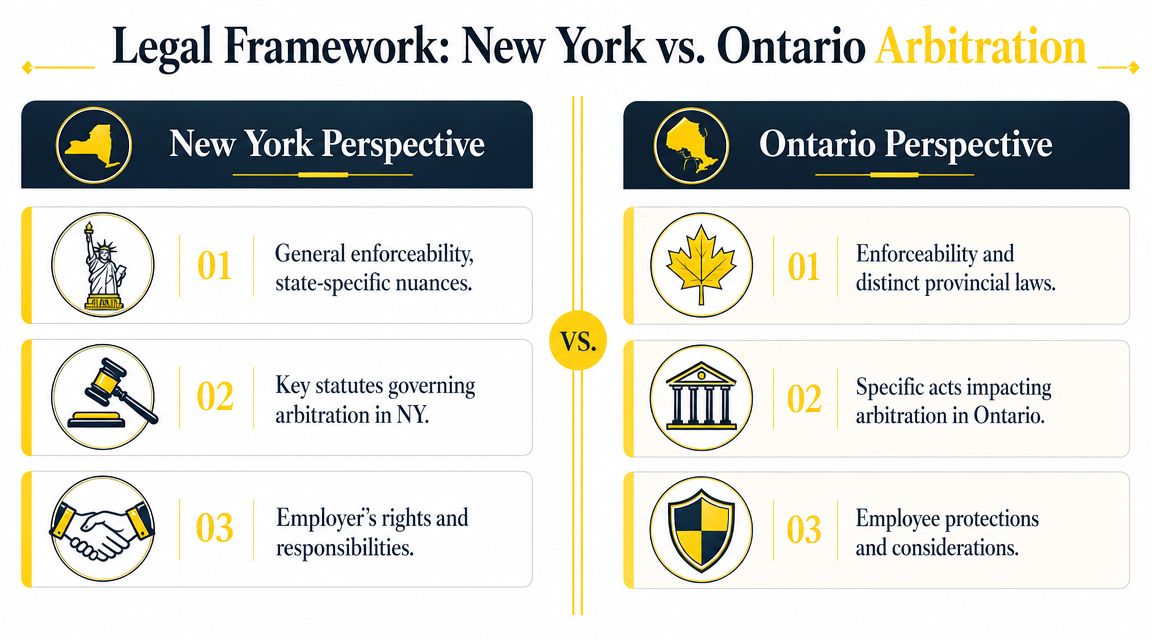
New York and the FAA
For employees tied to U.S. interstate commerce, the Federal Arbitration Act often dominates the analysis. Supreme Court decisions expanded enforcement over time, and mandatory arbitration agreements spread from 2% of non-union workers in 1992 to over 56.2% of the workforce by 2017, covering more than 60 million workers, as summarized in this historical overview of employment arbitration agreements.
That U.S. framework matters to New York employers because courts often begin with a presumption that arbitration agreements should be enforced. But enforceability still depends on drafting. Clauses can still fail if they are unconscionable, inconsistent, or improperly implemented.
Ontario and added scrutiny
Ontario approaches employment agreements through a more protective lens. Courts may scrutinize arbitration clauses for unconscionability, public policy concerns, and fairness, especially where the employee had little real bargaining power.
A clause that works for a New York hire may not travel well if it requires an Ontario employee to arbitrate in another forum, under unfamiliar rules, at disproportionate cost, or under terms that look one-sided. For a broader discussion of forum and enforcement issues, see arbitration in Canada, domestic Ontario framework, international arbitration and enforcement.
Why one template usually fails
Here’s the practical comparison:
| Issue | New York focus | Ontario focus |
|---|---|---|
| Enforceability baseline | Strong FAA support | Greater review of fairness in employment |
| Forum selection | Often upheld if drafted clearly | More likely to be challenged if burdensome |
| Cost structure | Employer should avoid shifting heavy costs to employee | Cost burden can become a major fairness issue |
| Drafting errors | May trigger litigation over scope and waiver | May trigger invalidation on fairness grounds |
If your workforce crosses borders, don’t assume “FAA governs” solves everything. It may help in the U.S. arm of the relationship, but Canadian courts may still ask whether the clause is fair and consistent with local employment protections.
Evaluating the Pros and Cons for Your Business
Arbitration gets sold as obviously pro-employer. That’s too simplistic. It changes the forum, the strategic advantages, and the economics. It doesn’t automatically favor one side in every case.

What employers often like
Employers usually value arbitration for practical reasons:
- Privacy: disputes may stay out of a public courtroom record.
- Process control: provider rules can create a more contained process than court.
- Speed: many businesses prefer a forum designed to move more directly to a hearing.
What employees may like, and dislike
Employees may benefit from a more efficient process in some cases. But they also lose a jury trial and may face narrower appeal options.
The data is mixed. In a large study of 10,486 employment arbitration cases terminated between 2014 and 2018 at AAA and JAMS, 73% settled, 17% were dismissed or withdrawn, and 10% resulted in awards. In that dataset, employee-plaintiffs received a median award of $113,818, compared with $51,866 in federal litigation, according to this empirical assessment of employment arbitration. But the same source also notes other studies showing lower win rates and lower outcomes for employees in different settings.
Don’t build policy around slogans. Build it around the kinds of disputes your company is actually likely to face.
That's the trade-off. If your main concern is confidential handling of executive compensation, equity disputes, or restrictive covenant fights, arbitration may fit. If your concern is preserving immediate court access for emergency IP issues, broad mandatory arbitration may not.
Key Clauses in an Arbitration Agreement
Most disputes over arbitration agreements in employment contracts come back to a handful of drafting choices. If those choices are sloppy, the clause may invite challenge.
Scope and consideration
Scope answers a basic question. What disputes are covered? Broad language such as “any dispute arising out of employment” is common, but scope should be deliberate, not reflexive. The clause also needs valid consideration, meaning a real exchange. Continued at-will employment may serve that role in some U.S. settings, and the agreement must not interfere with Section 7 rights under NLRB principles, as discussed in this piece on the fine print in arbitration agreements.
“Any dispute arising out of or relating to employment shall be resolved by binding arbitration, except claims expressly excluded below.”
Venue, rules, and carve-outs
Cross-border employers should pay close attention to forum and carve-outs. If you force every dispute into one city or one country, you may create avoidable enforceability problems.
A practical draft often separates ordinary employment claims from claims where a business may need urgent court relief.
- Venue clause: pick a realistic location tied to the employee or the business.
- Rules clause: identify the administering body and rules clearly.
- Court carve-out: preserve access to court for trade secrets, IP misuse, or emergency injunctive relief.
For related transaction drafting issues, see stock purchase agreements.
“Either party may seek temporary or injunctive relief from a court of competent jurisdiction for misuse of confidential information or intellectual property.”
Costs and decision standards
Cost allocation matters. If the employee bears heavy arbitration costs, the clause becomes much easier to attack. So does a clause that limits available remedies or hides how the arbitrator will be selected.
Drafting and Implementation Best Practices
A strong clause usually looks fair on its face and in practice. That means the employer isn’t just demanding arbitration from the employee while reserving every useful court remedy for itself.
What usually works better
Drafting tends to hold up better when the clause includes:
- Mutuality: both sides are bound, subject to narrow and defensible carve-outs.
- Neutral selection: the arbitrator is chosen through a neutral process.
- Adequate discovery: enough document exchange and witness access for the claim to be fairly heard.
- Full remedies: no artificial limits on damages or statutory relief otherwise available in court.
- Reasonable cost allocation: the employee should not face prohibitive arbitration costs.
These fairness points track the standards discussed in this article on arbitration employment clauses. The same source also highlights that clauses may fail when they cap remedies, limit discovery too sharply, or impose unreasonable employee costs.
How employers lose otherwise useful clauses
Implementation mistakes are common. The clause may be buried in onboarding, presented without clear acknowledgment, or paired with contradictory handbook language. Cross-border teams often also forget to align the clause with governing law, local venue, and statutory carve-outs.
A better process usually includes plain-language presentation, a separate signature block, and consistency across the offer letter, employment agreement, and internal policy set. Businesses handling multijurisdiction hiring often benefit from reviewing their templates alongside other cross-border contracts.
Special Issues for Cross-Border Employers
The cross-border problem isn’t only employment law. Arbitration clauses can affect immigration strategy, investigations, and emergency business disputes.
Immigration-related disputes
A sponsored employee may raise claims tied to recruitment promises, compensation terms, relocation commitments, or termination during a visa process. Even if the arbitration clause is broad, some parts of the dispute may touch regulatory systems outside ordinary contract enforcement.
That doesn’t mean arbitration is useless. It means the clause should be drafted with enough precision to avoid accidental overlap with processes that are governed elsewhere.
White-collar and business protection carve-outs
Some employers want broad arbitration for standard workplace claims but still want court access for fraud, theft of confidential information, or urgent injunctions. That can be reasonable if the carve-out is directly tied to emergency business protection and not written so broadly that the employer keeps court while the employee gets only arbitration.
Cross-border enforceability is the harder issue. U.S. law strongly favors arbitration for a very large share of workers, while Canadian courts may scrutinize those clauses for unconscionability and public policy concerns, especially for remote or cross-border employees, as noted in this NELP discussion of mandatory arbitration in employment. Businesses expanding internationally should also think about dispute planning alongside broader international business structuring.
Key considerations
- Match the clause to the worker’s location: where the employee sits matters.
- Avoid overbroad carve-outs: one-sided drafting invites challenge.
- Separate emergency court relief from routine disputes: the distinction should be narrow and explainable.
- Coordinate with immigration and compliance teams: a dispute clause can affect more than one legal workflow.
Frequently Asked Questions
Can an employee refuse to sign an arbitration agreement
That depends on the employment context, the jurisdiction, and how the agreement is presented. In practice, refusal often becomes a hiring or continued-employment issue, but enforceability may still depend on whether the clause was fairly drafted and supported by valid consideration.
Are arbitration awards legally binding
Usually, yes, if the agreement is enforceable and the process was properly conducted. Appeal options are often narrower than in court, which is one reason drafting quality matters so much at the front end.
What is the difference between arbitration and mediation
Arbitration leads to a binding decision by an arbitrator. Mediation is a settlement process where a neutral helps the parties try to resolve the dispute, but the mediator usually doesn’t impose a final ruling.
Do arbitration agreements cover discrimination or harassment claims
They often try to. But the answer depends on the wording of the clause and on statutory carve-outs. Employers should also account for claims that may not be arbitrable in the same way, including sexual harassment or sexual assault claims under applicable U.S. law.
Should a New York company use the same clause for Toronto employees
Usually, that’s risky. A clause drafted for FAA-heavy U.S. enforcement may not fit Ontario scrutiny of employment contracts. Cross-border employers often need separate or adapted versions rather than one universal template.
Build Your Business on Solid Legal Ground. Mayo Law advises startups and SMEs in Ontario and New York on employment contracts, cross-border risk, and dispute planning. If you’re reviewing arbitration agreements in employment contracts, schedule a consultation.
LEGAL DISCLAIMER: The information provided in this article is for general informational and educational purposes only and does not constitute legal advice. Reading this article, visiting mayo.law, or contacting Mayo Law does not create an attorney-client relationship. The content of this article should not be relied upon as a substitute for professional legal counsel tailored to your specific circumstances. Legal outcomes depend on the particular facts and circumstances of each individual case, and no attorney can guarantee a specific result. Laws, regulations, and legal procedures are subject to change and may vary by jurisdiction. If you require legal assistance, you should consult with a qualified attorney licensed to practice in the relevant jurisdiction. Mayo Law expressly disclaims any and all liability with respect to actions taken or not taken based on the contents of this article.