
Contents
- When Your Business Needs to Transfer a Contract
- What Is an Assignment of Contract
- Assignment vs Novation A Key Distinction
- Navigating Jurisdictional Differences New York vs Ontario
- Drafting and Consent The Cornerstones of a Valid Assignment
- A Practical Checklist for Assigning a Contract
- Build Your Business on Solid Legal Ground
- LEGAL DISCLAIMER
A founder in Toronto buys a small Buffalo company and assumes the supplier relationships can move over with the deal. Then a vendor says the contract is still with the old entity, not the buyer. Payment stalls, delivery pauses, and the integration starts slipping.
That’s where assignment of contract becomes a business issue, not just a drafting detail. For startups and SMEs expanding across New York and Ontario, contract transfer questions often surface during acquisitions, restructurings, affiliate rollups, and financing transactions. At Mayo Law, our attorneys regularly see that the true risk isn’t just whether a transfer is possible. It’s whether the transfer moved the rights you expected, preserved business continuity, and avoided leaving the old party on the hook. If you’re dealing with a sale, internal reorganization, or cross-border expansion, this is one of the first documents worth checking alongside your stock purchase agreements.
When Your Business Needs to Transfer a Contract
The common version looks simple. You buy assets, move operations into a new entity, or shift a customer contract to a U.S. or Canadian affiliate. Commercially, everyone treats the relationship as ongoing. Legally, the counterparty may still have rights only against the original signatory.
That gap causes avoidable problems. A distributor may refuse to ship. A customer may reject invoices from the new entity. A software vendor may argue the license never moved.
Practical rule: If a contract matters to revenue, supply, or compliance, don’t assume it moved because the business moved.
Founders run into this most often in three situations:
- Business sales: The buyer wants the benefit of existing customer, supplier, or service agreements.
- Corporate restructurings: A parent shifts contracts into a subsidiary, or consolidates entities after growth.
- Cross-border expansion: A New York contract is meant to support Ontario operations, or the reverse.
The legal question is usually narrow. Did you transfer only the benefit, or did someone also take on the burden?
What Is an Assignment of Contract
An assignment of contract transfers contractual rights from one party to another. The original transferring party is the assignor. The receiving party is the assignee. The party expected to perform under the original deal is often called the obligor.

A simple analogy helps. If you hold a ticket to an event and give it to a friend, you assigned your right to attend. The event organizer now deals with your friend on that right. Contract assignments work in a similar way, except commercial contracts usually carry more conditions, more risk, and more room for dispute.
What usually can be assigned
Under common law, rights are generally assignable unless the contract blocks assignment or the nature of the right makes transfer inappropriate. The default rule permits free assignability of rights unless the contract expressly prohibits it, and for an assignment of contract rights to have full legal effect, it typically must be in writing, absolute, and supported by express written notice to the obligor.
What usually can’t be assigned cleanly
Some rights are tied to a personal relationship or unique performance. A contract built around a particular consultant, artist, or founder often can’t be shifted without consent. A transfer also shouldn’t materially change what the other party has to do.
That is why the original contract matters first. A broad transfer idea in a deal document doesn’t override a specific restriction in the underlying agreement.
If your transaction includes pre-emptive rights or transfer controls elsewhere in the capital structure, those issues may need review alongside the assignment itself, including any right of first offer provisions.
Assignment vs Novation A Key Distinction
Clients often use these terms interchangeably. They shouldn’t. The business result can be very different.
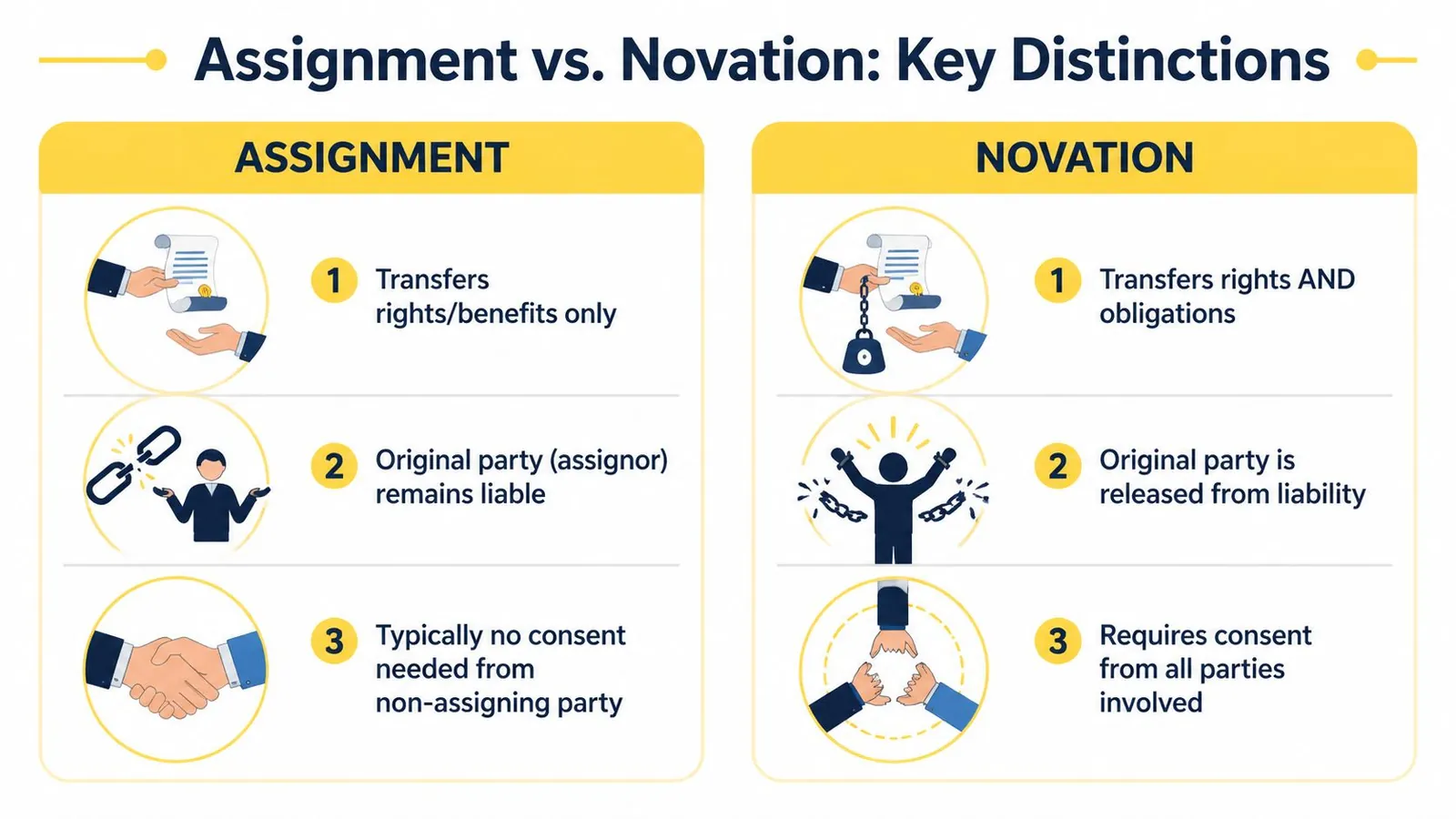
The short version
An assignment usually transfers rights. A novation replaces one party with another and is used when obligations and release matter.
| Feature | Assignment | Novation |
|---|---|---|
| What moves | Rights or benefits under the contract | Rights and obligations through a replacement arrangement |
| Original contract | Continues | Commonly replaced as part of the substitution |
| Liability of original party | Often remains unless separately released | Typically released if the novation says so |
| Consent | May depend on the contract and governing law | Requires agreement of all affected parties |
Why founders care
If you’re selling a business unit and want a clean exit, assignment alone may not get you there. The old entity may still face claims if the new operator fails to perform. In founder disputes and post-closing integration, that lingering exposure becomes expensive fast.
This is one reason transfer mechanics often sit beside governance terms in transactions and internal reorganizations, not apart from them. A weak transfer clause can undermine even a strong shareholders agreement strategy.
A good assignment moves value. A good novation moves value and closes liability.
Navigating Jurisdictional Differences New York vs Ontario
A startup signs a key customer agreement through its New York entity, then later shifts operations to Ontario after a financing, tax reorganization, or asset sale. The founders assume the contract can easily be moved to the Canadian affiliate. In practice, that assumption causes avoidable disputes.

New York draws harder distinctions in the papering
Under New York law, the drafting usually needs to separate the transfer of rights from the assumption of obligations. If your buyer or affiliate is supposed to perform the contract, pay indemnity exposure, or carry service obligations, the document should say so in express terms.
That point matters in a business sale. I often see sellers assume that transferring the revenue stream also transfers the work. Buyers often assume the opposite risk has been cut off. If the assignment document is thin, both sides may leave closing with different liability expectations.
Ontario often puts more pressure on contract mechanics and notice
Ontario reaches many of the same commercial outcomes, but the practical focus is often slightly different. Counsel usually starts with the underlying agreement, the form of assignment, whether notice to the counterparty is required or advisable, and whether the transfer fits the way the contract was originally structured.
The benefit of a contract may be assignable. The burden usually is not shed so easily. If the original Ontario entity is still on the hook absent consent, release, or a replacement arrangement, the founder who thought the restructuring cleaned up legacy exposure may still own the problem.
That is one reason entity planning matters early. Founders expanding on both sides of the border can avoid later transfer friction by choosing the right operating entities before key customer and supplier contracts are signed. For many startups, that analysis starts with the corporate setup questions covered in this guide to Ontario business structures.
Cross-border friction usually shows up at enforcement
The harder issue is not whether the transfer document looks acceptable internally. The harder issue is whether the counterparty, court, or arbitrator will treat the transfer as effective when a dispute arises.
Anti-assignment clauses, consent language, and party-specific performance terms can create different risks in a New York governed agreement being shifted to an Ontario entity, or the reverse. Cross-border enforcement concerns become sharper if the original contract assumed a local operating company, local licensing status, or a local forum for disputes, as discussed in LibreTexts’ overview of assignment of contract rights.
If the deal crosses the border, treat assignment as a contract review exercise and a liability review exercise. Not just a filing step.
Drafting and Consent The Cornerstones of a Valid Assignment
Drafting is where a workable transfer either holds up or creates a mess at closing.
I see founders focus on the transfer document and miss the clause that governs the result. In a New York or Ontario deal, the assignment agreement matters, but the original contract usually matters more. If the base agreement limits assignment, requires consent, or ties performance to a specific affiliate, no amount of clean drafting in the side document fixes that problem by itself.
Start with the contract language that can block the transfer or change the process. Read the assignment clause with the definitions, not in isolation. Then check the notice section, any change-of-control provision, and any schedules that name a specific legal entity, location, or license holder.
The questions are practical:
- Is assignment prohibited, or only subject to consent?
- Does a merger, share sale, or internal reorganization trigger a separate restriction?
- Is the counterparty relying on a specific entity’s skill, approvals, financial profile, or data access controls?
- Does the contract require consent in advance, or just notice after the transfer?
That last point often separates New York and Ontario risk in practice. Under both systems, clear contract wording usually governs. But Ontario counterparties in commercial relationships often care more about whether the assignee can perform in the same regulatory and operating context, especially if the contract touches local compliance, employment, or service delivery. New York contracts are often drafted more aggressively on assignment mechanics, with tighter wording around consent, affiliates, and change of control. The result is simple. A transfer that looks routine inside the deal team can still need a different consent strategy depending on which law governs and which entity is stepping in.
Once the restrictions are clear, draft the transfer paper for the dispute you want to avoid two years from now. Identify the original contract precisely. State what is being assigned. State what, if anything, is being assumed. If the assignor is supposed to remain liable, say so. If the assignee is taking on defined operational duties but not all historical liabilities, say that with equal clarity.
A useful assignment document usually covers:
- The contract being transferred. Include date, parties, amendments, and enough detail to avoid any argument about scope.
- The rights moving to the assignee. Payment rights, exclusivity rights, renewal rights, IP licenses, claims, and audit rights should be listed if they matter.
- The obligations being assumed. Delivery, support, confidentiality, data security, indemnity, payment, and reporting duties should not be left to implication.
- The effective timing. Say when the transfer takes effect and whether it is conditional on consent, closing, or another event.
- The consent and notice mechanics. Attach the consent if you have it. If notice is required, follow the original contract’s method exactly.
This is also where cross-border startups get tripped up on related documents. A customer contract may be assignable, while the software license, hosting terms, or escrow materials sitting behind it are not. If the value of the deal depends on access to code or continuity of vendor support, review any related software escrow arrangement at the same time instead of treating it as post-closing cleanup.
Good drafting does not replace consent. It puts you in a position to ask for consent without creating new ambiguity.
A Practical Checklist for Assigning a Contract
A strong assignment process is methodical. It doesn’t need to be fancy, but it does need to be documented.

The workflow
-
Review the original contract.
Find the assignment clause first. Then check for consent rights, notice language, and any change-of-control restriction. -
Confirm the business objective.
Are you only moving the benefit, or are you trying to shift the burden too? If the original party wants out entirely, consider whether novation is the better tool. -
Run diligence on the contract itself.
Check for existing defaults, unpaid amounts, side letters, amendments, and course-of-dealing issues. A transferred problem is still a problem. -
Draft the transfer paper precisely.
Identify the contract, the parties, the effective date, the assigned rights, and any assumed obligations. Avoid broad shorthand if a specific list would be clearer. -
Get consent where required.
If the contract says written consent is needed, get it before closing if possible. Post-closing cleanup creates an advantage for the other side. -
Send formal notice.
The other party should know where to send performance, invoices, and legal notices. -
Keep the file complete.
Save the original contract, amendments, written consent, the signed assignment, and proof of notice.
Clean execution matters. In cross-border deals, half the battle is proving exactly what moved, when it moved, and who accepted the change.
Build Your Business on Solid Legal Ground
A contract transfer can help a deal close on time. It can also create a dispute that surfaces only after closing, when revenue, liability, or enforcement rights sit with the wrong entity.
I see this most often in cross-border transactions involving New York and Ontario. The parties assume an assignment will work the same way on both sides of the border, then discover too late that the contract language, consent mechanics, or treatment of obligations does not line up with that assumption. The legal issue is rarely abstract. It affects who gets paid, who must perform, and who bears the cost if the other side objects.
If your company is buying a business, moving contracts within a corporate group, or restructuring before an investment, treat contract transfer as a deal point, not clerical cleanup. Mayo Law advises startups and SMEs on business sales, restructurings, and cross-border contract issues. If you want practical guidance specific to your transaction, schedule a consultation with Mayo Law.
LEGAL DISCLAIMER
LEGAL DISCLAIMER: The information provided in this article is for general informational and educational purposes only and does not constitute legal advice. Reading this article, visiting mayo.law, or contacting Mayo Law does not create an attorney-client relationship. The content of this article should not be relied upon as a substitute for professional legal counsel suited to your specific circumstances. Legal outcomes depend on the particular facts and circumstances of each individual case, and no attorney can guarantee a specific result. Laws, regulations, and legal procedures are subject to change and may vary by jurisdiction. If you require legal assistance, you should consult with a qualified attorney licensed to practice in the relevant jurisdiction. Mayo Law expressly disclaims any and all liability with respect to actions taken or not taken based on the contents of this article.
Mayo Law advises businesses in Ontario and New York on cross-border contracts, restructurings, acquisitions, and related risk issues. If your company is evaluating an assignment of contract as part of a sale or internal reorganization, schedule a consultation with Mayo Law.