If you’re expanding a Toronto company into New York, applying for an investor visa, or trying to legalize family or business documents for use across the border, you’ve probably run into a basic but important question. What Is an Embassy? People often hear “embassy,” “consulate,” and “foreign mission” used as if they mean the same thing.
At Mayo Law’s international business page, these are the kinds of cross-border issues we see every day. In simple terms, an embassy is a country’s main diplomatic office in another country. It represents its government, protects its nationals, and serves as a central point for diplomacy, consular support, and practical cross-border coordination.
Introduction What Is an Embassy and Why Does It Matter
A Toronto founder is preparing to open a sales office in New York. At the same time, her spouse needs a document recognized for use in the United States, and one executive loses a passport during a cross-border trip. Those problems look unrelated, but they often lead to the same question first. What does an embassy do, and when should you contact one?
An embassy is a country’s main official presence in another country. In practice, it works like a central government point of contact abroad. It helps its citizens, communicates with the host government, and supports cross-border matters that involve official filings, travel documents, or consular procedures.
For businesses and families working between the United States and Canada, that role is more practical than many people expect. An embassy or related foreign mission may be part of the process for visas, document legalization, emergency travel help, or other government-facing steps. If you regularly handle cross-border operations, international business legal matters often involve both tracks: embassy-level procedures on one side and legal planning on the other.
A useful way to frame it is this. An embassy can help with official government functions. It does not give you legal strategy specific to your company, your transaction, or your immigration risk. If the issue is administrative, the embassy may be the right starting point. If the issue involves legal judgment, timing, liability, or long-term planning, counsel is usually the better first call.
That distinction saves time. It also helps avoid a common mistake in US-Canada matters. People sometimes ask an embassy to solve a problem that is really legal in nature, or hire a lawyer for a task that is mainly consular and procedural. Knowing the difference early can prevent delays, duplicate filings, and unnecessary expense.
The Legal Status of an Embassy Sovereign Ground Abroad
An embassy is different from an ordinary office building because international law gives it special protection. The core idea is inviolability. Under Article 22 of the 1961 Vienna Convention on Diplomatic Relations, embassy premises are protected from intrusion by host-country authorities without permission.

You can think of this as a legal bubble. The embassy sits physically inside the host country, but the premises receive a high level of protection so diplomats can do their work without local interference. That protection matters because diplomatic work often involves sensitive communications, identity records, official filings, and state-to-state discussions.
Why this matters for cross-border documents
That legal protection isn’t only important for ambassadors. It also helps explain why embassy-based document handling can matter in business and personal matters. According to this explanation of embassy legal status, documents notarized or apostilled at an embassy may carry presumptive authenticity without host-jurisdiction interference.
For a U.S.-Canada matter, that can matter when you’re dealing with:
- Corporate records used in a cross-border transaction
- Powers of attorney signed abroad
- Affidavits and sworn statements needed for immigration or litigation
- Identity and civil status documents used for citizenship or family matters
A secure environment doesn’t mean every legal problem becomes easier. It means the official setting has a special legal status, which can reduce confusion around who may authenticate, receive, or process certain materials.
Why businesses should care
If your company is moving talent, forming a subsidiary, or preparing ownership records for a filing, the legal status of an embassy can affect how you handle paperwork. The issue isn’t glamour. It’s chain of custody, official recognition, and the credibility of government-issued or government-witnessed documents.
A business owner may also confuse embassy protection with blanket immunity for private conduct. That’s a mistake. The embassy’s protected status supports official diplomatic functions. It doesn’t turn a private contract dispute or compliance problem into a diplomatic matter.
For readers handling business immigration, this distinction often becomes relevant when coordinating investor or employment documentation through cross-border business immigration support.
Embassy protection supports official functions. It doesn’t replace legal analysis, due diligence, or compliance planning.
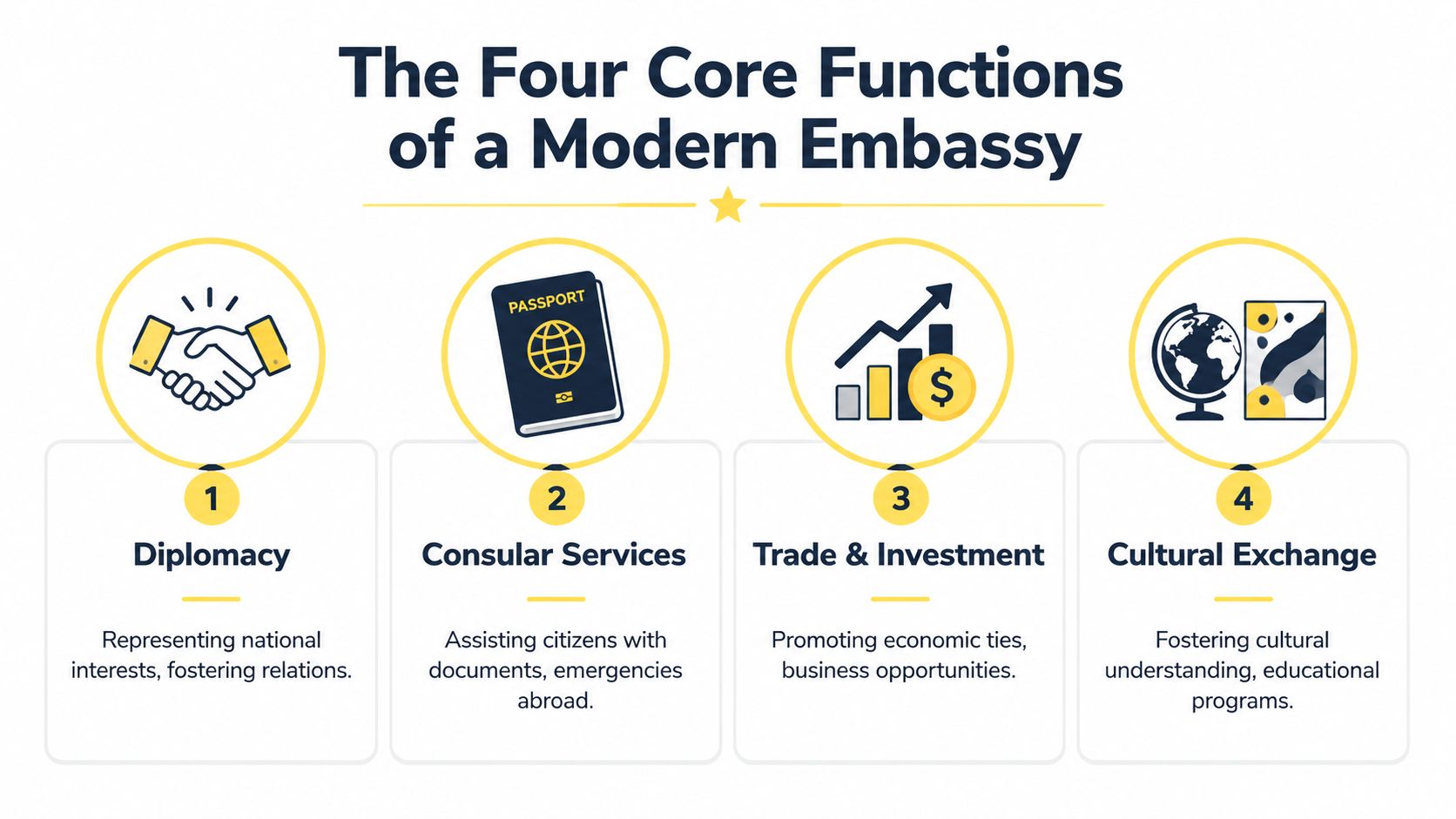
The Four Core Functions of a Modern Embassy
A modern embassy works less like a ceremonial office and more like a headquarters for one country’s official work inside another. For a business owner opening a Canadian subsidiary, or a family dealing with immigration papers across the border, that distinction matters because embassies handle very different kinds of problems under one roof.
Diplomatic representation
An embassy has an important representational function. It is the official channel through which one government communicates with the host government. The ambassador and embassy staff handle formal dialogue, report on legal and political developments, and address matters that affect bilateral relations.
For private parties, this usually matters indirectly. If a regulatory change, border policy shift, or political dispute affects travel, trade, or document processing, the embassy is often where those government-to-government conversations begin.
Consular support
Consular work is the function people encounter most often. Embassy staff and related consular posts may assist citizens with passports, emergency travel documents, welfare checks in serious situations, and certain notarial or record-related services, depending on the country’s rules.
That does not mean the embassy becomes your lawyer. If you are dealing with a denied visa, a cross-border probate issue, a disputed contract, or a business immigration strategy question, the embassy may explain procedures or process official requests, but legal advice usually belongs with counsel.
Trade and investment promotion
Embassies also support commercial ties between countries. As the U.S. State Department’s overview of U.S. embassies explains, embassies help advance economic and commercial interests abroad.
In practical terms, that can mean connecting companies with trade resources, explaining government contacts, or helping businesses understand which issues are commercial and which require direct legal work. A founder exploring U.S. expansion, for example, may look to the embassy for market-entry information but still need counsel for entity formation, compliance planning, or E-2 visa investment requirements for 2026.
Cultural and public engagement
Embassies also maintain relationships through education programs, public outreach, and cultural exchange. That may sound secondary to legal or commercial work, but it has practical effects. Cross-border business works better when institutions know each other, officials have established channels of communication, and the public has a basic level of trust in the relationship.
A simple way to organize these four functions is:
- Diplomacy: Official government communication and policy coordination
- Consular services: Citizen assistance and certain official administrative services
- Trade and investment: Support for cross-border commercial relationships
- Cultural exchange: Long-term relationship building through public engagement
If you keep those categories separate, embassy questions become easier to sort. Ask the embassy for official government or consular help. Ask your attorney to assess legal risk, prepare strategy, and handle matters where rights, liability, or compliance are on the line.
Embassy vs Consulate Understanding the Key Differences
A practical way to sort this out is to ask one question first: are you dealing with the foreign government’s main office in the capital, or one of its regional service offices?
An embassy is the primary diplomatic mission in the host country’s capital. A consulate is a smaller post in another city that handles local matters, especially citizen services and some document or visa-related functions. For U.S.-Canada matters, that distinction affects where you direct the problem and how quickly it gets to the right decision-maker.
The hierarchy matters
The embassy is led by an ambassador and serves as the top in-country channel for official government communication. Consulates are led by consuls or consuls general and usually focus on local administrative work. Under the Vienna Convention on Diplomatic Relations, Article 27, diplomatic communications receive specific protections. That legal framework helps explain why the embassy handles the broader state-to-state relationship, while consulates handle narrower local functions.
For a business owner, the difference is similar to the difference between headquarters and a branch office. A branch office may solve routine service issues. Headquarters handles matters that affect policy, escalation, or coordination across the whole country.
That distinction matters most when the issue is time-sensitive, politically sensitive, or tied to multiple agencies. A consulate may help start the conversation, but the embassy is often the office with the authority to coordinate at the highest level.
Embassy vs. Consulate at a Glance
| Feature | Embassy | Consulate |
|---|---|---|
| Typical location | Host country’s capital | Major cities outside the capital |
| Leadership | Ambassador | Consul or consul general |
| Primary role | Diplomacy and overall mission leadership | Local consular and administrative services |
| Authority level | Highest-ranking foreign mission in-country | Usually narrower and more localized |
| Common uses | Sensitive government communication, major disputes, high-level coordination | Passports, local assistance, document services, some visa-related processing |
A good rule is simple. If the matter involves bilateral relations, urgent intervention, or communication with senior government officials, start by identifying the embassy. If the matter is local and routine, a consulate is often the more efficient first stop.
That said, neither office replaces legal counsel. An embassy or consulate can explain its procedures, issue certain documents, and provide official assistance within its mandate. It does not give you legal strategy, assess liability, or protect your position in a cross-border dispute. The same is true for status questions that turn on family history, residency, or prior filings. For example, someone assessing eligibility through Canadian citizenship pathways may need formal legal analysis even if a consular post can describe the application process.
Use the post for official government functions. Use your attorney when the stakes involve rights, compliance, admissibility, or business risk.
Practical Embassy Services for Citizens and Businesses
A practical way to judge an embassy’s value is to ask a narrower question. What can it do for you on a real deadline, with real paperwork, and real consequences if you get it wrong?
Start with a common cross-border problem. A Canadian founder is in New York for investor meetings and needs a document sworn for use in Ontario. A U.S. citizen in Toronto loses a passport two days before a return flight. A company is preparing a visa filing and learns that one record must be authenticated or presented in a form a government office will accept. In each example, the embassy or consulate helps with an official act. It does not decide the legal strategy around that act.
That distinction matters. An embassy works like the government’s front counter abroad. It can issue, witness, certify, or direct you to the correct channel. If your question is whether a filing is wise, whether your structure creates immigration risk, or whether a document will solve the underlying legal problem, you are no longer asking for an administrative service.
Practical help for individuals
For private citizens, the most useful embassy services tend to be concrete and procedural:
- Emergency travel documents after a lost or stolen passport
- Notarial or witnessing services for documents intended for use in the home country
- Official reporting or registration steps for certain events that occur abroad
- Consular assistance in emergencies, such as hospitalization, arrest, or a family crisis
These services are important because timing matters. Missing a flight is inconvenient. Missing the right document in a custody matter, estate matter, or immigration filing can create larger problems.
Practical help for businesses
Businesses usually deal with an embassy or consulate in a narrower lane than many executives expect. The post may provide:
- Public guidance on visa procedures and where an application or interview fits in the process
- Document formalities tied to use before a foreign authority
- Commercial or country information that helps a company understand government channels
- Referrals to official resources rather than advice on how to structure the transaction itself
For a business owner, the easiest analogy is this. The embassy can help open the correct government door. It does not tell you which door best protects your company.
That is where confusion tends to arise in US-Canada matters. A consular post may explain what it needs to receive. It will not analyze whether your founder qualifies for a specific visa strategy, whether your expansion plan creates employment law exposure, or whether your ownership structure supports the application you want to file. If the issue involves planning rather than process, a business immigration lawyer for cross-border companies is usually the better first call.
The same rule applies to document work. An embassy may witness a signature or perform a limited official function. It does not review your shareholder agreement, resolve a dispute over corporate authority, or advise you on whether a Canadian order will be recognized and enforced in the United States.
Use the embassy for official government services abroad. Use counsel when the problem involves rights, risk, timing, or strategy.
When to Contact an Embassy vs When to Hire an Attorney
This is a frequently misunderstood distinction. The short version is simple. Use the embassy for administrative government support. Hire an attorney for strategy, advocacy, and legal representation.
Contact the embassy when
An embassy or consulate may be the right first step if you need:
- A passport service or emergency travel document
- General information about consular procedures
- A notarial or witnessing service offered by that post
- Emergency citizen assistance abroad
- A list of local resources, such as doctors or interpreters
These are government-facing tasks. They involve official process, identity, records, and citizen support.
Consult an attorney when
You likely need legal counsel if your issue involves judgment, risk, or contested rights. Examples include:
- Structuring an E-2 investment
- Responding to a fraud, tax, or money laundering investigation
- Planning a cross-border merger or reorganization
- Assessing a complex citizenship claim
- Handling a divorce, custody, or support issue with cross-border elements
- Preparing for a regulatory audit or compliance review
The distinction matters because embassies are administrative and geopolitical institutions. The Lowy Institute discussion of diplomatic missions notes that embassies safeguard nationals and play an important representational role, but they cannot provide legal representation in private matters, such as defending someone in a fraud investigation or structuring a cross-border merger.
A simple decision test
Ask yourself three questions:
-
Do I need a government service or a legal opinion?
If it's a service, start with the embassy or consulate. -
Is my issue contested, high-risk, or financially significant?
If yes, legal counsel may be the safer first move. -
Do I need someone to advocate for me?
Embassies provide assistance. Attorneys provide representation.
For cross-border employers, founders, and professionals, this difference often becomes most obvious in business immigration planning. A post may explain procedures. Counsel may help you evaluate eligibility, prepare evidence, reduce risk, and respond if the matter becomes complicated.
Navigating Your Cross-Border Legal Needs
An embassy can be indispensable. It may help with official records, urgent travel issues, consular formalities, and practical support when you're abroad. That's why understanding What Is an Embassy? matters for anyone moving between the United States and Canada.
Complex legal questions are different. If your situation involves an investor visa, a citizenship problem, a cross-border contract, document legalization strategy, or a government investigation, you may want legal advice specific to your facts.
Legal Disclaimer
LEGAL DISCLAIMER: The information provided in this article is for general informational and educational purposes only and does not constitute legal advice. Reading this article, visiting mayo.law, or contacting Mayo Law does not create an attorney-client relationship. The content of this article should not be relied upon as a substitute for professional legal counsel suited to your specific circumstances. Legal outcomes depend on the particular facts and circumstances of each individual case, and no attorney can guarantee a specific result. Laws, regulations, and legal procedures are subject to change and may vary by jurisdiction. If you require legal assistance, you should consult with a qualified attorney licensed to practice in the relevant jurisdiction. Mayo Law expressly disclaims any and all liability with respect to actions taken or not taken based on the contents of this article.
If you need more than administrative consular help, Mayo Law may help you evaluate your cross-border options. Build Your Business on Solid Legal Ground. Mayo Law advises startups and SMEs in Ontario and New York. Contact Mayo Law to discuss your needs and schedule a consultation.