Your first cross-border hire often looks simple on paper. You have a growing company, a strong candidate in Toronto or New York, and a compensation package that seems competitive. Then payroll asks whether the role is exempt or non-exempt, and suddenly a basic hiring decision turns into a wage-and-hour compliance issue.
That confusion is common. At Mayo Law, we often see founders and HR teams assume a salaried employee is automatically exempt, or that a classification used in Ontario can be easily copied into New York. It can’t. The rules differ, the penalties may be expensive, and a mistake can follow a company into audits, litigation, and deal diligence.
For businesses hiring across jurisdictions, employee status isn’t just an HR label. It’s a pay, records, overtime, and risk-management decision. A thoughtful review of employment contract terms and workplace classifications may prevent a problem that becomes much harder to unwind later.
Employee Classification The Critical First Step for Your Business
A founder hires a “operations lead” in Toronto and a “client success manager” in New York during the same quarter. Both are salaried. Both work hard. Both routinely answer messages after hours. The instinct is to treat them the same.
That is where trouble starts.
Under U.S. law, the line between exempt and non-exempt controls whether an employee must receive overtime. In Ontario, the analysis runs through the Employment Standards Act, and the labels don’t always map neatly onto U.S. categories. The same title may point in different directions depending on actual duties, pay structure, and where the employee works.
Practical rule: Titles don’t decide classification. Pay method and day-to-day responsibilities do.
Founders usually feel this issue in three places first:
- Payroll setup: Your payroll team needs to know whether hours must be tracked and when overtime rules apply.
- Offer letters and contracts: Compensation language that works for one jurisdiction may create problems in another.
- Manager expectations: A manager who assumes “salary means always available” may create overtime exposure fast.
The bigger point is business discipline. If you’re scaling in both New York and Ontario, classification should be reviewed at hiring, again when a role changes, and again before financing, acquisition, or an internal compliance review.
The Three-Pronged Test Under U.S. Federal Law (FLSA)
For U.S. employees, exempt status rises or falls on a three-part federal test. A role must satisfy all three parts, not two out of three. That matters for any company with staff in New York and Ontario, because the U.S. side of your business often starts with the FLSA analysis before you layer on stricter state rules.
The federal baseline comes from the Fair Labor Standards Act, enacted in 1938. It establishes the fundamental distinction between exempt and non-exempt employees in the United States. Under the FLSA, non-exempt employees generally must receive at least minimum wage and overtime at 1.5 times their regular rate for hours worked over 40 in a workweek, as noted earlier.
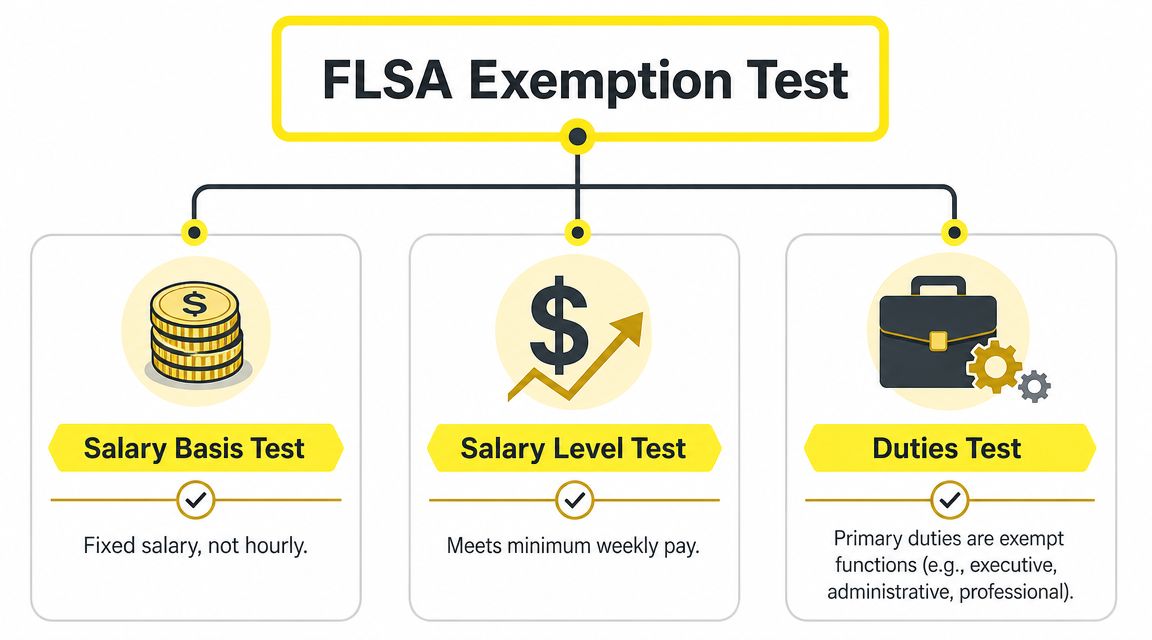
Salary basis test
An exempt employee must be paid on a salary basis. That usually means a fixed amount that does not change because the employee worked fewer hours in a given week or because a manager was unhappy with output.
This is often where payroll practices create avoidable exposure. A company pays a salary, docks pay for partial-day absences, or makes ad hoc deductions, then assumes the exemption still holds. In practice, those deductions can undercut the exemption before anyone even reaches the duties question.
A sound employment compliance review for payroll and classification practices should test how compensation is administered, not just how the offer letter describes it.
Salary level test
The employee must also meet the salary level test. Under the federal rules, the threshold was $684 per week through June 30, 2024, rises to $844 per week on July 1, 2024, and to $1,128 per week on January 1, 2025, as noted earlier.
Some categories use different figures. Federal rules also set a separate hourly minimum for certain computer employees and a higher annual compensation threshold for highly compensated employees, with part of that amount still needing to be paid on a salary basis.
The business takeaway is straightforward. Salary does not equal exempt. If a salaried employee falls below the required threshold, overtime exposure can still exist even if the title sounds senior.
Duties test
The duties test is usually the hardest part to get right. The employee’s primary duties must fit a recognized exempt category such as executive, administrative, professional, or outside sales. Job titles help very little. Actual authority, discretion, and day-to-day work carry far more weight.
A New York startup often learns this after hiring a “manager” who spends most of the week processing orders, answering support tickets, and following set workflows. That role may be important to the business, but importance is not the legal standard. If the employee is executing defined tasks rather than directing the business or exercising the required level of independent judgment, the exemption argument gets weak quickly.
I see this issue most often in scaling companies that want consistent titles across borders. A “Operations Manager” in Manhattan may be tested under the FLSA executive or administrative exemptions. An “Operations Manager” in Toronto may be reviewed under a different Ontario framework entirely. The title can stay the same, but the legal analysis cannot.
The duties test often exposes the gap between a founder’s org chart and what the employee is actually doing each week.
What non-exempt status means in practice
Non-exempt status requires discipline in time tracking and manager oversight. Remote work counts. After-hours calls count. Weekend log-ins, Slack messages, and short cleanup tasks can count too if they are part of the job.
Three operating habits reduce risk:
- Use timekeeping that matches real work patterns. If employees work from phones, laptops, and after-hours messaging tools, your system needs to capture that time.
- Train supervisors on overtime control. Many wage claims start with a manager informally expecting extra work, not with a payroll error.
- Match policy to practice. A written rule against unauthorized overtime does not remove the duty to pay for overtime that the company knew about or allowed.
For employers with teams in both New York and Ontario, this federal test is the U.S. starting point, not a universal rule for the whole company.
How New York and Ontario Rules Differ from Federal Standards
A founder salaries a Toronto manager, then uses the same title and pay structure for a hire in Manhattan. On paper, the roles match. In a wage-and-hour review, they often do not.
That is the practical problem for cross-border employers. U.S. federal law is only the starting point for a New York employee, and Ontario applies its own employment standards rules with its own exemption categories. Companies with teams on both sides of the border usually need employment policies designed for both jurisdictions, not copied templates with local add-ons.
Exempt vs. Non-Exempt At-a-Glance New York vs. Ontario
| Compliance Factor | New York State (NYS) | Ontario (ESA) |
|---|---|---|
| Governing Law | The FLSA sets the federal baseline, and New York may impose stricter wage-and-hour requirements | Ontario’s Employment Standards Act governs overtime and local exemption rules |
| Salary threshold focus | Salary level matters, but New York employers still need the duties and salary-basis analysis to hold up under U.S. law | Ontario uses a different statutory framework, and lower local pay levels do not make a New York role exempt |
| Overtime structure | Non-exempt employees generally receive overtime after 40 hours in a workweek under federal law | Ontario applies its own overtime rules and exemptions under the ESA |
| Manager and supervisor treatment | A manager title does not decide anything by itself. Actual authority and day-to-day duties control | Managers and supervisors may be excluded from overtime, but the test is framed differently than under the FLSA |
| Main compliance trap | Treating federal review as the full answer for a New York worker | Assuming an Ontario-compliant classification also works in New York |
Why New York creates added pressure
New York employers get into trouble when they stop after the federal analysis. That is a common mistake in growing companies, especially after a promotion or reorganization.
I often see the same pattern. A coordinator becomes a "manager," moves to salary, keeps handling the same client work or production tasks, and no one revisits whether the person now has real supervisory or administrative authority. The title changed. The legal exposure stayed in place.
New York also tends to produce harder questions around recordkeeping, overtime practices, and whether the company can defend its classification decision with actual facts, not just an offer letter.
Why Ontario creates different traps
Ontario has its own overtime exemptions for certain managers, supervisors, and professionals, but the analysis is not a U.S. duties test copied into Canadian law. That matters when a company tries to standardize roles across North America.
A compensation model that is acceptable for an Ontario employee may fail the U.S. salary requirements for an employee in New York. The reverse problem comes up too. A role that appears clean under a U.S. exempt analysis may still need a separate Ontario review because the local exemption categories and overtime rules are framed differently.
"One North American template" usually means one set of documents and two different compliance problems.
What this means for NY and Ontario businesses
For businesses hiring in both places, the legal question is not whether the title sounds senior enough. The question is which rules apply to the employee performing the work, in the place where that work is legally tied.
Review these points for each role:
- Where is the employee working as a legal and practical matter?
- What pay method applies to that role in that jurisdiction?
- What duties fill most of the employee's week?
- Which overtime rule applies if hours run long?
- Can the company defend the classification with documents, manager testimony, and real workflow evidence?
The safest process is a jurisdiction-by-jurisdiction review of the same role before expansion, transfer, or promotion. That takes more effort upfront. It is far less expensive than defending a wage claim in New York while fixing payroll practices for Ontario at the same time.
Real-World Examples of Job Classifications
The fastest way to understand exempt v non exempt is to look at actual roles. In practice, the title rarely decides the issue. Duties, authority, and how the work is performed do.

Office manager
An office manager may be exempt, or may not be. If the person mostly schedules vendors, orders supplies, handles reception coverage, and follows established processes, that role often looks more like non-exempt operational support. If the person actively manages staff, controls budgets, and exercises authority over significant business decisions, the argument for exemption gets stronger.
Software engineer
This role causes confusion because founders assume technical work automatically means exempt. Sometimes it does. Sometimes it doesn't. A highly skilled engineer paid above the applicable threshold and performing professional-level work may fit an exemption analysis more comfortably than a junior developer who works from assigned tickets with little independent authority.
Executive assistant
This role sits in a gray zone more often than employers expect. Supporting a founder or executive doesn't automatically make someone exempt. If the assistant coordinates calendars, travel, and administrative tasks under close direction, non-exempt treatment is often the safer starting point. If the role includes high-level decision support and genuine discretion on matters of significance, the analysis changes.
Paralegal and senior attorney
In cross-border businesses, role comparison can be sharp. A paralegal is typically non-exempt and requires overtime tracking, which creates audit exposure. A senior attorney is typically exempt if the primary duties involve independent judgment, such as contract negotiation or IP strategy, as discussed in the Enform HR classification example.
The same department can contain both exempt and non-exempt roles. Legal, finance, and operations teams often do.
A useful internal test is simple. Ask what the employee decides without approval, what policies the employee can depart from, and whether the company sells that person's work as part of its core service. Those answers usually tell you more than the title ever will.
A related contract issue is whether dispute resolution terms fit the workforce you're building. For some businesses, arbitration agreements in employment contracts may become part of the broader risk strategy.
The Financial and Legal Risks of Misclassification
Misclassification is rarely a small bookkeeping error. Once a company gets it wrong, the costs may spread across payroll, legal defense, management time, employee relations, and transaction readiness.

The scale of enforcement is significant. The U.S. Department of Labor recovered over $284 million in back wages for 216,000 workers in FY 2022, with many violations tied to misclassification and unpaid overtime, according to the Economic Policy Institute's discussion of overtime protections and enforcement.
How liability usually builds
A classification error often begins unnoticed. An employee works extra hours. Nobody records them because the role is treated as exempt. The employee leaves, speaks with counsel, or files a complaint. Then the company has to reconstruct time, defend the classification, and explain payroll decisions.
The practical exposure may include:
- Back overtime pay: The employer may owe unpaid wages for past work.
- Government scrutiny: A wage-and-hour complaint may trigger a broader review.
- Class or collective claims: If one role was misclassified, similar roles may be examined too.
- Deal friction: Buyers, investors, and lenders often examine employment compliance during diligence.
Why cross-border businesses feel this differently
Cross-border companies face an extra layer of complexity. They often use one finance team, one HR stack, and one set of managers across both jurisdictions. That structure is efficient until a local rule conflicts with the template.
A New York issue may also spill into other areas. If a payroll practice draws regulator attention, it may intersect with broader internal controls, document preservation, and investigative risk. In more serious situations, businesses sometimes need counsel experienced in white-collar defense and regulatory investigations.
Wage-and-hour mistakes are rarely isolated. They often reveal larger control problems inside a growing company.
The reputational cost matters too. Employees who believe the company cut corners on pay tend to scrutinize everything else more closely, including bonus plans, vacation policies, and termination practices.
A Proactive Checklist for Auditing Your Classifications
The most effective classification audits are practical, not theoretical. You don't need a glossy org chart. You need to know how people are paid, what they do, and whether your documents match reality.
The urgency is rising. Verified data notes that 27% of misclassifications involve salaried employees paid below the new thresholds who are incorrectly denied overtime, and that proactive audits matter because improper deductions for work quality or quantity may also defeat the exemption, as described in the Paychex-related video summary on overtime rule hikes and misclassification risk.
Start with the documents
Gather the materials that define the role on paper:
- Offer letters and contracts: Check salary language, overtime language, and any inconsistent provisions.
- Job descriptions: Compare the stated duties to what managers expect in practice.
- Payroll setup: Confirm whether the employee is coded as salaried exempt, salaried non-exempt, or hourly non-exempt.
If the documents conflict with each other, fix that first. Inconsistency is often the earliest warning sign.
Then test reality against the paperwork
Interview the manager. If needed, speak with the employee. Ask what decisions the role controls, what approvals are required, and how often the person works beyond regular hours.
Three questions usually surface the issue quickly:
- Does the employee meet the salary basis requirement, without improper deductions?
- Does the employee meet the salary threshold that applies to the jurisdiction and timing?
- Do the actual primary duties fit the claimed exemption?
Review role changes, not just new hires
Many classification errors begin after internal promotions. A company changes pay status but never re-checks the duties. Another common problem appears when a remote employee relocates from Ontario to New York or begins splitting time in both places.
A clean audit trail matters. If you reclassify someone, document why, when the change took effect, and how payroll was updated.
If you find a problem
Don't treat reclassification as an admission of wrongdoing in every circumstance. Often it's a necessary correction. What matters is handling the transition carefully, including timekeeping setup, manager training, and any payroll remediation that may need to be considered based on the facts.
Useful next steps often include:
- Update the job description
- Correct payroll coding
- Train the supervisor on overtime approval and recording
- Review whether similar roles were classified the same way
- Preserve the audit record
A focused internal audit is usually cheaper and calmer than responding after a complaint, an acquisition diligence request, or a regulator's inquiry.
Build Your Business on Solid Legal Ground
Exempt v non exempt decisions sit at the intersection of payroll, management, contracts, and risk. They look administrative until they aren't. For a company operating in both New York and Ontario, that pressure increases because one employee handbook or one compensation template usually isn't enough.
The practical takeaway is straightforward. Review classifications early. Revisit them when roles evolve. Treat cross-border hiring as a legal operations issue, not just a recruiting task.
If your business is growing across jurisdictions, employee classification may affect overtime exposure, compliance posture, and transaction readiness in ways that aren't obvious from the org chart. A careful review may save time, cost, and disruption later.
Build Your Business on Solid Legal Ground. Mayo Law advises startups and SMEs in Ontario and New York on cross-border employment, compliance, and business risk. If you're reviewing exempt v non exempt classifications, expanding your workforce, or updating employment agreements, schedule a consultation with Mayo Law.
LEGAL DISCLAIMER: The information provided in this article is for general informational and educational purposes only and does not constitute legal advice. Reading this article, visiting mayo.law, or contacting Mayo Law does not create an attorney-client relationship. The content of this article should not be relied upon as a substitute for professional legal counsel appropriate for your individual situation. Legal outcomes depend on the particular facts and circumstances of each individual case, and no attorney can guarantee a specific result. Laws, regulations, and legal procedures are subject to change and may vary by jurisdiction. If you require legal assistance, you should consult with a qualified attorney licensed to practice in the relevant jurisdiction. Mayo Law expressly disclaims any and all liability with respect to actions taken or not taken based on the contents of this article.