State courts across the United States enforced forum selection clauses in 77 percent of reported cases between 1972 and 2019, and that rate rose to 79 percent from 2010 to 2020. For a Canadian business signing a U.S. contract, that matters because the clause picking the court may work very reliably in the U.S. while facing tougher scrutiny in Canada.
You’re often asked to sign this clause near the end of a deal, buried with governing law, notices, and boilerplate. A founder scans past it, sees “exclusive jurisdiction of the courts of Delaware” or “consent to jurisdiction in New York,” and assumes it’s routine. Sometimes it is. Other times, it determines where a future dispute gets fought, which local lawyers you need, whether you can stop a parallel case elsewhere, and how much strategic advantage each side holds before the first motion is filed.
For Canadian companies doing business with U.S. customers, suppliers, investors, or acquirers, this is one of the most practical contract terms in the agreement. It’s not academic. It’s a cost-control term, a litigation-risk term, and often a negotiation term.
What Is a Forum Selection Clause and Why Does It Matter
A forum selection clause is the contract term that chooses the court or jurisdiction where disputes will be litigated. The easiest way to think about it is a pre-agreed home field for a game you hope never happens.

A Toronto software company signs a U.S. distribution agreement. The commercial terms look good. Then there’s one sentence saying all disputes “shall be brought only in the state courts of New York.” That sentence may decide whether a future claim is handled close to your team or in another country with a different litigation culture, different counsel, and different pressure points.
That’s why founders shouldn’t treat the clause as filler. In practice, it helps answer basic questions before there’s any conflict at all. Where will the case be filed? Who has to travel? Which court rules apply? Can one side sue somewhere else anyway?
Mandatory language and permissive language aren’t the same
The single biggest drafting mistake is confusing mandatory language with permissive language. Courts pay close attention to that distinction. As explained in McLane’s discussion of forum selection clause drafting, language such as “shall be brought only in” or “exclusive jurisdiction” is generally treated as mandatory, while wording like “consent to jurisdiction” is often treated as non-exclusive.
That difference sounds subtle, but commercially it isn’t.
- Mandatory clause: It tries to lock disputes into one chosen forum.
- Permissive clause: It usually says a forum is acceptable, not that it is the only place a case may proceed.
- Bad practical result: A business may think it bought certainty, when in reality it only created another argument.
Practical rule: If you want one court to be the only court, say so directly. “Exclusive” and “only” do real work.
Why founders should care early, not after a dispute
This clause matters most when the deal is still friendly. Once a dispute starts, nobody wants to make concessions about venue. By then, forum becomes strategy.
A strong clause can reduce uncertainty in a stock deal, licensing arrangement, supply contract, or cross-border services agreement. A weak one can create procedural fighting before anyone reaches the merits. If you’re already negotiating transaction documents, this is the stage to raise it, just as you would in stock purchase agreements.
A simple analogy that usually helps
Think of three versions of the same sports contract:
| Clause style | What it really means | Business effect |
|---|---|---|
| “Disputes shall be brought only in Ontario courts” | One agreed court system | Highest predictability |
| “Parties consent to Ontario jurisdiction” | Ontario is allowed, not required | Risk of parallel litigation |
| “Disputes may be brought in Ontario or New York” | Multiple acceptable venues | More flexibility, less certainty |
None of those clauses is automatically right or wrong. The right answer depends on bargaining power, deal structure, and where your company can realistically defend itself. But if you don’t know which version you’re signing, you’re giving up control without meaning to.
Enforceability Showdown US vs Canada
A Toronto founder signs a SaaS agreement with a U.S. customer. The contract says all disputes must be brought in New York. Six months later, payment stops, the customer sues first, and the fight turns into two separate arguments. One is about the invoices. The other is about whether New York gets to hear the case at all. That second fight is where cross-border contracts often go off course.
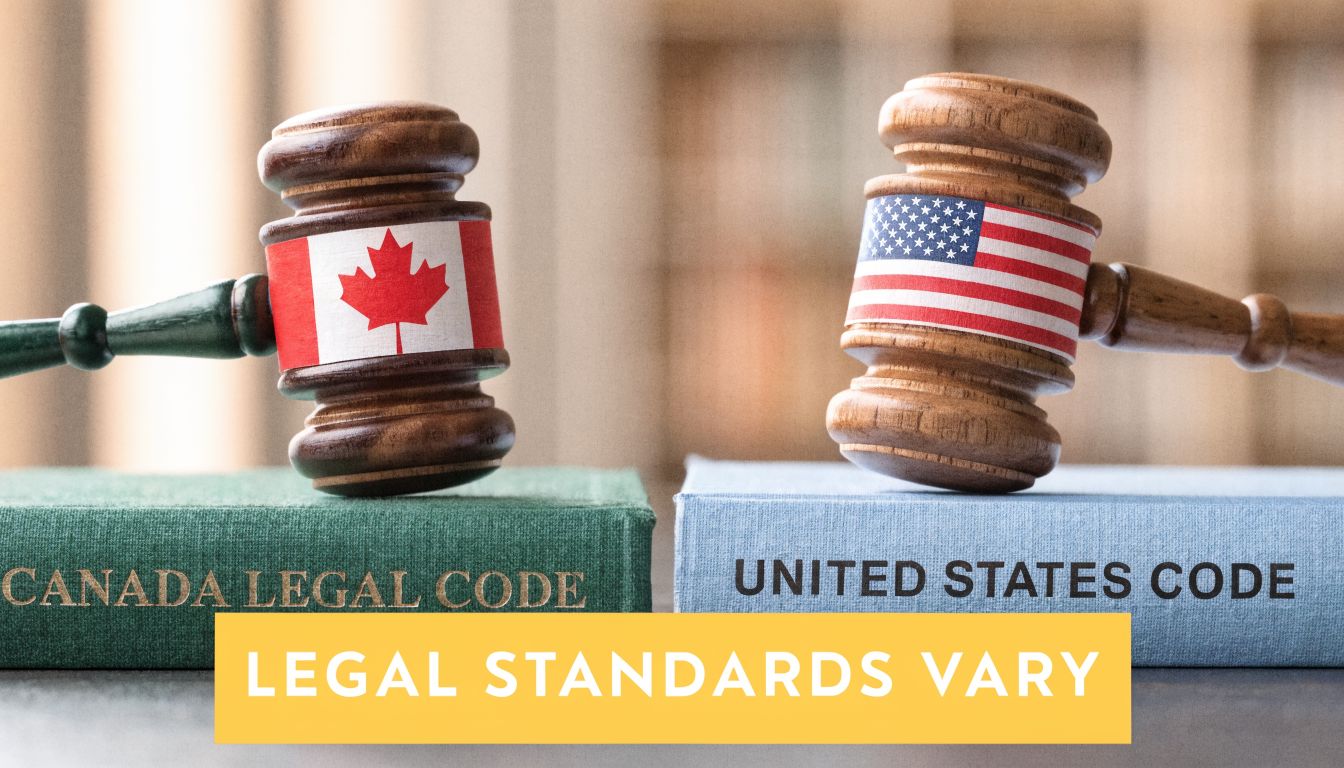
A lot of writing on forum selection clauses assumes a U.S. starting point. Canadian companies need a different lens. The clause may look settled on paper and still produce a harder enforcement question once a dispute crosses the border.
The U.S. starts from enforcement
In the United States, forum selection clauses have generally been treated as presumptively enforceable since the Supreme Court’s decision in M/S Bremen v. Zapata Off-Shore Co. That matters because the clause begins with momentum. The party resisting it usually carries the harder argument.
That approach shows up in practice. According to Columbia Blue Sky's court-enforcement data on forum selection clauses, U.S. state courts enforced these clauses in most reported cases over multiple decades, with high enforcement rates in forums such as Delaware, California, New York, and Florida.
For a startup signing a U.S. form contract, that has a concrete consequence. A New York or Delaware forum clause often will be enforced as written, so the cost of litigating away from home is not hypothetical. It should be priced into the deal at signing, not discovered after service of a claim.
A forum clause often decides whether the parties argue about the contract once, in one court, or spend months and legal fees arguing about where the case belongs.
Canada gives courts more room to intervene
Canadian courts use a different framework. The key concept is the strong cause test. A Canadian court may give effect to the clause, but it has more room to examine fairness, convenience, public policy, and the surrounding circumstances before holding a party to the chosen forum.
That difference matters for Canadian businesses because the same clause can face a more skeptical review north of the border than it would in a U.S. court. U.S. counsel may view the clause as routine. Canadian counsel will usually ask a second question. If enforcement is challenged here, what facts will the court care about?
In my experience, founders often miss that distinction because the wording looks familiar. The risk is not bad drafting alone. The risk is assuming the clause will travel cleanly across the border when the enforcement analysis does not.
The cross-border problem is the mismatch
The hard part is the asymmetry between the two systems. A U.S. company may treat a New York forum clause as the end of the venue discussion. A Canadian company may still have room to argue that the clause should not control in the circumstances. That mismatch creates delay, added motion practice, and pressure to settle on bad terms.
This is where drafting discipline matters. If the forum clause points to court litigation in one place, but the rest of the dispute section points in another direction, the clause becomes easier to attack. In some deals, arbitration offers a cleaner enforcement path than a court forum clause, especially if both sides may need to enforce rights in different countries. For that analysis, see this guide to arbitration in Canada, including Ontario rules and cross-border enforcement.
Forum choice inside the U.S. still matters
“U.S. courts” is not a serious drafting choice. The forum should be a state, and often a specific county or federal district, selected for a business reason you can defend later.
If the counterparty proposes Delaware, that usually reflects familiarity, predictability, and the fact that many companies are organized there. If they propose a distant state with no obvious tie to the deal, ask why. Sometimes the answer is administrative convenience. Sometimes the point is to raise your cost of defending the case.
For Canadian businesses, that question is more than negotiation theatre. It is part of enforcement strategy. A clause that works well for a U.S. enterprise customer can be expensive and awkward for a Canadian startup unless the rest of the contract, the governing law, and the dispute mechanism all line up.
The Three-Legged Stool Choice of Law Forum and Arbitration
A Canadian company signs a U.S. SaaS agreement that selects Delaware law, names New York courts, and then drops an arbitration sentence into the boilerplate near the end. The first dispute does not start with the merits. It starts with a fight over where the fight belongs.
That is why these clauses have to be read together.
In cross-border contracts, three terms do different jobs: choice of law, forum selection, and arbitration versus court litigation. If they point in different directions, the clause set stops being a plan and becomes a preliminary dispute.
Choice of law decides the rules
A choice of law clause answers which substantive law governs the contract. It deals with the rules a judge or arbitrator applies to the parties’ rights and obligations.
For a Canadian founder, this point gets missed often in U.S. paper. “Governed by Delaware law” does not tell you where a claim must be brought. It tells you which legal system will be used to interpret the contract. That can still matter a great deal on remedies, limitation issues, implied duties, and how courts read boilerplate.
Forum selection decides the courtroom
The forum selection clause chooses the court that will hear the dispute. It is about location and judicial system, not the underlying contract rules.
Those two clauses can be mixed. An Ontario company can agree to New York courts applying Ontario law, or Ontario courts applying California law. Both arrangements are legally possible. Both can also be expensive. A U.S. court applying Canadian law usually means extra briefing, expert evidence on foreign law, and more room for procedural skirmishing before anyone reaches the business problem.
Arbitration is a separate system
An arbitration clause does not merely pick another venue. It replaces court litigation with a private dispute process, subject to court supervision at the edges.
That difference matters at the border. If enforcement may be needed in more than one country, arbitration can offer a cleaner path than a court judgment in some cases. But only if the clause is drafted to work with the rest of the agreement. A contract that requires exclusive court proceedings in Ontario and then requires binding arbitration in New York invites a threshold fight that burns time and money.
I often tell founders to read these provisions as a package, not line by line. If one clause says “exclusive jurisdiction of the courts of British Columbia” and another says “any dispute shall be settled by arbitration in Texas,” someone has created ambiguity where the contract should have closed it.
A cross-border commercial agreement should also be checked against any stand-alone arbitration agreements in employment contracts or related documents if the deal includes founders, executives, or key staff.
Scope is where drafting failures show up
The hardest disputes are often about claims at the edge of the contract. A clause may clearly cover a breach of contract claim but leave room to argue about negligent misrepresentation, statutory claims, unjust enrichment, fiduciary duty, or competition claims.
That problem shows up often in U.S.-Canada deals. U.S. templates commonly use short phrasing such as “arising under this agreement” without much thought to cross-border enforcement strategy. If the clause is narrow, one side may try to litigate contract claims in the chosen forum and push related tort or statutory claims somewhere else. Now the parties have parallel proceedings, inconsistent timelines, and pressure to settle for cost reasons rather than merits.
Good drafting avoids that result. The dispute clause should make a clear decision about all three legs of the stool, and the language should be broad enough to catch the claims the parties are most likely to bring in real life, not just the claims they hope will be brought in theory.
Drafting Your Forum Selection Clause Best Practices
Boilerplate is where expensive mistakes hide. A good forum selection clause is short, but it shouldn’t be casual.

Use words that actually close the door
If exclusivity is the goal, use exclusivity words. “Only,” “exclusive,” and “must” do the heavy lifting. “Submit to jurisdiction” often does not.
Founders sometimes resist firm wording because it feels aggressive during negotiation. In reality, clarity is often the more commercial choice. Ambiguity doesn’t preserve the relationship. It just postpones the fight until it becomes more expensive.
Draft for the claims you don't want split apart
The biggest practical drafting issue after exclusivity is scope. As explained in Professor Coyle's discussion of scope in forum clauses, narrow clauses may cover only contract claims, while broad clauses can reach contract, tort, statutory, and equitable claims. The same source emphasizes that language covering “all claims, whether arising in contract, tort, statute, or equity” helps avoid fragmentation.
That matters in ordinary business settings:
- Supply agreement problem: The contract claim goes to the chosen court, but a negligence claim over the same facts is filed elsewhere.
- Share sale problem: A purchase-price dispute fits the clause, but a statutory misrepresentation claim triggers a new forum battle.
- IP licence problem: Breach claims are centralized, but related unfair competition or statutory claims are not.
Drafting point: If your business goal is one dispute in one place, your clause has to say more than “contract disputes.”
A similar drafting discipline helps in other commercial provisions too, including rights that appear simple but create major procedural consequences, such as a right of first offer clause.
Pick a forum your business can actually use
The “best” forum in theory can be the wrong forum in practice. A startup may accept Delaware because investors are comfortable with it, but that choice still has operational consequences. Who signs affidavits? Which witnesses need to travel? Is local counsel required? Is the chosen court tied to the actual deal, or was it inserted by habit?
A few useful questions help:
| Drafting issue | Better approach | Weak approach |
|---|---|---|
| Exclusivity | “shall be brought only in” | “consent to jurisdiction” |
| Scope | “all claims, whether arising in contract, tort, statute, or equity” | “disputes under this agreement” |
| Court identification | Specific court system named clearly | Vague references to “courts of competent jurisdiction” |
| Fit with transaction | Chosen forum has business logic | Forum appears one-sided or arbitrary |
Watch for non-signatory complications
Not every future dispute involves only the signatories. Parent companies, affiliates, officers, guarantors, and related entities often become part of the conflict. The verified data notes that virtually none of the analyzed clauses addressed non-signatories explicitly. That omission can become a serious litigation issue.
If affiliates or principals are central to performance, don’t assume the clause will neatly bind everyone later. Address that point while the deal is still on the table.
A Practical Checklist for Cross-Border Contracts
When a contract lands in your inbox, you don’t need a lecture. You need a review tool. Start with these questions before you sign.
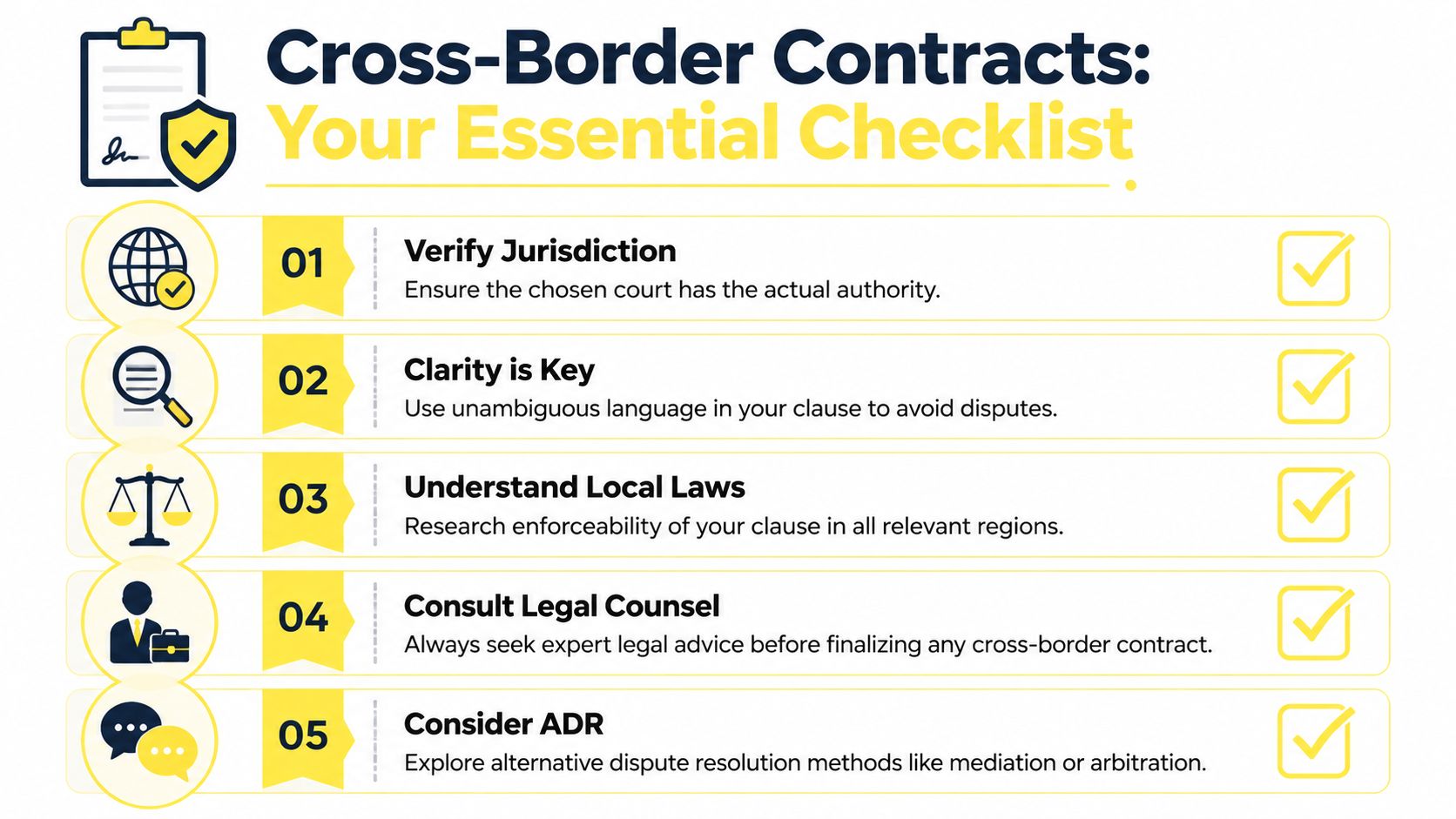
Five questions worth asking every time
-
Is the clause mandatory or permissive? Look for “exclusive,” “only,” or similar words. If they aren’t there, don’t assume the clause blocks litigation elsewhere.
-
Why was this forum chosen? Delaware and New York may be commercially understandable. A distant forum with no deal connection deserves a closer look.
-
Does the scope cover non-contract claims? If the clause only covers claims “under” the agreement, ask whether related tort or statutory claims could be filed somewhere else.
-
Does it conflict with the arbitration clause or governing-law clause? A neat-looking forum clause can still create confusion if another part of the agreement sends disputes to arbitration or picks a different legal system.
-
Can your business realistically litigate there? Budget, witnesses, management time, and access to documents all matter.
Two more checks that are easy to miss
Some cross-border files also involve formalities outside the core contract. If you’re signing powers of attorney, certificates, or supporting documents for a U.S. transaction, document authentication can become part of the workflow. That’s where practical issues such as how to get an apostille in New York can unexpectedly intersect with deal timing.
And don’t forget to review related documents, not just the main agreement. Side letters, guaranties, order forms, online terms, and annexes sometimes use different dispute language. A clean master agreement won’t save you if the operative document points somewhere else.
If the contract chooses one forum, the annex chooses another, and the online terms choose arbitration, you don’t have a dispute plan. You have three future motions.
Frequently Asked Questions About Forum Selection Clauses
Can I negotiate a forum selection clause or is it take-it-or-leave-it
Often, yes.
The answer usually turns on bargaining power, deal urgency, and how badly each side wants the contract signed this quarter. Even where a U.S. counterparty refuses to move the dispute to Ontario or another Canadian forum, there is often room to tighten the clause by clarifying whether it is exclusive, how broadly it applies, and how it fits with the governing law and arbitration provisions. Those edits can matter just as much as the named court.
What happens if a contract has no forum selection clause
The dispute starts with a fight about where the dispute belongs.
For a Canadian company in a U.S. deal, that can mean threshold motions, delay, duplicated legal spend, and pressure to settle on bad terms to avoid the venue fight. A missing clause rarely creates flexibility in practice. It usually creates cost.
Is New York always the right choice for a Canadian business
No. New York is common because commercial parties know it, courts there see complex contract disputes, and many U.S. templates default to it.
But common is not the same as sensible. If the witnesses, records, operations, and enforcement issues point elsewhere, New York may serve the other side far better than it serves your business. Canadian founders should treat "New York courts" as a business term with a price tag, not as neutral boilerplate.
Can a forum selection clause cover tort and statutory claims too
Yes, if the drafting is broad enough.
A clause limited to disputes "under this agreement" may leave room for negligence, misrepresentation, oppression, consumer protection, privacy, or other statutory claims to be argued in a different forum. In cross-border drafting, scope words do real work. If the goal is one forum, the clause should say so clearly.
Are these clauses enforceable in online click-wrap contracts
They can be. The central question is whether the user had fair notice of the terms and clearly assented to them.
I see this issue most often where a company has decent legal language buried inside a poor sign-up flow. If acceptance records are weak, the forum clause may become harder to enforce when the dispute matters.
Should we choose a neutral third-country or third-province forum
Sometimes, especially where both sides want to reduce home-court advantage.
Still, neutrality is only useful if the forum is practical. The court must be accessible, commercially competent, and legally consistent with the rest of the contract. A "neutral" forum that adds travel, local counsel, procedural uncertainty, or enforcement headaches is often an expensive compromise.
Do I need to match the forum selection clause with the governing law clause
Not necessarily. But if they do not match, that should be a deliberate choice.
A court in one jurisdiction can apply the law of another. That structure can work. It also increases cost and complexity, particularly when a Canadian business is litigating in the U.S. under a legal system it did not choose, or vice versa. If there is a mismatch, make sure someone on your side can explain the business reason in one sentence.
A strong forum selection clause does not prevent every dispute. It does prevent one of the most wasteful early battles in cross-border litigation. For Canadian businesses signing U.S. contracts, that is often the difference between a manageable dispute and a procedural mess before the merits are even heard.
If you are reviewing a U.S. contract from a Canadian perspective, Mayo Law can assess whether the forum selection clause fits your actual litigation risk, strategic advantage, and enforcement strategy on both sides of the border. Joseph Mayo is licensed in Ontario and New York, which matters when a clause needs to hold up in real cross-border use, not just look polished in a template.
Joseph Mayo is the principal lawyer at Mayo Law, licensed in Ontario and New York, with a Master's degree from NYU School of Law. He advises clients on business law matters across the GTA and cross-border between Canada and the U.S. Learn more at Joseph Mayo's profile.
For regulatory information, readers can also review the Law Society of Ontario lawyer directory and general court information from the Government of Canada.
This article is for informational purposes only and does not constitute legal advice. Every situation is different. Consult a licensed lawyer about your specific circumstances.