By Joseph Mayo
Published: May 6, 2026 | Last updated: May 6, 2026 | Read time: 12 minutes
You open the mail, see the USCIS interview notice, and feel two things at once. Relief, because the case is moving. Anxiety, because now you have to sit across from an officer and answer personal questions about your marriage.
That reaction is normal. A marriage interview for green card purposes is not designed to reward polished performances. It is designed to help the officer decide whether your marriage is real, ongoing, and supported by the facts in your file.
At Mayo Law, we help clients in Toronto, the GTA, and across the border work through immigration issues that often involve both Canadian and U.S. documents, records, and timelines. For many couples, the hardest part is not the relationship itself. It is presenting that relationship clearly, consistently, and calmly in a legal setting.
TL;DR: Focus on three things: complete evidence, honest and consistent answers, and a clear understanding of the interview process. Marriage-based green card applications face denial rates in the 10 to 20 percent range, so careful preparation matters (USCIS-related denial data summarized here).
If you're looking for practical guidance from an immigration attorney near you, start with this approach: review the filing line by line, organize current relationship evidence, and prepare to answer only what was asked, truthfully and without guessing.
Your Green Card Interview Is Scheduled Now What
You open the notice, confirm the date, and then the real question hits. What should you do between now and the interview so the case is presented clearly and accurately?
Start with this: an interview notice is progress, but it is also a shift in how USCIS will evaluate the case. The officer will not rely only on forms and uploaded documents. The officer will compare the file to your answers, your updated records, and the practical details of your life together.
For U.S.-Canadian couples, that review often gets more complicated than couples expect. Cross-border marriages can be genuine and still look unusual on paper. Different mailing addresses, employment in one country and residence in the other, frequent border crossings, separate bank systems, and delayed joint accounts can all raise questions if you do not explain them cleanly.
The first job is to audit the case you already filed. Read every form, every prior statement, and every piece of supporting evidence. If one spouse handled the paperwork, both spouses need to know what was submitted. I often see avoidable problems start there. A couple tells the truth at the interview but contradicts a date, address history, or work timeline that appears in the file.
Then get organized.
- Build one master timeline: first meeting, dating history, engagement, wedding, moves, travel, job changes, and any periods of living apart.
- Update the evidence: bring recent proof that the marriage is ongoing, including newer records created after filing.
- Identify issues that need explanation: prior marriages, inconsistent addresses, commuter marriages, remote work, long-distance stretches, or gaps in joint financial records.
- Prepare for cross-border questions: if you are a U.S.-Canadian couple, be ready to show how you manage money, housing, taxes, travel, and employment across two systems in practice.
- Practice answering out loud: keep it factual and natural. Officers want clear answers, not rehearsed speeches.
A strong interview file does not mean an overstuffed folder. It means the evidence matches your real life.
That point matters for Canadian spouses in particular. Many couples do not fully combine finances right away because they are waiting on work authorization, a Social Security number, a U.S. move, or access to joint banking on both sides of the border. That is not fatal. It does mean you should bring the records that show how the relationship functions in practice, such as shared travel, beneficiary designations, communication during time apart, joint lease planning, wire transfers, money sent for household expenses, or proof that one spouse is added to insurance or employer benefits.
If the facts are complicated, address them before interview day. Couples with cross-border work schedules, commuter arrangements, or recent relocations often benefit from getting case-specific guidance from a marriage green card interview attorney near you, especially where the paperwork does not tell the full story on its own.
One final point. Do not treat preparation as memorizing answers. Treat it as getting both spouses comfortable with the same truthful timeline, the same documents, and the same explanation for any fact that might look unusual at first glance.
Couples usually do well when their documents are current, their answers are direct, and the practical realities of a cross-border marriage are explained before the officer has to guess.
The Interview Timeline From Notice to Decision
The notice often lands in the mailbox on an ordinary day, then the questions start immediately. How long will the interview take. What happens if the officer focuses on the months you lived on opposite sides of the border. Which documents matter if your bank, job history, and address records span both the U.S. and Canada.
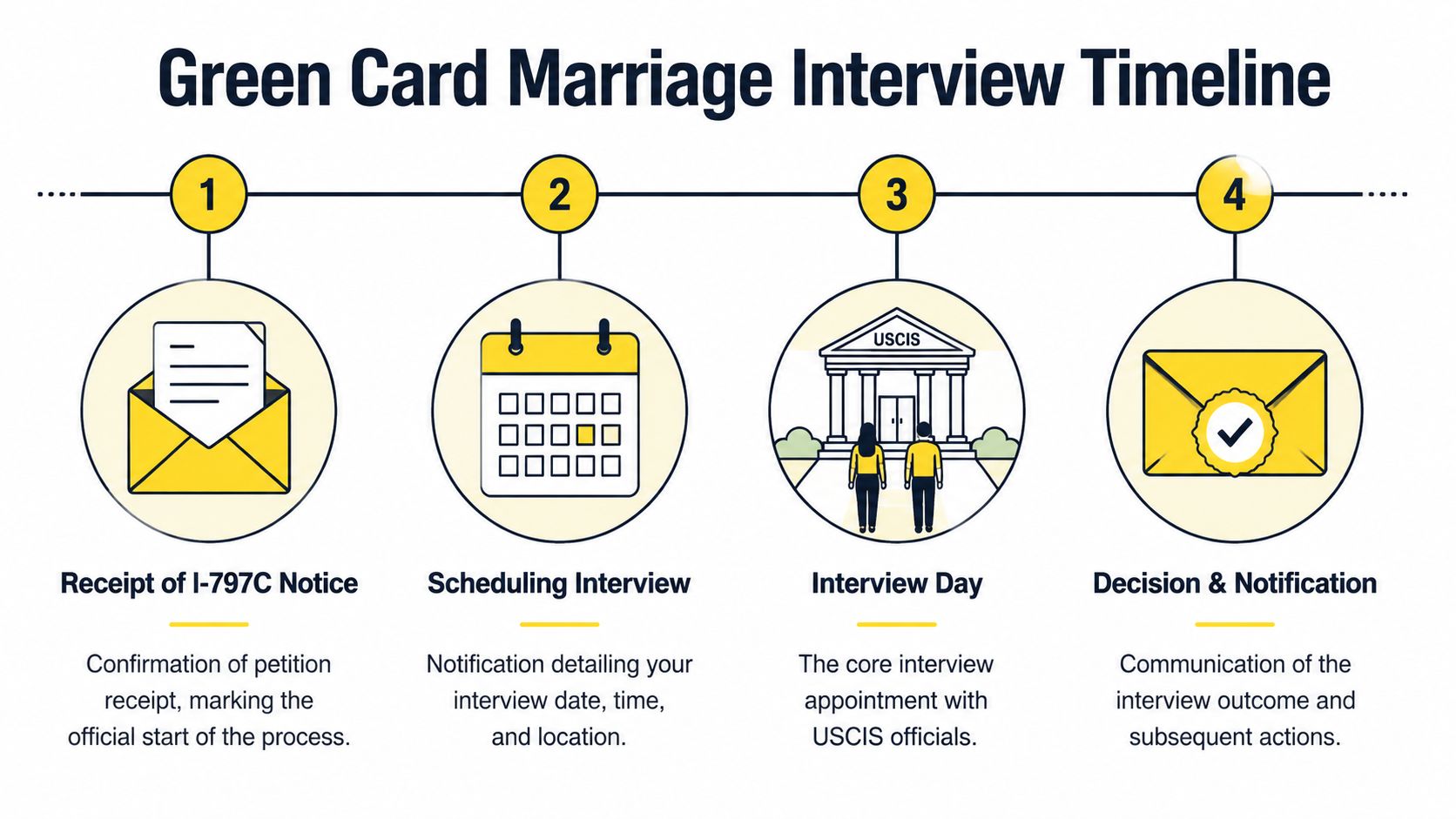
The interview process is usually more orderly than couples expect. The pressure comes from uncertainty, not from chaos. If you have already been through another immigration filing, such as getting a green card through employment, some of the procedural rhythm will feel familiar. A marriage case is different because the officer is reviewing forms, updated records, and the credibility of your shared life at the same time.
After the notice arrives
Start with the notice itself. Confirm the date, time, field office, and any instructions about what to bring. Then compare that notice with the forms and supporting documents already filed so there are no surprises about dates, addresses, travel, prior marriages, employment, or immigration history.
For U.S.-Canadian couples, this is usually the point where the real preparation begins. Cross-border marriages often include facts that are perfectly legitimate but easy for an officer to misread without context. One spouse may still have a Canadian employer. A couple may have used separate banks in each country. A recent move may leave a trail of mixed addresses, commuter records, or short-term housing. Those facts do not make the case weak. They do need a clear timeline and current records.
What interview day usually looks like
Arrive early and bring the interview notice, identification, and your organized file. Federal buildings run on security procedures and call lists. A late arrival can create an avoidable problem before the officer asks a single question.
The day usually follows a predictable sequence:
- Security screening at the building entrance.
- Check-in with your notice and government-issued identification.
- Waiting time until the officer calls your case.
- Interview in a private office or interview room.
- Follow-up processing if the officer needs additional review or documents.
Some interviews move quickly. Others take longer because the officer is updating the file, reviewing prior submissions, or asking for clarification on a point that looked inconsistent on paper.
What officers often focus on
Marriage interviews usually cover the relationship timeline, living arrangements, finances, family, employment, and day-to-day routines. For Canadian spouses, employment history often gets more attention than couples expect. Officers may want a clean explanation of where each spouse worked, in which country, under what status, and how the couple managed periods of distance or commuting.
Residency issues also come up often in cross-border cases. If one spouse kept a Canadian address for work, taxes, family obligations, or a gradual move to the United States, be ready to explain that plainly. The same goes for financial records. Separate accounts in two countries are not unusual. What matters is whether the records make sense together and match the way the marriage functioned during that period.
If the officer sees a concern about credibility, the case may receive closer review, including separate questioning in more serious situations. That is why consistent timelines matter. The goal is not perfect wording. The goal is accurate, matching facts.
When a decision comes
Some couples receive a clear verbal indication at the end of the interview. Many do not. A case can be approved later, held for supervisory review, or followed by a request for additional evidence.
Do not try to read too much into the officer's tone. A quiet interview can still lead to delays if the file needs another internal step. A more detailed interview can still end in approval if the officer was working through cross-border facts that were not obvious from the paperwork.
Practical rule: Treat the interview as a credibility check tied to documents. Bring current records, bring originals where available, and be ready to explain any U.S.-Canada detail that could look unusual without context.
For consular information, where applicable, review travel.state.gov.
Assembling Your Complete Interview Evidence File
Most weak interview files fail for a simple reason. They don't tell a coherent story.
The strongest evidence package is not the thickest one. It is the one that lets the officer quickly see a real marriage unfolding over time through records, shared obligations, and ordinary life.
For U.S.-Canada couples, this part deserves special attention. Many generic guides focus only on U.S. leases, U.S. taxes, and U.S. bank records. As noted in this discussion of I-485 marriage interview questions and cross-border evidence gaps, officers may closely examine Canadian financial and residency records when a couple’s life spans both countries.
Organize the file by story, not by panic
A good interview binder usually works best when divided into clear sections. Think like the officer. The file should answer four practical questions:
- Are you legally married?
- Do you live a shared life?
- Are your finances connected in a real way?
- Does your evidence continue up to the present?
Marriage Green Card Interview Document Checklist
| Category | Primary Documents | Secondary Evidence |
|---|---|---|
| Legal identity and status | Passports, government photo ID, marriage certificate, divorce records if applicable | Prior immigration notices, birth certificates |
| Joint residence | Lease, mortgage records, utility bills, address records | Mail addressed to both spouses, driver’s licenses showing same address |
| Joint finances | Bank statements, credit card statements, tax records, insurance policies | Beneficiary designations, shared purchases, proof of transfers between spouses |
| Shared life | Wedding photos, travel records, photos over time, evidence of visits with family | Messages, invitations, memberships, event bookings |
| Ongoing relationship updates | Recent statements and current records since filing | New trips, recent photos, updated bills, household records |
What officers actually find useful
Bring originals where possible, and copies in a clean, tabbed folder. Don't hand over loose screenshots in random order. Don't bury the strongest evidence under repetitive material.
Useful evidence usually includes:
- Joint financial records: Accounts used by both spouses, not accounts opened and ignored.
- Housing records: A lease or mortgage is strong, but so are consistent records showing the same address.
- Insurance and benefits: Health, auto, tenant, or life insurance showing each spouse listed in a meaningful way.
- Photos over time: A small, sensible set that shows the relationship in different settings and with other people.
- Travel records: Especially helpful when the couple spent time apart because of work, visas, or border issues.
Bring recent evidence even if similar documents were filed before. The officer is checking whether the marriage is ongoing, not frozen in time.
Cross-border evidence for U.S.-Canadian couples
Careful explanation matters more than volume.
If one spouse still has Canadian employment, Canadian tax filings, a provincial health card, or a Canadian bank account, none of that is automatically harmful. The issue is whether the records fit a believable cross-border life. If they do, present them in an organized way and be ready to explain why they exist.
For example:
- Canadian tax returns: These can support legitimacy when they align with residence and employment history.
- Cross-border banking: If you use accounts in both countries, show how each account fits the household.
- Canadian address history: If one spouse kept a Canadian address for work, family care, or transition planning, explain that directly.
- Property in Canada: Ownership is not the problem. Silence is. If the couple's living arrangements are split temporarily, document the reason.
Some supporting documents may need formal authentication depending on how they will be used in other contexts. If you are dealing with public documents issued in New York, this guide on how to get an apostille in New York may help with document planning.
What doesn't work
A few patterns create avoidable trouble:
- Brand-new joint accounts with no activity
- Stacks of photos but almost no financial or residence evidence
- Conflicting addresses across IDs, tax records, and forms
- Documents submitted without context for a cross-border lifestyle
A clean file says, “Here is our life, and here is why the records look the way they do.”
Navigating Interview Questions and Common Red Flags
The interview usually feels hardest in the waiting room. Then the officer starts with simple questions, and many couples realize the test is more practical than theatrical. USCIS is trying to decide whether your answers, documents, and day-to-day life fit together.

Before the appointment, review a realistic set of questions asked in immigration marriage interviews and practice answering them plainly, without trying to memorize a script. Good preparation improves clarity. Over-rehearsal creates problems.
The question categories you should expect
Officers often start with the basic timeline and then work into ordinary married life. They may ask how you met, when the relationship became serious, who proposed, and what happened at the wedding. From there, the questions often shift to routines, money, work, family, and future plans.
A typical interview covers topics like these:
- Relationship history: first meeting, dating timeline, proposal, ceremony
- Home life: current address, living arrangements, routines, chores
- Finances: bank accounts, rent or mortgage, bills, taxes, insurance
- Family and social life: relatives, holidays, friends, shared events
- Future plans: work, travel, children, where you expect to live
For U.S.-Canadian couples, the hard part is often not the question itself. It is explaining a real cross-border life in a way that sounds as ordinary as it is. One spouse may still have a Canadian employer, a Canadian mailing address for a period of transition, or accounts on both sides of the border. Those facts can be completely consistent with a bona fide marriage if the explanation is direct and the paperwork matches it.
What red flags look like from the officer’s side
Certain patterns get closer attention because they can signal inconsistency or a thin documentary record. That does not mean the case is weak. It means the officer is more likely to test the details.
Common examples include:
- Different current addresses
- Very limited joint financial activity
- Long periods of separation
- Prior immigration filings involving other spouses or partners
- Criminal or immigration history that affects credibility
- Cross-border records that appear inconsistent without context
I see this often with Canadian spouses who commute, work remotely for a Canadian company, or kept ties in Canada during the move to the United States. The red flag is usually not the tie itself. The problem is an unexplained gap between the forms, the identification documents, the tax history, and the story told at the interview.
Give short, accurate answers. Then back them up.
Strong interviews often come from couples with complicated facts who explain those facts simply and consistently.
How to handle a Stokes interview
A Stokes interview involves separate questioning. Each spouse is interviewed alone, and the officer compares the answers afterward. USCIS may use this format when there are fraud concerns or when earlier filings, documents, or interview answers do not line up cleanly.
The wrong approach is to sound polished at all costs. Couples get into trouble when they guess, volunteer extra details, or try to force identical wording.
Use these rules instead:
- Answer only the question asked
- Do not guess
- Say “I don't know” or “I don't remember” when that is the truth
- Keep your pace steady
- Do not try to copy what you think your spouse will say
Small differences are normal. Real couples forget dates, mix up who paid a bill, or remember events from different angles. What causes concern is a pattern of contradictions on important points, such as where you live, how often you see each other, whether families have met, or who is responsible for major household expenses.
Mayo Law works with clients across the GTA and on cross-border matters. Joseph Mayo is licensed in Ontario and New York, so clients with U.S. ties can coordinate related legal work in one place rather than splitting it between two firms.
A practical example
Consider a Canadian spouse who still works remotely for a Canadian employer while spending substantial time with a U.S. citizen spouse in New York. That can be a real marriage with a perfectly reasonable transition period. But if the I-130, adjustment forms, tax records, banking activity, and address history are not aligned, the officer may treat cross-border complexity as inconsistency.
Now consider a different file. The couple opens a joint account days before the interview, brings dozens of wedding photos, and has little proof of shared financial responsibility or a shared home. Even when the marriage is genuine, that presentation can look thin.
The goal is not a polished performance. The goal is a credible record that matches the way you live.
Understanding Post-Interview Outcomes and Next Steps
The interview ends. The officer collects the file, says little, and the couple walks out trying to decode every facial expression. That reaction is normal. Many marriage cases are not decided in the room, especially where the record involves Canadian employment, a retained residence in Canada, frequent border travel, or accounts held on both sides of the border.

Post-interview results usually fall into four categories: approval, a request for more evidence, continued review, or denial. The right next step depends on which one you receive, and on why.
If the officer indicates approval
That is a good sign, but it is still a preliminary one. Wait for the formal notice and case update before making travel plans, changing employment, or assuming the process is over.
Keep a full copy of the interview packet you brought, including any updated joint records. For U.S.-Canadian couples, that matters more than people expect. If USCIS later asks why a Canadian lease remained active, why a Canadian employer still appears on payroll records, or why certain funds moved between Canadian and U.S. accounts, the answer should match the evidence already in your file.
If permanent residence is approved and your long-term plan includes citizenship, this guide on how to get U.S. citizenship after getting a green card explains the next stage.
If USCIS asks for more evidence
A follow-up request usually means the officer wants a cleaner record, not that the case is lost. Read the notice slowly. Then answer the exact concern.
A good response is targeted. If the issue is shared residence, send documents that show where you lived and for how long. If the issue is finances, send records that show real use of joint accounts, shared bills, or regular support between spouses. In cross-border cases, I often see couples hurt themselves by sending stacks of documents without explaining the Canadian piece. A short, clear cover letter can fix that. It should explain, for example, why one spouse kept a Canadian job during the transition, why a Canadian bank account remained open, or why the couple temporarily maintained two addresses.
Send updated evidence, not recycled filler.
If the case is held for review
Continued review after a decent interview is common. Sometimes the officer wants supervisory review. Sometimes the file needs security checks or another look at documents that raise cross-border residency questions.
This stage calls for patience and discipline. Save the interview notes while your memory is fresh. Keep collecting current relationship evidence after the interview, especially joint financial records, proof of time spent together, and any document that clarifies ongoing ties in both countries. If USCIS contacts you again, the strongest response usually comes from the same organized record you carried into the interview.
If the case is denied
Start with the denial notice, not your impression of how the interview went. The notice usually tells you whether the problem was missing evidence, legal ineligibility, credibility concerns, or a finding that the marriage was not proven.
That distinction matters. A documentary problem is handled differently from a credibility problem. For example, a Canadian spouse who kept working for a Canadian company or holding a Canadian residence may still have a valid case, but only if the forms, tax filings, address history, and supporting records tell one consistent story. If the denial points to contradictions, the solution is not more paper alone. The solution is a focused legal review of what conflicted, why it conflicted, and whether the record can be corrected.
One practical point bears repeating from earlier in the article. Couples get into trouble after the interview when they assume details no longer matter. They do. Missed notices, late responses, and thin updates can turn a manageable issue into a harder one.
Frequently Asked Questions About the Marriage Interview
What should we wear to the interview
Business casual is usually the safest choice. Dress neatly, comfortably, and conservatively. You don't need to look formal. You do need to look prepared and respectful.
Can a lawyer attend the interview with us
Yes, in many cases counsel can attend. A lawyer can't answer for you, but can help ensure the process is handled fairly and that issues are addressed properly if they arise.
What if we don't remember the same small detail
Small differences don't automatically ruin a case. The problem is material inconsistency, guessing, or obvious coaching. If you don't remember, say so plainly.
How should a Canadian spouse answer questions about work or a home in Canada
Directly and with context. Explain why the job, address, or account still exists, and make sure your documents match that explanation.
Are separate interviews always a sign the case will be denied
No. Separate interviews mean the officer wants to test consistency more closely. The outcome depends on the answers, the documents, and the overall credibility of the case.
What if we're living apart temporarily
Temporary separation can be explainable if the reason is real and documented, such as work, study, or family obligations. The file should show an ongoing relationship despite the distance.
If your marriage interview for green card purposes involves Canadian records, cross-border finances, prior immigration issues, or other facts that don't fit the usual checklist, careful preparation matters. Mayo Law serves clients across Toronto, the GTA, and on cross-border matters between Canada and the U.S. Book a consultation at mayo.law.
How Mayo Law Can Help
Mayo Law advises on immigration matters involving U.S. and Canadian documents, cross-border planning, and interview preparation. The firm also assists with related issues such as apostilles, business immigration, and citizenship strategy where those matters intersect with a family-based case.
Joseph Mayo
Joseph Mayo is the principal lawyer at Mayo Law, licensed in Ontario and New York, with a Master's degree from NYU School of Law. He advises clients on immigration, business law, and cross-border matters across the GTA and between Canada and the U.S. Learn more at Joseph Mayo.
Related Articles
- How to get a green card through employment
- Questions in immigration marriage interviews
- How to get U.S. citizenship
This article is for informational purposes only and does not constitute legal advice. Every situation is different. Consult a licensed lawyer about your specific circumstances.