A lot of Canadian professionals reach the same point. Your U.S. role is going well, the company wants to keep you, but your status still feels temporary. If you’re on TN, L-1, or another work visa, the question usually isn’t whether you belong in the role. It’s how to turn that role into permanent residence without creating avoidable immigration risk.
Mayo Law works with cross-border employees and businesses in exactly this position, especially where U.S. and Canadian planning overlap. If you’re trying to understand U.S. immigration options for business and professionals, the employment-based green card process is usually a structured path, not a mystery. It has moving parts, tight documentation rules, and strategic timing issues. It also has a logic.
Introduction
How to get a green card through employment depends first on matching the worker to the right category, then sequencing the filings correctly. Some cases move through labor certification. Some don’t. Some can file the final step quickly. Others wait for a visa number.
For Canadian professionals, the challenge often isn’t qualifications. It’s coordination. A TN holder may have an excellent long-term case on paper but still need careful timing because TN status doesn’t treat immigrant intent the same way as H-1B or L-1. Employers face their own pressure points, especially if HR is handling recruitment, wage data, and internal postings across multiple offices.
The process works best when everyone understands the map early. Category choice affects whether PERM is required. PERM affects timing. The I-140 sets your place in line. The Visa Bulletin controls when the last filing may happen.
A strong case usually starts with the right category choice, not with paperwork volume.
Understanding Your Eligibility and Employment-Based Categories
The U.S. issues about 140,000 employment-based green cards each year across five preference categories, and the framework was set by the Immigration Act of 1990. For well-documented cases, FY2024 approval rates were 91%, even though average total processing times have stretched to 3.4 years according to IIT Chicago-Kent’s overview of the employment-based green card process.
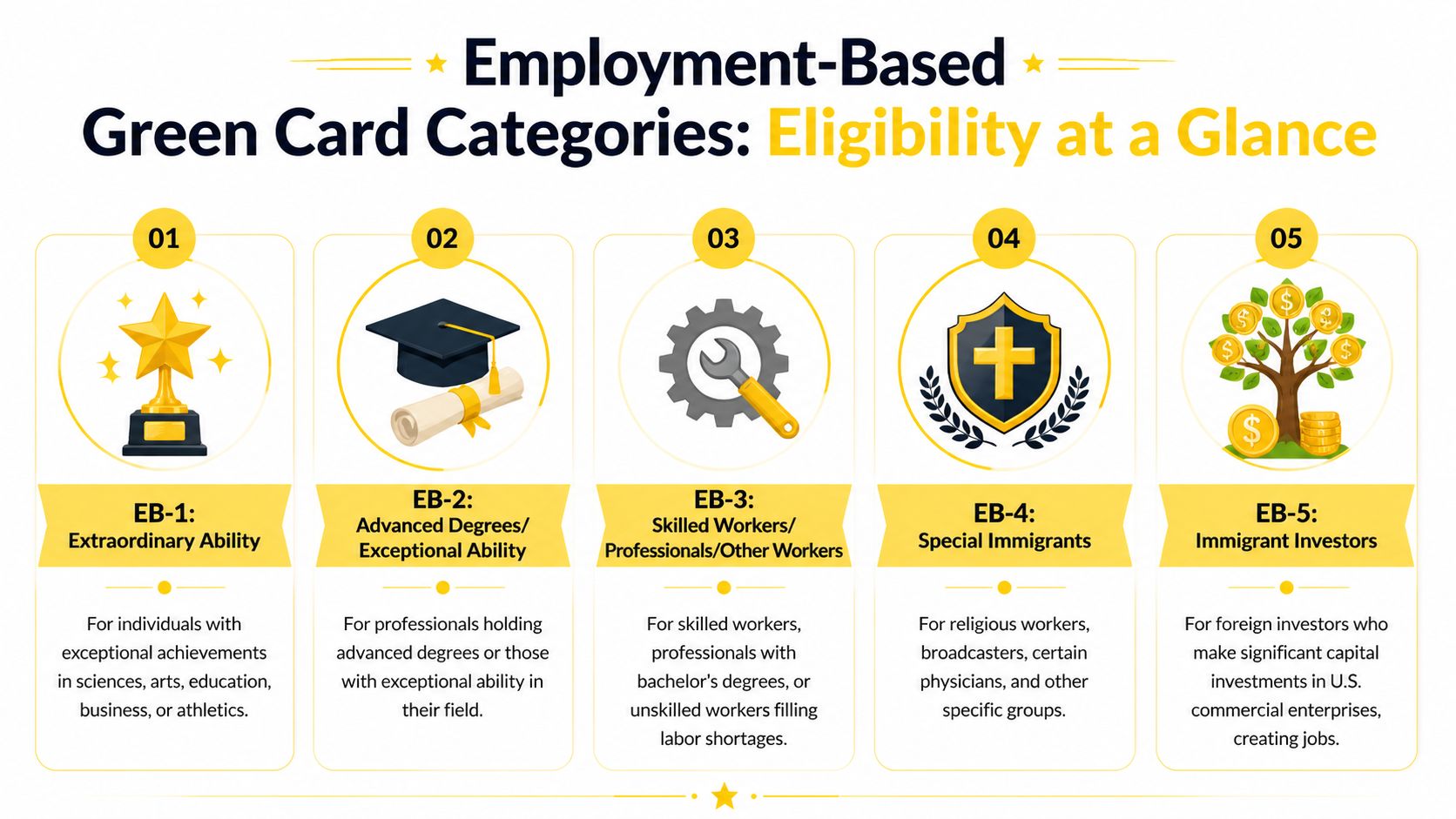
EB-1 for top-tier cases
EB-1 is the category employers and applicants want to qualify for if the facts support it. It covers extraordinary ability, outstanding professors or researchers, and multinational managers or executives.
For cross-border companies, the manager or executive route often matters most. If a Canadian employee has worked abroad in a qualifying managerial or executive role and transfers into the U.S. business in a similar capacity, EB-1C may be a strong fit. That can avoid PERM entirely.
EB-2 for advanced degree and exceptional ability professionals
EB-2 is often the practical home for experienced professionals. Think engineers, researchers, product leads, finance professionals, and senior technical employees whose roles require an advanced degree or its equivalent.
This category also includes the National Interest Waiver, where the applicant asks USCIS to waive the job offer and labor certification requirement. That’s attractive for founders, researchers, and professionals whose work has broader U.S. value. It isn’t a shortcut for every talented person. The evidence has to be framed carefully.
Working rule: If the case can credibly fit EB-1 or a strong NIW theory, it’s worth testing that before defaulting to PERM.
EB-3 for broad employer sponsorship
EB-3 covers skilled workers, professionals, and some other workers. Many employer-sponsored cases land here because the category is built for standard permanent roles that require at least the stated level of education or training.
This is often the category for a Canadian professional whose employer wants a straightforward sponsorship path but doesn’t have an EB-1 or NIW profile. The trade-off is that EB-3 usually means full PERM compliance.
EB-4 and EB-5 in narrower situations
EB-4 applies to specific special immigrant groups. It matters in some cases, but not for most private-sector Canadian professionals.
EB-5 is investor-based. It can fit entrepreneurs and high-net-worth individuals pursuing permanent residence through investment rather than employer sponsorship. If that route is relevant, a separate review with an EB-5 immigration attorney may be appropriate because the evidence, capital source review, and job creation analysis are different from PERM cases.
A practical category check
| Profile | Category often considered first |
|---|---|
| Senior executive transferred from Canada to U.S. affiliate | EB-1C |
| Researcher with significant record | EB-1 or EB-2 NIW |
| Professional role requiring advanced degree | EB-2 |
| Standard permanent skilled role | EB-3 |
| Investor building a U.S. enterprise | EB-5 |
The PERM Labor Certification Process Explained
PERM is often the longest and least forgiving part of an employer-sponsored EB-2 or EB-3 case. For many Canadian professionals already working in the United States in TN, H-1B, or L-1 status, it is also the stage where an employer learns whether it has treated green card sponsorship as a legal process or as ordinary recruiting.

The Department of Labor is not asking whether the foreign national is talented or already performing well. It is asking whether the employer has a real permanent job, stated the minimum requirements accurately, tested the U.S. labor market under strict rules, and found no qualified and available U.S. worker for that position. The governing framework appears in the Department of Labor's PERM regulations at 20 CFR Part 656.
The case usually turns on job design before recruitment begins
A sound PERM case starts with the role itself. The employer requests a Prevailing Wage Determination, but the larger strategic issue is how the position is defined. Titles that make sense in Canada do not always map neatly onto U.S. wage levels or standard occupational classifications. A cross-border employer may use one title internally across Toronto, Vancouver, and Chicago, yet the U.S. filing has to reflect the actual U.S. duties, minimum requirements, and worksite facts.
That is where many avoidable problems start.
If the listed requirements mirror the sponsored employee's resume too closely, the case can appear custom-fit. If the requirements are inflated to justify EB-2 treatment, the employer may create a wage level or business-necessity problem it did not expect. If the role includes travel, hybrid work, or oversight across Canadian and U.S. operations, those details need to be stated carefully at the front end, not patched later.
Recruitment has fixed rules and very little room for improvisation
PERM recruitment is a compliance exercise. It is not ordinary hiring, and employers get into trouble when managers treat it that way.
For a professional position, the employer generally must place a State Workforce Agency job order, run two Sunday newspaper advertisements, complete the internal notice step, and choose additional recruitment steps from the regulatory list, as outlined by the Department of Labor's PERM employer information page. Every step has timing rules, content rules, and recordkeeping requirements.
Three practices matter in real cases:
- Keep the job description stable. Recruitment content, the prevailing wage request, and ETA Form 9089 should describe the same position.
- Use lawful screening criteria. Anyone reviewing U.S. applicants must reject candidates only for job-related reasons tied to the stated minimum requirements.
- Build the audit file as recruitment happens. Save ads, screenshots, posting proofs, resumes received, contact logs, and interview notes while they are still easy to verify.
Canadian employers expanding into the U.S. often underestimate the documentation burden because their internal hiring process is centralized in Canada. PERM requires a U.S.-specific paper trail. If HR sits in Canada and the worksite is in the United States, someone still needs clear ownership of the recruitment calendar, applicant review, and retention of records. In many companies, that coordination falls to HR, finance, and business immigration counsel for employers working from the same checklist.
ETA Form 9089 is the filing step, not the cleanup step
Once recruitment is complete and the employer has documented lawful reasons for rejecting any U.S. applicants, the employer files ETA Form 9089. That filing locks in the case presented to the Department of Labor. It is a mistake to assume inconsistencies can be explained away later.
Audits are common enough that every PERM filing should be prepared as if one will happen. The employer should be able to show why the minimum requirements are normal for the occupation or necessary for the business, how each recruitment step was completed on time, and why each U.S. applicant was not qualified under the stated requirements. Vague notes like "not a fit" or "less experienced" are weak. Specific, job-related explanations are much easier to defend.
For Canadian professionals, there is also a practical status issue. PERM does not give work authorization or travel benefits by itself. If the employee is working in the U.S. in TN status, timing matters because PERM is part of an immigrant process, while TN is a nonimmigrant category that does not allow immigrant intent in the same way H-1B or L-1 can. That does not make PERM impossible for Canadians. It does mean the green card plan should be coordinated with the person's current status, travel habits, and border crossing pattern from the start.
Filing the I-140 Petition and Securing Your Priority Date
A common cross-border problem shows up here. A Canadian employee has a certified PERM case, the U.S. employer is ready to file, and everyone assumes the hard part is over. It often is not. The I-140 stage is where USCIS tests whether the job offer, the worker's background, and the employer's finances all support the category being requested.
Once PERM is certified, or immediately in a category that does not require PERM, the employer files Form I-140 to classify the worker in the selected employment-based category. In PERM-based cases, the priority date is usually the labor certification filing date. In non-PERM cases, it is usually the date USCIS receives the I-140. USCIS explains the filing framework and category requirements on its Form I-140 page.
Ability to pay drives many RFEs
USCIS does not treat the offered wage as a paper detail. The employer must show it had the ability to pay the proffered wage starting on the priority date and continuing until the worker gets permanent residence. In practice, that usually means federal tax returns, audited financial statements, or annual reports, along with payroll records if the worker is already being paid at or above the offered wage.
Smaller U.S. companies and Canadian-owned startups often get into trouble. A business may be operating well, signing new clients, and still file a weak I-140 because the financial evidence does not address the wage question cleanly. Gross revenue alone is often not enough. Net income, net current assets, and actual wages paid usually matter more.
The category has to match the record
The I-140 also tests whether the beneficiary qualifies for the category claimed. For EB-2 and EB-3 cases following PERM, USCIS compares the worker's education and experience to the minimum requirements listed in the labor certification. If the PERM says the role requires a bachelor's degree plus five years of progressive experience, the I-140 package has to prove exactly that. Close enough is where many avoidable problems start.
For Canadian professionals, credential issues can be more complicated than generic guides suggest. A Canadian degree often works well, but equivalency questions, post-secondary diplomas, and mixed education-plus-experience arguments should be framed carefully from the start. The same goes for experience letters from Canadian employers. Titles, dates, hours, and job duties should be specific enough for a USCIS officer who has never seen that employer before.
Premium processing helps with timing, not visa availability
Premium processing can still be useful here, especially if the worker is in a temporary status that requires careful planning. USCIS offers premium processing for certain Form I-140 petitions through its premium processing service page. That service speeds up USCIS's review of the petition. It does not make a visa number available any sooner.
For many Canadian-born applicants, that distinction matters less than it does for workers born in backlogged countries. Even so, faster I-140 adjudication can affect job changes, extension strategy, and whether the employer and employee are ready to file the final stage as soon as the category becomes current.
Priority date strategy matters too. An approved I-140 can sometimes preserve an earlier priority date for a later petition in another employment-based category, which can be valuable if the employee changes roles or the first case becomes impractical. That option needs to be handled carefully, especially in cross-border companies where promotions and U.S. entity restructuring are common.
Navigating the Visa Bulletin and Waiting for Your Turn
A Canadian engineer accepts a U.S. role, the I-140 is approved, and everyone expects the green card filing to follow right away. Then the case stalls because the priority date is not yet current, or it was current last month and retrogressed this month. That is often the point where employers realize the approval of the immigrant petition and the availability of a visa number are two separate things.
Read the bulletin like a quota chart
The Visa Bulletin controls when the final green card stage can be filed or approved. The U.S. Department of State publishes it monthly through its Visa Bulletin page, and employment-based applicants should check both the preference category and the country of chargeability.
For many Canadian-born professionals, this part of the process is less painful than it is for applicants born in India or China. That said, cross-border teams still make expensive mistakes here. I regularly see U.S. employers assume that Canadian citizenship means access to the Canadian queue. The rule is country of birth in most cases, not current citizenship.
Retrogression is the problem that catches people off guard. A category can be current when the case is being prepared and unavailable by the time filing is ready. That shift does not mean anything is wrong with the PERM or I-140. It means demand exceeded the number of visas available for that month.
Watch country of birth, not citizenship. A Canadian citizen born in a backlogged country is usually charged to the birth country for visa availability purposes.
Timing decisions while the date is pending
This waiting period is where planning matters.
If the worker is already in the United States in TN, H-1B, or another temporary status, the employer needs a calendar that accounts for status expiration, travel, and whether the person can stay employed if the green card filing window does not open on time. Canadian professionals often have more fluid travel patterns than other applicants. That creates practical issues around work location, I-94 records, and whether consular processing may fit the case better than waiting inside the U.S.
Current dates also affect filing strategy. If the category is current and expected to remain current long enough to prepare the case properly, concurrent filing can save time by allowing the immigrant petition and adjustment package to move together. If the bulletin is unstable, rushing a filing without clean support letters, status records, or civil documents usually creates more trouble than it solves.
Job changes during the wait
A long wait can change the job itself. Promotions, salary adjustments, manager changes, and entity restructuring are common in U.S.-Canada businesses, especially where employees start in Canada and later move into a U.S. affiliate role.
After 180 days of a pending I-485, some applicants may use AC21 portability to move to a same or similar position. USCIS explains that rule in its Adjustment of Status portability guidance. The opportunity is useful, but it needs disciplined analysis. Matching job titles is not enough. The new role should align in duties, seniority, skill level, and overall position in the organization.
That point matters even more for cross-border employers. A transfer from a Canadian parent company to a U.S. subsidiary, or from one related U.S. entity to another, may look simple from a business perspective while creating problems in the immigration record if the role no longer matches the underlying green card case.
The Final Step Adjustment of Status or Consular Processing
Once the priority date is current, the case reaches the last stage. From there, you typically choose between Adjustment of Status and Consular Processing.
Adjustment of Status inside the United States
Adjustment of Status means filing Form I-485 while you are physically in the U.S. in a qualifying situation. This route is often attractive because it keeps the process stateside and may also allow related work and travel applications while the case is pending.
In FY 2024, USCIS received 129,814 employment-based I-485 applications and approved 119,028, a 91% approval rate. The yearly average processing time was 13.2 months, with a range of 10.7 to 25.3 months depending on service center and case specifics, according to Docketwise's USCIS statistics summary.
That approval rate is encouraging, but the spread in processing times reveals the full situation. A careful filing matters. Missing civil documents, medical issues, inconsistent status history, and weak category evidence often trigger delays.
Consular Processing abroad
Consular Processing moves the final step to a U.S. consulate or embassy outside the United States. For some Canadian professionals, this may fit better if they are living in Canada, traveling frequently, or prefer to finalize the case abroad.
The trade-off is procedural control. Consular cases can be efficient, but they are less flexible once interview scheduling begins. If you're comparing consular timelines and interview mechanics, it may help to review how a U.S. embassy or consulate process works.
A short decision comparison
| Path | Often makes sense when | Main concern |
|---|---|---|
| Adjustment of Status | You are already in the U.S. and want to stay during processing | Maintaining a clean, complete filing |
| Consular Processing | You are abroad or prefer to finish outside the U.S. | Travel logistics and interview-driven timing |
Key Considerations for Cross-Border Employers and Applicants
The U.S.-Canada angle changes the strategy more than many general guides admit. TN cases are the clearest example. TN is useful, fast, and business-friendly. It is not built around immigrant intent.

TN professionals need timing, not panic
According to Super Lawyers' discussion of employment-based green cards, TN status technically prohibits immigrant intent, but USCIS policy updates have clarified that pursuing an I-140 can be permissible if handled correctly. That matters for the over 25,000 TN visas approved annually referenced in the same source.
This doesn't mean every TN holder should file immediately. It means the sequence matters. Travel plans, extension timing, consular issues, and whether a switch to another status makes sense should all be reviewed before the green card case starts.
Three common what-if questions
-
What if the employee changes jobs early?
A move before the case reaches the right stage can collapse the sponsorship. Employer-sponsored green cards are job-specific. -
What if the company is a startup?
Startups can sponsor, but the record has to show a real permanent role, a real wage commitment, and internal discipline on recruitment and payroll evidence. -
What if the worker may self-petition?
Some applicants should examine EB-1A or EB-2 NIW before committing to PERM. That is especially true for founders, researchers, and highly specialized professionals with a cross-border track record.
A practical checklist
Keep one file for immigration, but build it from payroll, HR, recruiting, and corporate records. Fragmented documentation is a recurring problem in cross-border companies.
Consider these steps before filing:
- Confirm the right category early: Don't force every strong worker into EB-3 if EB-1 or NIW may fit.
- Review status history: Unauthorized work, status gaps, or travel missteps can complicate the last stage.
- Align corporate records: Offer letters, organizational charts, tax records, and job descriptions should tell the same story.
- Plan around border travel: This is especially important for TN holders.
- Escalate audits quickly: Once PERM issues arise, ad hoc fixes rarely work well.
One practical option for businesses handling U.S.-Canada talent is working with counsel that can coordinate both sponsorship and cross-border compliance. Mayo Law advises on that combination, including immigration filings and related document planning.
Frequently Asked Questions
Can a Canadian on TN get a green card through employment
Yes, potentially. The main issue isn't whether a Canadian professional can qualify. The issue is how the case is timed and documented so the green card process does not create problems for TN travel or extensions.
Does every employment-based green card require PERM
No. EB-1 cases and some EB-2 National Interest Waiver cases may avoid PERM. Many EB-2 and most EB-3 employer-sponsored cases still require it.
Is an approved I-140 the same as permanent residence
No. An approved I-140 confirms the immigrant classification, but permanent residence usually comes only after visa availability and the final stage, either Adjustment of Status or Consular Processing.
Can the employer withdraw support later
Yes. Employer-sponsored cases depend on a genuine permanent job offer. If the role disappears or the employer no longer supports the petition, the case may be affected.
Which is better, Adjustment of Status or Consular Processing
Neither is automatically better. Adjustment may offer convenience for someone already in the U.S. Consular processing may fit someone living abroad or managing cross-border travel differently. The better path depends on status, travel, timing, and risk tolerance.
Do strong credentials alone make the case easy
Not usually. Excellent credentials help, but the government still looks at category fit, filing sequence, employer evidence, labor market steps where required, and final admissibility issues.
Ready to Explore Your U.S. Immigration Options?
If you're evaluating how to get a green card through employment, the right strategy usually comes from early planning, not late fixes. Whether you're sponsoring a key employee or building your own long-term plan in the U.S., experienced guidance may reduce avoidable delays and compliance problems. If you'd like to discuss your case, you can review Mayo Law's immigration attorneys near you and schedule a consultation.
LEGAL DISCLAIMER
LEGAL DISCLAIMER: The information provided in this article is for general informational and educational purposes only and does not constitute legal advice. Reading this article, visiting mayo.law, or contacting Mayo Law does not create an attorney-client relationship. The content of this article should not be relied upon as a substitute for professional legal counsel specific to your particular circumstances. Legal outcomes depend on the particular facts and circumstances of each individual case, and no attorney can guarantee a specific result. Laws, regulations, and legal procedures are subject to change and may vary by jurisdiction. If you require legal assistance, you should consult with a qualified attorney licensed to practice in the relevant jurisdiction. Mayo Law expressly disclaims any and all liability with respect to actions taken or not taken based on the contents of this article.
Questions about employment-based immigration and cross-border planning? Mayo Law advises Canadian professionals, startups, and U.S. employers on practical immigration pathways. Schedule a consultation to discuss your circumstances.