
Contents
- The Legal Purpose of a Certificate of Incorporation
- Anatomy of a Certificate of Incorporation
- New York vs Ontario A Cross-Border Comparison
- How to Obtain Your Certificate of Incorporation
- Common Incorporation Mistakes to Avoid
- Life After Incorporation Your Ongoing Obligations
- FAQs About Certificates of Incorporation
A certificate of incorporation is the official filing that creates a corporation as a separate legal entity from its owners. In the United States alone, there are approximately 33 million small businesses, and for many owners this document is the legal starting point for risk protection, ownership design, compliance, and growth.
If you’re starting a company, bringing in a co-founder, or planning to operate in both the U.S. and Canada, this document carries significant weight. Founders often treat it like a form to file once and forget. In practice, it can shape who controls the company, how investors come in, whether banks will deal with you, and what has to be fixed later during financing or a sale.
A simple way to think about it is this. Your certificate of incorporation is the company’s birth certificate. It gives the corporation legal existence, puts core details on the public record, and sets some of the rules that can become very important when money, disputes, or cross-border filings enter the picture.
The Legal Purpose of a Certificate of Incorporation
A founder signs a lease in Brooklyn under a new company name. A week later, the same business tries to open a bank account for its Toronto operations. Everyone involved assumes the corporation already exists because the name is on the pitch deck, the website is live, and the first customer invoice has gone out. Legally, none of that creates a corporation. The company exists only after the required incorporation filing is accepted by the government in the relevant jurisdiction.
That filing does one job with major consequences. It creates a separate legal person.
Once formed, the corporation can hold property, sign contracts, open accounts, register for taxes, and sue or be sued in its own name. Before formation, those acts often attach to the individuals behind the business. For startups, that difference affects who is on the hook if a contract goes bad, a vendor is unpaid, or a financing closes later than expected.
Why this matters in practice
The legal purpose of the certificate is simple, but the consequences are not. It marks the line between a business idea and a legal vehicle.
That legal vehicle is what makes limited liability possible in the first place. If the corporation is properly created and maintained, claims against the business usually stay with the business. If founders start operating before the entity exists, or file incorrectly and assume they are protected anyway, they can end up signing personally, owning assets personally, or taking on exposure they did not intend.
A common startup example shows the problem. Two founders begin selling software, hire a contractor, and sign a customer agreement using the company name they plan to incorporate next month. If a dispute arises before the filing is effective, the other side may pursue the people who made the deal, not the corporation that did not yet legally exist.
Cross-border businesses run into an added layer of confusion. In New York, the organizing document is commonly called the certificate of incorporation. In Ontario, the corporation comes into existence through articles of incorporation, and the province then issues a certificate confirming incorporation. Different labels, same core function. The state or province is recognizing that a separate corporate person now exists. If you mix up those documents, especially while opening accounts, qualifying to do business elsewhere, or answering investor diligence requests, paperwork delays follow fast.
What the certificate does, and what it does not do
The certificate is the document that brings the corporation into legal existence. It is the foundation, not the whole structure.
By itself, it does not settle how founders will vote, what happens if one leaves, how shares vest, or how day-to-day decisions get made. Those issues are usually handled through bylaws, shareholder agreements, director resolutions, and related corporate records. Founders often miss this point because the government filing feels like the hard part. In practice, the filing creates the shell, and the internal documents determine how that shell operates.
It also puts key facts on the public record. That matters more than many founders expect. Banks, counterparties, regulators, and investors do not just want to hear that your company exists. They want documentation showing when it was formed, under which jurisdiction, and under what legal name. For a business active in both the U.S. and Canada, that public record also helps answer a recurring question: which entity are we dealing with?
One more point causes confusion. Incorporation does not mean your company is automatically authorized to carry on business everywhere. A New York corporation doing business in Ontario may still need extra registrations. An Ontario corporation operating in New York may face the same issue in reverse. The certificate creates the entity. It does not replace the separate analysis of where that entity must register, report, and comply. If you are still deciding whether a corporation is the right fit, this guide to Ontario business structures gives helpful context.
Anatomy of a Certificate of Incorporation
A certificate of incorporation is the corporation’s birth record. It is short, formal, and easy to underestimate. Founders often expect a long operating manual. What they get is closer to a legal identity card that states a small set of facts the government will recognize.
Those facts matter because other people rely on them. A bank opening an account, an investor reviewing diligence, or a cross-border customer checking whether it is contracting with a New York corporation or an Ontario corporation will look for the basics in this document or in the public record tied to it.
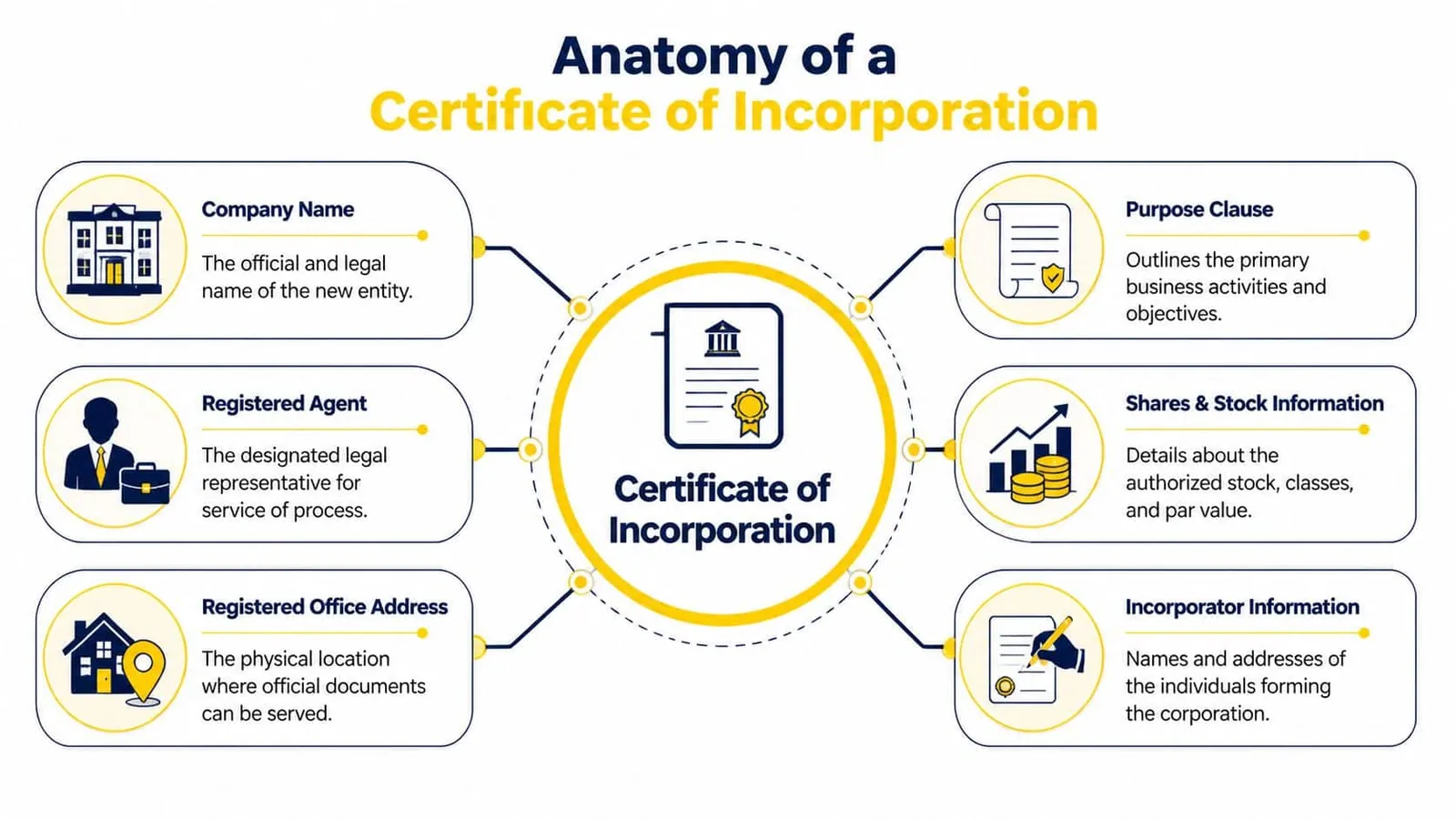
The name and registered office
Start with the two details that sound administrative but cause real problems when handled carelessly: the corporate name and the registered office.
The name has to satisfy the rules of the filing jurisdiction. It also has to avoid conflict with existing names, trademarks, and restricted terms. That issue gets sharper in cross-border businesses. A name that clears in one place may still create trouble in the other, especially if a startup plans to market in both New York and Ontario under the same brand.
The registered office serves a practical legal function. It is the address used for official records and formal notices. If that address is outdated, unattended, or chosen just for convenience, the company can miss tax correspondence, service of process, or registry notices. A missed notice can turn into a default judgment, a late filing penalty, or a status problem that surfaces during financing.
The purpose clause and company type
The next part usually identifies what kind of corporation this is and, in some cases, what it is formed to do.
Founders often read the purpose language quickly because it can feel generic. It is still worth checking. Broad drafting gives the company room to grow, pivot, and add lines of business without amending the formation document each time strategy changes. Narrow drafting can create cleanup work later, especially if the company starts in one activity and expands into software, licensing, manufacturing, or cross-border sales.
The company type and jurisdiction tell outsiders how to classify the entity. That affects search results, due diligence, and document requests. It also affects expectations. A New York corporation and an Ontario corporation may both be “incorporated,” but the filings, terminology, and supporting records around them are not identical. If you are still deciding whether a corporation is the right vehicle on the U.S. side, this comparison of a New York LLC versus a corporation helps frame that choice.
The share structure
This is usually the part with the longest tail of consequences.
The certificate may state how many shares the corporation is authorized to issue and, depending on the jurisdiction and drafting, whether there are different classes of shares with different rights. For an owner-managed business, that can seem like paperwork. For a startup planning to issue equity to co-founders, employees, or investors, it can shape control, economics, and future financing options.
A simple analogy helps. The share structure is the floor plan of the ownership house. If you design only one small room because that is all you need on day one, renovations become expensive once new people need to come in. Amendments are possible, but they often require approvals, updated filings, and extra legal and accounting review.
This is one place where New York and Ontario founders often get tripped up by forms and terminology. The underlying concept is familiar in both places, but the way share terms appear in the public filing, supporting resolutions, and later corporate records may differ. That matters in cross-border deals because investors and counsel will ask whether the rights they expect were created in the correct document.
A well-drafted certificate does not try to answer every governance question. It gets the foundation right, leaves room for growth, and avoids creating avoidable amendment work a few months after launch.
New York vs Ontario A Cross-Border Comparison
Founders operating across the border often assume an incorporation document carries the same practical weight everywhere. It doesn’t. The language, filing systems, and recognition issues can differ in ways that matter quickly.
One source of confusion is terminology. In everyday conversation, people may use “certificate of incorporation” and “articles of incorporation” loosely. In practice, the exact name depends on the jurisdiction and filing system. The more important point is to confirm what document the government issued, what it proves, and what a bank, regulator, investor, or counterparty in the other country will accept.
Incorporation at a Glance New York vs. Ontario
| Feature | New York (USA) | Ontario (Canada) |
|---|---|---|
| Core formation concept | Corporation is created by filing the required incorporation document with the state | Corporation is created by filing the required incorporation document with the provincial registry |
| Common terminology | Certificate of Incorporation is a familiar term in U.S. practice | Articles of Incorporation is common terminology in Ontario practice |
| Filing authority | State-level authority | Provincial-level authority |
| Public search approach | State registry search tools are used | Provincial or corporate registry tools are used |
| What search results usually show | Entity name, type, status, date, and registered agent details are commonly available in state systems | Registry results typically confirm legal identity and status based on the Ontario filing system |
| Cross-border use | May need supplementary authentication for use in Canada | May need supplementary authentication for use in the U.S. |
Where cross-border problems start
The most important practical issue isn't the label on the document. It's recognition.
As noted in Motaword's discussion of certificates and cross-border use, certificates issued in one country often require additional documentation such as apostilles, certified copies, or supplementary filings to be recognized across the border. The same source notes that a Delaware corporation's certificate alone may not satisfy Ontario regulatory requirements without additional steps.
That point applies more broadly than Delaware. A New York corporation doing business in Ontario may need more than its formation document to satisfy a bank, regulator, or transactional counterparty. The reverse is also true for an Ontario corporation presenting documents in the U.S.
If your company is crossing the border, don't assume "we're incorporated" answers the whole question. Often the real question is, "What proof will this institution accept in this jurisdiction?"
Why this matters for startups
Startups usually feel this issue first in one of three places:
- Banking and onboarding: A financial institution may ask for certified or supplementary documents, not just a plain copy of the original filing.
- Commercial contracts: A U.S. customer or Canadian partner may ask for evidence of status, authority, or good standing before signing.
- Expansion filings: Operating in another jurisdiction can trigger separate registration requirements even when the corporation already exists at home.
If you're deciding between entity types on the U.S. side, this comparison of LLC vs corporation in New York can help frame the choice before you file.
How to Obtain Your Certificate of Incorporation
A founder forms a New York corporation on Friday, then spends Monday trying to open an Ontario bank account for a Canadian customer contract. The business exists. The filing was accepted. But the next question is not "Did you incorporate?" It is "Which jurisdiction issued the record, and will this institution accept it as proof?"
That is the practical lens to use here. Getting a certificate of incorporation is not just a filing exercise. It is setting up a document that has to work later, sometimes across two legal systems that use similar words for different records.

A practical filing checklist
-
Choose the jurisdiction first
This choice shapes almost everything that follows. A startup expecting U.S. investors may form in Delaware. A local operating business may prefer New York. A business centered in Canada may incorporate in Ontario, either provincially or federally depending on its plans. The wrong starting point can create extra registration work, added costs, and avoidable cross-border proof problems later. -
Clear the name properly
A corporation cannot be filed under a name the registry will reject. In New York, that means checking availability and compliance with naming rules. In Ontario, it can also mean dealing with name search requirements or deciding whether a numbered corporation makes more sense. This step works like reserving a legal identity before you print it onto contracts, invoices, and bank records. -
Set the official contact information
Every corporation needs a reliable public point of contact. In U.S. filings, that often means a registered agent or service address. In Ontario, the registry will require an address and other identifying details. Founders sometimes rush this part, then miss legal notices, tax mail, or service of process. That is a fixable problem at formation and a painful one in litigation. -
Draft the incorporation document with the future in mind
Startups often encounter difficulties here. The certificate or articles should reflect how the company will operate, not just how fast it can be filed. Share structure, stated purpose where relevant, director information, and other required terms need to fit the business plan. If a company expects outside investment, founder departures, or U.S.-Canada expansion, a bare-bones filing can age badly. -
File with the correct authority and confirm what was issued
In New York, filings go through the state system. In Ontario, they go through the provincial registry process. You should verify current requirements directly with the relevant government source, such as New York Department of State corporate filing information and Ontario's business incorporation services. After acceptance, confirm the exact record you received. In cross-border practice, that detail matters because a bank, investor, or regulator may ask for a certificate, articles, certified copy, or status document by a specific name. -
Store the issued record like you will need it under pressure
Keep official copies organized from day one. A clean corporate record saves time when opening accounts, signing a major customer, registering extra-provincially, or answering diligence questions from counsel on the other side of the border.
Two patterns cause trouble again and again.
The first is treating filing speed as the goal. Fast filing is helpful. Filing that matches your ownership plan, financing path, and cross-border footprint is better.
The second is assuming a formation platform answers legal judgment questions. It usually does not. Software can submit data. It cannot decide whether your Ontario corporation will need extra-provincial registration in New York, or whether a New York startup should build a share structure that will make sense to Canadian stakeholders later.
If you are forming on the Canadian side, this Ontario incorporation checklist with steps, costs, and timelines is a useful companion.
Common Incorporation Mistakes to Avoid
The most expensive incorporation errors usually don't look dramatic at the start. They look small, efficient, and cheap.
A founder downloads a template, changes the company name, files it, and assumes the hard part is done. Months later, the problems appear during a financing round, a shareholder dispute, or due diligence for a sale.
Mistake one. Treating the certificate like a formality
Some people think the certificate is just an administrative prerequisite, while the "real" deal lives in the shareholder agreement or cap table spreadsheet. That mindset causes trouble.
The certificate can control core rights and capital structure. If it conflicts with later expectations, the company may need formal amendments instead of simple cleanup.
A common example is a startup that plans to raise money but uses a bare-bones filing with no thought given to future classes of shares or voting arrangements. Nothing feels wrong at formation. The friction comes later, when investors ask questions the original document doesn't answer well.
Mistake two. Using a weak share structure
In such situations, DIY filings often age badly.
The technical specification of authorized share structure, including the number of shares, par value, and voting rights, must be drafted precisely at formation because later changes require formal amendment procedures. Inaccuracies can affect future capital raising efficiency and surface in due diligence as material defects requiring costly remediation.
A bad share structure rarely fails on day one. It fails when the company needs investment, wants to issue equity properly, or has to answer diligence questions under time pressure.
Mistake three. Choosing today's structure without thinking about tomorrow's market
A founder in Toronto may incorporate for local operations, then six months later pitch U.S. investors, hire in New York, or prepare for an E-2 related business move. The original filing may still be legally valid, but it may not be strategically well designed for what the company is trying to do next.
That doesn't mean every business should default to one jurisdiction. It means the formation decision should match the business plan, ownership plan, and expected geography.
If you're weighing that earlier-stage decision, this guide on choosing the right entity for your U.S. business is a useful next read.
Life After Incorporation Your Ongoing Obligations
On Monday, a founder gets the filing receipt and assumes the hard part is over. On Friday, the bank asks for bylaws, a director resolution, and proof of who owns the shares. A month later, a U.S. customer asks an Ontario company for status documents, or an Ontario investor asks a New York corporation for records that were never prepared. That is usually the moment founders learn incorporation created the company, but it did not organize it.
The certificate is the birth record. The corporation still needs a working legal file, clear ownership records, and current government filings.
What usually needs to happen after filing
After incorporation, the company should be set up so that someone outside the business can tell, from the records alone, who controls it and whether it is in good standing. That usually includes:
- Adopting internal governance rules: The corporation should approve bylaws and any initial organizational resolutions.
- Issuing shares correctly: Ownership should be backed by board approval, proper consideration, and a written record, not informal messages.
- Documenting key decisions: Director and shareholder actions should be recorded in resolutions or minutes.
- Maintaining the minute book and registers: Core records should stay current, organized, and easy to produce.
- Filing ongoing annual returns or reports: New York and Ontario both expect periodic filings to keep the corporation active and current in the registry.
Cross-border confusion can quickly emerge. In New York, people often ask for a Certificate of Good Standing or similar status confirmation. In Ontario, the wording and issuing process may differ, and counterparties sometimes ask for documents using U.S. terms that do not match Ontario practice exactly. The practical point is the same in both places. If your records are incomplete or your filings are overdue, routine requests start turning into delays.
Why this matters in real life
Poor post-incorporation maintenance creates problems at the worst time. A financing closes slower because the share issuances were never properly approved. A bank account opening stalls because the company cannot produce current governance documents. A cross-border contract gets held up because the other side wants confirmation that the corporation exists and remains active.
Startups feel this more sharply than mature companies. Early-stage teams often move fast, change roles often, and treat legal paperwork as something to clean up later. Later is expensive. Cleaning up missing resolutions, unclear share ownership, or stale records during diligence usually costs more than doing it properly at the start.
If you are unsure what internal rules the corporation should adopt after filing, this plain-English guide to company bylaws is a useful next read.
FAQs About Certificates of Incorporation
Is a certificate of incorporation the same as bylaws
No. The certificate creates the corporation and sets core public-facing terms. Bylaws are internal governance rules adopted after formation.
Can a certificate of incorporation be changed
Yes, but changes often require formal approvals and a filed amendment. That's one reason careful drafting at the start matters.
What if I lose my original certificate
You can usually obtain official or certified copies through the relevant registry or filing authority in the jurisdiction where the company was formed.
Is the certificate enough to operate across the U.S.-Canada border
Usually not by itself. Cross-border recognition often requires extra documentation, filings, or certified records depending on the institution and jurisdiction involved.
How do I check whether a corporation exists
In the U.S., each state generally maintains its own registry search. For public companies, incorporation information may also be found through SEC EDGAR.
What is a certificate of incorporation in plain English
It's the government-filed document that officially creates a corporation and records key details such as its name, office, purpose, and share structure.
If you're setting up a business that will operate in New York, Ontario, or both, getting the formation document right at the start can prevent expensive fixes later. Mayo Law advises founders, startups, and growing businesses on cross-border business structure, incorporation, governance, and related documentation.
Joseph Mayo is the principal lawyer at Mayo Law, licensed in Ontario and New York, with a Master's degree from NYU School of Law. He advises clients on business law matters across the GTA and cross-border between Canada and the U.S. Learn more on the Joseph Mayo profile.
This article is for informational purposes only and does not constitute legal advice. Every situation is different. Consult a licensed lawyer about your specific circumstances.