Published: May 25, 2026
Updated: May 25, 2026
Read time: 14 minutes
Introduction
A family often learns this problem exists at the worst time. A passport application is due, a child is starting school abroad, or an employer is trying to confirm whether a new hire needs Canadian work authorization. Then the question surfaces: was citizenship passed down, or was it cut off because the Canadian parent was also born outside Canada?
Bill C-3 changes the answer for many of those families. In practice, I tell clients to sort their case into two separate tracks before they do anything else. One group may already be Canadian by operation of law and now needs proof. The other group is dealing with future citizenship by descent and needs to show a real parental connection to Canada under the new rules.
That distinction matters.
At Mayo Law, we advise families, founders, and employers in Toronto and in cross-border matters involving Canada and the United States. The first practical question is usually not academic. It is whether citizenship already exists, whether a child born abroad can claim it, and what records Immigration, Refugees and Citizenship Canada will accept to support that position.
The risk is treating every case as if it works the same way. It does not. Some people should focus on gathering documents that confirm an existing citizenship claim. Others need to prepare for a forward-looking eligibility test tied to a parent's presence in Canada. Getting that wrong can delay applications, create problems for travel planning, and lead employers to make incorrect assumptions about work authorization or sponsorship needs.
What Is the Core Change in Bill C-3
Bill C-3 is a 2025 amendment to Canada's Citizenship Act that removes the old second-generation cut-off for many families, restores citizenship to many “lost Canadians,” and creates a new substantial connection rule for certain future births abroad based on a parent's physical presence in Canada.
The Old Rules vs The New A Simple Breakdown
For years, the hard stop in these cases was the first-generation limit. In simple terms, if a Canadian citizen was born outside Canada, that person often could not automatically pass citizenship to a child also born abroad. Families with strong Canadian ties still ran into a legal wall because the chain stopped after one generation outside Canada.
Bill C-3 changed that framework in a way that matters both historically and operationally. According to the Parliament of Canada LEGISinfo record for Bill C-3, the bill is titled An Act to amend the Citizenship Act (2025) and received royal assent on November 20, 2025. That reform is widely understood as a major reset of citizenship by descent rules.
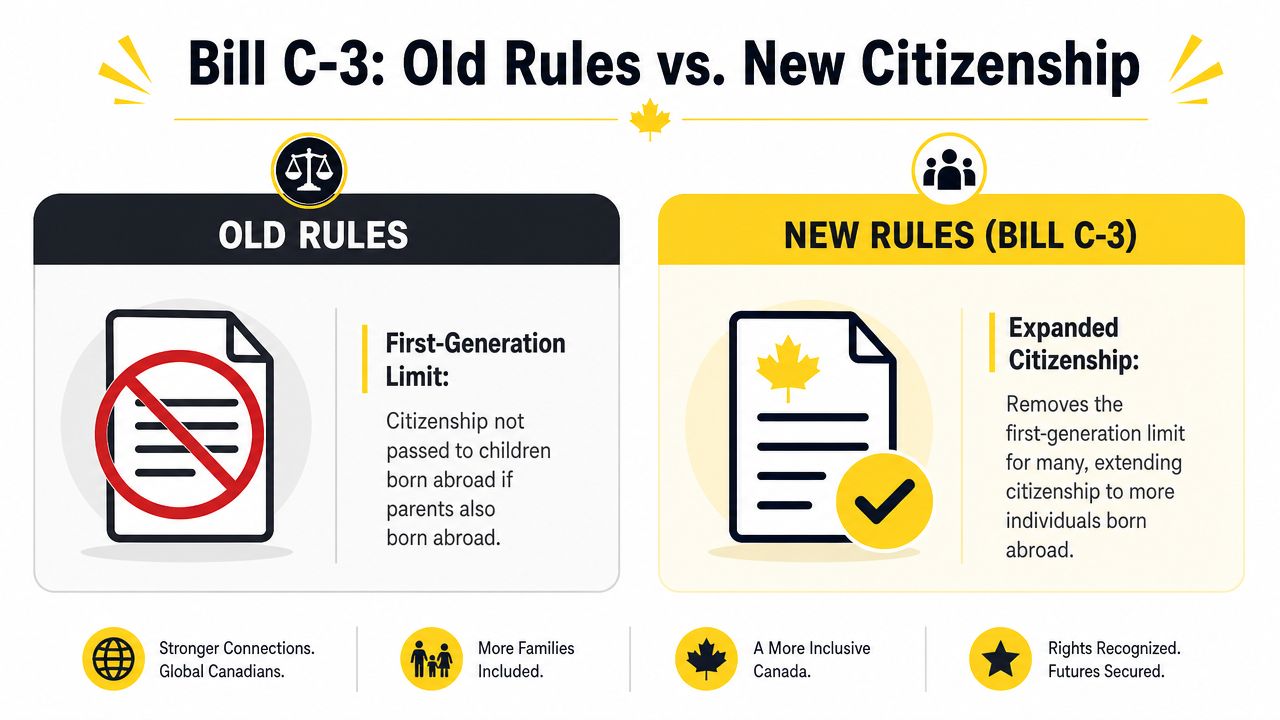
Why the old rule caused so many problems
The old system worked cleanly only for some families. If a parent was a Canadian citizen and born in Canada, citizenship by descent was usually straightforward for a child born abroad. But where the Canadian parent was also foreign-born, the next child often fell outside automatic citizenship.
That produced two recurring problems in practice:
- Families were treated differently based on place of birth: Two Canadian families could have nearly identical ties to Canada, yet one child qualified and another did not.
- People relied on outdated advice: Many were told years ago that their chain of descent ended, then stopped asking questions.
Practical rule: Old refusals and old assumptions deserve a fresh review. Bill C-3 changed the legal starting point.
What the new framework does
The new law is easier to understand if you stop thinking in one rule and start thinking in two. For many people born abroad before the operative cutoff, the law now recognizes citizenship retroactively. For later births abroad in the affected category, the issue becomes whether the Canadian parent can meet a residency-based connection test.
Here is the simplest side-by-side view:
| Aspect | Rule Before Bill C-3 | Rule After Bill C-3 |
|---|---|---|
| Basic second-generation citizenship by descent | Often blocked if the Canadian parent was also born abroad | Expanded in defined cases |
| Main barrier | First-generation limit | Evidence of eligibility depends on timing and facts |
| People born abroad before the new cutoff | Many were excluded | Many may already be citizens |
| Future births abroad in affected cases | Old limit controlled | New connection-based test applies |
| Main proof issue | Lineage | Lineage, and in some future cases parental presence in Canada |
A good first screening question is whether you were born abroad to a Canadian parent who was also born abroad. If yes, you should reassess your file under the new law rather than rely on a pre-2025 answer. That kind of review overlaps with the issues discussed in this piece on whether you are a Canadian citizen born abroad to a Canadian parent.
What works and what does not
What works is a date-first analysis. Start with when the child was born or adopted, then identify how the Canadian parent got citizenship, then build the family chain.
What does not work is making assumptions from family lore. “My grandmother was born in Canada, so I must qualify” is not enough. Neither is “I was denied once, so nothing changed.” Under Bill C-3, both statements may be wrong for opposite reasons.
Who Is Affected by the Bill C-3 Citizenship Act
The first practical question is whether you fall into the retroactive group or the future-proof group. The answer changes everything about strategy, documents, and risk.

Are people born abroad before December 15, 2025 already Canadian
In many cases, yes. Government guidance states that people born or adopted abroad before December 15, 2025 who benefit from the new rules are already citizens in most cases and must apply for a citizenship certificate to prove status, as explained in IRCC's 2025 citizenship rules guidance.
That distinction matters. You are generally not applying to become a citizen on this track. You are applying for proof of citizenship you may already have.
Who should look closely at the retroactive track
Several groups should revisit their status:
- Adults previously excluded by the first-generation limit
- Children born abroad whose parents were told the chain stopped
- Families with a Canadian parent or grandparent who died before the law changed
- Descendants of people often described as lost Canadians
If that sounds familiar, this background on lost Canadian citizenship restoration is a useful companion issue to review.
Many people now have a status problem, not an eligibility problem. The law may already recognize them. The missing piece is proof.
Does the law affect children born or adopted abroad on or after December 15, 2025
Yes, but differently. Those cases are not primarily about retroactive recognition. They are about whether the Canadian parent in the affected category can meet the required connection to Canada.
Families often get tripped up regarding this point. They hear that Bill C-3 “removed the cutoff” and assume future cases are automatic. They are not. The law is generous to many earlier-born descendants, but more evidence-focused for later births in the affected group.
What if a parent or grandparent is deceased
This is one of the most important practical issues, especially in multigenerational cases. Government and parliamentary materials acknowledge that families may need to prove a citizenship chain even where the qualifying ancestor died before the law took effect.
That means the file may depend on records rather than living testimony. In practice, the challenge is rarely legal theory. It is whether you can prove each link in the chain with reliable civil documents, identity records, and name-change evidence.
A common fact pattern
A client may say: “My father was born in Europe to a Canadian mother. I was born in the U.S. and was told I wasn't Canadian.” Under Bill C-3, that answer may no longer hold.
Another family may have the opposite issue. Their child is expected abroad after the cutoff, and the Canadian parent was also born abroad. In that case, the key question is not descent alone. It is whether the parent can prove enough physical presence in Canada before the birth.
The Substantial Connection Test Explained
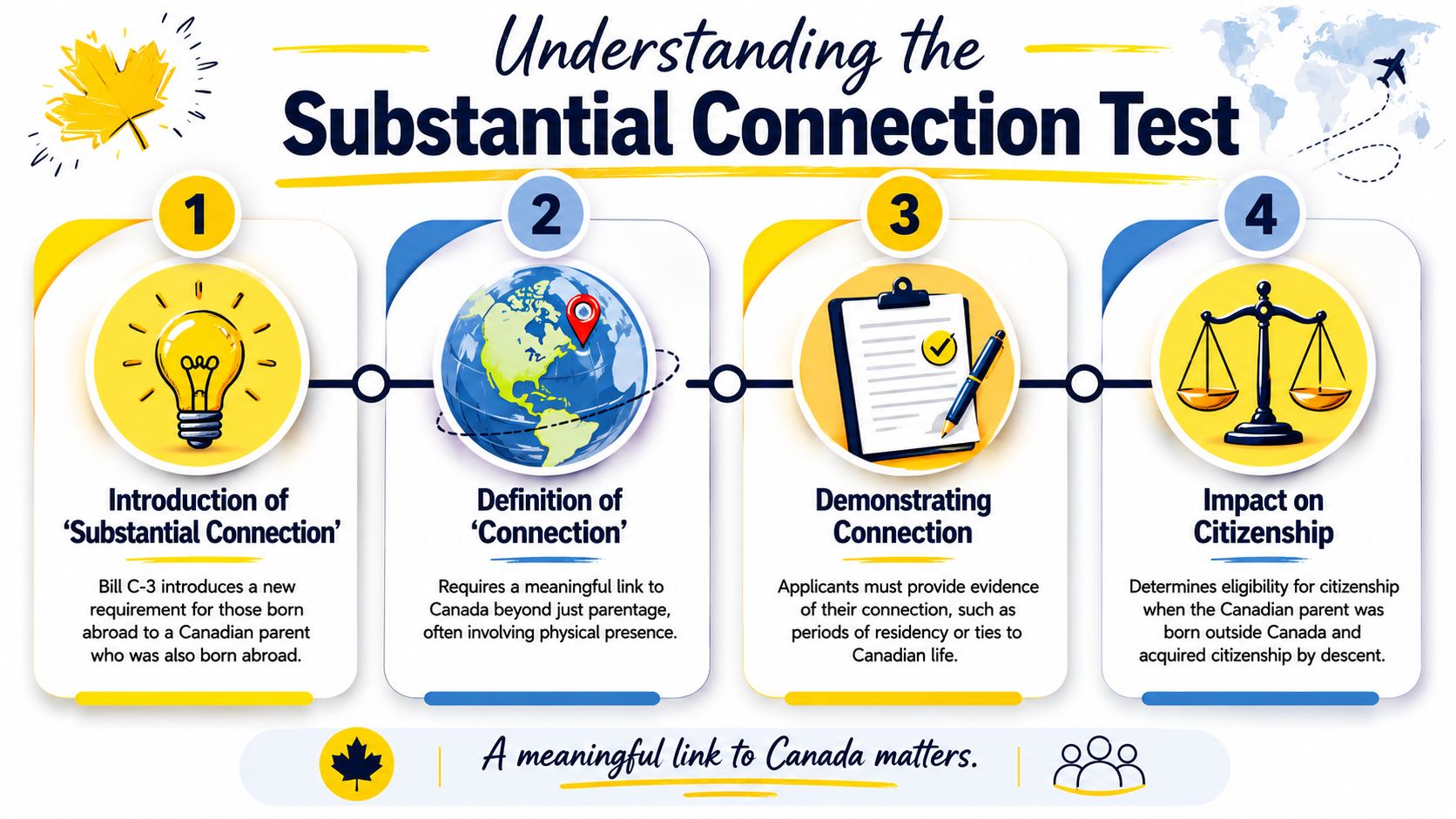
The new concept that matters most for future cases is the substantial connection test. This is the part of Bill C-3 that turns a citizenship file into a records file.
According to the verified summary of the in-force amendments, the test applies only where the child was born or adopted abroad on or after December 15, 2025, and the Canadian parent was also born or adopted abroad. The parent must show 1,095 days, or 3 years, of physical presence in Canada before the child's birth or adoption, as described in this summary of the substantial connection requirement.
What the rule actually asks
The law asks a narrow but demanding question. Before the child's birth or adoption, did the Canadian parent accumulate enough physical presence in Canada to meet the threshold?
This is not just about identity or ancestry. It is about evidence of actual time spent in Canada.
What usually helps prove physical presence
IRCC's detailed evidentiary expectations will matter case by case, but in practice families should start gathering records that place the parent in Canada over time. Useful categories often include:
- School records: Enrollment documents, transcripts, report cards
- Employment records: Offer letters, pay records, employer confirmations
- Tax records: Canadian filings or notices connected to residence
- Housing records: Leases, mortgage papers, utility bills
- Health and government records: Provincial records that show residence history
- Travel history support: Passport stamps or entry records where available
No single document usually carries the entire file. Strong applications build a timeline from overlapping records.
Evidence rule: Don't wait until after a child is born abroad to reconstruct years of Canadian presence. Start building the record early.
What does not work well
Several approaches commonly fail or create avoidable trouble:
- Loose estimates of time in Canada: “I lived there on and off for years” is not proof.
- Relying on one type of record only: A single tax document or one school transcript rarely tells the full story.
- Ignoring gaps: If there are long unaccounted periods, expect questions.
- Using lineage documents as a substitute: A birth certificate proves parentage, not physical presence.
An anonymized example
Consider a Canadian citizen born abroad who later studied and worked in Toronto before moving back to the United States. Years later, that person has a child abroad after the cutoff date. The citizenship question for the child may depend on whether the parent can document enough time in Canada before the birth.
A well-prepared file might include school records, lease documents, employment confirmations, and tax records that together support the required total. A weak file might rely on memory, scattered emails, and a few old bills. The legal rule is the same in both cases. The outcome often turns on organization.
Practical Steps for Applicants After Bill C-3
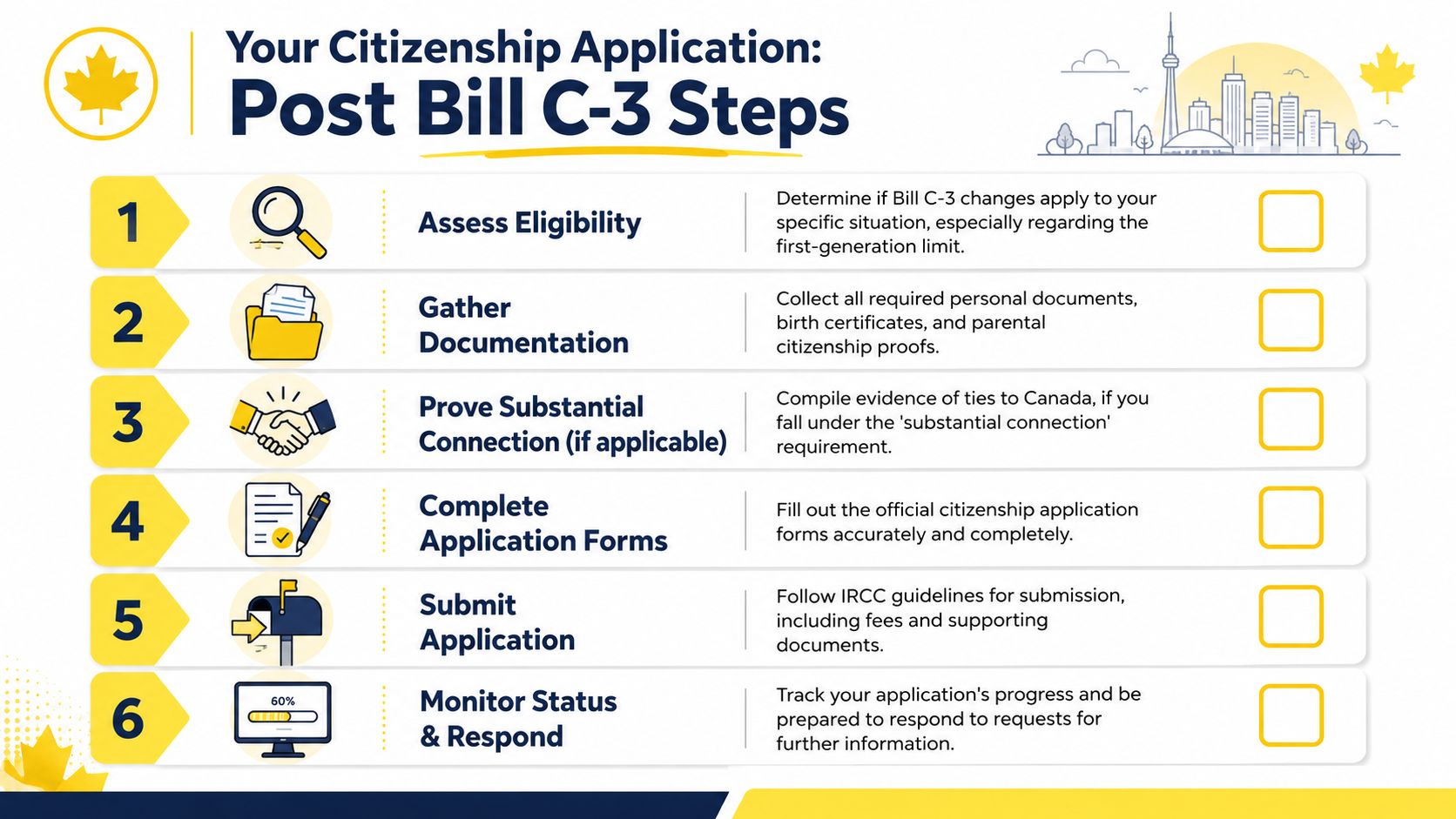
Applicants should approach Bill C-3 as a sorting exercise first, then an application exercise. The wrong first move is rushing to forms before you know which track applies.
IRCC describes the new system as a practical split between retroactive recognition for earlier cases and an evidentiary test for certain later births, as set out in the government's Bill C-3 implementation update. That means your file strategy should match your track.
Start with the right threshold question
Ask these in order:
- Were you or the child born or adopted abroad before or after December 15, 2025
- Was the Canadian parent also born or adopted abroad
- Is the issue proof of existing citizenship, or proof of parental connection
- Can you document each family link clearly
That first screening changes the entire file.
If you may already be a citizen
For retroactive cases, the main steps are usually:
- Trace the descent line: Gather birth certificates and records that connect each generation.
- Confirm the Canadian ancestor's status: This may be a Canadian birth record or other citizenship proof.
- Apply for a citizenship certificate: This is the formal proof document many people now need.
- Prepare for document gaps: Older families often need name-change, marriage, or death records to close the chain.
If records come from outside Canada, document authentication may become part of the file. In cross-border matters, that often overlaps with apostille and notarization work, including issues like how to get an apostille in New York.
If the substantial connection test applies
For prospective cases, shift your focus from ancestry to chronology. Build a timeline of the parent's presence in Canada before the child's birth or adoption.
Use a practical file structure:
- Create a year-by-year timeline
- Match each period with at least one record
- Flag gaps early
- Keep originals and clear copies
- Avoid inconsistent dates across forms and exhibits
What a strong application package usually includes
A workable package often pulls from different folders, not one drawer. For example:
- Identity and civil status documents
- Documents proving the Canadian ancestor's citizenship
- Records linking each generation
- Residency evidence where required
- Translations where needed
- A concise cover explanation if the history is complex
Mayo Law works with families and cross-border clients across the GTA and on matters that touch both Canadian and U.S. records. Joseph Mayo is licensed in Ontario and New York, so clients with U.S. ties can coordinate related legal work in one place rather than splitting document, immigration, and compliance issues across separate counsel.
What applicants often get wrong
The biggest mistake is claiming certainty too early. Someone may say “I am Canadian” before they have a certificate or before the file has been properly reviewed. Another common problem is submitting a lineage-heavy package in a case where physical presence is the primary issue.
File strategy now depends on the track. Pre-cutoff cases are often about proving the chain. Post-cutoff cases in the affected group are about proving the chain and the parent's presence.
Implications for Employers and Cross-Border Issues
A common HR problem now looks different. A candidate is lined up for a transfer to Canada, the business starts discussing a work permit, and only then does someone notice a Canadian parent or grandparent in the family history. Under Bill C-3, that person may fall into one of two very different categories. They may already be a citizen and need proof, or they may be in the future-facing group that still has to meet the connection test.
For employers, that distinction affects hiring documents, start dates, relocation planning, and compliance risk.
The first track is retrospective. If the employee fits the retroactive group, the issue is usually not whether the company can sponsor status. The issue is whether the employee can document citizenship quickly enough to satisfy onboarding and travel requirements. In practice, that can pause a transfer if HR assumes immigration sponsorship is the answer when the actual bottleneck is obtaining a citizenship certificate and supporting records.
The second track is prospective. For employees in the group that must prove a substantial connection through a parent, the company should expect a different timeline and a different kind of evidence review. Those cases are less about lineage alone and more about whether the required Canadian presence can be shown on paper.
What HR should do differently
HR teams should treat possible citizenship claims as a threshold issue, not a side note after immigration planning has already begun. That does not mean accepting an employee's belief at face value. It means asking the right preliminary questions early enough to avoid putting the person into the wrong process.
A practical approach includes:
- Ask early whether the employee has a Canadian parent or grandparent
- Separate "possible citizen" cases from foreign national work authorization cases
- Require formal proof before recording citizenship status in onboarding files
- Build extra time into cross-border transfers where citizenship may exist but is not yet documented
- Coordinate with immigration counsel before starting a permit strategy that may be unnecessary
This saves time, but it also prevents compliance mistakes. An employer should not place someone in a work-permit process if the person may already have the right to work in Canada. The reverse is also true. An employer should not code someone as a Canadian citizen for payroll, I-9 related planning, travel, or mobility purposes without proper evidence.
Cross-border businesses need to watch the side effects. Citizenship status can change the immigration plan, but it can also change tax residence analysis, benefits administration, withholding questions, and document requests across Canada and the United States.
A typical example involves a U.S.-based employee scheduled to move to Toronto. If the employee is on the retroactive track, the legal question is often, "Can they prove they are already a citizen?" If the employee is on the prospective track, the question becomes, "Can they prove the parent's Canadian connection under the new test?" Those are different files, different timelines, and different risks.
Employers with disputed status issues or complicated cross-border records sometimes need advice that overlaps with hearings, procedural fairness, or contested immigration matters. In those cases, it helps to involve counsel familiar with both workplace mobility and more formal proceedings, including an immigration court lawyer where the facts point in that direction.
Potential Compliance Risks and Legal Challenges
The safest approach to Bill C-3 is careful, not casual. The law is helpful, but a sloppy file can still create real problems.
The main risk in individual files
The biggest compliance risk is asserting citizenship on official forms before you have a sound basis to do so. People hear that they are “already citizens in most cases” under the retroactive track and jump from possibility to certainty. That can backfire if the chain of descent is incomplete or the documents don't support the claim.
The main risk in future-track files
For later births in the affected category, the danger is underestimating the proof burden. Families often have genuine ties to Canada but poor records. If the parent cannot document physical presence well, the file becomes vulnerable even where the equities are strong.
Where legal disputes may arise
The new law solves one set of fairness problems, but it may not end litigation. The substantial connection test is specific and operational. It may also generate disputes around documentary sufficiency, interpretation, and edge cases involving older records or unusual family histories.
For contested or high-risk matters, broad immigration strategy can overlap with litigation posture and procedural fairness concerns, including issues handled in more formal immigration proceedings such as those discussed on our immigration court lawyer page.
Frequently Asked Questions
Is Bill C-3 the same as applying for Canadian citizenship
Not always. For many people born abroad before the cutoff who now benefit from the law, the issue is proving citizenship they may already have, usually through a citizenship certificate. That is different from a standard naturalization path. If you are comparing routes, this overview of how to become a Canadian citizen helps distinguish citizenship by descent from other pathways.
How much does it cost to prove citizenship under Bill C-3
This article does not state government fees because no verified fee data was provided for citation here. Before filing, check the current IRCC fee schedule directly on Canada's official immigration website. Do not rely on old blog posts or screenshots. Government fees and filing methods can change.
How long does a citizenship certificate take
Processing times were not provided in the verified data for this article, so the careful answer is to check IRCC's live processing tools before submitting. In practice, families should expect document gathering to take time, especially where records span multiple countries, name changes, adoptions, or deceased ancestors.
Does Bill C-3 affect dual citizenship
Bill C-3 can result in some people holding Canadian citizenship in addition to another nationality, depending on the laws of the other country. The Canadian side of the question is citizenship status. The non-Canadian side may involve separate nationality, tax, military, or estate consequences. That part should be reviewed country by country.
Does Bill C-3 help people applying for citizenship through residence in Canada
No. Bill C-3 is about citizenship by descent and related restoration issues, not the regular grant process based on residence in Canada. If your route to citizenship depends on living in Canada and meeting ordinary eligibility rules, Bill C-3 is usually not the provision controlling your case.
Conclusion
A common fact pattern is simple. A parent or grandparent was told years ago that the Canadian citizenship line stopped outside Canada, and the family treated that answer as final. Bill C-3 means some of those old answers are now wrong.
The practical issue is to separate your case into the right legal track. For some people, the law works retroactively. They may already be Canadian citizens and need proof of status, not a discretionary decision. For others, the law works prospectively. Their result turns on whether the Canadian parent can meet the substantial connection test with evidence that will stand up to review.
That distinction matters because the evidence, timing, and risk are different on each track. On the retroactive side, the main problems are usually missing civil records, inconsistent names, and family history spread across more than one country. On the prospective side, the main problems are legal eligibility and proof. A weak record can delay the file or lead to refusal even where the family story sounds strong.
The right approach is disciplined and specific. Confirm the family timeline. Identify which generation is relevant. Match the facts to the correct legal route before filing anything with IRCC.
Handled properly, Bill C-3 can give families access to a status they were wrongly denied, while setting a clearer rule for future claims based on a real connection to Canada.
How Mayo Law Can Help
Bill C-3 files tend to split in two. One group needs proof of citizenship that already exists in law. The other needs a carefully documented case that a Canadian parent meets the substantial connection requirement.
Mayo Law helps clients identify the correct track before they file with IRCC. That usually means reviewing the family timeline, testing the claim against the statute and current government process, and spotting problems early, such as missing birth records, name discrepancies, prior refusals, or U.S. and Canadian documents that do not line up.
We also advise employers and mobile families dealing with the practical consequences of an unresolved citizenship question, including hiring documentation, work authorization assumptions, and cross-border travel planning while proof or a determination is still pending.
Disclaimer
This article is for informational purposes only and does not constitute legal advice. Every situation is different. Consult a licensed lawyer about your specific circumstances. Mayo Law provides legal services through Mayo Law PC in Ontario and Joseph Mayo PLLC in New York.
Related Articles
Readers dealing with Bill C-3 often need adjacent guidance on proof, travel documents, and cross-border status issues. These articles cover two of the practical side issues that come up after a citizenship analysis.
If you need help sorting out whether Bill C-3 applies to you, your child, or an employee with Canadian ties, contact Mayo Law.