You were born outside Canada. One of your parents is Canadian. Maybe a grandparent was born in Toronto, Vancouver, or Montreal. Now you're asking a question that sounds simple but often isn't: am I a Canadian citizen born abroad to Canadian parent?
For many families, the confusion starts when relatives give conflicting answers. One person says citizenship passes down automatically. Another says it stopped with your parent. A third says the law changed and you may already be Canadian. All three can sound plausible because Canadian citizenship by descent has changed more than once, and the answer often turns on dates, generations, and documents.
If you're anxious about your family's status, that reaction makes sense. A person can feel obviously Canadian in family history and still have trouble proving legal status on paper.
At Mayo Law, we help people in Toronto, the GTA, and across the border manage citizenship and immigration issues that often involve both Canada and the U.S., bringing experience licensed in both Ontario and New York to a process that often spans both sides of the border.
TL;DR: You may be a Canadian citizen if you were born abroad to a Canadian parent, but the answer depends on when you were born, whether your Canadian parent was born in Canada or abroad, and, for some families under the 2025 rules, whether that parent can prove 1,095 cumulative days in Canada before your birth.
Are You Canadian? Unpacking a Complex Question
A common example goes like this. You were born in the United States. Your mother is Canadian. She moved south for work years ago. You have Canadian cousins, Canadian grandparents, and maybe even spent summers in Ontario. You assume the answer must be yes.
Sometimes it is yes. Sometimes it isn't. Sometimes the answer is yes, but you still need formal proof from the government before you can get a passport or use that status in any practical way.
The hard part is that citizenship by descent has not followed one stable rule. The law treated families differently depending on the era. A child born abroad before a major legal change may have a stronger claim than a child with nearly identical family facts born later. That feels unfair to many people, but it's why dates matter so much.
Three questions usually decide where to start:
- When were you born? Your birth date can place you under a different legal regime.
- Where was your Canadian parent born? A parent born in Canada is treated differently from a parent who was also born abroad.
- Are you trying to confirm your own status, or your child's? Those are related questions, but not always governed the same way.
The biggest mistake people make is assuming family identity and legal status are the same thing. In citizenship law, the paper trail matters.
If you're reading this because your parent was Canadian but born outside Canada, your instincts are right to pause. That detail is where many cases become more technical.
The Shifting Rules of Citizenship by Descent A Historical Overview
Canadian citizenship law makes more sense when you stop treating it as one rule and start treating it as a timeline.
Before the 2009 cutoff
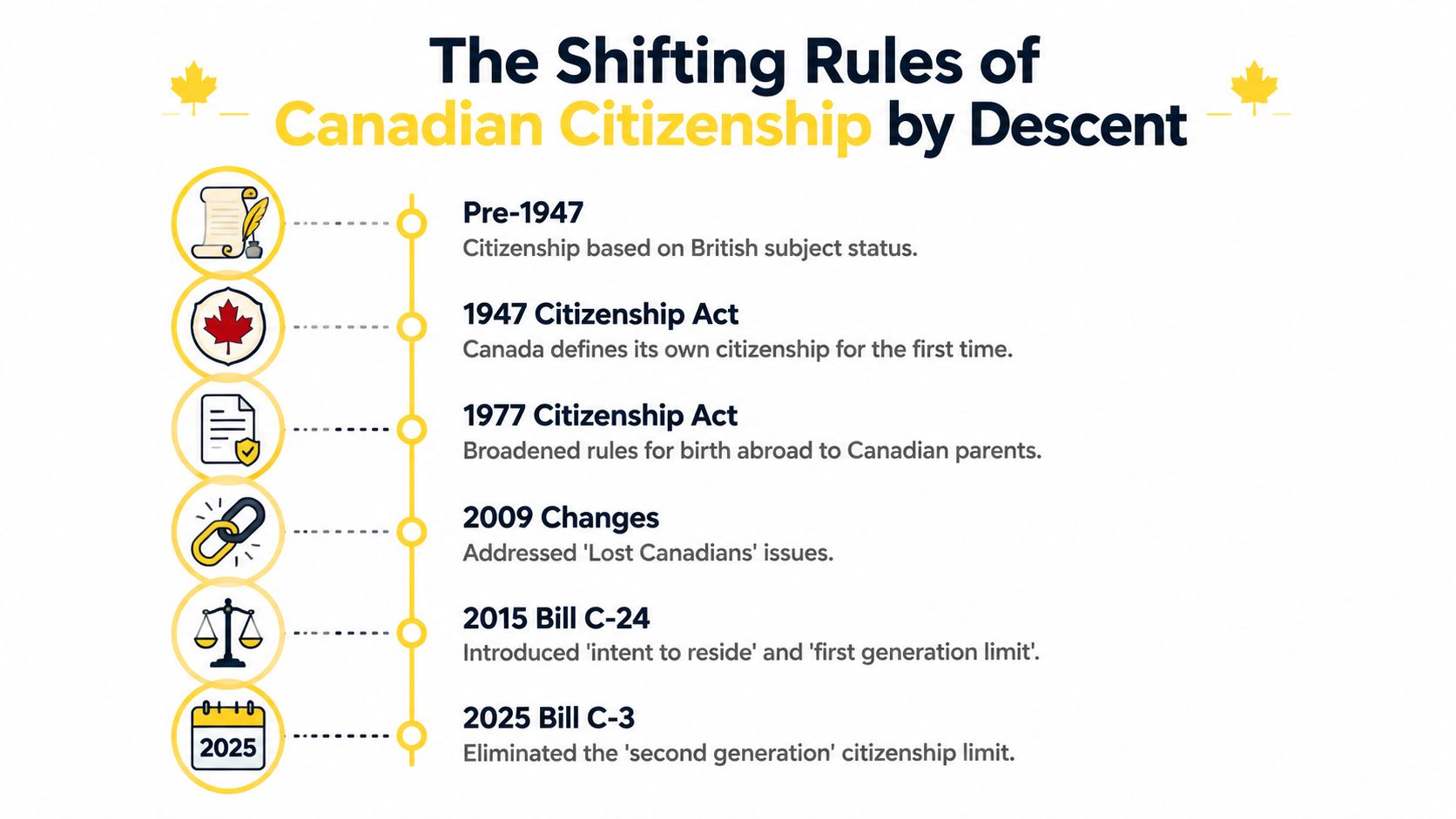
Under the 1977 Citizenship Act, children born abroad to a Canadian parent could benefit from a much broader transmission rule. Before April 17, 2009, that law allowed unlimited generations of transmission abroad without residency requirements, according to IRCC's explanation of citizenship changes.
That broad rule created room for many families abroad to continue passing citizenship down the line. But it also left unresolved problems for people later described as "Lost Canadians". The verified data states that retroactive changes connected to the Act's proclamation resulted in an estimated 20,000 to 50,000 Lost Canadians.
If your family has an older story involving citizenship that seemed to appear, disappear, or become unclear over time, that's often why. The law wasn't generous or restrictive by itself. It was also messy.
April 17, 2009 changed the default rule
On April 17, 2009, Bill C-37 came into force and imposed a strict first-generation limit. After that change, only children of Canadian citizens who were born in Canada or naturalized in Canada automatically acquired citizenship abroad as the first generation born outside Canada.
That means a simple two-family comparison could produce opposite outcomes:
| Family situation | Result under post-2009 first-generation limit |
|---|---|
| Parent born in Canada, child born abroad | Child could acquire citizenship automatically |
| Parent born abroad to a Canadian parent, child also born abroad | Child was blocked |
The verified data states that this change affected approximately 20,000 individuals immediately, and that IRCC data indicated over 10,000 applications for citizenship certificates or passports were denied annually in the following years because of the limit, as described in IRCC’s background on these citizenship rules.
For many readers, this is the moment where family stories stop matching legal reality. Your parent may have been Canadian. You may have grown up fully expecting to be Canadian too. But if your parent was also born abroad, the 2009 rule often cut off automatic transmission.
Practical rule: If you were born abroad to a Canadian parent, your own birth date is crucial. But your parent’s birth location may be just as important.
Court decisions and partial fixes
A 2010 Federal Court ruling in Ha v. Canada declared the first-generation limit unconstitutional for those born before 2009. Later, Bill C-24 in 2015 restored citizenship retroactively to about 6,000 first-generation Lost Canadians through deemed citizenship provisions under section 5.1(4) of the Citizenship Act.
That helped some people, but it did not solve the full problem for second-generation families born abroad. So many people still sat outside the line even after the 2015 amendments.
Here is the simplest way to think about those years:
- Before April 17, 2009. The law was generally broader for descent abroad.
- From April 17, 2009 until the 2025 reform took effect. The first-generation limit became the barrier for many families.
- After the 2025 reform takes effect. The legal situation changes again.
The coming 2025 turning point
The verified data states that Bill C-3, in force December 15, 2025, eliminates the first-generation limit for past cases and retroactively recognizes citizenship for Generation 2 and beyond if linked to an anchor citizen. The same verified data states this change is expected to impact 100,000+ individuals globally.
If your family was previously told, “citizenship stopped with your parent,” that may no longer be the end of the story once the 2025 framework applies. The key question becomes which timeline fits your family, and whether your documents can prove it.
The New Era of Canadian Citizenship The 2025 Rules and Substantial Connection
The 2025 rules are easier to understand if you separate past cases from future births. Those are not the same issue.
What Bill C-3 changes
The verified data states that Bill C-3, effective December 15, 2025, eliminates the first-generation limit for past cases and allows transmission beyond the first generation, while still maintaining an anchor requirement. A qualifying claim must still trace back to a Canadian-born or naturalized ancestor.
That last point matters. The law becomes much more flexible, but it does not create a free-floating right to citizenship disconnected from a real Canadian ancestor in the line.
If you were previously excluded because both you and your Canadian parent were born abroad, this is the reform that matters most.
For a fuller discussion of the legislative change, Mayo Law’s overview of Bill C-3 in Canada is a useful starting point.
The substantial connection rule
For children born under the new law where the transmitting parent was also born abroad, the key concept is substantial connection.
The verified data states that a Canadian parent born abroad can pass citizenship to a child if the parent proves 1,095 cumulative days of physical presence in Canada before the child’s birth, and that these days do not need to be consecutive, as described in this summary of the Bill C-3 substantial connection rule.
That one word, cumulative, resolves a lot of anxiety. Many people hear “three years” and assume they needed one uninterrupted block in Canada. That isn’t how the verified rule is described. Time can be accumulated across separate periods.
A parent might have:
- Studied in Canada for part of university
- Worked in Canada before relocating abroad
- Returned later for another job assignment
- Lived with family between contracts or businesses
Those periods can matter if they add up and can be proven.
A scattered life can still satisfy the rule. The real issue is whether the parent can document physical presence well enough to satisfy the officer reviewing the file.
What counts as proof
The verified data identifies examples of evidence used to show physical presence, including pay stubs, academic transcripts, lease agreements, and employment records. Officers review the totality of the documents, which means this is a factual assessment rather than a single-document test.
That creates a practical difference between families who “know” someone lived in Canada and families who can prove it.
A parent may honestly remember spending substantial time in Canada, but memory alone usually won’t carry the file. Documentary records from the relevant period are what make the claim workable.
A three-generation example
Consider this family:
- A grandmother was born in Canada.
- Her son was born in the U.S.
- That son later lived in Canada for school and work across several separate periods.
- His daughter was then born in France.
Under the old first-generation limit, the daughter’s claim would have run into serious trouble because her father was also born abroad. Under the 2025 framework, the analysis changes. The claim can still work if the father’s citizenship traces back to the Canadian-born grandmother and if he can prove the required 1,095 cumulative days in Canada before his daughter’s birth.
Now change one fact. The father spent meaningful time in Canada but has almost no records left. No school transcript. No lease. No employment documents. The legal theory may still be sound, but the evidentiary problem becomes the obstacle.
The anchor requirement is still there
The verified data makes clear that Bill C-3 keeps an anchor requirement. Citizenship transmission must trace back to a Canadian-born or naturalized ancestor. So while people often say the generational limit is gone, that shorthand can be misleading if understood strictly.
The better way to say it is this: the old cutoff no longer blocks many families, but the chain still has to connect to a valid Canadian anchor, and timing still matters.
Gathering Your Proof The Documents Needed for a Citizenship Claim
Once people understand the rule, they usually run into a second problem. They don’t know what to gather first.
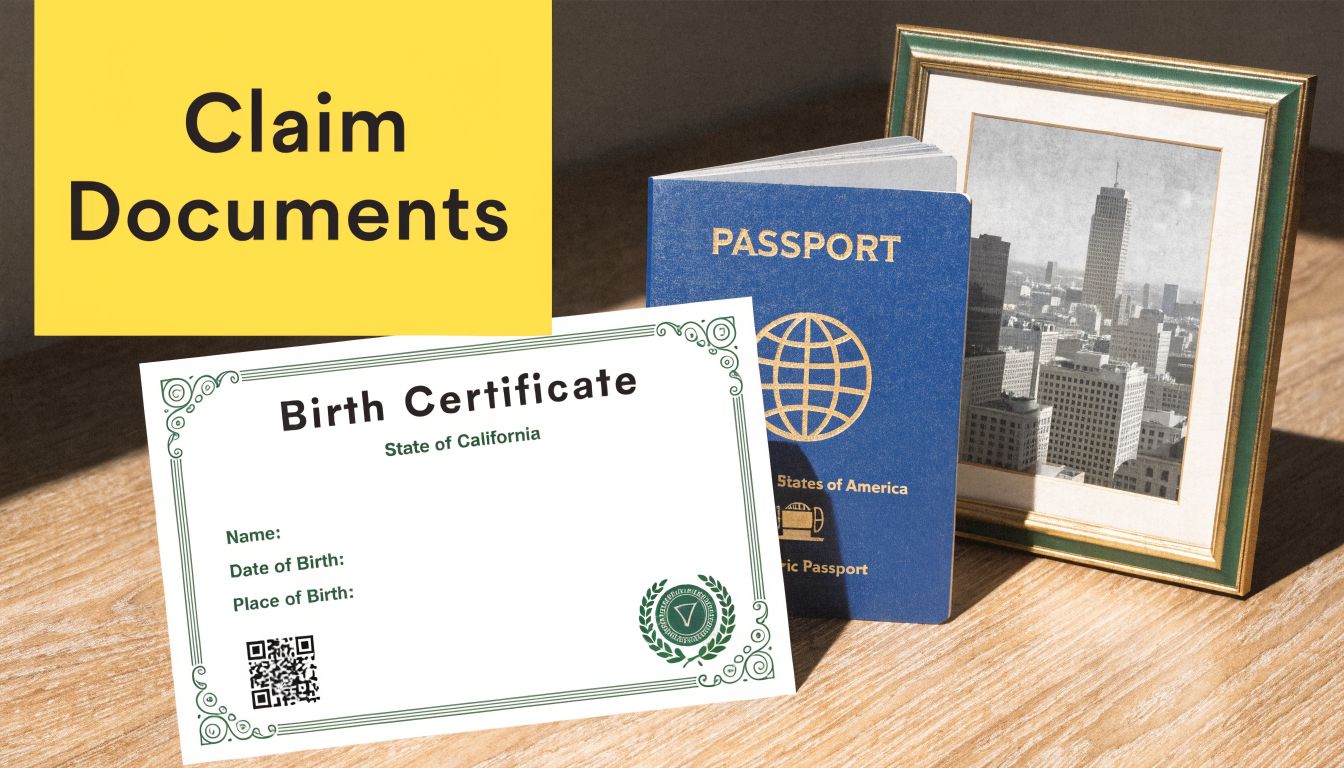
The cleanest approach is to divide documents into two groups. One group proves the family chain. The other proves the parent’s presence in Canada, where required.
Primary proof of identity and lineage
Start with the records that show who gave birth to whom, and when.
You will usually want to collect:
- Your long-form birth certificate showing your parents’ names
- Your Canadian parent’s proof of citizenship, such as a Canadian birth certificate or citizenship certificate
- The parent-through-whom-you-claim records, if your case runs through a grandparent or earlier ancestor
- Marriage records or name-change documents where surnames changed between generations
- Identity documents that help tie names and dates together consistently
If a record comes from outside Canada, pay attention to whether the issuing authority provided a certified copy, whether translation is needed, and whether the document format matches what the receiving authority expects. Families lose time over small inconsistencies, especially with middle names, maiden names, or different spellings used across decades.
If you’re gathering U.S. records for a Canadian file, Mayo Law’s guide to getting an apostille in New York may help you organize foreign-issued documents for broader cross-border use.
Substantial connection evidence
The verified data states that Bill C-3 keeps an anchor requirement, and that for a second-generation child born abroad to receive citizenship, the parent who was also born abroad must have accumulated 1,095 days of presence in Canada before the child’s birth, as summarized in this explanation of the anchor requirement and residency proof.
That means the timeline of your documents matters as much as the documents themselves.
Useful evidence can include:
- Pay records from Canadian employment
- School records such as transcripts
- Lease documents or housing records
- Employment letters and HR records
- Other contemporaneous records showing physical presence in Canada
Recordkeeping advice: Don’t just gather documents. Put them in date order. A decision-maker needs to see the chain of citizenship and, where relevant, the chain of physical presence.
A practical way to assemble the file
Instead of collecting records in random batches, build a chronology.
Try this:
- Anchor ancestor first. Start with the Canadian-born or naturalized person.
- Move generation by generation. Add each birth record that links parent to child.
- Resolve name issues early. If one generation married, divorced, or changed names, account for it before submission.
- Add Canada-presence proof last. Only after the family chain is clear should you build the residence timeline.
That order helps because most difficult files fail from confusion, not from lack of family connection.
How to Formally Confirm and Apply for Proof of Citizenship
Even if you’re confident you qualify, the practical question remains the same. How do you get the government to confirm it?
Often, the answer is to apply for a citizenship certificate, often called proof of citizenship. This is the document that confirms status. It is not the same thing as a passport, and it is not the same thing as a fresh grant of citizenship.
Start with IRCC’s application process
IRCC provides the official application materials and instructions. The place to begin is the government’s page for a citizenship certificate application. That page explains who should use the process and what proof is generally required.
If you’re looking at your family story and still asking, “am I a Canadian citizen born abroad to Canadian parent,” this application is the formal route to an answer from the government.
You should also review:
- IRCC’s application forms and instruction guide
- IRCC’s online fee list
- IRCC’s processing times tool
I am not repeating fee amounts or timelines here because those items can change, and the government pages above are where you should confirm the current figures directly.
How to think about the application
This process goes more smoothly when you treat it as a proof package, not as a form-filling exercise.
The application usually requires you to line up several things correctly:
| Part of the file | What it does |
|---|---|
| Identity documents | Shows who you are |
| Birth records | Connects you to the Canadian parent or ancestor |
| Citizenship proof of parent or ancestor | Establishes the legal source of the claim |
| Presence evidence, where relevant | Supports substantial connection under the newer framework |
A few practical habits help:
- Read the guide before filling anything out. People often complete forms too early, then discover they used inconsistent names or dates.
- Match every date across documents. If one document differs, explain it clearly and support the explanation.
- Use the same naming format throughout. Small inconsistencies can trigger delays.
- Submit a coherent package. Officers should be able to follow the story without guessing.
For a broader overview of the path to citizenship status and related processes, this Mayo Law article on how to become a Canadian citizen may be helpful background.
What happens after submission
After you submit, the government reviews the file and may ask for more information if something is missing or unclear. That’s one reason document organization matters so much. A weak filing can create delay even where the underlying claim is strong.
If approved, the certificate becomes your formal proof. That document can then support a Canadian passport application.
Navigating Complications Adoption Statelessness and Other Edge Cases
Some families don’t fit the standard parent-child paperwork model. That’s where uncertainty gets sharper, because the answer may depend on rules outside the usual descent analysis.
Adoption cases
Adoption can raise different legal questions than biological descent. The timing of the adoption, the legal status of the adoptive parent at that time, and the statutory route being used can all matter.
If your claim involves international adoption, don’t assume the standard birth-abroad rule applies in exactly the same way. The family relationship may be real and undisputed, but the legal framework can differ.
Cases involving statelessness
Some citizenship systems contain provisions intended to reduce the risk that a child will have no nationality at all. When a child born abroad might otherwise be left stateless, the analysis can become more specialized and fact-sensitive.
These cases deserve careful review because they don’t always fit ordinary assumptions about descent, registration, or proof. A family can miss an important protection if they frame the issue too narrowly.
Parentage problems on paper
Another common complication is simpler but no less serious. The Canadian parent isn’t named on the birth certificate, or the name on the birth certificate doesn’t match later identity records.
That does not always end the claim. But it usually means more evidence is needed to prove the legal relationship and to explain discrepancies cleanly. In practice, these files often turn on document consistency.
Mayo Law works with clients across the GTA and on cross-border matters. Joseph Mayo is licensed in Ontario and New York, so clients with U.S. ties can coordinate their legal work in one place rather than juggling two firms. For readers trying to assess whether they need legal help at all, this page on finding immigration attorneys near me may help frame what to look for.
When a case falls outside the standard pattern, the risk isn’t always that the claim fails. The risk is that the file is presented under the wrong legal theory.
Frequently Asked Questions About Citizenship by Descent
| Question | Answer |
|---|---|
| If my Canadian parent never had a passport, can I still qualify? | Possibly. A passport isn’t the only way to prove citizenship. Birth or citizenship records may matter more than whether the parent ever applied for a passport. |
| Do I need to move to Canada to confirm citizenship by descent? | No. A citizenship certificate application can be pursued without relocating to Canada. |
| If I qualify, do I apply for citizenship or proof? | Usually proof. In many descent cases, the issue is confirming existing status, not applying as a new citizen. |
| What if my parent lived in Canada in different periods? | That can still matter. Under the verified 2025 rule, qualifying days can be cumulative rather than consecutive. |
| Can a grandparent help my claim? | Often yes, but only if the legal chain is intact and can be documented back to the Canadian-born or naturalized anchor ancestor. |
| What if names changed across generations? | Name changes don’t automatically defeat a claim, but they must be explained with supporting records so the lineage is clear. |
If you're stuck between family lore and government paperwork, get clarity before filing. Mayo Law serves clients across Toronto, the GTA, and on cross-border matters between Canada and the U.S. To discuss your situation, visit Mayo Law.
This article is for informational purposes only and does not constitute legal advice. Every situation is different. Consult a licensed lawyer about your specific circumstances.