Published: May 26, 2026
Updated: May 26, 2026
Read time: 11 minutes
You may already have the business idea, the U.S. target market, and even a shortlist of companies to buy. What usually slows Canadian founders down isn’t ambition. It’s uncertainty about the immigration path, the paperwork, and the risk of building the wrong file.
The E-2 visa application is often the right vehicle for a Canadian investor who wants to start or acquire a U.S. business and actively run it. But it isn’t a form-filling exercise. It is a proof exercise. You have to show treaty nationality, a qualifying investment, a real business, lawful source of funds, and a coherent plan for operating the company in the United States.
At Mayo Law, we help entrepreneurs and investors in Toronto, the GTA, and across the border manage the E-2 visa application, with experience licensed in both Ontario and New York on a process that often spans both sides of the border. For Canadians, that cross-border piece matters. Corporate records, banking trails, tax documents, and interview preparation often sit on both sides of the border.
What Are the Core E-2 Visa Requirements?
An E-2 visa application succeeds when the applicant proves six core points: treaty-country nationality, a substantial investment, a real operating enterprise, capital placed at risk, the ability to develop and direct the business, and intent to depart when E-2 status ends. Those are the pillars officers test, even when the facts vary from one business to the next.
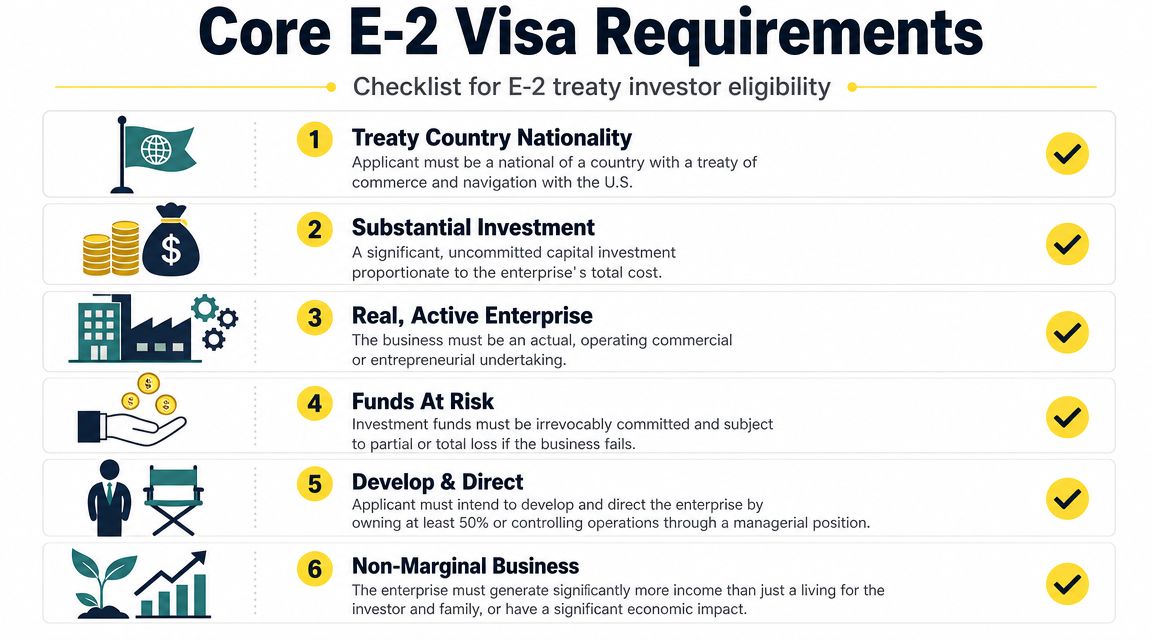
- Treaty nationality. The applicant must be a national of a country that qualifies under the U.S. treaty framework.
- Substantial investment. The investment must be proportionate to the cost of the business, not just meaningful in the abstract.
- Real enterprise. The company must be an actual commercial undertaking, not a passive holding vehicle.
- At-risk capital. The funds must be committed and exposed to loss if the business fails.
- Control and direction. The investor must own at least half the business or otherwise control it in a real managerial sense.
- Nonimmigrant intent. The E-2 is temporary, so the applicant must intend to depart when status ends.
For Canadian applicants, the first point is usually straightforward. Canada is a treaty country under the U.S. Department of State framework, and that treaty-country system is the foundation of the category, as the Department of State explains in its treaty country guidance. But straightforward doesn’t mean automatic. Dual nationals, holding companies, and cap table issues can complicate what looks simple at first glance.
The second point causes more trouble. There is no fixed statutory minimum investment amount. E-2 adjudication uses a proportionality test, and many practitioners treat the required amount as a function of the business model, startup cost, and how much of that cost has already been committed. If you want a deeper breakdown of that issue, see this discussion of E-2 visa minimum investment amount.
Practical rule: If the business can be started cheaply, the officer usually expects you to have committed a higher percentage of the total cost before filing.
Confirming Eligibility: Nationality and Investment Source
The treaty question is binary. If your nationality qualifies, you move to the evidence. If it doesn’t, the E-2 route isn’t available no matter how strong the business may be. The Department of State’s treaty-country framework makes that clear, and it also shows that eligibility can change through specific legal milestones for different countries, which is why nationality analysis should be done carefully at the start, not at the end.
For Canadians, the issue usually becomes less about nationality itself and more about matching the nationality of the investor to the treaty enterprise. If a Canadian founder owns the U.S. company directly, that is usually cleaner than a layered structure with mixed-nationality ownership. Once outside investors come in, especially on a startup cap table, you need to think ahead about whether control and treaty nationality remain clear.
If you’re starting from the basic question, this overview on whether a Canadian can get an E-2 visa is a useful starting point.
Lawful source of funds matters more than most applicants expect
A good E-2 file doesn’t just show that money exists. It shows where it came from, how it moved, and why the officer should be satisfied it was lawfully obtained.
Common sources can include:
- Personal savings backed by employment income, dividend income, or accumulated retained earnings distributions.
- Sale proceeds from real estate, shares, or another business.
- Gifts with records showing the donor’s identity, transfer, and lawful source.
- Loans where the structure doesn’t undercut the at-risk requirement.
In practice, the path of funds often causes more delay than the business plan. Canadian applicants may have funds moving from a personal account, to a corporation, to a U.S. operating entity, with an exchange conversion along the way. Every step should be documented. Missing one transfer receipt can turn a clear story into a credibility problem.
The strongest files read like an audit trail, not a pitch deck.
Can I use a loan for my E-2 investment?
Yes, sometimes. The primary question isn’t whether the money was borrowed. The question is whether the applicant can still prove lawful source, control over the funds, and that the investment is at risk in the business. A loosely documented loan, or one that leaves the officer unsure who really controls the capital, can weaken the case quickly.
Two anonymized examples show the difference.
A Toronto consultant used sale proceeds from a condo, moved the funds through a personal account, then into a U.S. LLC for a service business. The file worked because every transfer, closing statement, and deposit was documented cleanly.
A second applicant relied on family transfers and an informal shareholder advance from a Canadian company. The business itself was viable, but the paper trail was inconsistent, and the officer focused on tracing problems instead of the commercial merits.
Building Your Compliant Investment and Business Plan
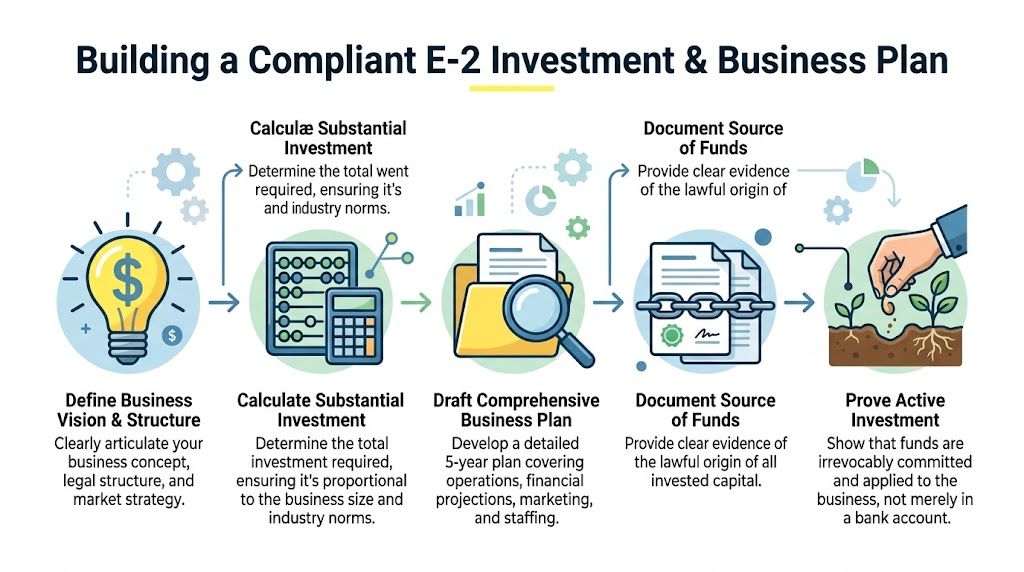
The investment side of the case has to answer a simple question. Is this amount substantial for this business? The rule is not fixed by statute. It is proportional.
According to the E-2 framework described in this E-2 visa analysis, officers compare the amount invested against the purchase price of an existing business or the total startup cost of a new one. That same source notes that many attorneys recommend roughly $75,000 to $100,000 for typical cases, while smaller amounts may work only for very low-cost ventures where the invested capital represents a large share of total startup costs.
How much money is a substantial investment for an E-2 visa?
There isn’t a universal number. A service business with modest startup costs may require the investor to fund most of the setup cost directly. A more expensive acquisition may tolerate a lower percentage, provided the dollar amount and business structure still show real commitment. The wrong question is “What’s the minimum?” The better question is “What does this specific enterprise realistically cost to launch or acquire?”
That is why low-cost businesses often get more scrutiny, not less. If the venture can be started cheaply, the officer may ask why more of the total cost wasn’t already committed before filing.
The business plan isn’t filler
A weak business plan tells the officer the business exists only on paper. A strong one shows operating logic. It should connect the money, the market, and the hiring plan.
A credible E-2 business plan usually needs to show:
- A real market thesis with target customers, competitors, and sales approach.
- Five-year projections that fit the industry and the startup stage.
- A hiring plan showing the business can support more than the investor alone.
- Operating detail such as lease, vendors, equipment, licensing, or inventory.
- Use of funds that matches the bank records and purchase documents.
If you’re building this part of the file, this guide to E-2 visa business plan requirements can help frame what needs to be documented.
What works: projections tied to real assumptions, actual startup expenses, and a staffing plan the officer can follow.
What doesn’t: generic charts, copied market language, and revenue forecasts with no visible basis.
For Canadians buying an existing U.S. business, I usually want the file to explain not just the purchase, but the transition. Who will run operations on day one? What contracts continue? What payroll or vendor obligations already exist? The best applications don’t merely prove eligibility. They show operational readiness.
Filing Your Application: Consular Processing vs. Change of Status
This is one of the most important strategic choices in the process. Canadians often have both options in view, but the right answer depends on where you are, how quickly you need work-authorized status, and whether international travel matters during the filing period.
According to guidance on E-2 processing timelines, a stronger E-2 filing is prepared with the business plan, source-of-funds evidence, and corporate structuring built simultaneously over about 4 to 8 weeks. After submission, consular processing typically takes about 2 to 4 months, depending on interview availability. By contrast, USCIS change-of-status cases can be adjudicated within 15 business days with premium processing, although that clock pauses if USCIS issues an RFE.
A side-by-side comparison
| Filing path | Best fit | Main advantage | Main drawback |
|---|---|---|---|
| Consular processing | Applicants outside the U.S., including most Canadians | Produces an actual visa for travel and admission | Depends on interview scheduling and consular workflow |
| Change of status | Applicants already in the U.S. in valid status | Can move quickly with premium processing in some cases | Doesn’t give you a visa stamp and can create travel complications |
Why Canadians often choose consular processing
For a Canadian founder based in Toronto, Vancouver, or Montreal, consular processing is often the more natural path. It aligns with the fact that the applicant is outside the United States and needs a visa to enter in E-2 status. It also lets the officer review the case in the setting where E-2 adjudication is commonly handled.
Change of status can still make sense. If you're already in the U.S. in valid status and need a domestic filing path, it may be the cleaner short-term option. But many applicants miss the practical consequence. Approval of a change of status by USCIS is not the same as getting a visa foil in your passport. If you later leave the U.S., you may still need consular processing to return in E-2 classification.
What works better in practice
Mayo Law works with entrepreneurs across the GTA and on cross-border matters. Joseph Mayo is licensed in Ontario and New York, so clients with U.S. ties coordinate their legal work in one place rather than juggling two firms.
That matters because filing path decisions are often driven by non-immigration details:
- Corporate timing if a U.S. acquisition is closing soon.
- Banking setup if funds are already committed south of the border.
- Travel demands if the investor needs to move between Canada and the U.S.
- Family timing if spouse and children are applying together.
One anonymized scenario illustrates the trade-off. A Canadian buyer closing on a small U.S. services company wanted speed and was already in the United States. Change of status looked attractive. But frequent travel back to Ontario for family reasons made a domestic-only status approval awkward. Consular processing ended up fitting the actual-life facts better, even if it required more patience upfront.
Avoiding Common E-2 Denials and Administrative Processing
Most E-2 refusals aren't caused by one dramatic flaw. They usually arise from a file that leaves too many questions unanswered. The encouraging part is that many of those problems are preventable.
In Fiscal Year 2020, the U.S. Department of State recorded 26,759 E-2 cases globally, with 23,493 issued and 3,266 refused, for an issuance rate of about 87.8%. Canada ranked second that year with 2,500 E-2 approvals, according to this E-2 statistics summary. That doesn't mean approval is easy. It does suggest that well-prepared applications are often approvable.
The denial themes I watch most closely
- Marginality concerns. If the business appears likely to support only the investor and family, the file weakens.
- Funds not at risk. Money parked in an account with no real commitment is a recurring problem.
- Source-of-funds gaps. Missing records make even lawful funds look uncertain.
- Control problems. Ownership, operating agreements, and job role must line up.
- Inconsistent documents. Different versions of the same story across the petition, corporate records, and interview answers can trigger delay.
A common mistake among Canadian applicants is assuming a profitable solo consultancy automatically makes a good E-2 case. It may be a real business, but if the file doesn't show room for growth beyond the principal investor, the officer may see marginality.
If you're still deciding what kind of company to launch or acquire, reviewing practical categories of businesses that fit E-2 approval patterns can help you avoid that issue at the planning stage.
What is a 221(g) refusal and how do I respond?
A 221(g) notice usually means the case isn't fully resolved and the officer wants more evidence or additional processing before final adjudication. It isn't the same as a final merits denial, but it should be treated seriously and answered precisely. One practitioner source notes that applicants are usually expected to respond within 120 days to avoid refusal, and cases in administrative processing often hinge on how quickly and clearly the requested material is supplied.
Send exactly what was requested, organized the way the consulate can review it quickly. Over-answering with loose documents often makes the record harder to follow.
The largest delay triggers identified in practitioner guidance are documentary inconsistency, weak source-of-funds tracing, marginality concerns, and post-interview document requests. Those are preventable if the file is built as one coordinated record from the start.
Life After Approval: Renewals, Family, and Long-Term Strategy
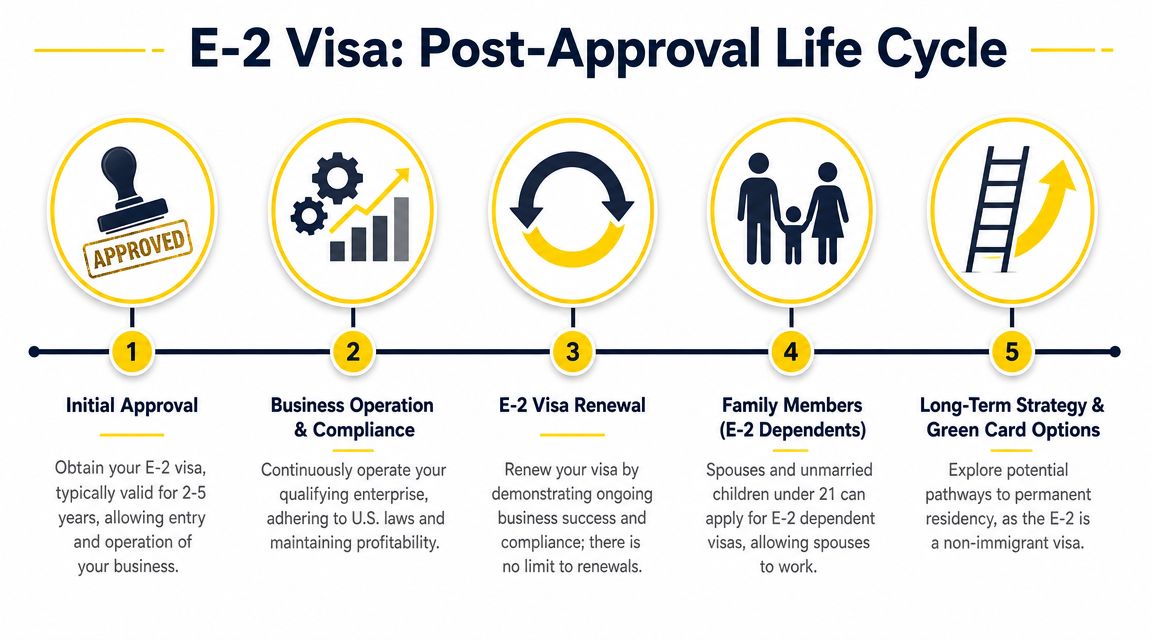
The approval notice is the beginning of the harder part. The business now has to keep proving that it is real, active, and worth the status you were given.
Renewals depend on what the business actually did
Renewal cases are won or lost in the records. Officers want to see that the company operated in line with the application, or that any changes were normal business developments explained clearly in the file.
That means keeping clean evidence from the start: business bank statements, tax filings, payroll records, contracts, invoices, lease documents, and proof that the company is still delivering goods or services. If revenue was slower than projected, address it directly. If the company pivoted, show why the change made commercial sense and how the enterprise still meets E-2 requirements.
Canadian applicants have an added practical issue. Many renew through consular processing in Canada, and the file often gets reviewed by someone who knows nothing about the day-to-day history of the business. A well-organized renewal package matters more in that setting because the officer is not filling in gaps for you.
Family members and cross-border planning
Spouses and qualifying children can accompany the principal investor, but family strategy should be part of the original planning, not an afterthought.
For Canadians, that usually means sorting out where the family will live, how often they will cross the border, whether children will age out soon, and whether the spouse plans to work in the United States. I often see founders focus on the company and leave those issues until after approval. That creates avoidable stress, especially for families managing Canadian tax residency, U.S. school enrollment, and a business that still has ties on both sides of the border.
The E-2 can support a workable cross-border life. It does not simplify tax filing, corporate maintenance, or residence planning on its own.
Can an E-2 lead to a green card?
E-2 status is temporary by design. It can be renewed, sometimes many times, if the business continues to qualify, but it does not convert into permanent residence on its own.
That distinction matters early. A founder who wants a long-term U.S. future should decide whether the E-2 is the main strategy or a temporary bridge while building toward another option such as EB-2 NIW, EB-1A, EB-1C, or in some cases EB-5. The right answer depends on the founder's background, the company structure, and how quickly the business may support a permanent residence case.
If permanent residence is part of the plan, map that out before the first renewal cycle. This overview of employment-based green card options for founders and professionals is a useful starting point.
Frequently Asked Questions
Is the E-2 visa available to every entrepreneur?
No. E-2 classification is limited to nationals of treaty countries, and the company must meet the ownership and control rules that go with that nationality. For Canadians, this is often straightforward, but I still verify it early because ownership changes, cap table mistakes, and non-treaty co-founders can undermine an otherwise good case.
How much does an E-2 application cost overall?
The filing cost depends on whether the case goes through a U.S. consulate or through USCIS, and the fee schedule can change, so applicants should confirm current amounts with the government before filing. In practice, the larger cost issue is usually elsewhere: getting the company set up properly, documenting the source of funds, preparing a credible business plan, and making sure the investment is already committed in a way the consulate will accept.
How long does the process usually take?
The legal filing is only part of the timeline. The primary variable is how quickly the applicant can assemble clean source-of-funds records, corporate documents, banking records, and a business plan that matches the actual launch strategy.
For a Canadian applicant using consular processing, I usually tell clients to expect a preparation phase measured in weeks, not days. After submission, timing depends on the consulate's procedures, interview availability in Canada, and whether the officer requests follow-up documents or places the case in administrative processing.
Can I apply from Canada if my business will be in the United States?
Yes, and for many Canadians that is the practical route. If you live in Canada and are opening or buying a U.S. business, consular processing is often cleaner than trying to patch together status from inside the United States.
That choice has trade-offs. A consular filing can give you visa issuance and clearer travel documentation, but it also means preparing for a post-specific review process and an interview. For Canadians, those logistics matter. Where you file, how your package is organized, and how the business activity is framed for a Canadian-based officer can affect speed and predictability.
What is the biggest risk in a self-prepared file?
Inconsistency.
A self-prepared E-2 package often has enough documents, but the documents do not tell the same story. The wire transfer does not match the subscription agreement. The business plan projects hiring, but the lease is too small for the stated operation. The applicant says one thing at interview, while the cover letter says another. Those gaps are what create trouble.
If you're weighing an E-2 visa application against other U.S. options, or trying to structure a Canadian-to-U.S. expansion without creating avoidable immigration problems, Mayo Law can help assess the route, the business setup, and the evidence plan in one cross-border review.
Conclusion
If you're a Canadian founder looking at the U.S. market, the E-2 can be a practical visa category. But the strength of the case usually turns on preparation, not enthusiasm. The right filing path, a clean source-of-funds record, and a business plan grounded in actual operations make the difference. Done properly, the process is manageable and often worth the effort.
How Mayo Law Can Help
Mayo Law handles E-2 matters with a cross-border lens. For Canadian applicants, that usually means coordinating the U.S. immigration filing with the Canadian and U.S. corporate, tax, and funds trail issues that can weaken a case if they are handled separately.
Our role is practical. We review whether the business structure fits the visa strategy, trace the investment funds into a clean evidentiary record, prepare the application for consular processing in Canada, and address issues that often matter more for Canadians than generic guides suggest. That includes timing around a Toronto-based founder's travel, matching ownership documents across both countries, and avoiding preventable problems that can trigger delays at the consulate.
Dual licensure matters here. It allows the legal analysis on the immigration side and the cross-border business side to stay aligned from the start.
Disclaimer
This article is for informational purposes only and does not constitute legal advice. Every situation is different. Consult a licensed lawyer about your specific circumstances. Mayo Law provides legal services through Mayo Law PC in Ontario and Joseph Mayo PLLC in New York.
Related Articles