Published: May 29, 2026
Updated: May 29, 2026
Read time: 15 minutes
You usually realize you need trade secret lawyers at the worst possible moment. A developer resigns, a distributor starts selling a suspiciously similar product, or a former manager begins calling your customers with information they should not still have. By then, your problem is not academic. It is operational, commercial, and often cross-border.
If your business works in both the U.S. and Canada, the pressure rises fast. Evidence may sit on devices in one country, employees may move in another, and the practical question becomes what to do before your confidential know-how spreads further. Businesses dealing with cross-border risk often also need coordinated international business counsel and internal controls that fit with broader compliance planning.
What Is a Trade Secret?
A trade secret is commercially valuable information that isn’t generally known and is protected by reasonable efforts to keep it secret. In plain terms, it can be the information that gives your business an edge, but only if you treat it like something confidential.

The easiest way to think about it is a protected recipe. The value does not come from registration. It comes from the fact that competitors do not know it, cannot easily reverse engineer it, and would benefit if they got it. A formula, source code, pricing model, manufacturing process, customer list, supplier terms, or internal workflow can all fit.
The two elements that matter most
A business usually has to show two things.
- The information has real business value because it is secret
- The business took reasonable steps to keep it secret
If either piece is missing, the claim gets much weaker. A company that says a spreadsheet is confidential, but stores it in a shared drive open to everyone and never uses confidentiality language, has a problem. Courts tend to look at conduct, not slogans.
Practical rule: If you would struggle to show who had access, what rules applied, and when the information was marked confidential, expect a fight over whether it was really a trade secret at all.
The U.S. and Canada do not frame the issue the same way
In the United States, the modern turning point was the Defend Trade Secrets Act, which created a federal civil cause of action in 2016. That changed venue strategy, speed, and litigation posture. An employer-focused review noted that in the first two months of 2022, at least 139 new trade secret disputes had already entered the federal court system, which shows how active the federal docket remained after the law’s passage, according to the Fisher Phillips review of post-DTSA trade secret litigation.
Canada is different. You do not start from a single equivalent federal statute for most private trade secret disputes. Canadian claims often arise through common law duties of confidence, contract claims, employment obligations, and related commercial remedies. That difference matters. U.S. businesses often expect a federal litigation playbook. Canadian businesses often need to think first about confidentiality duties, contractual drafting, and the provincial court route.
What usually qualifies, and what usually does not
Information often qualifies when it is specific, useful, and controlled. Examples include:
- Customer intelligence that is not public and took effort to build
- Algorithms or software logic that drives product performance
- Manufacturing methods known only inside the business
- Internal pricing rules that shape margin strategy
- Supplier or distributor terms not available in the market
What usually fails is information that is public, obvious, casually handled, or remembered only as general skill and experience. Employees are allowed to use what they know as professionals. They are not allowed to walk out with your confidential files and relabel them as memory.
How Is a Trade Secret Different from a Patent?
Many founders ask the wrong question. They ask which form of protection is stronger. The better question is which form of protection fits the asset and the business model.
Trade Secret vs. Patent At a Glance
| Attribute | Trade Secret | Patent |
|---|---|---|
| Scope | Protects confidential business information | Protects inventions that meet patentability rules |
| Public disclosure | Requires secrecy to keep protection alive | Requires public disclosure through the patent system |
| Duration | Can last as long as secrecy is preserved | Time-limited protection |
| How rights are lost | Loss of secrecy can destroy protection | Rights depend on validity, maintenance, and scope |
| Typical fit | Processes, source code, methods, data, commercial know-how | Technical inventions you can disclose and claim |
A patent is a bargain with the state. You disclose the invention publicly, and in exchange you receive a limited monopoly if the application succeeds. A trade secret is the opposite model. You disclose nothing publicly, but protection survives only while secrecy does.
Why startups often hesitate
For an SME, the decision is not just legal. It is operational.
If your product can be reverse engineered once sold, secrecy may not last. In that situation, a patent may be worth considering. If the core value sits in internal process know-how, source code architecture, customer segmentation logic, or manufacturing tolerances that stay inside the company, trade secret protection may be more practical.
A founder should also ask how fast the market moves. Patent timing can be too slow for some businesses. Secrecy can work immediately, but only if controls exist on day one.
A weak trade secret program is not a cheaper patent strategy. It is often no strategy at all.
The legal trigger is different
Patent infringement does not depend on theft. Someone can infringe a valid patent even if they developed the technology independently. Trade secret law usually focuses on wrongful acquisition, disclosure, or use of confidential information.
That distinction changes evidence. In a trade secret case, your lawyers will care about access trails, departing employees, downloads, device imaging, cloud transfers, NDA language, and who knew what when. If you are weighing both options, this comparison of trade secret vs patent is usually where the strategic discussion starts.
What Are Reasonable Steps to Protect a Trade Secret?
Most SMEs lose this issue long before they reach court. They assume the information is obviously secret, so they skip the boring controls. Courts usually care about the boring controls.
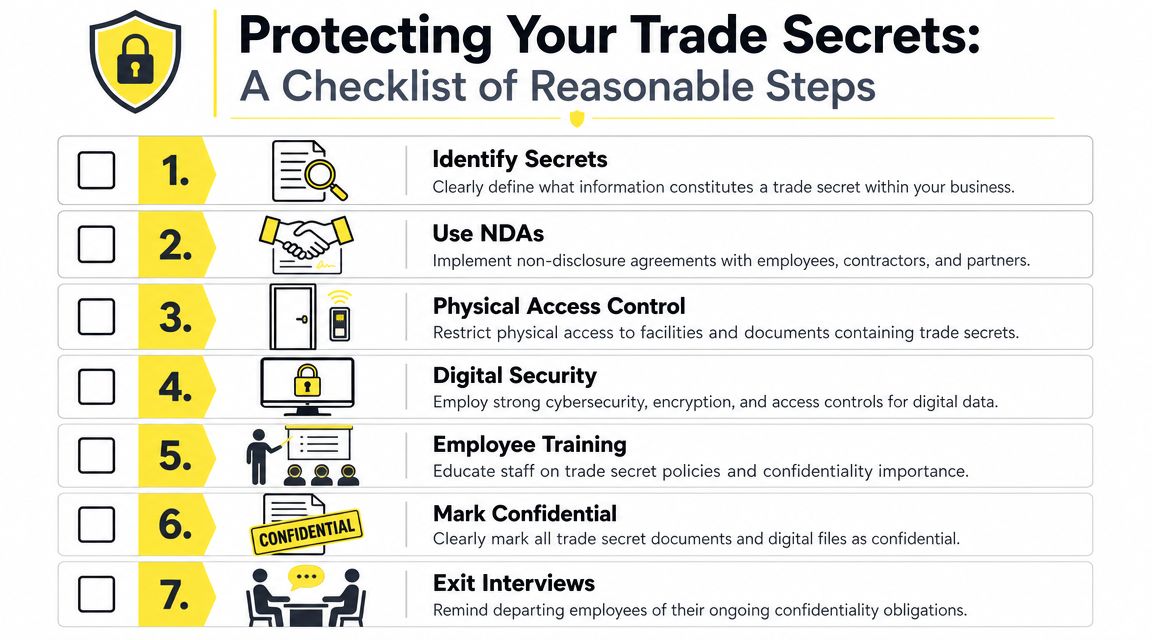
Leading firms emphasize protection programs that combine secrecy controls, physical security, NDAs, and employee, partner, and customer confidentiality agreements to reduce the risk of misappropriation in the first place, as described by Robins Kaplan's trade secret practice overview.
Contracts are the floor, not the ceiling
An NDA matters. So does a confidentiality clause in an employment agreement, contractor agreement, consulting agreement, reseller agreement, and joint development agreement. But paper alone is not enough.
A practical contract system should do at least four things:
- Define the confidential information clearly so nobody argues later that the category was too vague
- Limit permitted use to a stated business purpose
- Require return or destruction when the relationship ends
- Preserve post-termination obligations after an employee or contractor leaves
In cross-border work, I often see a mismatch. A Canadian company uses a short-form confidentiality clause that might be serviceable for routine commercial discussions, then tries to rely on it in a U.S. federal dispute involving software or technical data. That gap becomes expensive.
Access control is what proves you meant it
If everyone can access everything, the “secret” part becomes harder to prove. Good practice is not glamorous. It is controlled permissions, segmented folders, role-based access, logging, locked rooms, clean device policies, and clear retention rules.
Use practical labels. “Confidential” still matters. So do restricted repositories and named project access groups. If your team uses GitHub, Google Drive, Microsoft 365, Slack, or Dropbox, your policy needs to match those tools rather than living in a PDF no one reads.
Employee lifecycle discipline matters more than founders expect
Trade secret loss often happens at two moments. During rapid hiring. During rushed departures.
Use onboarding to teach people what the company treats as confidential. Show examples. Make engineers, sales staff, operations managers, and contractors acknowledge the rules in context, not just by checking a box.
Then take exits seriously:
- Cut access promptly when employment ends
- Preserve devices and logs before wiping or reassigning them
- Remind the person in writing of ongoing confidentiality duties
- Ask direct questions about personal email forwarding, cloud storage, and external drives
- Notify the new employer when appropriate and when strategy supports it
The companies in the strongest position are rarely the ones with the longest contracts. They are the ones that can show a consistent pattern of controlled access and repeated confidentiality reminders.
SMEs need a system they can actually maintain
A startup does not need a Fortune 500 compliance stack. It does need a repeatable process. Usually that means:
- A trade secret inventory identifying what matters most
- A classification policy for sensitive data and know-how
- Template agreements for employees, contractors, vendors, and partners
- An incident plan for suspicious downloads, resignations, or competitor contact
- Escrow or continuity planning for critical code or licensed software
For software-heavy businesses, a related issue is continuity and control over code assets. That is one reason some companies also review software in escrow as part of broader IP risk planning.
Enforcing Your Rights When a Trade Secret Is Stolen
On Friday, a key employee resigns. By Monday, your team spots unusual downloads, forwarded files, or repository activity from the week before departure. Two weeks later, a U.S. or Canadian competitor launches something that looks uncomfortably familiar.
The first legal mistake is usually speed without control. Founders want to confront the person, threaten the new employer, or send a demand letter before they know what happened. That approach can destroy evidence, lock the other side into a defensive story, and make emergency relief harder to get.
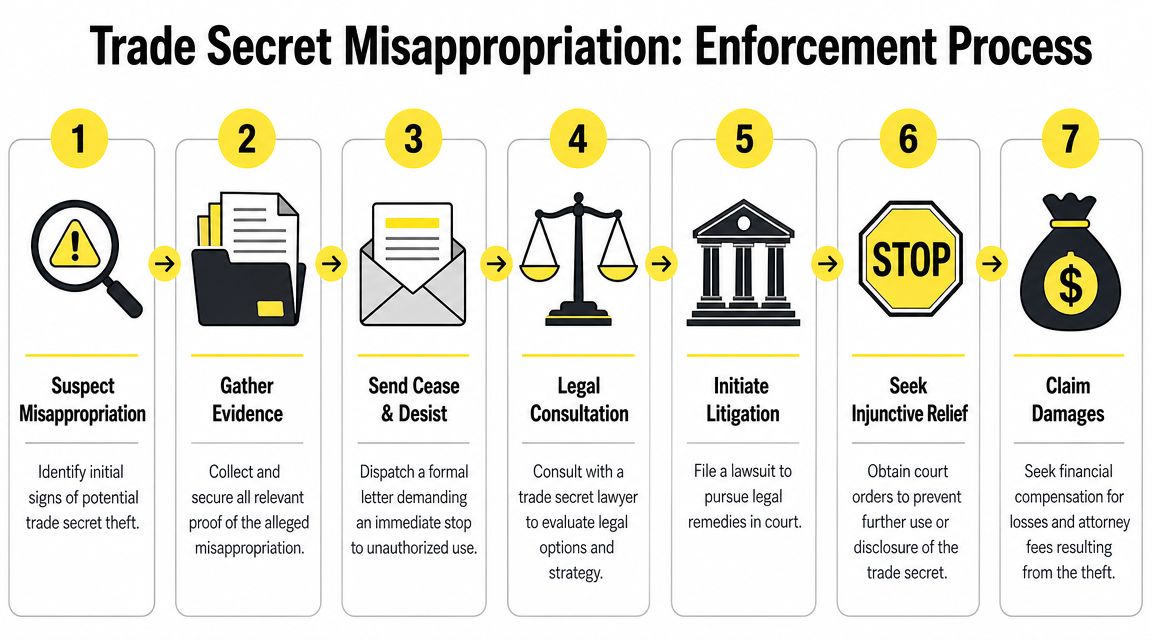
Secure the evidence first
Start with preservation. Freeze relevant accounts, devices, cloud logs, messaging data, access records, and version history. Tell internal IT not to wipe, reissue, reset, or “tidy up” anything tied to the employee, contractor, or business partner in question.
In software and manufacturing matters, a few hours can matter. Sync logs disappear. Temporary files roll off. Mobile device data gets overwritten. If the dispute may cross the U.S.-Canada border, preserving data sources early also helps avoid later fights about where the evidence sits and which court can compel its production.
Confirm what was taken and why it matters
A trade secret claim rises or falls on specifics. What information was accessed. Why it was confidential. Who was allowed to use it. Whether the use stayed within that permission. Whether there is evidence of copying, transfer, retention, or competitive use.
That usually requires a coordinated review of:
- Devices, accounts, and cloud activity
- Confidentiality, invention, and contractor agreements
- Departure timing, customer contact, and competitor communications
- The business value of the information at issue
I often tell SME clients to separate suspicion from proof. Courts do not grant injunctions because a departure felt disloyal. They act when the record shows identifiable confidential information, real protective measures, and a credible risk of misuse.
Decide early whether you need an injunction
In many cases, the practical goal is not damages at trial. It is a court order stopping use, disclosure, solicitation, or further transfer now.
That analysis looks different in the United States and Canada. In both countries, delay hurts you. If a company waits too long, the other side argues there was no real urgency. But the procedural path, timing, and evidentiary expectations can differ by province, state, and court. A founder with staff in Toronto, servers in the U.S., and a departing employee joining a U.S. buyer may need to choose quickly where to file and what relief is realistic in that forum.
Contract drafting matters here. A clear governing-law and venue provision can save time and money when the facts are moving fast. That is one reason I push clients to address dispute location in advance through a carefully drafted forum selection clause.
Cross-border cases create pressure points that domestic guides miss
A Canadian company may discover the misuse in Ontario, while the new employer, devices, or customers are in the United States. A U.S. business may have key witnesses in Canada and need to preserve evidence held by a Canadian affiliate or contractor. The legal theory may be strong, but enforcement can still be awkward.
Three issues show up repeatedly:
- Jurisdiction and forum fights over where the case belongs
- Evidence access problems when devices, accounts, or witnesses are in the other country
- Parallel legal advice on employment, privacy, and injunction strategy
For SMEs, cost discipline is particularly important. Filing in the wrong place, sending an overbroad demand, or accusing a competitor before the facts are pinned down can turn a contained problem into a multi-front dispute.
Use business pressure carefully
Litigation is not the only tool. Depending on the evidence, the stage of misuse, and the commercial relationship, a company may send a preservation demand, seek negotiated restrictions, require forensic inspection, or notify the new employer of existing confidentiality obligations. Sometimes a fast negotiated standstill gets the result more efficiently than an immediate court application.
Sometimes it does not.
If the other side is already using the information in product development, manufacturing, pricing, or customer solicitation, delay can harden the damage. At that point, the question is not whether the conduct feels unfair. The question is what remedy will stop it and what evidence will support that remedy in court.
A common cross-border example
A Canadian food manufacturer shares process details with a U.S. co-packer during expansion talks. Internal access controls at the co-packer are loose. Months later, a competing product appears with strikingly similar process choices and production steps.
The dispute is no longer just about theft. It becomes a fight over purpose limits in the agreement, internal circulation, proof of use, jurisdiction, and whether emergency relief is still available. Those are exactly the points generic U.S.-only trade secret articles tend to miss.
The companies in the best position are usually the ones that can act in a sequence. Preserve evidence. Define the trade secret precisely. Assess forum and injunction options. Apply pressure where it helps. File when delay creates more risk than cost.
How Much Does Trade Secret Litigation Cost?
There is no honest flat answer. Cost depends less on the label “trade secret case” and more on the stage, speed, and technical burden.
The first phase is usually the most intense
If you need urgent injunctive relief, spending concentrates early. Lawyers may need to review agreements, secure evidence, prepare affidavits, coordinate forensic work, draft emergency materials, and appear in court on very short notice. That phase can feel disproportionate because it is.
This is also where weak preparation becomes expensive. Businesses that lack a clean confidentiality trail usually spend more time reconstructing what should already exist.
Discovery and experts drive much of the budget
After the emergency phase, cost often shifts to evidence production and expert work. Common drivers include:
- Document collection and review across email, cloud platforms, and devices
- Examinations or depositions of employees, founders, IT staff, and competitors
- Forensic experts to trace copying, deletion, or transfer activity
- Damages experts to address lost profits, unjust enrichment, or valuation issues
A software case and a customer-list case may both be called trade secret litigation, but they do not cost the same to prove. Source code, data architecture, and technical workflows can require more specialized review.
Jurisdiction affects efficiency
Cross-border disputes often cost more because they create duplication. One set of counsel may address U.S. federal procedure. Another may handle Canadian injunctions, local enforcement, or related employment issues. Different discovery expectations also change the volume of work.
Ask for a phased budget, not a single number. The right question is what the next decision point will cost, not what the entire dispute might cost in the abstract.
What helps control spend
Clients manage cost better when they make early choices about goals. Do you want to stop use immediately, force return of information, send a message to the market, or litigate through trial for compensation? Those are different paths.
A practical cost conversation should cover:
- What can be done in the first ten days
- What evidence is already available
- Whether settlement pressure is realistic
- Which claims are essential and which are ornamental
- Whether the forum is helping or hurting efficiency
Cross-Border Challenges for U.S. and Canadian Businesses
Cross-border trade secret disputes are not just domestic cases with extra paperwork. The legal pressure points change once people, devices, servers, witnesses, and assets sit on both sides of the border.
Forum choice can decide leverage early
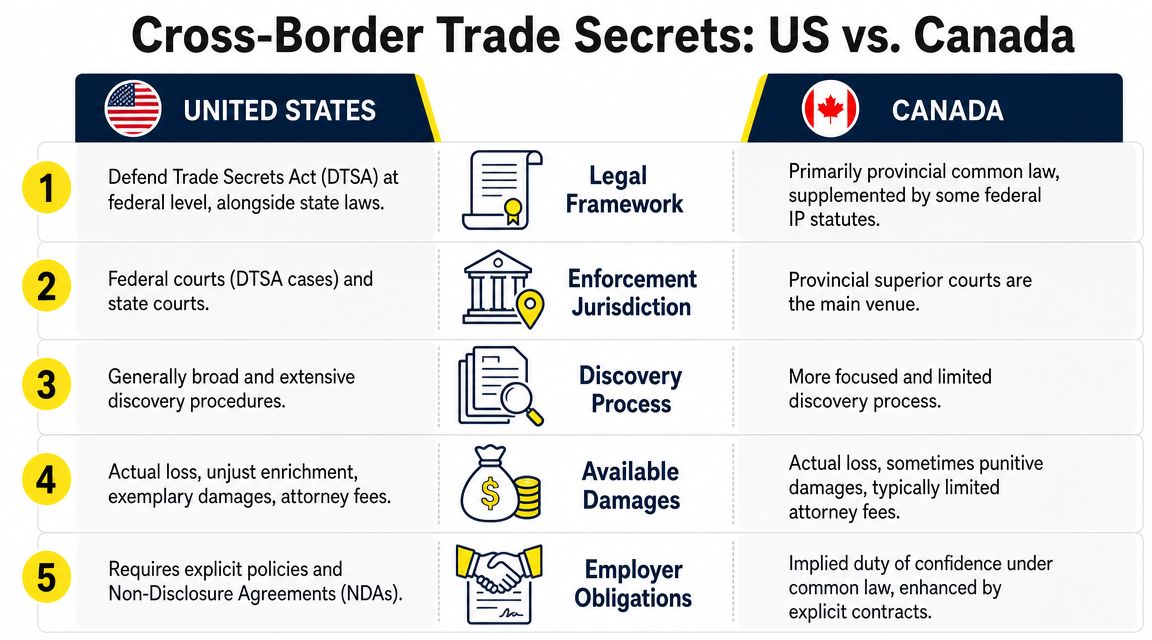
A U.S. business may want federal court under the DTSA. A Canadian business may be looking at provincial court claims grounded in confidence, contract, or employment obligations. Sometimes both options are in play. Sometimes neither side likes the other's preferred venue.
The hard part is not just where you can file. It is where you can move quickly, compel evidence effectively, and enforce the result against the people or assets that matter.
Discovery expectations are not the same
This is one of the biggest practical differences. U.S. litigation generally permits broader discovery. Canadian procedure is usually more focused. That affects strategy from day one.
If you are a Canadian SME sued in the U.S., discovery may feel far more intrusive than what you expected at home. If you are a U.S. business trying to prove a case in Canada, you may need a tighter theory and a cleaner factual record because you cannot assume the same breadth of pre-trial access.
Enforcement is not automatic across the border
A court order in one country may still require separate recognition or enforcement steps in the other. That can matter if the employee moved, the competitor's assets sit elsewhere, or the key servers and devices are outside the original forum.
Founders often underestimate delay. Winning a paper order is not the same as stopping conduct on the ground. Cross-border planning has to account for practical enforceability.
Employment law and confidentiality norms also differ
Canadian employers sometimes rely more heavily on implied duties of confidence than U.S. businesses would expect. U.S. employers often use more explicit restrictive language and may be quicker to frame the dispute around federal trade secret claims and emergency relief.
Neither side should assume its home-country template travels well. A confidentiality package drafted only for one market may underperform in the other.
If the dispute touches market entry, supply arrangements, cross-border staffing, or shared IP development, it often overlaps with broader trade secret misappropriation issues and commercial structure decisions made long before the conflict surfaced.
How to Choose the Right Trade Secret Lawyers
A founder usually calls after a bad Friday. A developer resigned, a sales lead exported customer data, or a Canadian contractor set up a U.S. competitor using the same playbook. At that point, the question is not what kind of lawyer sounds impressive. The question is who can contain the risk in the first 48 hours and still build a case that holds up if the dispute crosses the U.S.-Canada border.
Trade secret matters rarely fit inside one silo. The right team can handle injunction work, internal investigation, employment issues, forensic collection, and the contract questions that often decide where the fight starts. For an SME, that matters because budget gets burned quickly when one firm chases the emergency motion, another reviews the departing employee file, and a third tries to figure out where the data went.
Look for injunction experience and early-case judgment
Trade secret disputes are front-loaded. If you wait for perfect facts, the evidence may be gone, the customer relationships may shift, and the former insider may have more time to spread the information.
Ask a direct question. Have you sought urgent court relief in a case involving confidential information, and what did you need in hand before filing? A lawyer who does this work regularly should be able to answer in practical terms: devices to preserve, witnesses to lock down, what can be proven now, and what should wait.
General commercial litigators can be very capable. That is not the same as knowing how to move fast without overclaiming.
Choose counsel who can define the secret with precision
Many weak cases fail because the alleged secret is described too broadly. Courts do not like vague claims about "know-how," "strategy," or "our system." Your lawyer should be able to identify the asset, the people who had access, the controls around it, and the business harm that followed from the misuse.
That requires enough technical fluency to work with your team and any forensic vendor. The lawyer does not need to write code or run your production floor. The lawyer does need to understand source repositories, access logs, shared drives, device imaging, and how technical employees use information day to day.
A good test is simple. Ask how they would separate a genuine trade secret from employee skill and general industry knowledge. In cross-border files, that distinction can affect both pleading strategy and settlement value.
Industry familiarity saves money and avoids bad strategy
A case involving manufacturing tolerances is different from one involving pricing models, logistics methods, or a customer success workflow. Counsel who understands your operating model will usually frame the case faster and with fewer expensive detours.
This is especially important for smaller businesses. SMEs often do not have the luxury of litigating every issue to the edge. They need counsel who can tell the difference between a point worth fighting over and a point that only increases cost.
By the end of the first serious call, your lawyer should be able to say what was secret, how it was protected, who likely touched it, and what immediate steps reduce harm.
Cross-border coordination matters from day one
If your business operates in both Canada and the United States, ask how the firm handles forum selection, evidence located in another country, employee departures across the border, and orders that may need to be enforced outside the original court. Forum choice can decide early advantage.
Do not accept a vague promise to bring in foreign counsel later unless there is a clear plan behind it. In many files, the right answer is a coordinated approach from the start, especially where contracts, staffing changes, and customer communications have to line up with the litigation position. For companies with operations on both sides of the border, advice from an international business lawyer for cross-border operations often needs to sit alongside the dispute strategy, not arrive after the first filing.
If your company believes a former employee, partner, or competitor took confidential know-how, act early and keep the response disciplined. Mayo Law serves clients across Toronto, the GTA, and in cross-border matters. To discuss your situation, visit Mayo Law.
Frequently Asked Questions
Do trade secret lawyers only handle lawsuits?
No. Good trade secret lawyers usually spend substantial time on prevention. That includes confidentiality agreements, data-access controls, onboarding and offboarding procedures, internal investigations, and dispute planning. The litigation file gets attention, but many of the most important decisions happen before anyone files a claim.
How much does it cost to hire trade secret lawyers?
It depends on the stage and urgency. Early emergency work, forensic review, injunction materials, and expert involvement can increase cost quickly. A more useful discussion is phased budgeting. Ask what the first response phase will require, what assumptions drive that estimate, and what facts could change the budget.
How quickly should I act if I suspect trade secret theft?
Immediately, but not recklessly. Preserve devices, accounts, logs, and documents first. Avoid tipping off the suspected party before you understand where evidence sits and what relief you may need. Delay can weaken your ability to get urgent court orders and can also make proof of misuse harder.
Can a Canadian business sue in the United States for trade secret theft?
Sometimes, yes, but it depends on the facts. The dispute may involve U.S. federal claims, Canadian common law claims, contractual forum clauses, or a mix of them. The practical issues include where the conduct occurred, where the defendant is located, where the evidence sits, and where a court order can be enforced effectively.
What is the biggest mistake SMEs make with trade secrets?
Treating confidentiality as an assumption instead of a system. Many smaller businesses know what is valuable but cannot prove they restricted access, trained staff, marked information, or enforced return obligations on exit. That gap often becomes the other side's first line of attack.
How Mayo Law Can Help
Trade secret problems rarely stay confined to one file or one country. A founder may be dealing with a departing employee in Ontario, a distributor in New York, servers in both countries, and a customer list that now appears in a competitor's hands. The right response has to match that reality.
Mayo Law advises companies facing U.S.-Canada trade secret risk and builds practical response plans around the business goal, the available evidence, and the jurisdictions that matter. That can include early containment, contract and policy review, cross-border strategy, and coordination with local counsel where court action becomes necessary.
If your business is trying to protect confidential know-how without wasting time or budget on the wrong first move, Mayo Law can help assess the problem and set a clear course.
Disclaimer
This article is for informational purposes only and does not constitute legal advice. Every situation is different. Consult a licensed lawyer about your specific circumstances. Mayo Law provides legal services through Mayo Law PC in Ontario and Joseph Mayo PLLC in New York.
Related Articles
If you are dealing with a departing employee, a competitor who suddenly looks too familiar, or a U.S.-Canada information handling problem, these related topics may help you tighten controls before the dispute gets more expensive.