Published: May 30, 2026
Updated: May 30, 2026
Read time: 15 minutes
A lot of parents are in the same position right now. You were born outside Canada to a Canadian parent, you've built a life abroad, and now your own child has been born outside Canada too. Until recently, that fact pattern often triggered the old second-generation barrier. Families who assumed citizenship would pass automatically learned, sometimes late, that it often didn't.
At Mayo Law's immigration practice, we help families in Toronto, the GTA, and across the border deal with citizenship questions that touch both Canada and the United States. Canadian citizenship by descent second generation cases now turn on a very specific legal split. It depends on whether the child was born before or on/after December 15, 2025, and in some cases whether a parent can prove 1,095 days of physical presence in Canada before the child's birth or adoption, as set out in Canada's 2025 citizenship rules.
Introduction
What Is the Second Generation Cut-Off for Canadian Citizenship?
The second generation cut-off is a rule in Canadian citizenship law that historically prevented a Canadian citizen who was also born abroad from automatically passing citizenship to their own child born abroad. In plain English, if citizenship had already passed once outside Canada, it often stopped there.
That old framework created the most confusion in families with a Canadian grandparent, a parent born outside Canada, and a child also born outside Canada. The parent might be Canadian. The child might not have been, at least under the former first-generation limit.
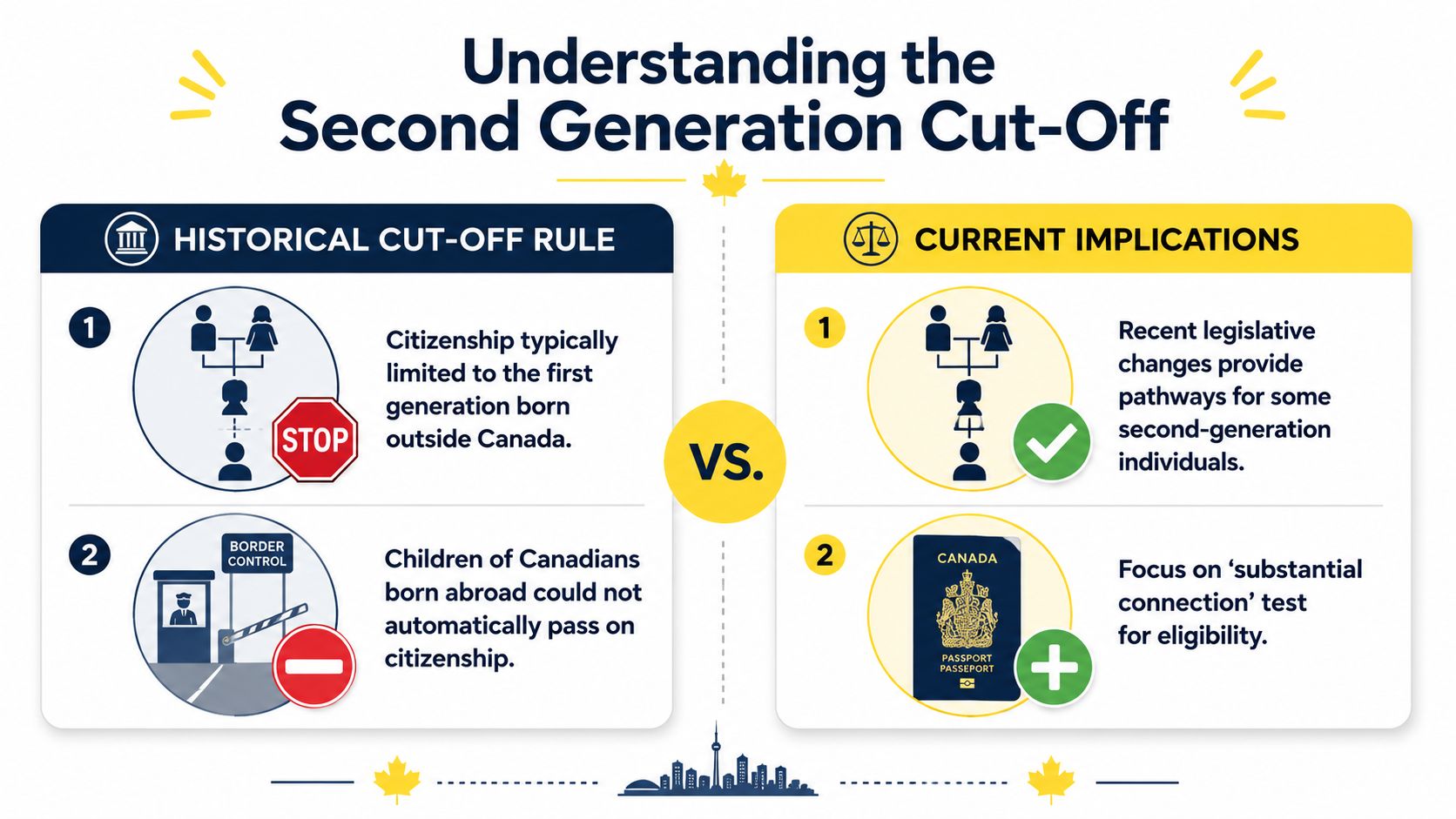
Citizenship by descent rules old vs new
The legal change that matters is December 15, 2025. For people born before that date, the law can restore or recognize citizenship retroactively for descendants beyond one generation. For children born or adopted on or after that date outside Canada in the second generation or later, citizenship can still pass, but only if the Canadian parent born abroad proves a substantial connection to Canada through at least 1,095 days of physical presence before the child's birth or adoption, according to IRCC's Bill C-3 rules page.
| Provision | Rule Before Dec 15, 2025 | Rule On or After Dec 15, 2025 |
|---|---|---|
| Second generation born abroad | Often blocked by the first-generation limit | May qualify if the parent born abroad proves substantial connection |
| Key legal test | First-generation limit controlled many cases | 1,095 days of physical presence before birth or adoption |
| Who must show connection to Canada | Usually not the core issue because the claim often failed at the cut-off | The Canadian parent born abroad must prove the physical presence |
| Children born before Dec 15, 2025 | Many families were excluded under the old framework | The law can restore or recognize citizenship retroactively |
| Child’s own residence in Canada | Not the basis of the old cut-off | Still not the qualifying test for the substantial connection rule |
Practical rule: If your child was born before December 15, 2025, ask whether citizenship already exists by operation of law. If your child was born on or after that date, start with the parent's proof of physical presence.
Why the old rule caused real problems
In practice, the old cut-off hit mobile families hardest. Executives on assignment, dual-national families, military families, and Canadians who spent most of their lives abroad could all end up with children who had a real family tie to Canada but no recognized citizenship path.
The 2025 reform did more than tweak procedure. It changed who can qualify, and it turned many future cases into evidence cases rather than bright-line denials.
How Did the 2025 Citizenship Act Changes Affect Descent Rules?
A common fact pattern now looks like this: a Canadian parent was born outside Canada, their child was also born outside Canada, and the family wants to know whether the file is a dead end or a documentation exercise. Since December 15, 2025, the answer depends first on the child's date of birth and then on whether the parent can prove enough time in Canada.
For children born before December 15, 2025, the change is mainly about legal status. Many people who would have been blocked by the old first-generation cut-off may now already be citizens by operation of law. The practical problem is proving it. IRCC still has to see a clear descent chain, civil status records, and identity documents before it will issue a citizenship certificate.
For children born or adopted on or after December 15, 2025, the analysis shifts. The case no longer turns on the old bright-line cut-off alone. It turns on whether the Canadian parent who was also born abroad can meet the substantial connection rule through 1,095 days of physical presence in Canada before the child's birth or adoption.
That is the primary change in practice. Under the old rule, many second-generation cases ended quickly. Under the new rule, more cases are legally possible, but they are only as strong as the records behind them.
A good starting point is Mayo Law's guide to Bill C-3 and Canadian citizenship by descent. It helps frame the first question correctly: are you dealing with an existing claim to citizenship, or a claim that depends on proving the parent's qualifying presence in Canada before the relevant date?
If the child was born before December 15, 2025
These cases often require two separate conversations. One is about whether citizenship exists in law. The other is about what IRCC will accept as proof.
That distinction matters. A family may be right on the law and still face delays because the parent's birth record, the grandparent's Canadian citizenship record, marriage records, name-change documents, or older identity documents do not line up cleanly. In cross-border files, the hardest part is often not the legal test. It is getting a coherent paper trail from more than one country.
If the child was born on or after December 15, 2025
These cases are more evidence-driven from the start. The child's later residence in Canada does not satisfy the rule. The parent's physical presence before the birth or adoption is what matters.
Timing is strict. If a parent is short on qualifying days as of the child's birth, later time in Canada does not repair that gap for this citizenship-by-descent analysis.
What changed for families in practical terms
The 2025 amendments replaced many automatic refusals with a proof-heavy assessment. That helps some families and creates new pressure points for others.
Parents who spent long, well-documented periods in Canada usually have a manageable file. Parents with fragmented records, frequent travel, old passport gaps, or years in Canada during childhood may have a harder time, even if they likely meet the threshold. I often tell clients to test the evidence before they assume they have a case. School transcripts, tax records, entry histories, leases, employment records, and provincial health records do not always exist for every period, and they do not always agree.
Three questions to answer before filing
-
Was the child born before or on/after December 15, 2025?
That date determines whether you may already be dealing with citizenship that exists in law, or a claim that depends on the parent meeting the new test. -
Is the Canadian parent also a citizen by descent born outside Canada?
If yes, the second-generation issue is directly engaged. -
Can the parent document enough time in Canada before the child's birth or adoption?
Start with a dated timeline and match each period in Canada to records. If the timeline is thin, fix that before filing.
Strong files are built chronologically. Dates of residence, school, work, travel, and status changes should be reconciled first. That is usually where the case is won or lost.
What Is the 1,095-Day Substantial Connection Test?
For children born on or after December 15, 2025, citizenship can pass beyond the first generation born abroad only if the Canadian parent can prove a substantial connection to Canada. That substantial connection is defined as at least 1,095 days of physical presence in Canada before the child's birth or adoption, as discussed in this analysis of the new era of eligibility.
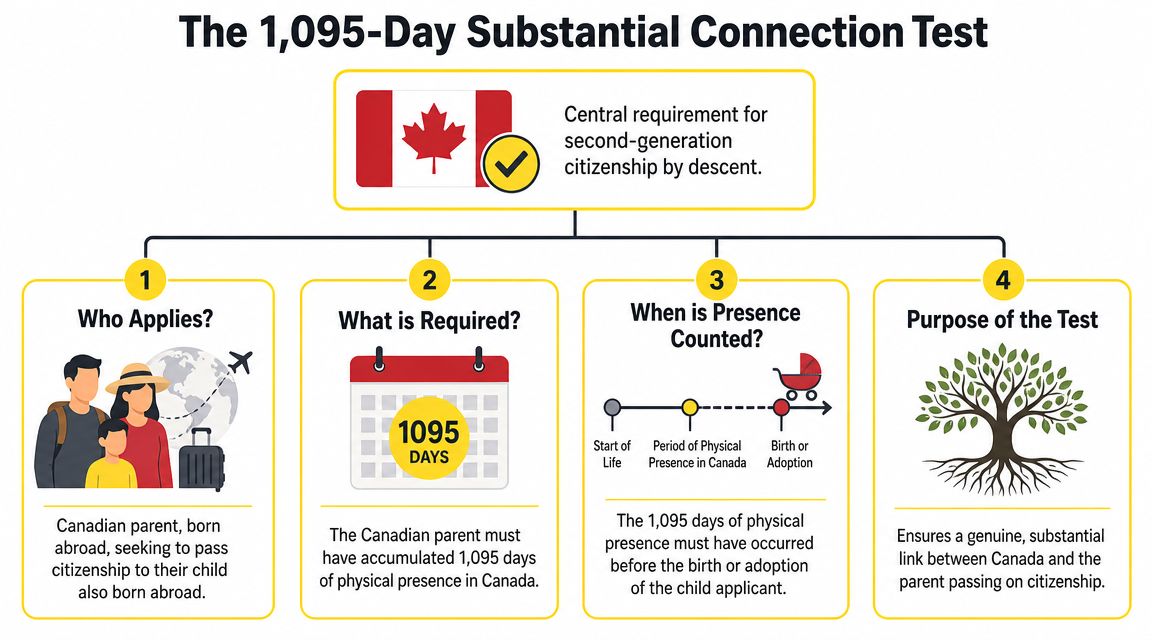
Who has to meet the test
The person who must meet the test is the Canadian parent born abroad, not the child. That's a critical point. Families often assume they can strengthen a case by showing the child later spent time in Canada. For this specific test, that misses the issue.
The qualifying connection has to exist in the parent's own history before the child arrives.
What cumulative means
The 1,095 days are cumulative. They do not have to be continuous. A parent may have spent part of childhood in Canada, returned for university, then worked in Canada for another period later. Those periods can potentially be added together if they occurred before the child's birth or adoption.
Careful chronology matters. You are not proving a general emotional tie to Canada. You are proving physical presence over time.
What usually works and what usually fails
What works is a dated record trail. Parents who attended school in Canada, held Canadian jobs, filed taxes connected to Canadian work, or have travel and residence records usually have a structure to build on.
What fails is relying on memory alone. Statements like “I spent a lot of summers in Toronto” or “we lived there off and on” may be true, but they don't answer the evidentiary question by themselves.
If you think you have enough days, don't ask only whether the time happened. Ask whether you can prove the time happened.
Common practical questions
Does time in Canada as a child count
If the parent was physically present in Canada during childhood, that presence may form part of the cumulative total, provided it can be documented. School and medical records are often important here.
Does old presence still count
Older periods of presence can still matter. The rule focuses on whether the days occurred before the child's birth or adoption, not on how recent they were.
Do short visits count
Short stays may matter if they are part of the cumulative record and if the parent can document them well enough. The challenge is usually not legal theory. It is proof.
A workable way to assess the test
I usually suggest building the file in this order:
- Start with a timeline that lists every Canada stay by month and year.
- Group by life stage such as childhood, school, early work, and later residence.
- Match each period to at least one independent record.
- Flag gaps early where travel history or civil records are missing.
- Count conservatively rather than assuming every claimed day will be accepted.
That approach exposes weak spots early, before the application is built around assumptions that can't be proved.
What Documents Prove a Parent's Substantial Connection to Canada?
The legal test is straightforward. The evidence work usually is not.
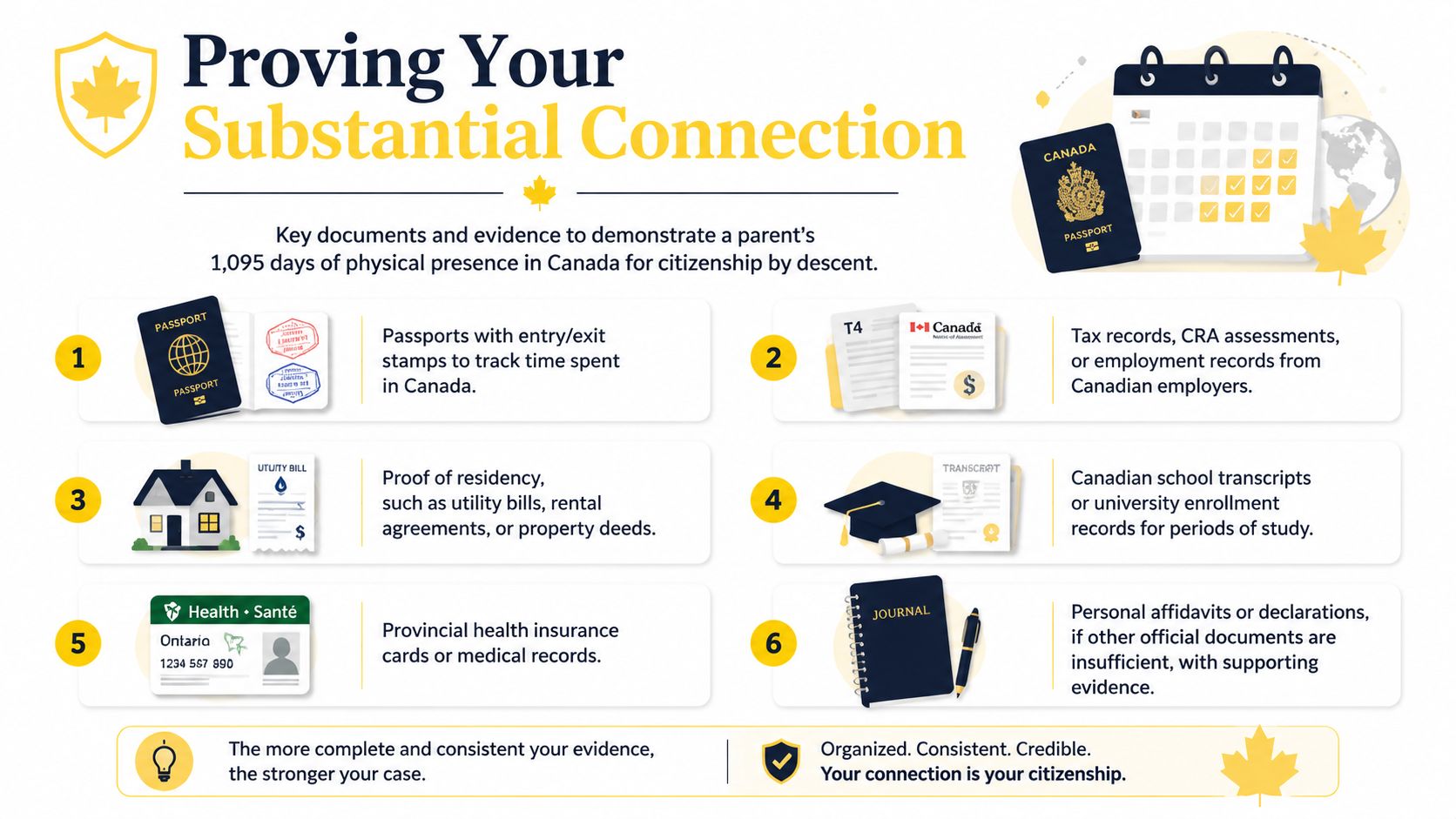
For parents relying on the post-December 15, 2025 descent rules, IRCC will want records that show actual physical presence in Canada before the child's birth or adoption, not just a believable family history. In practice, the strongest files prove presence across time from more than one source. Government and practitioner commentary have pointed to records such as travel history, employment files, and school records as the kinds of evidence that can establish the required days, as summarized in this Bill C-3 evidence discussion.
The evidence that usually carries the file
Some documents show that a person had ties to Canada. Others show that the person was physically in Canada on identifiable dates. That distinction matters.
The records I trust most are the ones that anchor time to a place:
-
Travel history records
CBSA entries, airline records, passport stamps, and older immigration records can help establish entry and exit patterns. Stamps alone are often incomplete, especially for land crossings and older travel. -
Educational records
School transcripts, enrollment confirmations, report cards, attendance records, and yearbooks can be very persuasive for childhood and early adulthood. If the parent attended school in Canada for multiple years, this is often the cleanest way to prove long blocks of time. -
Employment records
T4 slips, pay stubs, Records of Employment, union records, and employer letters showing work location can support recurring presence in Canada over sustained periods. -
Residence records
Leases, rent receipts, property tax records, mortgage statements, and utility bills help show where the parent was living. On their own, they are usually weaker than school or work records because they show an address more clearly than they show daily presence. -
Health and provincial records
Provincial health registration, billing histories, vaccination records, and family doctor files can help fill gaps, especially where the parent lived in Canada as a child. -
Tax and government records
Notices of assessment, provincial benefit records, and other government correspondence can support the timeline, though they usually work best as corroborating evidence rather than the main proof.
What a persuasive package actually looks like
A strong application usually reads like a dated timeline with exhibits attached.
For example, one year of high school records in Alberta, followed by a university transcript in British Columbia, followed by payroll records from a job in Ontario, gives IRCC overlapping evidence from independent sources. That is much easier to assess than a declaration saying the parent lived in Canada “on and off” for several years.
I usually advise clients to build the file by period, not by document type. Childhood records go together. Post-secondary records go together. Employment and tax records go together. That approach makes missing years obvious early, before the application is submitted with a gap no one can explain.
Two recurring proof problems
A parent may have spent enough time in Canada but have records scattered across decades, provinces, and institutions that have merged, closed, or archived old files offsite. That case is often winnable, but it takes work. School boards may need weeks to retrieve records. Former employers may only have payroll summaries. Older landlords rarely have anything useful.
The harder case is the parent whose time in Canada came through short visits over many years. The law may still allow those days to count if they add up before the child's birth or adoption. The problem is evidentiary. Families often discover that old passports were replaced, land-border travel left little paper trail, and there is no single record tying the visits together.
The deciding issue is often not whether the parent was in Canada. It is whether the parent can prove enough of those days with records that line up.
Cross-border document issues
Many files need civil records from outside Canada to support the timeline or the family chain, including birth certificates, marriage certificates, adoption records, school files, and employment confirmations. If U.S. documents will be submitted in a Canadian process, certification and apostille steps can slow things down. For New York records, New York apostille support may help with that part of the file preparation.
Translation can be another issue. If records are not in English or French, certified translations are usually required, and names or date formats must stay consistent across the package.
What usually does not prove the days by itself
These items may add context, but they rarely carry the substantial-connection issue on their own:
- Personal statements without supporting records
- Undated family photographs or correspondence
- General claims about summer visits or seeing relatives
- The child's later residence in Canada
- A parent's present plan to return to Canada
Used properly, those materials can support a broader narrative. They should not be the foundation of a file that depends on meeting the 1,095-day test.
Proving You Are a Citizen vs Applying for Proof
A common client scenario looks like this. A child is born outside Canada, one parent has a Canadian parent or grandparent, and the family wants to know whether the child already is a citizen or needs to qualify under the new descent rules after December 15, 2025. The answer changes how the file is built, what evidence matters, and how long the process usually takes.
The first point is legal. Citizenship status and proof of citizenship are different things.
A person may already be a Canadian citizen by operation of law and still be unable to do anything practical with that status until IRCC issues a citizenship certificate. Airlines, passport offices, schools, and other institutions do not accept a family history explanation. They want the document. In those cases, the application is for proof of an existing status, not an application to become a citizen.
That distinction matters even more after December 15, 2025. For some children born abroad before that date, the analysis is largely historical. The question is whether the law already recognized citizenship through the family line. For children whose claim depends on the new descent framework, the case often turns on two separate evidentiary tracks: the lineage documents and the Canadian parent's proof of at least 1,095 days of physical presence in Canada before the child's birth or adoption.
Families often miss that second track.
In practice, I see two very different file types:
- Proof cases focus on the chain of citizenship and parentage.
- Post-December 15, 2025 descent cases require the same family chain, plus a well-supported physical presence record for the Canadian parent.
The lineage side usually requires records for each step in the chain, such as:
- the Canadian ancestor's birth certificate, citizenship certificate, or naturalization record
- the next generation's birth certificate showing parentage
- marriage certificates, divorce records, or legal name change documents where names changed
- the applicant's own birth certificate or adoption record
If one document does not line up with the next, the file can stall. The recurring problems are old records from multiple countries, inconsistent spelling of names, missing middle names, informal name changes, and birth records that identify parents differently from later identity documents.
The post-December 15, 2025 cases add another layer. A parent may be clearly Canadian and still fail on paper if they cannot prove enough days in Canada with records that match the timeline. That is why the legal question, "Is my child eligible?" quickly becomes a documentation question. "Can we prove the parent's days, with dates, from reliable records?" For a broader eligibility overview, see this guide on being born abroad to a Canadian parent.
A simple example shows the difference. If a mother was already a Canadian citizen by descent and her child was born abroad before December 15, 2025, the file may only require proof of the family chain and her own citizenship status. If the child's claim depends on the rules in force after December 15, 2025, the same family may also need school records, tax filings, employment records, leases, entry records, and other documents that establish the mother's actual days in Canada before the birth.
That changes strategy, timing, and document collection from the start.
Mayo Law works with families across the GTA and on cross-border matters. Joseph Mayo is licensed in Ontario and New York, which is useful when the citizenship chain and supporting records run through both Canada and the United States.
Navigating Dual Citizenship and Other Considerations
A common client scenario is straightforward on paper and messy in practice. The child qualifies for Canadian citizenship, also has another nationality through the other parent or country of birth, and the family assumes the rest is administrative. In reality, the citizenship certificate often resolves the status question but leaves travel, record-matching, and foreign-law issues to sort out.
Canada permits dual citizenship. A child recognized as Canadian usually does not need to give up another citizenship they acquired under a different country's law. That point matters, but it is only the starting point.
What citizenship gives the child
Once the child has proof of citizenship, the practical rights are clear. The child can apply for a Canadian passport and has the right to live, work, and study in Canada.
For many families, the immediate issue is not relocation. It is preserving options. A Canadian passport can affect later decisions about school, university tuition, family sponsorship, and where the child can settle as an adult.
What families should think about next
The next questions are usually about documents and cross-border use of those documents. A citizenship certificate should match the rest of the child's identity record as closely as possible. If the birth certificate, foreign passport, and Canadian records use different spellings, different name order, or omit middle names, those discrepancies tend to surface later during passport applications, school enrollment, or travel bookings.
I often tell families to treat the approval as the start of file cleanup, not the end of the matter.
A few practical steps help:
- Store the citizenship certificate carefully and keep a clear copy, because future passport and status applications may depend on it.
- Compare all identity records side by side to catch name, date, and place-of-birth inconsistencies before they create delays.
- Check the other country's citizenship rules if the child holds or may claim another nationality, especially if that country has military service, registration, or retention rules.
- Review whether foreign documents need authentication or certified translation before they are used again in Canada or abroad.
Some families also discover that the child's file points to an older problem in the parent or grandparent's status history. That can happen in cases involving older retention rules, prior loss of status, or people who may be Canadians but were never formally documented. In that situation, information on restoring lost Canadian citizenship is often the right next reference point.
Approval answers the citizenship question. It does not fix inconsistent civil records, foreign registry problems, or conflicting identity documents.
Rights and responsibilities
Citizenship gives the child a legal right to enter and remain in Canada. It does not, by itself, determine tax residence or filing obligations in Canada or another country. Those issues usually depend on where the child or family lives, earns income, owns property, or maintains residential ties.
That distinction matters for cross-border families. A passport is one legal fact. Residence, tax, and reporting obligations are separate questions and should be reviewed on their own facts.
What Is the Application Process, Timeline, and Cost?
A parent usually reaches this stage after answering the legal question and runs into the practical one: what exactly gets filed, how long will it take, and what will IRCC want to see if the child was born after December 15, 2025?
For most descent cases, the filing is an application for a citizenship certificate, which is the formal proof of Canadian citizenship. The difference after December 15, 2025 is that some families will need more than the usual birth and identity records. They will also need a well-supported record showing that the Canadian parent met the 1,095-day substantial connection requirement before the child's birth or adoption. That evidence work often takes longer than the government processing itself.
How the process usually works
-
Identify the correct rule by the child's date of birth
If the child was born before December 15, 2025, the case may fall under the earlier descent rules discussed above. If the child was born on or after that date, review whether the Canadian parent must prove 1,095 days of physical presence in Canada. -
Build the core family-status file
IRCC will usually expect the child's long-form birth record, the Canadian parent's proof of citizenship, photo identification, and documents linking each generation where names, dates, or places differ across records. -
Prepare the physical-presence evidence, if required
Many applications weaken at this stage. Do not rely on a single document or a reconstructed travel estimate. Use overlapping records such as school transcripts, CRA notices, leases, employment records, provincial health history, entry records, and passport copies to show the parent was in Canada for the required period. -
Complete the current IRCC package carefully
Small inconsistencies cause avoidable delay. I pay close attention to name formatting, old surnames, translation certificates, and date gaps that invite a request for more documents. -
Submit the application and respond quickly to follow-up requests
Keep a full copy of the filing package. If IRCC asks for more proof, a prompt and organized response can save months.
The live requirements are on IRCC's citizenship certificate application page. Processing times change, so check IRCC's processing time tool close to the filing date rather than relying on a fixed estimate in an article.
Cost is usually the simplest part of the analysis. There is a government fee for the citizenship certificate application, and families should also budget for practical extras such as certified translations, replacement civil records, courier charges, notarization where needed, and document retrieval from schools, employers, or provincial agencies. In second-generation cases after December 15, 2025, those supporting-document costs can exceed the filing fee if the parent's history in Canada spans many years and provinces.
If you are comparing descent-based proof with other citizenship routes, this overview of how to become a Canadian citizen helps separate certificate cases from naturalization applications. They use different legal tests, different forms, and often very different evidence.
Frequently Asked Questions
Does a grandparent born in Canada help in a second-generation case?
Yes, often it does. But a Canadian grandparent is not enough by itself. You still need to document the full chain from the Canadian ancestor to the parent and then to the child. For children born on or after December 15, 2025, the parent's physical presence in Canada may also become a separate requirement.
If my child was born before December 15, 2025, do we still need to apply?
Usually yes, if you need usable proof. The legal position may be that the child is already a citizen through descent, but institutions will still expect formal evidence. In practice, that means applying to IRCC for a citizenship certificate so the status can be documented and used.
How long does it take to get proof of citizenship?
Processing times change, so fixed estimates in blog posts go stale quickly. The safer approach is to check IRCC's current processing-time tool before you file and again after submission. The bigger practical delay in many second-generation files is often document collection, especially where records span countries and generations.
What if the parent has enough days in Canada but weak records?
That is common. The issue becomes evidence, not necessarily eligibility. A parent may well satisfy the legal test but still need time to rebuild the record through school files, work history, travel records, and civil documents. Strong files usually use overlapping evidence instead of relying on a single source.
Can adopted children benefit from these rules too?
The verified government guidance referred to in this article includes people born or adopted outside Canada in the relevant categories. The timing and proof issues still matter. In adoption cases, the civil and legal records often need especially careful review to make sure the chain of status and dates is clearly documented.
Conclusion
If your child was born outside Canada and you were also born outside Canada to a Canadian parent, the answer is no longer automatically no. But it is not automatically yes either. The legal outcome now depends first on the child's birth date, and in many newer cases on whether the parent can prove a substantial historical connection to Canada through records.
That's why these cases are won or lost on file preparation. The law is clearer than it was. The documentation burden is heavier than many families expect.
Footer Block
Families usually arrive at this stage with one practical question left: do we have enough records to file now, or do we need to spend time rebuilding the history first?
That question matters more than many applicants expect. A parent who lived in Canada long enough may still have a weak file if the evidence is scattered across old passports, school records, tax documents, provincial health files, and entry records. In second generation descent cases after December 15, 2025, the legal rule and the paper trail have to line up. If they do not, delay is common.
A careful review before filing often avoids the problems that create the longest processing setbacks, especially inconsistent names, missing long-form birth certificates, absent travel history, and records that prove presence in Canada only indirectly.
If the documents are incomplete, the better course is often to build the record first and file once the chronology is coherent. In practice, that is often faster than submitting a thin application and answering follow-up requests months later.
How Mayo Law Can Help
Mayo Law serves clients across Toronto, the GTA, and on cross-border matters. For citizenship by descent cases, that often means helping families sort out which legal rule applies, assemble generational records, and address document issues that span Canada and the United States. To discuss your matter, visit Mayo Law's immigration services.
Disclaimer
This article is for informational purposes only and does not constitute legal advice. Every situation is different. Consult a licensed lawyer about your specific circumstances. Mayo Law provides legal services through Mayo Law PC in Ontario and Joseph Mayo PLLC in New York.
Related Articles
- Business immigration services
- Notary services for cross-border documents
- International business and cross-border legal services
If you're trying to determine whether your child is already Canadian or whether your case depends on the new substantial-connection test, Mayo Law can help you assess the legal pathway and the documents needed to support it.