Published: June 7, 2026
Updated: June 7, 2026
Read time: 11 min
Your first month as HR Director is going fine until cross-border problems arrive all at once. A Canadian manager needs to start work in New York next week. A U.S. engineer wants to relocate to Toronto while keeping projects moving. One employee's visa renewal looks approvable, but your I-9 process is messy and no one can tell you whether the company's records would survive an audit.
That's when an employment immigration attorney stops being “the person who files visa forms” and becomes part of your operating team. At Mayo Law, we help employers in Toronto, the GTA, and across the border handle business immigration with experience licensed in both Ontario and New York on a process that often spans both sides of the border.
The need is real. IBISWorld projected 46,019 employed immigration lawyers and attorneys in the U.S. market in 2026, up from 44,670 in 2025, while still describing a five-year pattern that was uneven rather than smooth growth IBISWorld employment data.
What Does an Employment Immigration Attorney Do?
An employment immigration attorney advises employers and foreign national employees on work visas, employment-based permanent residence, and related compliance. The role combines case strategy, document preparation, government filings, and employer risk management so a company can hire, move, and retain talent without creating avoidable immigration or audit exposure.
That definition is the starting point, not the job.
For a U.S.-Canada employer, the primary work usually falls into two tracks at the same time. The first is the visible track: work authorization, consular processing, border entry strategy, renewals, permanent residence, and responses to government questions. The second is the less visible track: making sure the facts in the petition match payroll, job duties, organizational charts, work location, and HR records.
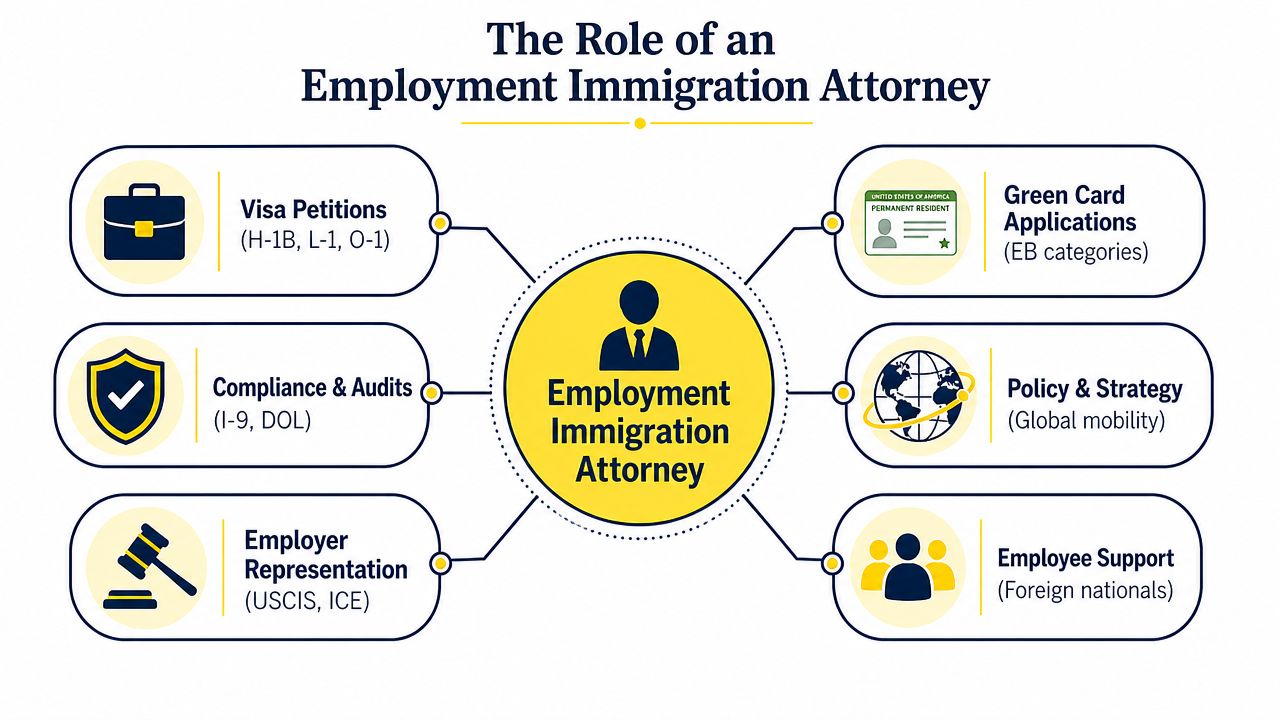
A general immigration practice may focus on family sponsorships, status problems, or removal defense. Employment immigration is different. It starts from the employer's business objective: hire this person, move that executive, launch this office, preserve this project timeline, close this acquisition without breaking work authorization, and keep the records clean enough to survive review.
What employers usually need day to day
- Hiring strategy: Choose the category that fits the role, credentials, timing, and structure.
- Mobility planning: Move staff between the U.S. and Canada without accidental status violations.
- Permanent residence planning: Align green card or Canadian PR strategy with retention goals.
- Audit readiness: Keep filings consistent with I-9, payroll, wages, and HR records.
- Government response: Handle RFEs, inspections, border issues, and compliance questions.
Practical rule: If the immigration story and the HR story don't match, the case is weaker than it looks.
For companies operating in both countries, the attorney also has to think one move ahead. A U.S. filing can create Canadian tax, payroll, or employment-law consequences. A Canadian transfer can affect U.S. status maintenance. That's why businesses often need counsel who can see both sides of the corridor, not just one filing at a time. For related cross-border immigration issues, see this US-Canada immigration lawyer resource.
Core Services for US-Canada Employers
A new HR Director often sees the pressure point before the paperwork. The sales team wants a Canadian executive in Chicago next month. Finance has not finished the U.S. entity setup. The manager has already promised the start date. At that stage, employment immigration counsel is solving a business timing problem, a work authorization problem, and a cross-border documentation problem at the same time.
For employers operating on both sides of the border, the service list is wider than visa filing. The job is to choose a category that fits the role, the corporate structure, the payroll setup, and the longer-term retention plan. A case that looks approvable in one country can still create trouble in the other if the transfer changes tax residency, reporting lines, or future permanent residence options.
Temporary work visas in the United States
For Canadian companies expanding into the U.S., temporary work authorization is usually the first active issue. The right category depends on the employee's actual duties, education, prior work history, and the legal relationship between the Canadian and U.S. entities.
| Visa Type | Ideal Candidate | Initial Term | Key Requirement |
|---|---|---|---|
| L-1 | Executive, manager, or specialized knowledge employee transferring within a company | Varies by classification and case structure | Qualifying corporate relationship and prior related employment abroad |
| H-1B | Professional in a specialty occupation | Varies by petition and status history | Role normally requires specialized degree-level knowledge |
| TN | Canadian professional in a listed occupation | Temporary admission, often used for fast cross-border mobility | Occupation must fit treaty list and applicant must meet category requirements |
The strategic choice is rarely obvious.
An L-1 can support an intracompany transfer and fit a broader U.S. expansion plan, but new-office cases require disciplined evidence and realistic staffing plans. A TN can be faster and more practical for a specific hire, but the occupation list and job description have to line up tightly. H-1B may suit the role well, yet annual cap timing can make it a poor tool for an urgent launch or acquisition integration.
That is where cross-border counsel adds value. The filing has to work at the border, with USCIS, and inside the company's actual operating model.
Permanent residence strategy
Green card planning should start well before temporary status becomes tight. If the company expects to keep a key employee in the U.S., the permanent residence path should be mapped against likely promotions, compensation changes, relocations, and business restructuring.
That planning often includes:
- PERM-based sponsorship for professional or skilled positions
- Immigrant petition analysis under the employment-based category that fits the role and background
- Timing decisions tied to travel needs, job changes, remote work, and corporate reorganization
- Retention planning so the case supports continuity instead of creating avoidable churn
The trade-off is straightforward. Starting early gives the company more control over evidence, timing, and employee expectations. Waiting until a status expiration is close usually means fewer options and more internal scrambling.
For companies that need counsel to align visa strategy with hiring and expansion plans, a business immigration lawyer for employers should be assessing the position beyond basic eligibility.
Canadian pathways for U.S. employers
U.S. employers face the same pressures in reverse. They may need to transfer a manager to Toronto, send technical staff to a client site in Alberta, or build a Canadian team after an acquisition.
The legal analysis usually covers:
- Canadian work permit options
- LMIA-based and LMIA-exempt categories
- Intra-company transfers and other cross-border assignment structures
- Entry timing, payroll setup, and lawful start dates in Canada
This is where a dually licensed U.S.-Canada perspective matters. A U.S. employer can secure Canadian work authorization and still create problems if the employee's reporting line, compensation method, or assignment terms do not match how the company is operating in the United States. Good cross-border planning catches those conflicts before they affect onboarding, payroll, or later permanent residence strategy.
The strongest cross-border immigration strategy starts with the org chart, payroll flow, and project timeline.
Two common cross-border scenarios
Scenario one: A Toronto software company needs its product lead in New York for a client implementation. On paper, one visa category may appear available. In practice, the U.S. role has drifted from the employee's Canadian duties, and the manager is describing the position differently than HR. Counsel needs to tighten the job definition, confirm the entity relationship, and decide whether the fast option will still support the company's longer-term U.S. plan.
Scenario two: A U.S. manufacturer acquires a Canadian affiliate and wants senior personnel moved quickly. The immigration options may exist, but the records on titles, prior employment, and reporting lines are inconsistent across HR files and transaction documents. In that situation, legal work includes filing strategy, evidence cleanup, and coordination between the U.S. and Canadian sides so one country's filing does not undercut the other.
Navigating Employer Compliance and Audit Defense
The filing is only half the job. The other half is making sure your company can defend what it filed.
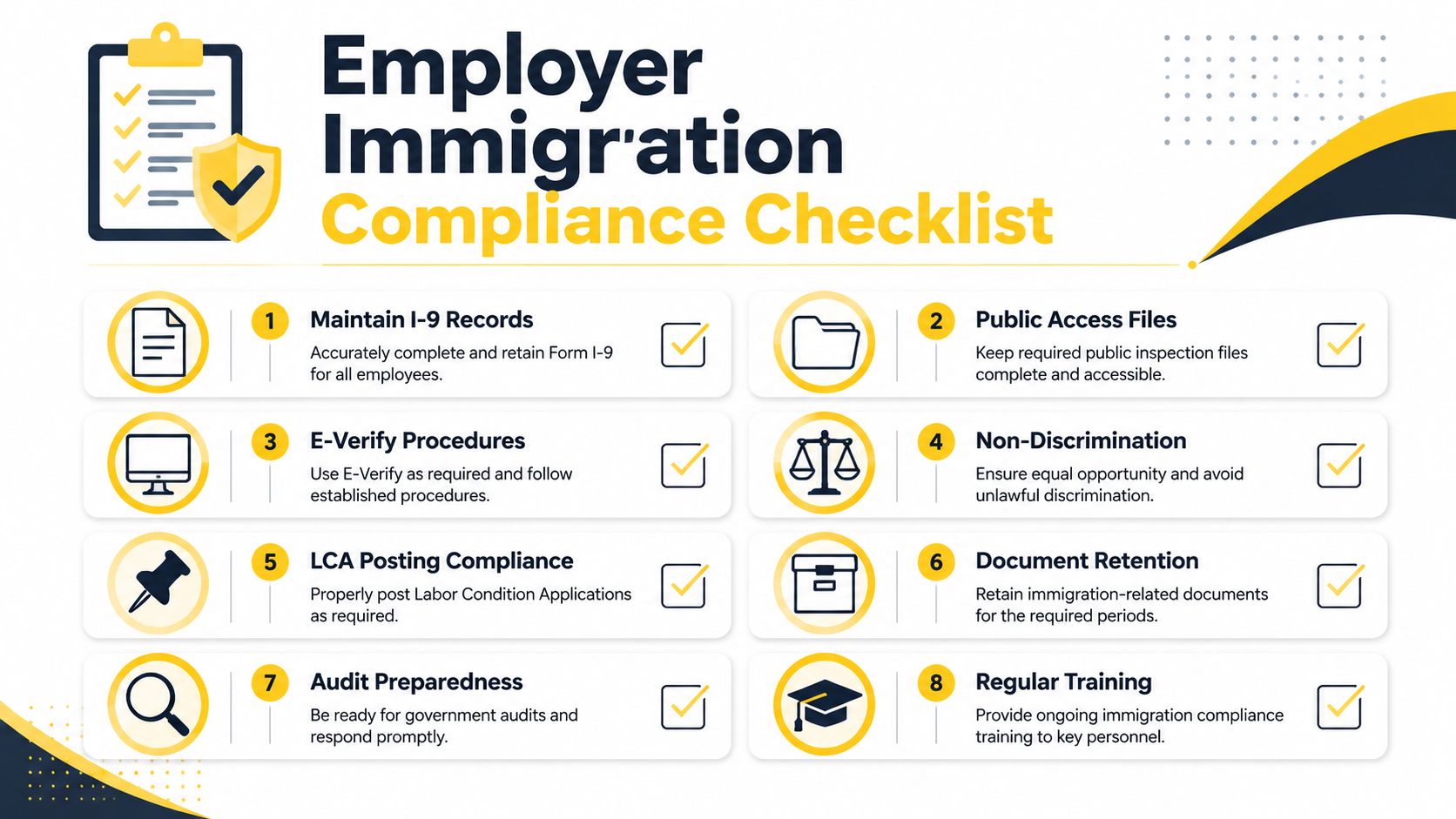
Employment immigration counsel typically handles both visa strategy and employer compliance controls, including Form I-9 verification, Social Security No-Match response, E-Verify counseling, internal audits, and enforcement defense Jackson Lewis immigration services overview. That's not a side issue. It's the operating system behind the case.
Why compliance changes legal strategy
A petition can be legally sound and still create trouble if the supporting facts don't line up with internal records. The title in the immigration filing must fit the title used elsewhere. The work location must match what HR and managers expect. Wage statements, onboarding records, and public access files have to tell the same story.
That is why the legal risk isn't just denial. It's downstream exposure.
- I-9 problems can surface during audits or transactions.
- E-Verify misuse can create its own liability.
- Wage alignment issues can weaken both filings and defenses.
- Bad record retention can turn fixable issues into expensive ones.
What audit-ready actually looks like
Most HR teams don't need perfection. They need a repeatable system.
A practical compliance review usually includes:
- I-9 process review for timing, reverification, storage, and corrections
- Worksite review to confirm locations match active filings
- Public access file check where required
- Payroll and role alignment against petition facts
- Manager training so supervisors don't casually change terms that matter legally
- Response plan for site visits, notices, or record requests
If your managers can change title, location, or duties without telling HR, your immigration program isn't under control.
For startups and growth-stage companies, this often matters more than they expect. The visa case may start in legal, but the risk usually lands in HR operations. An attorney who can only draft forms and not test your process won't help much once the government or a buyer asks for records.
If your team is building those controls, then broader compliance officer responsibilities intersect with immigration work.
Audit defense is easier before the audit
When a company gets an inspection notice, the pressure is immediate. Records have to be gathered quickly. Explanations need to be consistent. Managers may say things that don't help. That is the worst time to discover the company has treated immigration as an isolated admin task.
Mayo Law works with employers across the GTA and on cross-border matters. Joseph Mayo is licensed in Ontario and New York, so clients with U.S. ties coordinate their legal work in one place rather than juggling two firms.
How Much Does It Cost and How Long Does It Take?
A new HR Director often gets this question from finance before the first strategy call. A sales leader wants a Canadian executive in New York next month. A U.S. manager wants a Toronto hire onboarded before quarter end. The budget question sounds simple, but the core issue is whether the company is paying for speed, flexibility, or damage control after a poor filing choice.
Cost and timing depend on the category, the facts, and how much coordination the case requires across HR, payroll, managers, and the employee. For employers operating in both the United States and Canada, the legal work also includes a jurisdiction choice. In some cases, the faster answer is not the better business answer if it creates compliance problems on the other side of the border.
Where the money goes
Employers usually pay in two categories:
- Government filing fees charged by the agency
- Legal fees charged by counsel, often as a flat fee for a defined filing and hourly for strategy, urgent issues, audit response, or RFE work
For current U.S. filing fees, review the official USCIS fee schedule. For Canadian government fees and processing times, use the official IRCC resources only after confirming you are on the correct page for the application type and stream.
The larger cost issue is scope. A quote for preparing forms is different from a quote that includes category analysis, document review, manager coordination, border-entry preparation, and post-approval guidance. For cross-border employers, that difference matters because a work permit or petition can affect payroll setup, start dates, travel planning, and tax coordination.
What affects timing
Government processing time is only one part of the calendar.
Total case time often includes intake, strategy review, document collection, drafting, internal approvals, filing logistics, government processing, and post-approval steps needed before the employee can start work. If the employee is moving between Canada and the United States, travel history, citizenship, prior status, and work location details can change the timeline quickly.
For current U.S. estimates, review USCIS processing times.
A practical example helps. A Canadian citizen entering the U.S. in a qualifying category may move faster than a case that requires a petition review and follow-up questions. The faster route is not automatic. HR still needs the right job description, corporate relationship documents where relevant, and a plan for what the employee will say at the port of entry or consular interview.
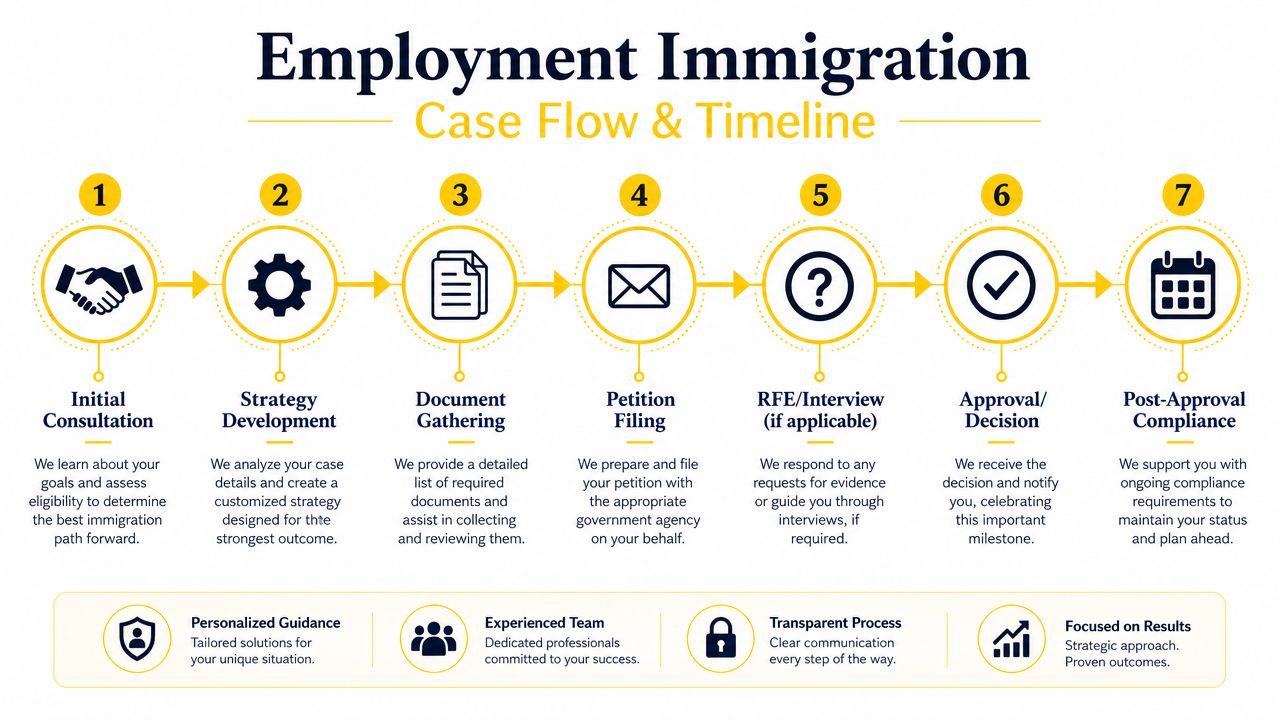
A realistic case flow
Most employer-side matters follow this sequence:
- Initial consultation to identify the business objective, timing pressure, and available options
- Strategy selection based on role, nationality, work location, and risk tolerance
- Document collection from HR, payroll, managers, and the employee
- Drafting and filing with the relevant agency or preparation for border presentation
- Follow-up if there is a request for evidence, interview, or entry inspection issue
- Approval and onboarding after work authorization is in place
- Post-approval tracking for expiries, amendments, and employer obligations
The shortest timeline on paper can become the most expensive timeline in practice if HR has to redo start dates, pause onboarding, or explain to leadership why the employee cannot travel. I regularly advise companies to compare two numbers, filing cost and business interruption cost. That is where a cross-border view helps. A lawyer who handles both U.S. and Canadian matters can often spot when a company is solving the wrong timing problem.
Ask this early: What is included, what triggers extra fees, and who owns government follow-up and employee coordination?
If your question is whether the role belongs in the lottery system at all, start with this cap-exempt H-1B overview for employers.
Do I Need an Employment Immigration Attorney?
If your company hires across borders rarely, it is tempting to think you can use templates, internal HR, or a basic filing service. Sometimes that works for a simple matter. Often it works until something changes.
The better question is not whether a lawyer is always required. It is whether your business can absorb the cost of getting the timing, category, or compliance position wrong.

Situations where counsel usually makes sense
Your first foreign national hire
The first case sets the template for the next ten. If HR builds the process on a bad assumption, those mistakes repeat.
A key person must move fast
Startups and SMEs often can't tolerate downtime. In that setting, the value of counsel is often reducing business interruption risk through timing, filing strategy, and workforce planning, not just pushing approval odds business interruption framing for SMEs.
You received an RFE or a denial
At that point, the issue is no longer just eligibility. It is how the government sees your facts, your records, and your credibility.
You are under compliance scrutiny
If there is already I-9 risk, audit exposure, or messy distributed work arrangements, immigration strategy has to adapt to that reality.
Two practical examples
A Canadian founder wants to spend meaningful time in the U.S. market while keeping the Canadian company active. The obvious visa choice may not fit the founder's actual role, ownership structure, or travel pattern. A filing service can complete forms. It usually won't redesign the legal narrative to match the business model.
A U.S. company with remote staff in both countries wants to sponsor permanent residence for a key employee. The case may be approvable, but remote work, title changes, and inconsistent reporting lines can make it fragile. In that situation, legal work overlaps with HR cleanup and manager coordination.
What doesn't work well
- copying a prior filing without checking whether facts changed
- treating border questions as routine travel issues
- waiting until expiration is near before choosing a strategy
- assuming U.S. and Canadian categories operate the same way
- separating immigration from payroll, recordkeeping, and operations
If your company is moving from temporary status planning into long-term retention, this employment-based green card guide is a useful next step.
Frequently Asked Questions
What is the difference between U.S. and Canadian employment immigration for employers?
The biggest difference is not just the forms. It is the structure of the systems. U.S. categories often turn on detailed statutory classifications and filing-specific compliance layers, while Canadian pathways may focus more heavily on work permit streams, exemption analysis, and labor market testing where required. Employers operating in both countries need a single factual record that can support both systems.
What does dual intent mean in business immigration?
Dual intent means a person can hold certain temporary status while also having a long-term immigration goal, such as permanent residence. It matters because many employees need to keep working now while planning for a green card later. But dual intent doesn't fix every category or every travel issue, so HR shouldn't assume the concept applies broadly without checking the specific classification.
What should an employer do after a Request for Evidence?
First, don't treat the RFE as a clerical nuisance. It often signals a mismatch between the role, the evidence, and the legal standard. Preserve the original filing record, review the job description and reporting structure carefully, and coordinate with the employee before responding. Fast but sloppy answers often create a second problem rather than solving the first.
How do business immigration lawyers usually charge?
Many routine employer filings are billed on a flat-fee basis. Strategy-heavy matters, audit defense, policy work, or complicated responses are often billed hourly. HR should ask whether the quote includes drafting, filing, agency correspondence, and follow-up. The cheapest proposal is often the one with the most exclusions, which is where surprise costs usually appear.
What is the risk of using a visa consultant for a business immigration matter?
The main risk is not just technical error. It is the lack of legal judgment when the case intersects with compliance, cross-border employment structure, or a problem record. A consultant may help collect forms. An attorney should be assessing legal risk, privilege, evidence consistency, and what the filing means for the company if an audit, acquisition, or border issue follows.
If your company is hiring across the U.S.-Canada corridor, opening a new office, or trying to fix an immigration process that already feels too reactive, Mayo Law can help you assess the legal and operational risk before it becomes a disruption. Start with Mayo Law.
A strong employment immigration program is not just about getting approvals. It is about keeping projects moving, protecting the company's records, and making sure HR, management, and legal strategy are working from the same facts. That matters even more when your people, entities, and timelines cross the U.S.-Canada border. The earlier you address those issues, the more options you usually have.
How Mayo Law Can Help
A new HR Director often inherits a cross-border process after the first problem appears. A key employee is delayed at the border, a U.S. filing does not match the Canadian job structure, or an internal transfer was set up without enough attention to payroll, entity control, or recordkeeping.
Mayo Law advises employers that need one legal strategy across the U.S. and Canada. That matters when the business question is bigger than a single work permit or petition. The legal analysis often has to account for corporate structure, employee classification, timing, manager expectations, and what will happen if the file is later reviewed by immigration authorities or raised during a transaction.
As a firm handling both sides of the border, Mayo Law helps companies make decisions that fit the full mobility plan, not just the next filing. That can mean identifying the fastest viable path, flagging where a Canadian plan creates U.S. risk, or building HR procedures that reduce repeat errors across offices in both countries.
If your company needs practical advice on hiring, transfers, compliance exposure, or cross-border workforce planning, Mayo Law can assess the issue and set out the legal options in business terms.
Disclaimer
This article is for informational purposes only and does not constitute legal advice. Every situation is different. Consult a licensed lawyer about your specific circumstances. Mayo Law provides legal services through Mayo Law PC in Ontario and Joseph Mayo PLLC in New York.
Related Articles
- Business immigration services
- Cross-border international business law
- Compliance and regulatory risk services




![Yellow decorative banner with a maple leaf and city skyline; title reads 'Employment Immigration Attorney Guide for US-Canada Business'.] ,](https://mayo.law/wp-content/uploads/2026/06/employment-immigration-attorney-business-guide-1024x569.jpg "employment-immigration-attorney-business-guide - Mayo Law")