Published: June 4, 2026
Updated: June 4, 2026
Read time: 12 minutes
You may be hiring in Toronto while opening a U.S. office. Or you may be moving from New York to Canada and finding that one job offer has turned into two legal processes, two agencies, and two sets of documents that must line up exactly. That's where many cross-border matters start to go sideways. The issue usually isn't just choosing a visa or permit. It's keeping your business plan, employment terms, family status, and travel timing consistent on both sides of the border.
At Mayo Law, we help clients in Toronto, the GTA, and across the border manage this process with experience licensed in both Ontario and New York on a matter that often spans both sides of the border. If your move also involves corporate setup, the business side matters too, especially when immigration timing depends on entity structure, payroll, and ownership records. See our guidance on starting a business in both Canada and the US.
Navigating the US-Canada Border for Work and Business
A cross-border move rarely fails because the client picked the wrong acronym on day one. It usually breaks down because the legal story is fragmented. One lawyer handles the U.S. filing. Another handles Canada. HR keeps separate files. The founder gives one version of the role to immigration counsel and another to payroll or tax.
A US Canada immigration lawyer is valuable because the work is operational as much as legal. The job isn't only to prepare forms. It's to make sure the same facts support the work permit, the visa strategy, the company documents, the travel plan, and any later permanent residence path.
Two situations come up often:
- A Canadian company expanding south needs the right U.S. work authorization, a defensible corporate structure, and documents that match what officers will actually review.
- A U.S. professional moving north needs to understand not just entry options, but how Canadian policy changes may affect longer-term planning for family, work, or permanent residence.
A good cross-border plan starts with one factual record. Titles, duties, ownership, compensation, and travel history should match everywhere they appear.
What Does a US-Canada Immigration Lawyer Do?
A US-Canada immigration lawyer advises on cross-border status, filings, timing, and compliance so your move works in practice, not just on paper. The role usually includes strategy, document preparation, coordination across U.S. and Canadian systems, and risk management for employers and families.
- Builds the right path first. Matches your facts to the visa or permit category that fits.
- Prepares a consistent record. Aligns company documents, support letters, personal history, and prior filings.
- Coordinates both sides of the border. Reduces the chance that U.S. and Canadian submissions contradict each other.
- Plans around delays. Helps with timing, travel, status maintenance, and start-date risk.
- Advises employers. Covers onboarding, document retention, audit exposure, and internal process gaps.
- Handles family issues. Reviews dependent options, work rights, school access, and status sequencing.
- Responds to problems. Addresses officer concerns, document requests, refusals, and port-of-entry issues.
That matters because the market is large, but access is still uneven. IBISWorld estimates the U.S. immigration lawyers and attorneys industry at $10.6 billion in 2026, with 18,417 businesses and 2.6% CAGR from 2021 to 2026, while TRAC reported that the share of noncitizens finding attorneys fell from 65% to 30% in five years, even though the number represented rose only 50% as demand increased, according to IBISWorld's immigration-law industry profile.
If your matter is employment-based, business ownership, family-linked, or tied to a company transfer, broad immigration coverage matters more than a narrow filing service. Our related page on an immigration lawyer for business explains how business immigration strategy often overlaps with compliance and corporate planning.
What a lawyer does beyond form filing
Most clients come in asking, “What form do I need?” The better question is, “What facts need to be proven, and will those facts still help me six months from now?” A filing that solves today's entry issue can create later problems if it conflicts with your tax structure, ownership documents, or family plans.
That's why practical counsel often starts with document mapping. Before filing, counsel should identify who employs you, where you work, who controls the business, whether the role is temporary or growth-oriented, and what later permanent options may depend on today's record.
Common US and Canadian Immigration Paths
No single path works for everyone. Founders, employees, executives, and families often look at the same border crossing but need very different legal strategies. In practice, the right category depends on your role, ownership, credentials, the corporate relationship between entities, and whether this is a short-term move or the first step toward permanent residence.
US-Canada Work Visa and Permit Comparison
| Visa/Permit | Who It’s For | Key Requirement | Path to PR? |
|---|---|---|---|
| TN | Canadian or Mexican professionals working in listed occupations | Qualifying profession and role must fit treaty criteria | Not direct, but future planning is possible |
| L-1 | Executives, managers, or specialized knowledge employees transferring within related companies | Qualifying corporate relationship and prior employment with the company abroad | Can support later permanent residence strategy |
| E-2 | Treaty investors and certain essential employees | Substantial investment in a bona fide U.S. enterprise | Not direct, but can fit into broader long-term planning |
| H-1B | Specialty occupation workers | Qualifying position and required credentials | Can connect to employer-sponsored permanent residence |
| CUSMA work permit | Certain professionals moving into Canada under treaty rules | Qualifying nationality, profession, and job terms | Separate permanent residence planning may be needed |
| Employer-specific Canadian work permit | Workers sponsored by Canadian employers | Offer, category fit, and supporting compliance steps | May support later permanent residence depending on stream |
TN for professionals
TN status can work well when the role fits a treaty-listed profession and the job duties line up cleanly with that category. It often looks simple from the outside, but the legal risk is usually in the fit between the actual role and the professional classification.
A common mistake is treating a modern business or tech role as if any title will do. It won't. If the duties sound different from the profession being claimed, the application becomes harder to defend.
L-1 for company transfers
L-1 matters are often the right fit for companies opening or expanding operations across the border. They are especially useful when a founder, executive, manager, or key employee has already worked for a related entity abroad and will transfer into a qualifying U.S. role.
This path works best when the corporate documents are in order before the filing starts. Ownership charts, job descriptions, payroll records, and business plans must tell one story.
The transfer category is only as strong as the company record behind it. If the entity relationship is vague, the filing becomes harder than it needs to be.
E-2 for investors and founders
The E-2 category is often a practical route for Canadian nationals building or buying a U.S. business. It is business-driven, so the file usually turns on ownership, source of funds, enterprise viability, and the investor's role in directing or developing the company.
For readers focused on that route, our page on an E-2 visa covers the business-side legal issues that usually matter most before filing.
Canadian work permits and longer-term planning
For U.S. citizens moving north, Canadian work authorization may come through treaty-based professional routes or other employer-driven pathways. The harder question is often what comes next. A temporary permit may solve the immediate hiring need, but it should be assessed against family plans, location, and eventual permanent residence options.
That matters even more because Canada's policy environment has moved quickly. The Migration Policy Institute reports that permanent-resident targets rose from 341,000 in 2019 to 437,000 in 2022, with a goal of 500,000 annually by 2025 before policy tightened in 2024. It also notes a cap of 360,000 international study permits in January 2024, followed by a 45% drop in approvals, a target to reduce temporary residents from 6.5% of the population to 5% by 2026, reduced permanent targets of 365,000 annually by 2027, and Provincial Nominee Program allocations cut from about 110,000 to 55,000 per year, according to the Migration Policy Institute's analysis of Canada's immigration inflection point.
Two anonymized scenarios
A Toronto software company wanted to move a senior employee to New York quickly. The primary issue wasn't choosing between categories in the abstract. It was proving the employee's prior role abroad, documenting the relationship between the Canadian and U.S. entities, and making sure HR records matched the support letter.
A U.S. executive accepted a role in Ontario and assumed the work permit was the whole file. It wasn't. The family's timeline, school planning, and future permanent residence options drove the strategy more than the initial entry document did.
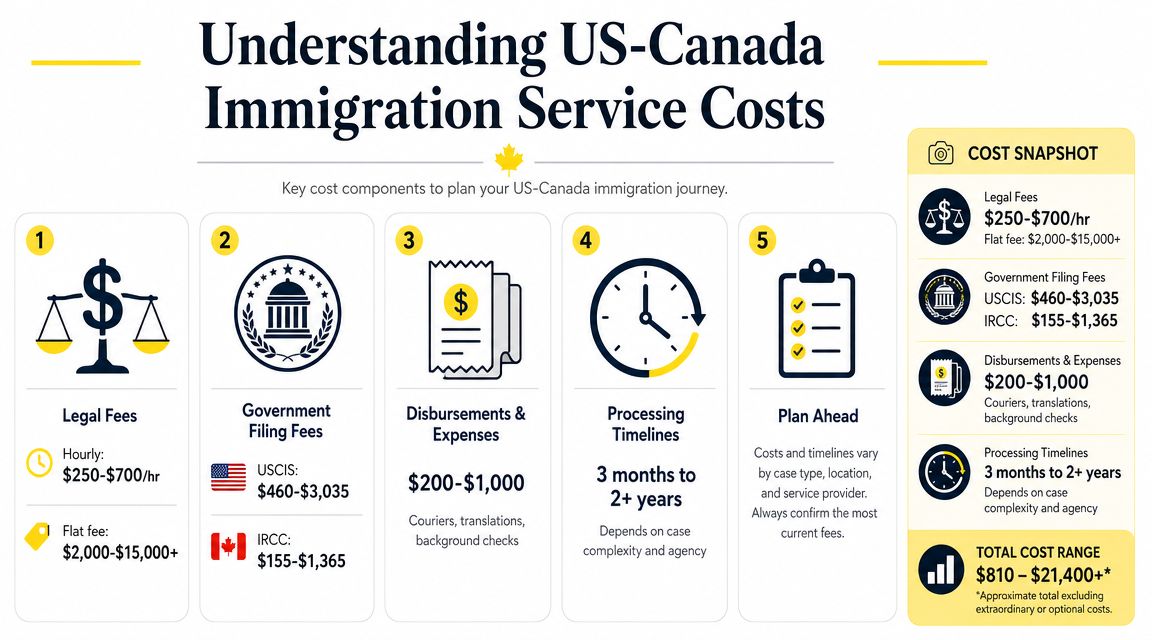
How Much Do US-Canada Immigration Services Cost?
Cost questions are fair, but they're often framed too narrowly. Clients ask what the filing will cost. The larger risk is what delay, inconsistency, or a weak first submission will cost your business or family plan.
Government fees should always be checked at the source because they change. For U.S. filings, review the current fee schedule and form instructions on USCIS. For Canadian applications, review current fees and process pages on IRCC.
Legal fees usually depend on a few practical variables:
- Case type. A treaty professional application is different from an investor file or multi-employee transfer.
- Volume of documents. Founders and employers often need more corporate evidence than individual applicants expect.
- Urgency and travel pressure. Tight start dates can increase legal work even when the law is straightforward.
- Family members and prior history. Dependents, refusals, status issues, or border complications add work.
Why timing often matters more than the fee quote
A major challenge in cross-border planning is that government processing doesn't move in a straight line. Official USCIS case-processing dashboards and CBP border wait tools show month-to-month variability, which is why timing strategy matters as much as eligibility, as discussed in Phillips Lytle's immigration overview.
That's where counsel adds value beyond quoting a fee. A lawyer should help you answer questions like these:
- Can the employee start remotely?
- Is travel safe while another filing is pending?
- Should dependents file now or later?
- Does a Canadian filing affect the U.S. timeline, or vice versa?
Fees are visible. Timing risk is often the bigger business problem.
If a company wants someone in place by a fixed launch date, the strategy should be built backward from that date. Waiting until the last minute often produces rushed documents, inconsistent evidence, and avoidable stress at the border.
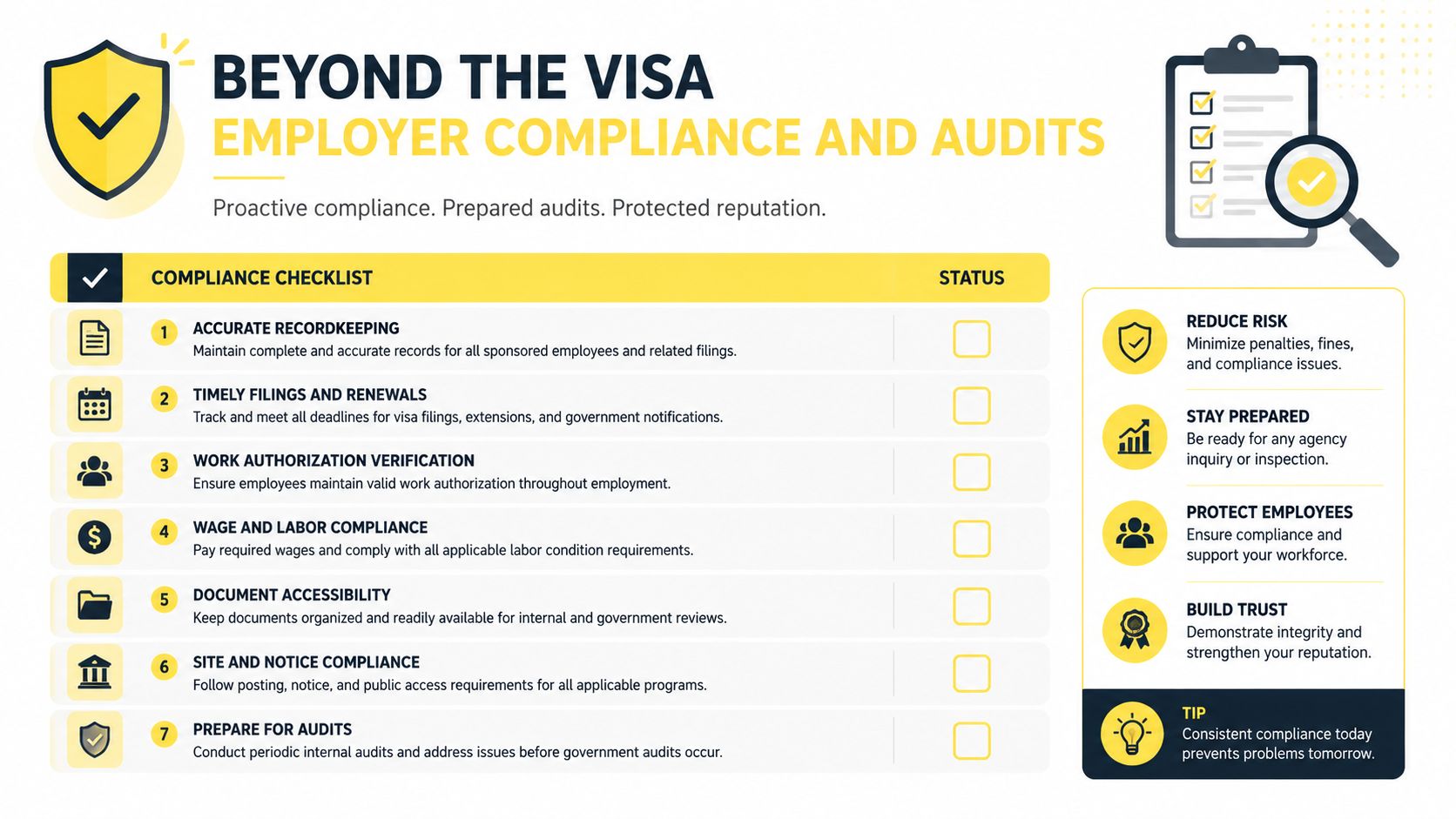
Beyond the Visa Employer Compliance and Audits
Many employers think immigration counsel is only for getting approval. That view is too narrow. Once a worker is hired, the company still has obligations around verification, records, role consistency, and internal controls.
In the U.S., that usually means I-9 compliance and related onboarding discipline. In Canada, employer compliance can include recordkeeping and inspection exposure in relevant work-permit streams. Those aren't side issues. They are part of the immigration file because a mismatch between the worker's authorized role and the employer's internal records can create problems later.
What employers miss most often
The hidden risk usually isn't bad intent. It's drift. A sponsored employee changes title. Reporting lines move. Remote work expands across borders. Payroll sits in one entity while day-to-day supervision sits in another.
Those facts can affect both status and compliance.
According to the summary provided above and reflected by Immigrant Defense Advocates, employers in both countries face real recordkeeping and inspection burdens, and immigration counsel can play an important role in HR risk management and audit readiness. If compliance is part of your issue, see our page on compliance officer responsibilities.
Unified counsel helps when HR and legal need one record
Mayo Law works with employers across the GTA and on cross-border matters. Joseph Mayo is licensed in Ontario and New York, so clients with U.S. ties coordinate their legal work in one place rather than juggling two firms.
That structure matters most when a company is hiring fast and doesn't want separate U.S. and Canadian advice creating conflicting instructions. A unified file helps HR use one set of facts for offer letters, immigration support, onboarding, and audit preparation.
If the employer record is clean from the start, renewals and future permanent filings are usually easier to defend.
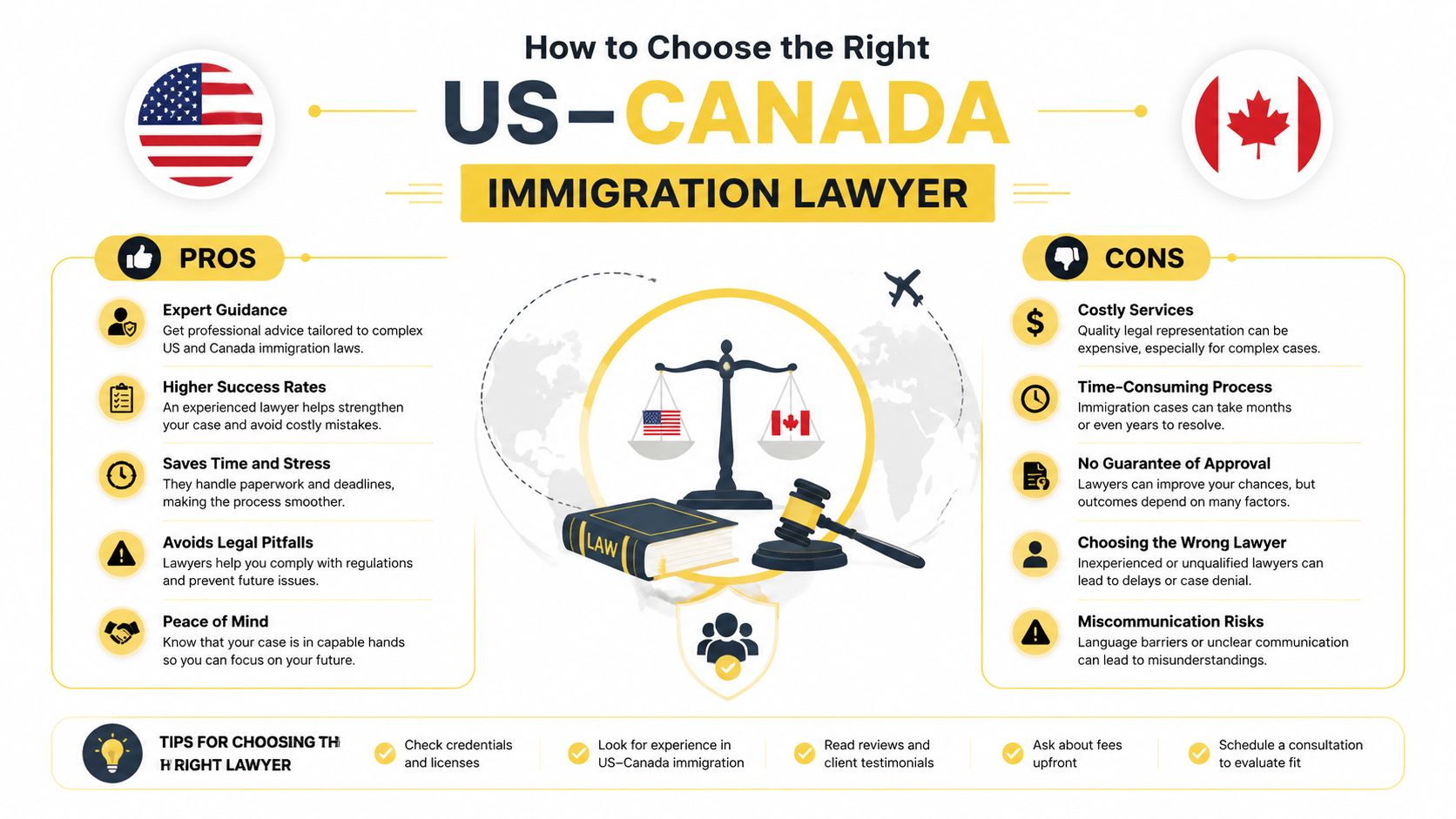
How to Choose the Right US-Canada Immigration Lawyer
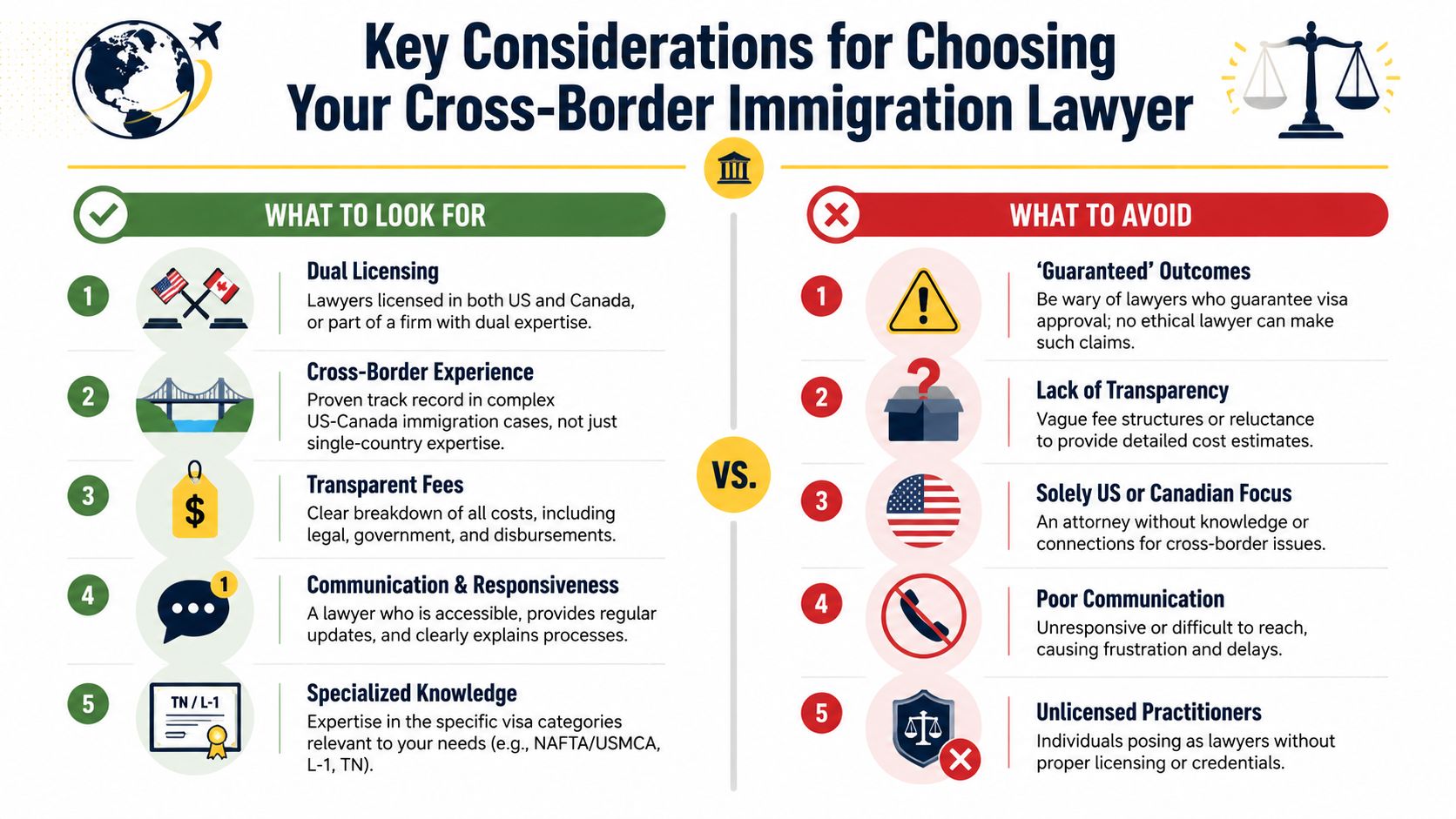
Choosing counsel for a cross-border matter is less about branding and more about fit. You need someone who can control facts across two systems, explain trade-offs clearly, and spot business issues before they become immigration problems.
Ask whether one team can manage both sides
The strongest practical question is simple. Who is responsible for making sure the U.S. and Canadian versions of your case match?
The verified guidance above notes that a lawyer licensed in both Canada and the U.S. can coordinate filings without forcing the client to manage two separate firms, and that this model supports tighter control over evidence, deadlines, and consistency across applications, as reflected by Allen & Hodgman's description of a dual U.S.-Canadian practice.
That doesn't mean dual licensure is the only acceptable model. But it does mean you should ask who owns the whole strategy.
A short client checklist
- Licensing: Are they licensed in the relevant U.S. jurisdiction and Canadian province, or working in a structure that clearly covers both?
- Scope: Can they advise on business immigration, family implications, and employer compliance?
- Communication: Do they explain risks in plain English, or only list forms?
- Process control: Who reviews the factual record across all filings?
- Fees: Is the billing structure clear before work begins?
If you're comparing local options, a search for immigration attorneys near me is a starting point, but proximity matters less than whether counsel can manage the full cross-border file.
What usually does not work
A fragmented setup often causes the most trouble. One U.S. lawyer may draft based on one version of the role, while Canadian counsel works from another. The client then becomes the go-between, carrying legal and factual instructions back and forth.
That approach increases communication overhead and creates room for contradiction. In a border-sensitive file, even small inconsistencies can matter.
What to Expect When Working With Your Lawyer
Most strong matters follow the same broad sequence. First comes intake and fact review. Then strategy. Then document collection, drafting, filing, and follow-up. The difference between a smooth case and a painful one is usually how much cleanup is needed at the fact-review stage.
The normal file lifecycle
A good first meeting should identify your objective, your constraints, and your hidden risks. That includes travel dates, prior refusals, family members, corporate ownership, job duties, and where the work will be performed.
After that, the lawyer should map the record. That means deciding which documents matter, what needs clarification, and where the weak points are before anything is filed.
A practical example
A startup needed to move a key developer from Toronto to New York while raising funds. The immigration issue looked urgent, but the primary pressure point was consistency. Investor materials, the employee's title, internal org charts, and the proposed U.S. role all used slightly different language.
That kind of mismatch is common. A lawyer's job is to fix it before it becomes an officer's concern.
What clients can do to help
- Answer early and fully. Missing history causes delays later.
- Use one document set. Don't send different versions to HR, counsel, and payroll.
- Raise business changes quickly. New ownership, title changes, and remote-work plans can matter.
- Treat timing as legal strategy. Travel and start dates affect filing choices.
The process is usually less stressful when everyone works from one controlled record and updates it as facts change.
Frequently Asked Questions
| Question | Answer |
|---|---|
| What is a US-Canada immigration lawyer? | A US-Canada immigration lawyer handles immigration matters that touch both countries, such as work visas, permits, family planning, employer compliance, and cross-border business movement. The real value is often in coordinating one factual record across two legal systems so filings don’t conflict. |
| Do I need one lawyer for both countries? | Not always. Two firms can work if the file is tightly managed. But where timing, company structure, family status, or permanent residence planning overlap, one coordinated team often reduces confusion and lowers the chance of inconsistent submissions. |
| How long will my case take? | That depends on the category, the quality of the evidence, government workload, and whether border processing is involved. In practice, the most useful early advice is often not a prediction. It’s a timing plan that accounts for travel, start dates, dependents, and possible delays. |
| Can a lawyer help if the problem is delay, not eligibility? | Yes. Delay planning is a major part of cross-border practice. Counsel can help with sequencing, travel risk, maintenance of status, document strategy, and when appropriate, requests tied to urgent timing or business need. |
| What should employers ask before hiring across the border? | Ask who will employ the worker, where the work will be performed, which entity controls the role, what records must be retained, and whether the company’s onboarding process matches the immigration position being claimed. Those questions often matter as much as the filing itself. |
Conclusion
Cross-border immigration work isn't just about getting through one application. It's about keeping your legal story accurate, consistent, and useful across two countries. If you're moving for work, hiring across the border, or building a business in both markets, the right plan usually starts with one coordinated record and a realistic timeline.
If your matter involves work authorization, founder mobility, investor planning, or employer compliance across the U.S. and Canada, Mayo Law offers cross-border legal services grounded in Ontario and New York licensure. To discuss your situation, visit Mayo Law.