Published: June 11, 2026 | Updated: June 11, 2026 | Read time: 11 minutes
You may be sitting in the U.S. right now wondering how you can live in Canada long term, protect family assets, or build a cross-border life, and you’re trying to figure out how to get Canadian citizenship from the US without wasting years on the wrong process.
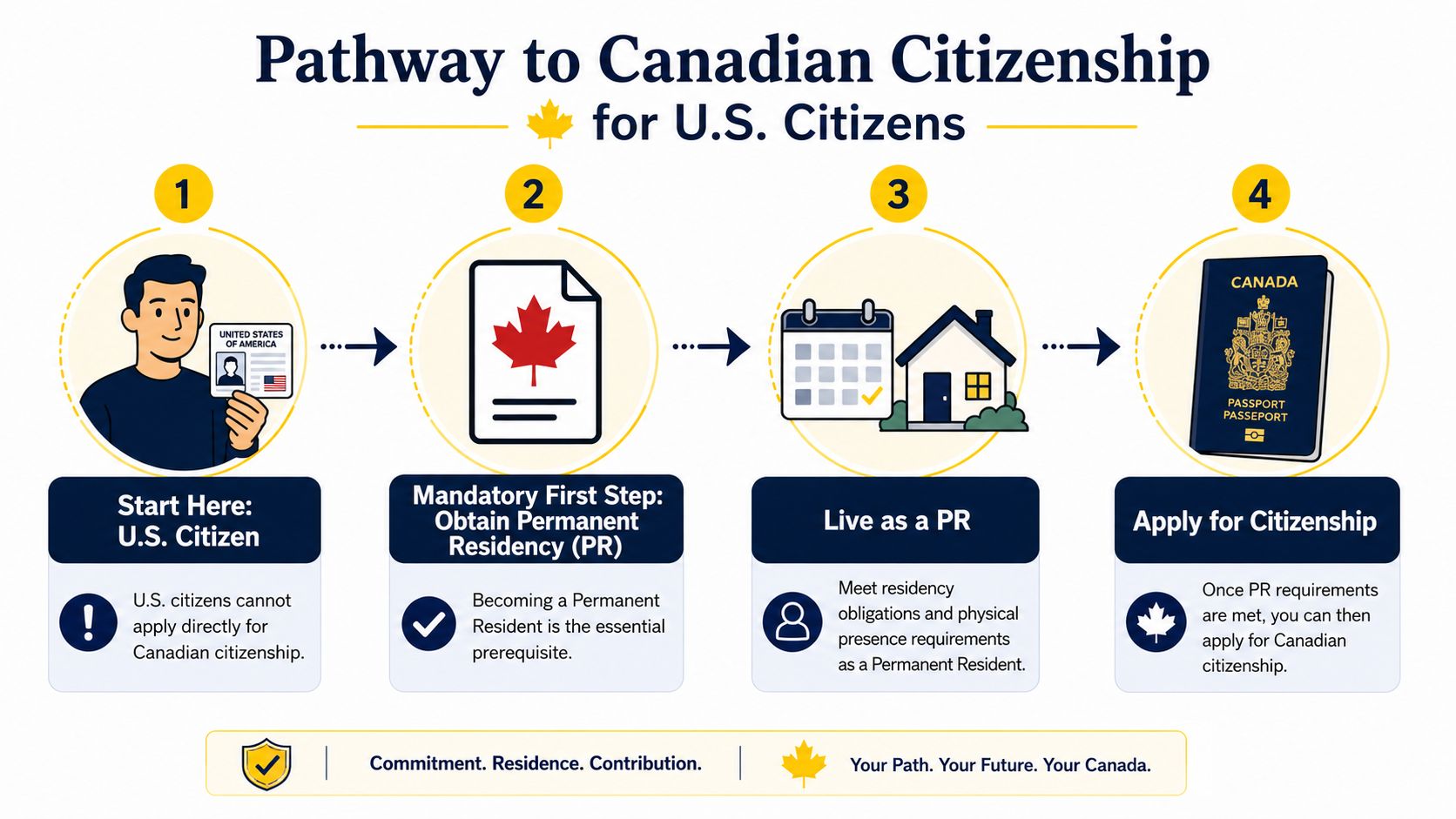
At Mayo Law, we help professionals and families in the U.S. and Canada handle cross-border immigration matters. Most U.S. citizens cannot apply directly for Canadian citizenship. They usually must first become Canadian permanent residents, live in Canada long enough to qualify, and only then apply for citizenship.
There’s one major exception. Some people searching this topic may already be Canadian citizens without even knowing, and only need proof. The right first step is either naturalization after permanent residence or proof of citizenship by descent.
What Are the Requirements for a Canadian Citizenship?
For a U.S. citizen pursuing Canadian naturalization, the legal requirements are straightforward. The practical difficulty is meeting them in a way you can prove later.
Canadian citizenship usually requires all of the following:
- Permanent resident status at the time you apply
- Enough physical presence in Canada during the qualifying period before the application is signed
- Canadian tax filings, if required, for the relevant years
- A citizenship test for applicants in the applicable age range
- Proof of English or French ability for applicants in the applicable age range
- A complete application with the correct supporting documents
For many U.S. clients, the pressure point is recordkeeping. Travel back and forth to the United States, remote work, partial-year moves, and confusion about tax residence can all create problems if the dates in your application do not line up with passports, entry records, and tax filings.
Age also matters. Adults in the standard testing range generally need to take the citizenship test and provide language proof. Outside that range, different rules may apply, so the application strategy should match the applicant’s specific circumstances.
This article addresses two different groups because they are often mixed together online. One group must first become permanent residents and later apply for citizenship. The other group may already be Canadian by descent and only need proof of citizenship, which is a different process with different evidence and timing. If you want a broader overview of the naturalization route, see our guide on how to become a Canadian citizen.
Before spending time on forms, determine which track you are on. Filing a citizenship application when you first need permanent residence, or when you may already be a citizen by descent, wastes time and often leads to avoidable delay.
The Mandatory First Step Becoming a Canadian Permanent Resident
A U.S. passport doesn’t give you a shortcut to Canadian citizenship. It may help with travel and some work-permit options, but it doesn’t replace the need for permanent resident status if you are not already Canadian.
Common ways U.S. citizens reach PR
In practice, U.S. applicants usually arrive at Canadian permanent residence through one of a few channels.
- Economic immigration: Skilled workers often pursue pathways tied to education, work history, language ability, and Canadian labor market needs.
- Canadian work history first: Some people start with a work permit, build time in Canada, then transition to PR.
- Family sponsorship: If you have a qualifying Canadian family relationship, sponsorship may be the cleanest route.
- Business immigration planning: Founders, executives, and investors sometimes structure a temporary-entry strategy first, then assess whether a permanent path is available.
For cross-border professionals, this planning often overlaps with U.S. work commitments, stock compensation, family residence decisions, and tax residency questions. If your situation is business-driven, cross-border immigration planning usually needs to happen before the move, not after. Mayo Law works with clients on these issues through its business immigration practice.
Why the PR stage matters so much
The citizenship clock is not something you casually “pick up later.” Your PR stage affects almost everything that follows, including travel patterns, tax filings, document retention, and how soon you can validly apply.
Practical rule: If your long-term goal is citizenship, treat permanent residence as the start of a compliance file, not just an immigration approval.
That means keeping organized records from day one. Save entry and exit confirmations, lease documents, payroll records, school records, and any documents that show where you lived.
An anonymized example is useful here. A U.S. software engineer accepts a role in Toronto, enters Canada through a work-based pathway, later secures PR, and assumes citizenship is just paperwork after a few calendar years. It usually isn’t that simple. Frequent U.S. business trips, a period of working remotely from New York, or gaps in tax filings can delay the application.
Citizenship is common for long-settled immigrants
Canadian citizenship is not some fringe outcome for a tiny subset of immigrants. In the 2021 Census release from Statistics Canada, 80.7% of eligible immigrants had become naturalized Canadian citizens. The same release found that among naturalized Canadian citizens, 44.7% held multiple citizenships.
That matters for U.S. readers for two reasons. First, the process is realistic for people who settle in Canada and maintain eligibility. Second, dual citizenship is not unusual in this context.
Calculating Your Physical Presence and Documenting Your Time
If there is one issue that causes avoidable trouble, it’s physical presence. People often count loosely. IRCC does not.
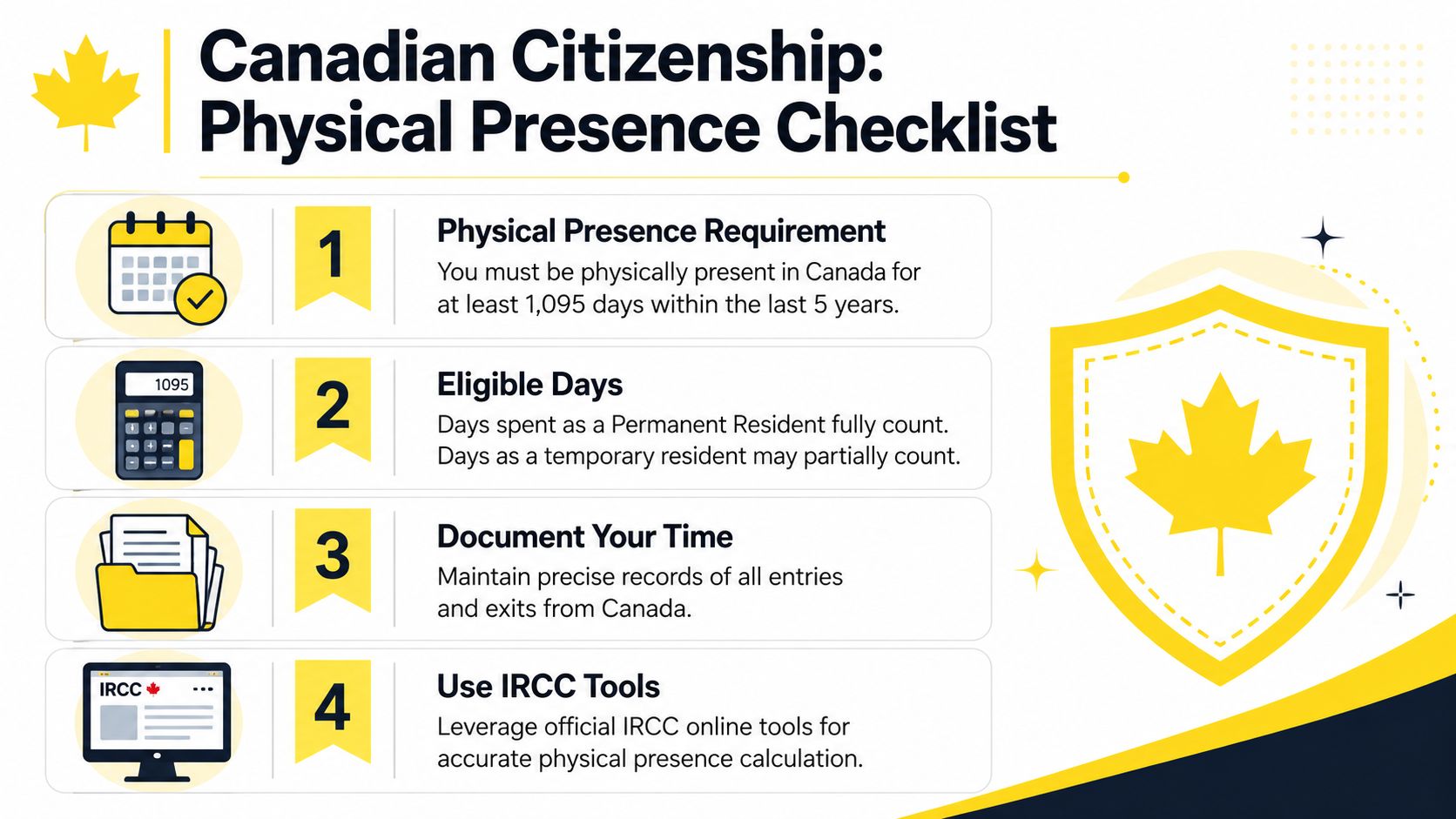
According to the Government of Canada’s citizenship eligibility rules, you must have been in Canada for at least 1,095 days during the 5 years before signing the application, and 730 of those days must be as a permanent resident. Adults 18 to 54 must also pass the citizenship test and show language ability at CLB 4 or higher, while many applicants must have filed Canadian taxes for at least 3 years in that period.
What works in real life
Good citizenship files are built with evidence, not memory. For many applicants, that means maintaining a running travel log and matching it against the documents you have.
Useful records often include:
- Passport records: Entry and exit stamps, renewal dates, and old passports.
- Travel confirmations: Flight bookings, boarding records, and itinerary emails.
- Residence proof: Leases, utility bills, home purchase records, or landlord confirmations.
- Work and school records: Pay stubs, employer letters, attendance records, or enrollment documents.
- Tax records: Canadian returns and related supporting documents.
If any U.S. supporting records need formal authentication for another part of your file, this New York guide on how to get an apostille in New York can be relevant for document preparation.
What trips people up
U.S. applicants often assume that living “mostly” in Canada is enough. It isn’t. IRCC looks at actual presence. A commuter setup, heavy consulting travel, long stretches helping family in the U.S., or remote work from outside Canada can all reduce your count.
Don’t apply based on a rough estimate. If your count is tight, wait until it is comfortably supported by documents.
A second anonymized scenario shows the risk. A U.S. business owner kept a condo in Toronto and believed he had clearly met the threshold. When he reconstructed his travel history, regular trips back to Chicago had cut deeper into his days than expected. Applying early would have created a credibility problem and likely a long delay.
A practical way to prepare
Use a disciplined checklist before you file:
- Rebuild your travel history from all passports and booking records.
- Match each period in Canada to a residence, job, school, or family record.
- Review tax filing years before you assume you qualify.
- Check language and test readiness if you fall in the required age range.
- Wait if necessary rather than forcing a weak application.
A careful file usually beats a fast one.
The Citizenship Application Process and Timeline
Once you are eligible, the application itself is procedural, but the details matter. Most adult applicants now deal with a structured online process, and small formatting problems still cause major frustration.

The Government of Canada’s online citizenship application guide lays out a strict sequence. You confirm eligibility, complete the guided questionnaire, upload high-quality color scans and the required digital photo, add translations for any non-English or non-French documents, review completeness, and pay fees before submitting. IRCC also warns that false or misleading information is a serious offence.
What the workflow looks like
In practice, the application usually breaks down into these stages:
| Stage | What you do |
|---|---|
| Eligibility check | Confirm that your days, status, taxes, and age-based requirements line up |
| Online questionnaire | Answer the guided questions carefully and consistently |
| Document upload | Add identity documents, scans, photos, and translations if needed |
| Final review | Check for missing fields, date mismatches, and image quality problems |
| Submission | Pay government fees through the portal and submit |
What tends to work well is preparing the evidence first, then completing the online application in one focused sitting or two short sessions with a final review at the end. What doesn't work is uploading whatever you have and hoping IRCC will sort it out.
Where U.S. clients hit avoidable friction
Cross-border applicants often have document sets from multiple jurisdictions. That creates a few recurring issues:
- Name variation problems: Middle names, suffixes, prior married names, and inconsistent passport records can create unnecessary questions.
- Translation issues: Any non-English or non-French document needs proper translation support.
- Photo formatting errors: These sound minor, but they are a common reason files stumble.
- History mismatches: Residence dates, travel dates, and tax filing periods must align.
A citizenship application is not the place to “explain later.” If a date looks off, fix it before submission.
Timeline thinking for U.S. families
I'm deliberately not giving a processing-time estimate for routine grants here because those change and should be checked directly with IRCC before filing. The practical point is different. Citizenship is the final step in a file that may already involve years of residence-building, travel tracking, and tax compliance.
For U.S. citizens, there is another layer. Becoming Canadian does not end U.S. obligations. U.S. citizens usually continue to deal with U.S. tax filing on worldwide income even after moving to Canada or acquiring another citizenship. That's not a reason to avoid Canadian citizenship. It is a reason to coordinate immigration and tax planning early.
Common Pitfalls for US Applicants to Avoid
Most mistakes are not dramatic. They are ordinary cross-border habits that become legal problems later.
Assuming citizenship is a direct application
The most common misunderstanding is the biggest one. People search “how to get Canadian citizenship from US” and assume there is a direct form for Americans. Usually there isn't. If you are not already Canadian, the process starts with status in Canada and long-term residence planning.
Underestimating U.S. travel
Many U.S. applicants keep business, family, or property ties south of the border. That is normal. The problem starts when those trips are not tracked carefully.
A person may live in Toronto, consult in Boston two weeks each month, and still feel firmly settled in Canada. But physical presence is counted by actual days, not intent. If your work requires heavy U.S. travel, your citizenship timeline may be longer than you expect.
Ignoring U.S. tax issues
U.S. tax filing doesn't disappear because you move to Canada or later hold Canadian citizenship too. That catches some people by surprise, especially those who assumed a move north would simplify everything. It rarely does unless the immigration and tax sides are planned together.
Overlooking criminal inadmissibility concerns
Some U.S. applicants focus only on citizenship eligibility and forget the earlier immigration issue. A prior U.S. criminal matter can affect your ability to enter or remain in Canada, which can disrupt the permanent residence stage long before citizenship is on the table. Even old cases that seem minor under U.S. law can raise Canadian admissibility questions.
Mayo Law works with clients across the GTA and on cross-border matters. Joseph Mayo is licensed in Ontario and New York, so clients with U.S. ties can coordinate their legal work in one place rather than juggling two firms.
Failing to ask whether you already are Canadian
This is the pitfall generic guides often miss. Some readers don't need naturalization at all. They need to confirm whether they already acquired citizenship through a Canadian parent and then apply for proof. If you think there may be a family-based claim, review that first. For related background, this page on lost Canadian citizenship and restoration issues may help frame the problem.
Are You Already a Canadian Citizen by Descent?
This is the question that can save you years.
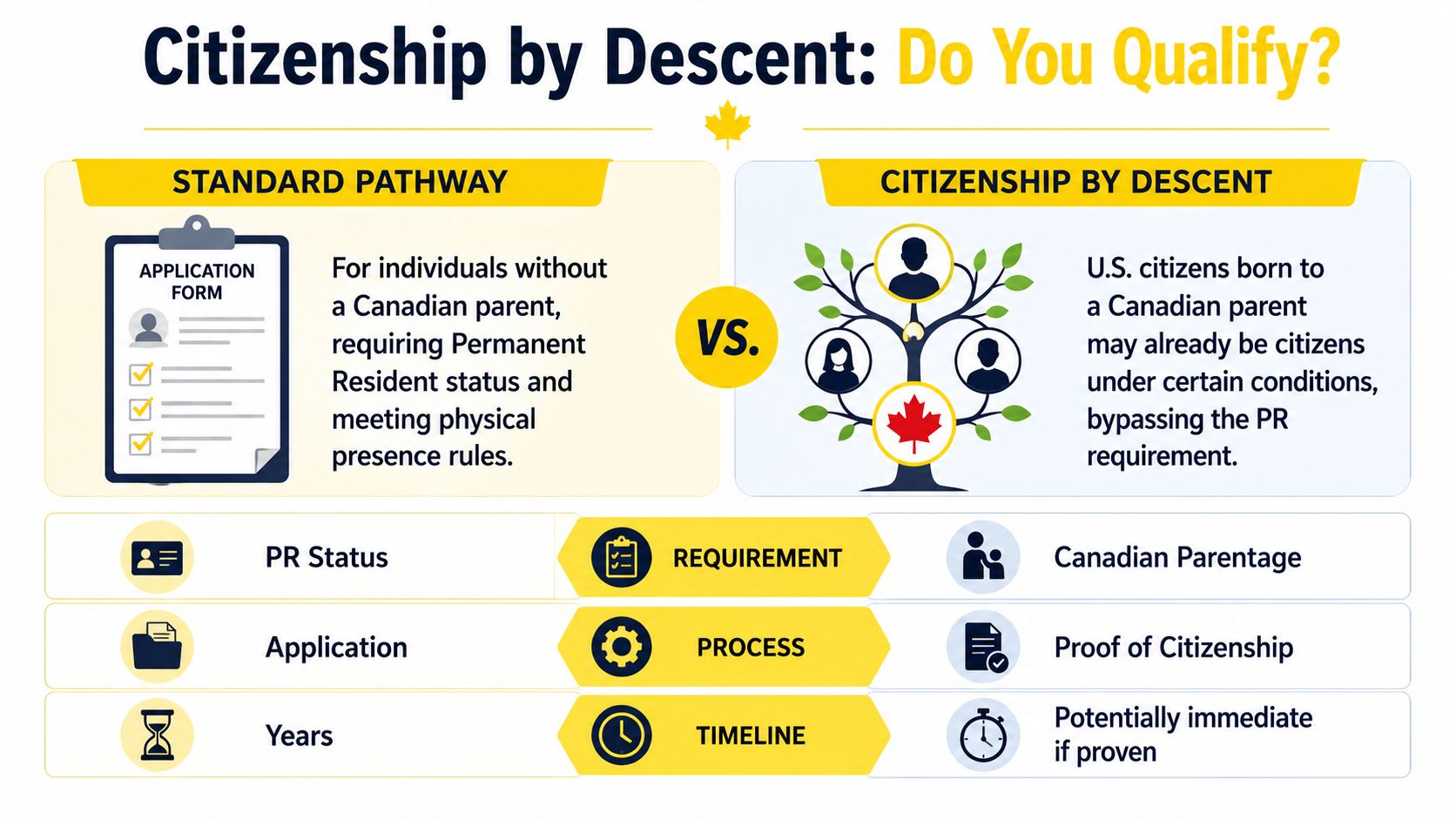
Canada says on its already a citizen guidance page that you may apply for a citizenship certificate if you were born outside Canada to a Canadian parent, if you lost proof, or if you are unsure whether you are already a citizen. The government also says the certificate is the document needed to get a Canadian passport and avoid border delays.
Why this is a different process
If you are already Canadian by descent, you are not applying for a grant of citizenship. You are applying for proof of citizenship. Those are different legal paths with different evidence, different forms, and different practical timelines.
Recent reporting noted in the same background issue indicates roughly 56,000 proof-of-citizenship applications were pending, with an estimated 10-month processing time. That backlog is one reason to sort this issue out early rather than assume you should naturalize.
Quick comparison
- Standard route: Become a permanent resident, live in Canada long enough, then apply for citizenship.
- Descent route: Prove that you already are a citizen because of your Canadian parentage.
- Key evidence: Birth certificates, parentage documents, and identity records, not residence accumulation in Canada.
If one of your parents was Canadian when you were born, stop and verify your status before planning a PR-to-citizenship strategy.
For people dealing with multi-generation family records or recent descent-rule changes, this resource on Canadian citizenship by descent and second-generation issues may be the more relevant starting point.
Frequently Asked Questions
Do I need permanent residence before I can become a Canadian citizen from the U.S.?
Usually, yes. If you are a U.S. citizen who is not already Canadian, the normal path is to become a Canadian permanent resident first, then build enough qualifying time in Canada to apply for citizenship. The major exception is where you may already be Canadian by descent and only need proof.
How much does the citizenship application cost?
Government fees change, so you should confirm the current amount directly with IRCC before submitting. The safer approach is not to rely on blog posts for filing fees. Check the official application portal and payment instructions when your documents are ready to go.
How long does it take to get Canadian citizenship from the U.S.?
There isn't one useful single answer because the timeline typically includes two different stages. First, you need a path to permanent residence. Then you need enough qualifying presence in Canada before filing for citizenship. If you may already be Canadian by descent, the process is different and can be shorter in structure, though proof applications can still face delay.
Can I travel while my citizenship application is being processed?
Yes, many applicants do travel. A key issue is recordkeeping and responsiveness. Keep your travel history organized, monitor your account, and make sure you can respond quickly if IRCC asks for additional information or schedules a test, interview, or ceremony step.
What if I fail the citizenship test?
Failing the test does not automatically end the process, but it usually means you will have to follow IRCC's next instructions and may face additional steps. The practical lesson is to prepare seriously if you are in the age group required to take the test.
Conclusion
If you're trying to figure out how to get Canadian citizenship from the US, the right answer depends on which of two groups you fall into. Most Americans need a long-term path that starts with permanent residence, careful residence tracking, and a clean citizenship application when the timing is right. A smaller but important group may already be Canadian and only need proof of that status.
The best results usually come from identifying the correct pathway early, keeping records from the start, and treating the move as both an immigration and cross-border planning project. That saves time, avoids the wrong application, and reduces problems that are much harder to fix later.
If you need help sorting out whether your path is permanent residence to citizenship or proof of existing status, Mayo Law advises clients across Toronto, the GTA, and on cross-border matters, including U.S.-Canada immigration issues.
How Mayo Law Can Help
Mayo Law advises U.S. clients at the point where the strategy needs to be right the first time. That often means separating two very different matters early. One client needs a permanent residence plan that supports a later citizenship application. Another may already be a Canadian citizen by descent and needs proof, not naturalization.
Our role is to assess which process fits your facts, identify weak spots in the record, and prepare an application package that matches the legal route you are entitled to use. For U.S. applicants, that also means addressing practical issues generic citizenship guides miss, including travel history gaps, inconsistent family records, prior immigration filings, and cross-border tax considerations that can affect timing and planning.
We also help clients avoid expensive category errors. Filing for citizenship when the issue is proving existing status wastes time. Waiting too long to document residence, absences, or family lineage can make a valid case harder to prove than it should be.
Disclaimer
This article is for informational purposes only and does not constitute legal advice. Every situation is different. Consult a licensed lawyer about your specific circumstances. Mayo Law provides legal services through Mayo Law PC in Ontario and Joseph Mayo PLLC in New York.
Related Articles
Readers dealing with cross-border filings often need help beyond the citizenship application itself. These articles cover adjacent issues that come up for U.S. clients, especially document authentication and international legal coordination.