

Contents
- Introduction
- Quick Answer
- Reason 1: Expertise in Business Law
- Reason 2: Protecting Your Business Structure
- Reason 3: Drafting and Reviewing Contracts
- Reason 4: Navigating Regulatory Requirements
- Reason 5: Dispute Resolution and Litigation Support
- Conclusion
- Frequently Asked Questions
- How Mayo Law Can Help
- Disclaimer
Introduction
Every startup makes its most expensive legal decisions in its first year, usually without noticing. The structure chosen at registration, the first client contract, the handshake arrangement with a co-founder: each one sets terms the business will live with for a decade. Business lawyers exist to make those early decisions deliberately rather than by accident, and for Canadian founders the case for involving one early can be made with numbers rather than slogans.
Importance of Legal Support for Startups
As of December 2024, Canada had 1.10 million employer businesses, and 98.2 percent of them were small businesses with fewer than 100 employees, according to Innovation, Science and Economic Development Canada. Most run lean: 59.1 percent of Canadian employer businesses have one to four employees, and more than three out of four have fewer than ten. A team that size has no legal department, so every contract, hire, and regulatory filing lands on the founder’s desk, which is exactly the gap business lawyers fill.
The federal government’s own guidance for small business owners makes the core point plainly: it costs less to have legal work done properly at the start than to pay a lawyer to fix a problem after it happens. That is the entire argument of this article, made by the least dramatic source available.
Overview of Business Lawyers
A business lawyer advises companies on the legal side of commerce: choosing and setting up a structure, drafting and reviewing contracts, employment documents, protection for intellectual property, regulatory compliance, and resolving disputes. The vocabulary shifts by region. Canadians usually say business lawyer or corporate lawyer; Americans lean toward business attorney or small business attorney; and someone typing corporate attorney near me into a search bar is looking for the same professional. Whatever the label, the job is identical: spot legal risk before it costs money, and paper the deals that matter.
Quick Answer
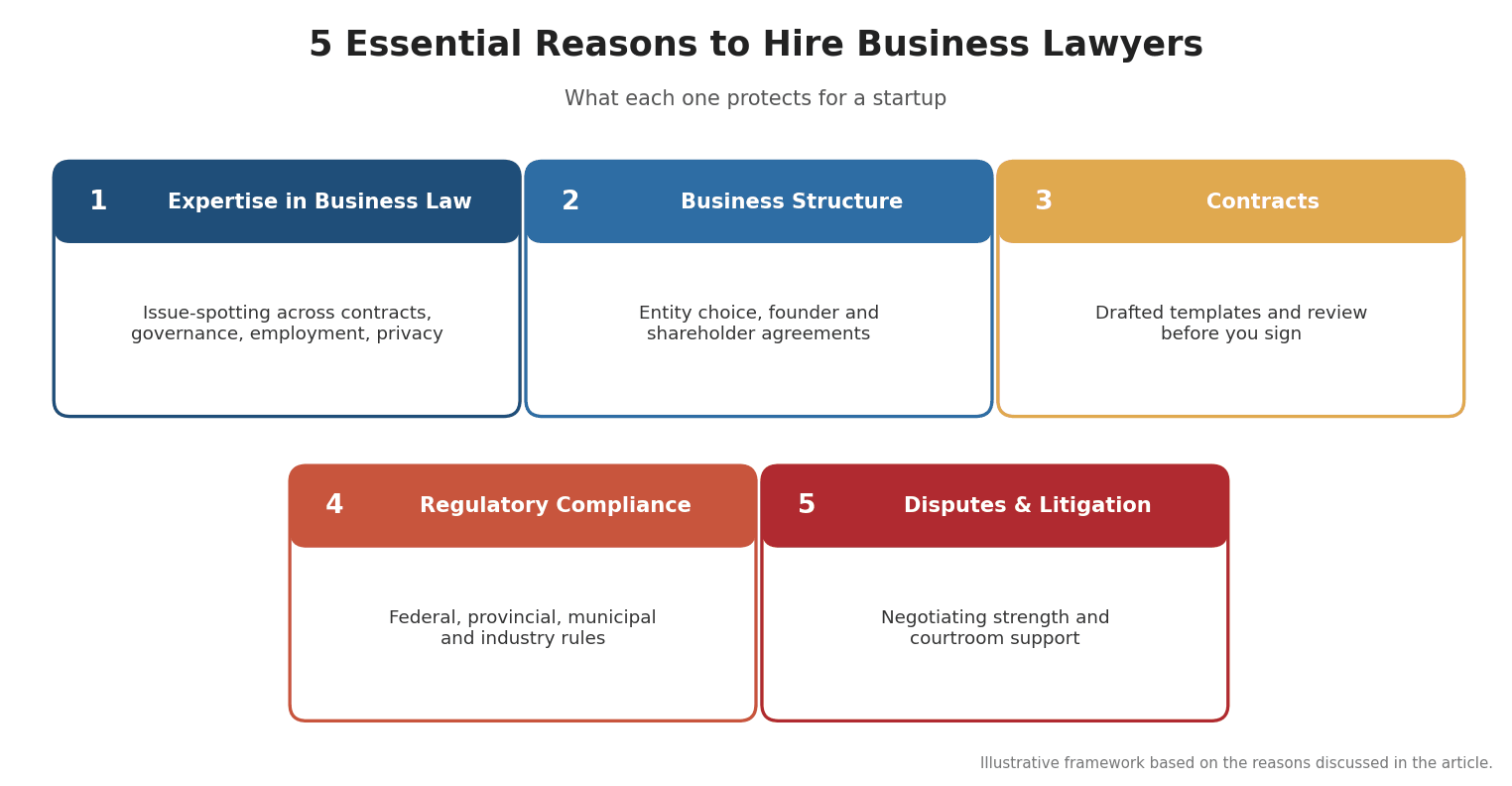
Startups hire business lawyers for five core reasons: specialized expertise in business law, help choosing and protecting the right business structure, professionally drafted and reviewed contracts, guidance through federal, provincial, and municipal regulations, and support when disputes arise. Handled early, each is a modest, one-time cost. Handled late, each can become an emergency.
Reason 1: Expertise in Business Law
Understanding Business Law Fundamentals
Business law in Canada is not one subject. It is a stack of them: contract formation and enforcement, corporate governance under provincial or federal incorporation statutes, employment standards that differ province by province, privacy rules for customer data, tax obligations, and the licensing regimes attached to specific industries. No founder can master the stack while also building a product and finding customers, and the rules in Ontario are not the rules in Alberta, let alone New York.
General knowledge is also not the same as issue-spotting. The expensive mistakes rarely announce themselves; they sit quietly in a clause nobody read or a filing nobody knew was required, and they surface at the worst possible moment, usually during a financing, a sale, or a dispute.
Advantages of a Business Law Lawyer
A business law lawyer brings pattern recognition. They have watched many companies sign the agreement you are about to sign, and they know where those deals went wrong. That experience converts into practical outputs: contracts that match how your business actually operates, filings done on schedule, and honest advice about which risks are worth taking. For a startup the value is concentrated at the beginning, when one afternoon of advice can prevent a problem that would take a year of litigation to unwind. Our guide to working with a startup business attorney covers what that first engagement usually looks like.
Reason 2: Protecting Your Business Structure
Choosing the Right Business Entity
Canadian founders choose among a sole proprietorship, a partnership, and a corporation, incorporated either provincially or federally, with co-operatives filling a niche. Each option sets liability exposure, tax treatment, and how investors can come aboard later. The trade-offs are real: a sole proprietorship is cheap and fast but leaves personal assets exposed, while a corporation costs more to set up and maintain but separates the business’s obligations from your own. Our guide to Ontario business structures walks through the full comparison, and our Ontario incorporation guide covers the mechanics step by step.
Founders planning for both sides of the border face a harder version of the question, because the Canadian and American systems do not mirror each other, and a structure that is efficient in one country can create tax problems in the other. Designing the pair together, covered in our guide to starting a business in both Canada and the US, is cheaper than bolting on a second entity later.
Role of a Business Lawyer in Structuring
The lawyer’s job at this stage goes well past registration paperwork. It is the shareholders or partnership agreement that settles equity splits, vesting, decision rights, and what happens when a founder leaves; the minute book that keeps the corporation legally real; and share issuances done correctly the first time. Founder fallouts are among the most common ways young companies die, and nearly every one of them is cheaper to prevent in a signed agreement than to resolve in a courtroom.
Reason 3: Drafting and Reviewing Contracts
Importance of Contracts in Business
Contracts are the operating system of a business. The same federal guidance cited above lists the places where legal advice on contracts pays for itself: licensing and franchise agreements, employment contracts, subcontractor terms, partnership and shareholder agreements, leases, and purchase agreements. For most startups the working set is short. A customer-facing agreement, a supplier agreement, a non-disclosure agreement, employment and contractor templates, and the lease will carry the business for years if they are drafted well.
The commercial lease deserves its own warning. It is often a startup’s largest fixed commitment, and the printed terms favour the landlord unless someone pushes back on assignment rights, renewal options, and what happens if the business needs to move or grow.
How a Business Attorney Ensures Compliance
A business attorney earns the fee twice on contracts. Once by drafting templates that reflect your actual risk tolerance, so the company stops improvising a new document for every deal. And again by reviewing the other side’s paper before signature, because the costly surprises live in clauses founders skim: limitation of liability, indemnities, auto-renewal, and termination rights. A focused contract review service is one of the cheapest forms of insurance a small company can buy.
Reason 4: Navigating Regulatory Requirements
Understanding Business Regulations
Regulation arrives in layers. Federal rules govern areas such as privacy in commercial activity and anti-spam; provinces set employment standards, consumer protection, and most licensing; municipalities add zoning and local permits. The layers differ by province, so a compliance setup built for Ontario does not transfer cleanly to British Columbia, and certainly not to New York. Industry adds a further layer, since food, finance, health, transport, and construction each carry regimes of their own.
Two areas generate outsized risk for small companies: misclassifying employees as independent contractors, and mishandling customer or employee personal information. Both are routine to get right with the correct documents in place, and both are expensive to get wrong. Our employment compliance guide covers the first in detail.
The Role of a Small Business Lawyer
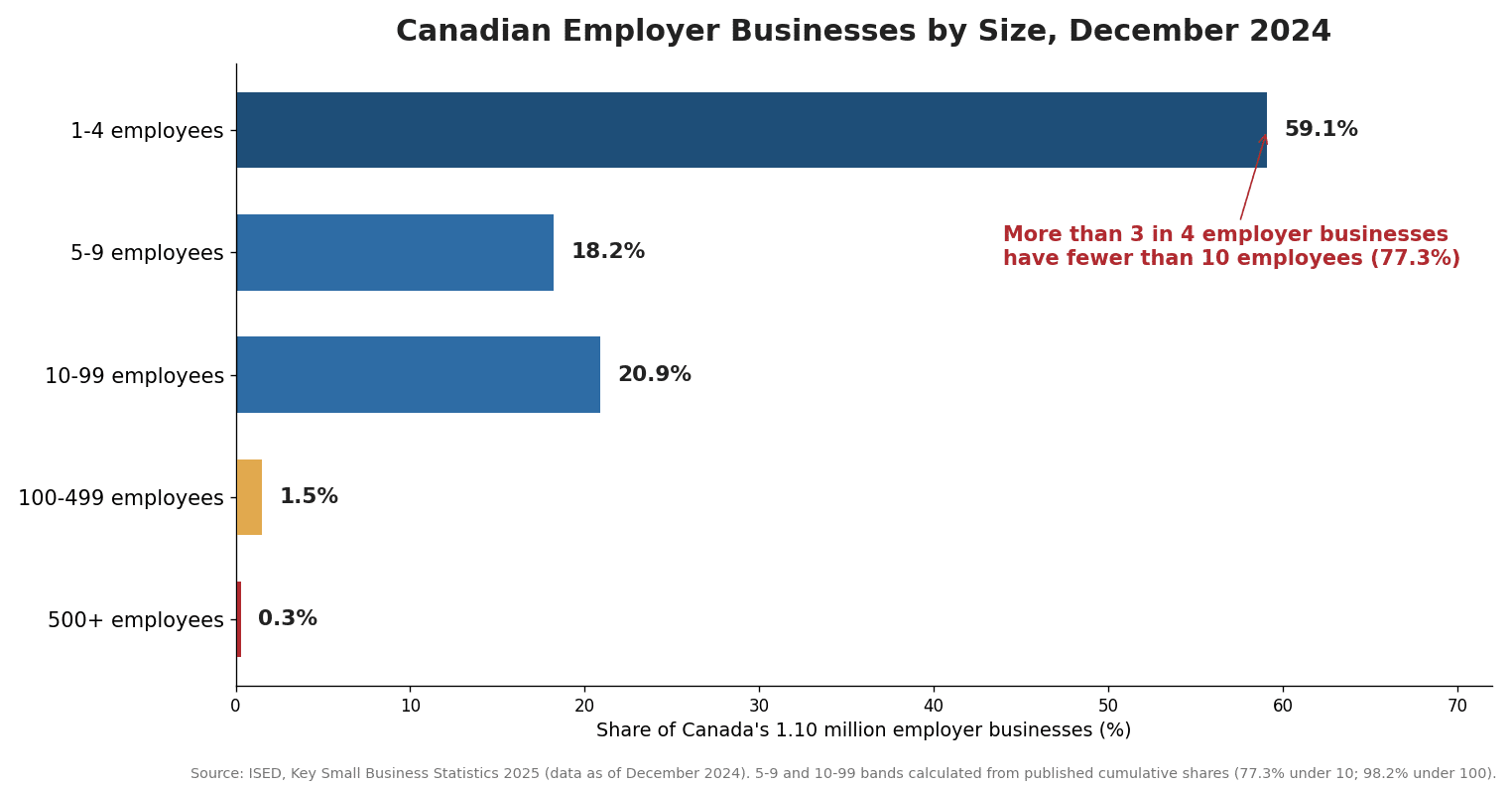
This is where a small business lawyer earns a relationship rather than a transaction. Most Canadian businesses run with fewer than ten people, and the chart above is the compliance department most of them have, which is to say none. A lawyer who knows the company maintains the baseline: employment documents that match the province of work, privacy basics, licence renewals, and a phone call before a new obligation lands. Founders searching for a business lawyer for small business needs are usually looking for exactly this arrangement, modest, ongoing, and preventive. Our guides to hiring a small business lawyer in Toronto and to legal services for SMEs cover how these engagements are typically structured.
Reason 5: Dispute Resolution and Litigation Support
Common Legal Disputes in Startups
Startup disputes cluster in predictable places: co-founders who separate without an agreement that says what happens next, customers who do not pay, employment claims after a termination handled informally, and arguments over who owns intellectual property created by contractors before any assignment was signed. Our intellectual property guide explains why that last one is so common: without written assignment language, default ownership rules often surprise everyone involved.
How a Corporate Attorney Can Help
Most disputes end by negotiation, and the quality of your paperwork decides your negotiating position. A corporate attorney’s first contribution is usually a well-founded demand letter and a realistic read on the strength of your case; the second is knowing when settling beats winning. When litigation cannot be avoided, counsel who already knows the company saves months of ramp-up. The pattern worth internalizing is simple: the documents from Reasons 2 and 3 are what make Reason 5 survivable.
Conclusion
Recap of Key Reasons
- Expertise in business law turns unknown risks into a managed list.
- The right structure, with founder agreements, contains liability and prevents ownership fights.
- A short stack of well-drafted contracts protects revenue, premises, and relationships.
- Regulatory guidance keeps employment, privacy, and licensing obligations current in every province where you operate.
- Dispute support converts all of that preparation into negotiating strength when something goes wrong anyway.
Final Thoughts on Hiring a Business Lawyer
The best time to hire business lawyers is earlier than feels natural, and the right hire is about fit. Look for a lawyer who acts for companies at your stage, is licensed where you actually operate, and will quote flat fees for defined projects. In Ontario, the Law Society of Ontario’s public directory lets you confirm any lawyer’s licence and standing before you engage them. If your plans cross the border, ask early whether your counsel can act on both sides, because retrofitting cross-border advice is harder than starting with it.
Frequently Asked Questions
What do business lawyers do for startups?
Business lawyers build the legal infrastructure a young company needs: choosing and registering a structure, founder and shareholder agreements, customer and supplier contracts, employment documents, intellectual property assignments, regulatory basics, and dispute handling. Early-stage work is mostly preventive drafting; later work shifts toward negotiations, financings, and resolving conflicts as they arise.
When should a startup hire a business lawyer?
Before the first irreversible commitment: incorporating, signing a lease, taking money from anyone, hiring a first employee, or signing a major customer contract. Each of those events sets legal terms that are difficult to undo, and a short consultation beforehand costs far less than unwinding a mistake afterward.
What is the difference between a business lawyer and a corporate attorney?
Mostly vocabulary. In Canada, business lawyer and corporate lawyer are the usual terms, while business attorney and corporate attorney are more common in the United States. Some lawyers do distinguish corporate work, meaning governance, shares, and transactions, from broader commercial work such as contracts and leases, so ask about the specific experience you need.
Do small businesses really need a lawyer if templates are available online?
Templates work for low-stakes documents in a single jurisdiction, and they fail quietly everywhere else. A generic template is not written for your province’s employment standards, your industry’s rules, or your actual risk. The pattern that hurts companies most is signing the other side’s contract unread because a template once looked similar.
How much does a business lawyer cost in Canada?
It depends on the work, the region, and the firm, so treat any single number with suspicion. Defined projects such as incorporations and contract templates are widely offered at flat fees, ongoing advice increasingly comes as a monthly arrangement, and hourly billing persists for disputes. Ask for the billing model before you engage.
How do I find a good business lawyer near me?
Ask other founders and your accountant for referrals, then verify independently. In Ontario, the Law Society of Ontario’s public directory confirms whether a lawyer is licensed and in good standing. Prioritize lawyers who act for companies at your stage and in your industry, and who will explain their fees in advance.
Can one lawyer handle both Canadian and US legal needs?
Only if they are licensed on both sides. A lawyer called in one country cannot advise on the other country’s law, so cross-border companies either coordinate two firms or engage counsel licensed in both an American and a Canadian jurisdiction, which keeps structure, contracts, and immigration advice consistent.
How Mayo Law Can Help
Mayo Law is a cross-border business law firm with offices in Toronto and New York. Principal attorney Joseph Mayo is licensed in Ontario and New York, so a company operating on both sides of the border can keep its structure, contracts, employment documents, and founder immigration questions with one firm instead of splitting them between advisors who never see the whole picture.
For Canadian startups, the firm supports every stage this article covers, from a first conversation through financing and cross-border expansion. Our business and corporate law page explains how the practice works and how to book a consultation.
Disclaimer
This article is provided for general informational purposes only. It is not legal advice, it does not address the facts of any particular case, and reading it does not create an attorney-client relationship with Mayo Law or any of its lawyers. Government statistics and legal rules change; the figures above reflect official sources as accessed in July 2026 and are attributed where they appear. Mayo Law provides legal services in Ontario and New York. Attorney advertising. Consult a licensed attorney about your specific situation before acting.