

Contents
- Quick Answer
- What is the Canada sanctions list, and why is there more than one?
- Which Canadian sanctions lists exist, and who holds each one?
- What is actually on the Canadian list right now?
- What do Canadian sanctions actually prohibit?
- Does a listed person's subsidiary count? The ownership and control test
- How do you screen a counterparty against the Canada sanctions list?
- What happens when you get a match?
- What are the penalties for breaching Canadian sanctions?
- How does the Canada sanctions list compare with the US OFAC SDN list?
- Who enforces sanctions in Canada?
- Frequently Asked Questions
- Conclusion
- How Mayo Law Can Help
- Disclaimer
Most companies that ask about the Canada sanctions list are really asking a narrower question: before we wire this payment, ship this order, or sign this distribution agreement, is the other side a person we are allowed to deal with? The answer is not on one page. Canada runs several separate lists under three separate statutes, and each one carries a different penalty if you get it wrong. The largest of them, the Consolidated Canadian Autonomous Sanctions List, held 5,698 entries when Global Affairs Canada last updated it on 4 September 2026. That list is the starting point, not the whole search.
Quick Answer
The Canada sanctions list usually means the Consolidated Canadian Autonomous Sanctions List, published by Global Affairs Canada under the Special Economic Measures Act and the Justice for Victims of Corrupt Foreign Officials Act. It held 5,698 entries on 4 September 2026. Canada also maintains United Nations listings and a separate Criminal Code list of terrorist entities.
What is the Canada sanctions list, and why is there more than one?
Canada imposes sanctions under three statutes, and the list a name appears on depends on which statute put it there.
The Special Economic Measures Act (SEMA) and the Justice for Victims of Corrupt Foreign Officials Act (JVCFOA) are Canada's autonomous authorities. Cabinet uses them when Canada decides on its own to act, and the names listed under their regulations are gathered into the Consolidated Canadian Autonomous Sanctions List.
The United Nations Act is different. When the Security Council decides on measures under Article 41 of the UN Charter, Canada is legally required to implement them, and it does so through regulations under that Act. Those names are not on the consolidated list. Global Affairs Canada directs screeners to the United Nations Security Council Consolidated List for them.
The Criminal Code adds a fourth set of names. Under section 83.05, Cabinet may list an entity as a terrorist entity on the recommendation of the Minister of Public Safety, where there are reasonable grounds to believe the entity knowingly carried out, attempted, participated in or facilitated a terrorist activity, or knowingly acted on its behalf or at its direction. Public Safety Canada published 89 currently listed entities when the page was read on 22 September 2026.
A fifth authority sits beside these. The Freezing Assets of Corrupt Foreign Officials Act lets Canada freeze the property of politically exposed foreign persons at the request of a country in political turmoil. Global Affairs Canada records measures under it for Tunisia and for Ukraine.
So a screening hit that comes back clean against the consolidated list has not cleared the UN list, the terrorist-entity list, or the corrupt-officials measures. Treating the consolidated list as the complete answer is the most common structural mistake we see in a Canadian compliance file.
Which Canadian sanctions lists exist, and who holds each one?
| List | Legal authority | Who publishes it | What it covers |
|---|---|---|---|
| Consolidated Canadian Autonomous Sanctions List | Special Economic Measures Act; Justice for Victims of Corrupt Foreign Officials Act | Global Affairs Canada | Individuals, entities and ships listed by Canada acting on its own |
| United Nations Security Council Consolidated List | United Nations Act regulations | United Nations, implemented by Canada | Names Canada is obliged to implement under Article 41 |
| Currently listed entities | Criminal Code, section 83.05 | Public Safety Canada | Terrorist entities listed by Cabinet |
| Corrupt foreign officials measures | Freezing Assets of Corrupt Foreign Officials Act | Global Affairs Canada | Politically exposed foreign persons, by request of a foreign state |
Global Affairs Canada is explicit that the consolidated list is an administrative convenience. In its own words, the list is not a regulation and does not have force of law. The regulations do. If a name matches, the next step is to read the regulation that listed that person, because the prohibitions and the exceptions live there, not in the list.
What is actually on the Canadian list right now?
We downloaded the official XML version of the consolidated list published by Global Affairs Canada and counted it. The file contains 5,698 records, which matches the entry count the department displays, and the most recent date of listing in the file is 4 September 2026, which matches the stated update date.
Of those 5,698 records, 3,522 are individuals and 2,176 are named entities or ships.
The concentration is the part most compliance programs underestimate.
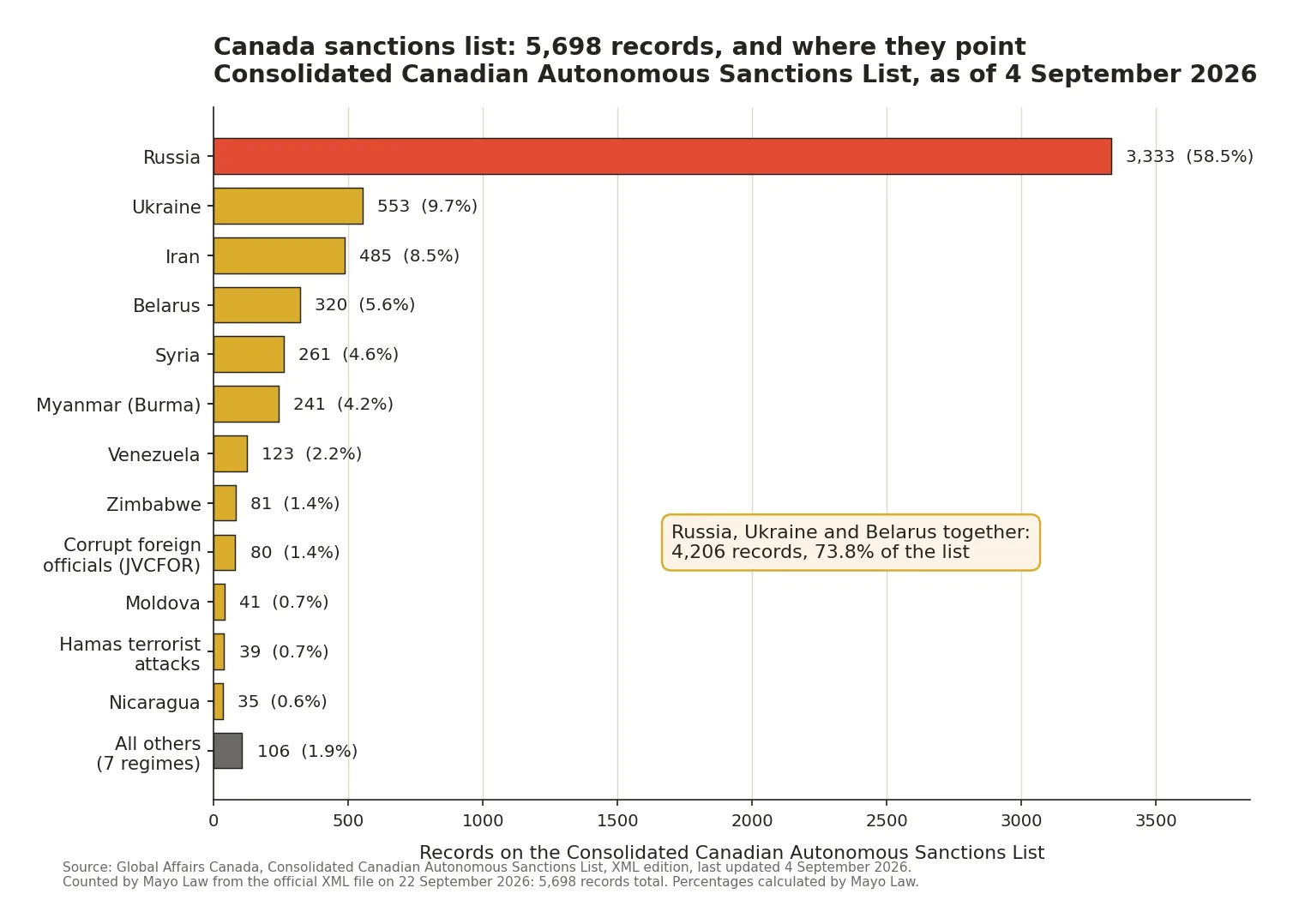
Russia accounts for 3,333 records, 58.5 percent of the entire list. Add the Ukraine regulations, which target Russia's actions there, and Belarus, and the three together reach 4,206 records, or 73.8 percent. Iran follows at 485, Syria at 261 and Myanmar at 241. China, by contrast, carries 13.
The listings are also recent. Counting by date of listing in the same file, 2022 produced 1,714 new records, 2023 produced 911, 2025 produced 764, and the first eight months of 2026 produced 508. The earliest record is dated 4 September 2008.
| Year of listing | New records |
|---|---|
| 2022 | 1,714 |
| 2023 | 911 |
| 2024 | 378 |
| 2025 | 764 |
| 2026 to 4 September | 508 |
For a business, the practical reading is that a counterparty screened clean two years ago may not screen clean today, and the regimes where that is most likely are Russia, Belarus and Ukraine.
What do Canadian sanctions actually prohibit?
Global Affairs Canada groups the measures into five families, and a single regulation may use several of them.
A dealings prohibition and asset freeze is the default for a targeted listing. It bars persons in Canada and Canadians outside Canada from transacting with the listed person, making any goods available to them, or providing services to their benefit.
Financial prohibitions restrict transactions and services such as foreign investment, acquisitions, wire transfers and letters of credit.
Export and import restrictions prohibit buying, selling or shipping identified goods, commodities, services or technologies to or from a targeted country. These are separate from the broader export and import controls administered under the Export and Import Permits Act, which is a different regime with its own permits.
Arms embargoes prohibit the export and import of arms and related materials and may extend to technical data and to financial transactions connected to military activity.
Technical assistance prohibitions attach to the products and technologies caught by an export prohibition and typically bar technical data, training and other technical support.
Two further consequences follow automatically. Every individual listed under SEMA, the JVCFOA or the United Nations Act is inadmissible to Canada under the Immigration and Refugee Protection Act. And under SEMA section 4(1)(b), Cabinet may order property in Canada seized or restrained, with forfeiture available on application to a superior court judge under section 5.4.
Does a listed person's subsidiary count? The ownership and control test
This is where Canadian screening most often fails, because the subsidiary's own name is not on any list.
SEMA section 2.1 and JVCFOA section 2.01 both deem property owned by a controlled entity to be owned by the listed person. Control is established if any one of three criteria is met:
- the person holds, directly or indirectly, 50 percent or more of the shares or ownership interests, or 50 percent or more of the voting rights;
- the person is able, directly or indirectly, to change the composition or powers of the entity's board of directors; or
- it is reasonable to conclude, having regard to all the circumstances, that the person is able, directly or indirectly and through any means, to direct the entity's activities.
The second and third criteria have no percentage attached. A listed person holding 20 percent of a company but able to appoint or remove its directors triggers the deeming provision just as squarely as a majority shareholder. Global Affairs Canada's own guidance works through the point with a scenario in which a listed parent falls below the 50 percent threshold but exercises considerable influence over strategic decision-making, and concludes the dealing is prohibited.
The prohibition also reaches indirect dealings. Under most SEMA and JVCFOA regulations it is prohibited to enter into or facilitate a transaction related to a dealing with a listed person even through a third party, including where that third party is neither Canadian nor located in Canada. A Canadian buyer purchasing from a clean foreign supplier can be caught if the supplier sources the input from a listed company.
How do you screen a counterparty against the Canada sanctions list?
Global Affairs Canada frames due diligence as a set of questions rather than a single lookup, and the sequence below follows that framing.
Step 1: identify the country exposure. Check whether the activity touches a country under Canadian or UN sanctions. Canada's current-sanctions index lists 24 countries, from Belarus and China through Russia, Syria and Venezuela to Yemen and Zimbabwe.
Step 2: screen the names. Run the counterparty, its owners and its directors against the Consolidated Canadian Autonomous Sanctions List and the United Nations Security Council Consolidated List. The department advises searching partial names, because spellings and name order vary and the list records aliases.
Step 3: screen beyond the counterparty. Consider subsidiaries of listed entities, parent and holding companies, intermediary banks, family members and associates, legal representatives, and anyone acting on behalf of a listed person. This is the step the ownership and control test makes mandatory rather than optional. It is also the discipline that carries over from US export screening, where the same principle applies to every party to a transaction and not only the named buyer. Our guide to export control compliance for US and Canadian SMEs sets out the American side of that workflow.
Step 4: check the goods and the services, not just the names. A country regime can prohibit specified goods, services, technical data or technical assistance regardless of who the counterparty is.
Step 5: check your foreign subsidiaries. Canadian entities operating abroad remain subject to Canadian sanctions law. Global Affairs Canada states the point directly: compliance with another country's sanctions legislation does not ensure compliance with Canadian law, and the reverse is equally true.
Step 6: record what you did. There is no Canadian safe harbour for a screening decision, but SEMA, the JVCFOA and the Criminal Code each protect a person who acts reasonably to comply, and a contemporaneous record is what makes that protection usable. Deciding who inside the company owns this process is a governance question before it is a legal one, and we cover how that role is usually scoped in compliance officer responsibilities.
What happens when you get a match?
Stop the transaction first. Contravening sanctions is a criminal offence, and there is no permission that operates retroactively.
If the match is a listed person or a deemed-controlled entity, the dealings prohibition applies immediately. Unless the relevant regulation contains a wind-down period or an exception, prohibitions apply from the date the listing comes into force.
If you hold their property, disclosure duties attach. Under JVCFOA section 6, banks, authorized foreign banks, credit unions, insurers, trust and loan companies, securities dealers and portfolio managers must determine on a continuing basis whether they hold property of a listed foreign national. Section 7(1) then requires disclosure to the principal supervising or regulating agency without delay and once every three months after that. Section 7(2) goes further and applies to everyone: every person in Canada and every Canadian outside Canada must disclose to the Commissioner of the RCMP or the Director of CSIS both the existence of the property and information about any transaction or proposed transaction in it. Disclosure made in good faith carries immunity under section 7(3).
If the match is a Criminal Code terrorist entity, section 83.08 prohibits knowingly dealing in the property, facilitating a transaction in it, or providing related financial or other services. Section 83.1 requires disclosure without delay to the RCMP Commissioner or the CSIS Director, again with immunity for good-faith disclosure.
If you think the transaction should be allowed anyway, the route is a permit or a certificate, and the terminology tracks the statute. Permits are issued under SEMA and the JVCFOA; certificates are issued in relation to United Nations Act prohibitions. Both are discretionary, granted case by case by the Minister of Foreign Affairs. Global Affairs Canada states that there is no guarantee of approval and that it cannot give timelines, and it warns against undertaking the activity until a signed permit or certificate is in hand.
If the match is a false positive on your own name, JVCFOA section 9 provides a mistaken-identity certificate. The Minister must decide within 45 days of receiving the application.
If you are the listed person, section 8 allows an application to be delisted, and the Minister must decide within 90 days. For a Criminal Code listing, section 83.05(2) allows an application to the Minister, section 83.05(3) deems the application refused if no decision is made within 90 days, and section 83.05(5) gives 60 days from notice to apply for judicial review.
Self-reporting goes to the RCMP. Global Affairs Canada identifies Federal Policing Intake at the RCMP as the main point of contact for self-reporting, and the Canada Border Services Agency accepts tips through its online submission. If the file has already reached the investigation stage, the sequencing questions are the same ones that arise in any cross-border enforcement matter, which we set out in what to do if you are under federal investigation.
What are the penalties for breaching Canadian sanctions?
The penalty depends entirely on which statute the listing sits under, and the spread is wide.
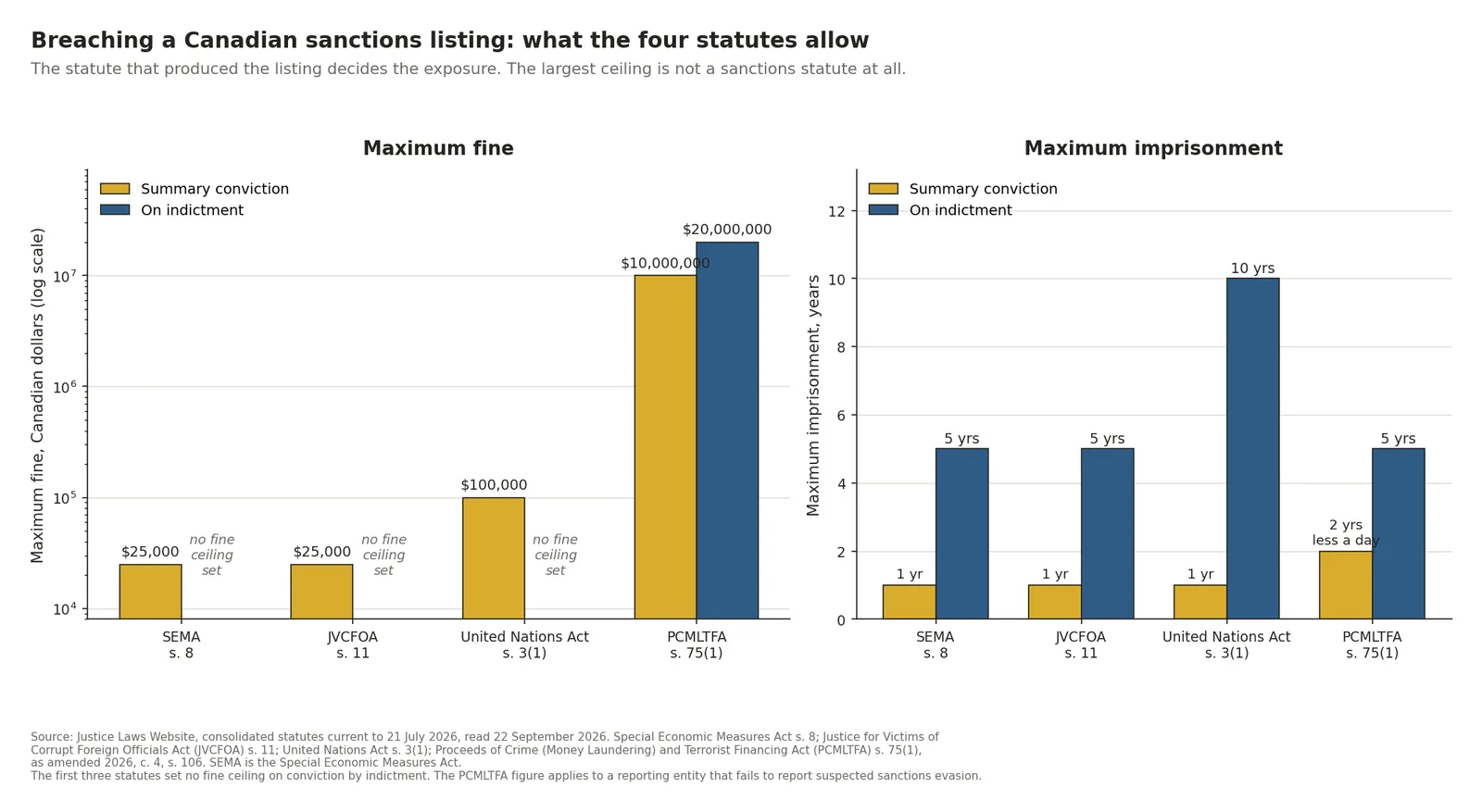
| Statute | Summary conviction maximum | Indictment maximum |
|---|---|---|
| Special Economic Measures Act, section 8 | $25,000 fine, or 1 year, or both | 5 years imprisonment |
| Justice for Victims of Corrupt Foreign Officials Act, section 11 | $25,000 fine, or 1 year, or both | 5 years imprisonment |
| United Nations Act, section 3(1) | $100,000 fine, or 1 year, or both | 10 years imprisonment |
| Proceeds of Crime (Money Laundering) and Terrorist Financing Act, section 75(1) | $10,000,000 fine, or 2 years less a day, or both | $20,000,000 fine, or 5 years, or both |
All four are read from the consolidated statutes on the Justice Laws website, each current to 21 July 2026.
Two features of that table deserve emphasis.
First, breaching a UN listing is four times the maximum fine and twice the maximum prison term of breaching a SEMA listing. Same transaction, same screening failure, different statute, materially different exposure. That is a reason to record which list produced the hit.
Second, the largest number in the table is not a sanctions statute at all. Section 7 of the Proceeds of Crime (Money Laundering) and Terrorist Financing Act requires a reporting entity to report to FINTRAC every transaction, completed or attempted, that it has reasonable grounds to suspect relates to the commission or attempted commission of a sanctions evasion offence. That trigger was added to section 7 in 2024. Failing to report is an offence under section 75(1), and Parliament raised the ceiling in 2026 to $10,000,000 on summary conviction and $20,000,000 on indictment.
That figure is worth checking carefully, because the government's own guidance is behind the statute. Global Affairs Canada's sanctions guidance page, last modified 17 July 2026, states the penalty for failing to report as a fine of not more than $1,000,000 under section 77(1). The Act as it currently reads sets section 77(1) at $10,000,000, and section 77(1) addresses the section 9 reporting duty rather than the suspicious-transaction duty in section 7 under which sanctions evasion is reported. Where guidance and statute diverge, the statute governs. Any reporting entity relying on the million-dollar figure in a board risk assessment is understating its exposure by a factor of ten.
Separate penalties apply under the Criminal Code, the Freezing Assets of Corrupt Foreign Officials Act and the Export and Import Permits Act. A single course of conduct can engage more than one of them. Where a sanctions file turns into a criminal exposure question for directors and officers, it belongs with white collar defence counsel rather than with the compliance function alone, and the Canadian charging landscape for business offences is set out in our guide to fraud charges in Canada.
How does the Canada sanctions list compare with the US OFAC SDN list?
Companies operating on both sides of the border often assume that screening against the larger American list covers the Canadian one. It does not, and the two lists are not the same size or the same shape.
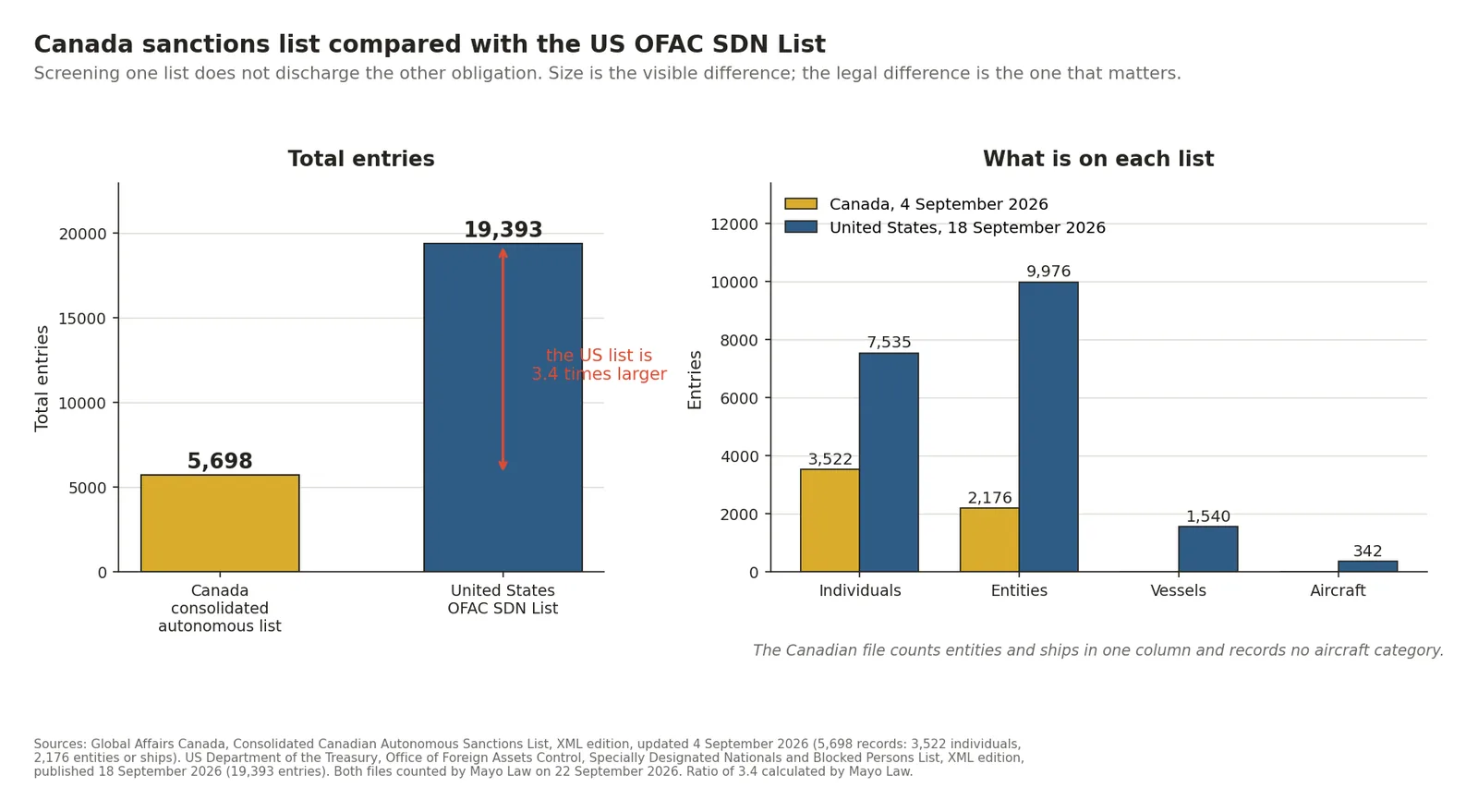
The US Treasury's Office of Foreign Assets Control published its Specially Designated Nationals and Blocked Persons List on 18 September 2026 with 19,393 entries: 9,976 entities, 7,535 individuals, 1,540 vessels and 342 aircraft. The Canadian consolidated list, updated 4 September 2026, held 5,698. The SDN List is roughly 3.4 times the size.
| Canada, consolidated autonomous list | United States, OFAC SDN List | |
|---|---|---|
| Total entries | 5,698 | 19,393 |
| As of | 4 September 2026 | 18 September 2026 |
| Individuals | 3,522 | 7,535 |
| Entities, vessels and aircraft | 2,176 | 11,858 |
| Governing authority | SEMA and the JVCFOA | US sanctions programs administered by OFAC |
| Force of law | List is administrative; the regulations bind | List is the operative designation record |
Size is not the important difference. The important difference is legal. Global Affairs Canada states that compliance with another country's sanctions legislation does not ensure compliance with Canadian law, and vice versa. A Canadian subsidiary of a US parent that screens only against OFAC data has not discharged a Canadian obligation, and a US company whose Canadian affiliate deals with a SEMA-listed person has a Canadian criminal exposure that no OFAC licence cures. Firms with operations in both Ontario and New York need both screens running, and they need to know which regulator to call when a name hits.
One further Canadian point has no American analogue in the same form. The consolidated list is expressly not a regulation and has no force of law. In the United States, the SDN List is the designation record itself. A Canadian compliance file that documents a clean screen against the list, without recording which regulation was checked, has documented the wrong thing.
Who enforces sanctions in Canada?
Enforcement is split, which matters when you decide whom to call.
The Canada Border Services Agency enforces the trade side. It assesses risk, detains and examines goods, regulates trade in goods prohibited by sanctions, supports criminal investigations and prevents listed individuals from entering Canada.
The RCMP and the CBSA share responsibility for investigating criminal sanctions evasion. The RCMP is the main point of contact for self-reporting.
FINTRAC supervises reporting entities on sanctions-evasion reporting and produces financial intelligence that supports CBSA and RCMP investigations.
Global Affairs Canada develops the measures through its Sanctions Bureau and issues permits and certificates. It does not give legal advice and says so expressly, and it will not confirm in advance whether a proposed transaction requires a permit.
That division explains a practical point. There is no single Canadian regulator who will tell you whether your transaction is lawful. The determination is yours to make, on the regulations, before the transaction happens. Ongoing compliance counsel is how most mid-sized cross-border businesses close that gap.
Frequently Asked Questions
Is the Consolidated Canadian Autonomous Sanctions List the only Canadian sanctions list?
No. It covers only listings made under the Special Economic Measures Act and the Justice for Victims of Corrupt Foreign Officials Act. Names listed under United Nations Act regulations appear on the United Nations Security Council Consolidated List, and terrorist entities listed under section 83.05 of the Criminal Code are published separately by Public Safety Canada. Measures under the Freezing Assets of Corrupt Foreign Officials Act are separate again. A complete screen checks all of them.
How often is the Canada sanctions list updated?
There is no fixed schedule. Global Affairs Canada warns on the list page that regulations are updated frequently and that the published version may not be current. The version read for this article was updated on 4 September 2026 and contained 5,698 entries. Counting by date of listing, 508 records were added in the first eight months of 2026 and 1,714 were added during 2022. Periodic rescreening of existing counterparties is the only way to keep pace.
Can we deal with a company that is not listed but is owned by someone who is?
Usually not. Under SEMA section 2.1 and JVCFOA section 2.01, property of an entity controlled by a listed person is deemed to be that person's property. Control is met by 50 percent or more of shares or voting rights, or by the ability to change the board's composition or powers, or where it is reasonable to conclude the listed person can direct the entity's activities by any means. Two of those three tests have no ownership percentage attached, so a minority stake can still capture the subsidiary.
What is the penalty for breaching Canadian sanctions?
It depends on the statute. Under the Special Economic Measures Act and the Justice for Victims of Corrupt Foreign Officials Act, the maximum on summary conviction is a $25,000 fine or one year in prison or both, and the maximum on indictment is five years. Under the United Nations Act the maximums are a $100,000 fine or one year on summary conviction, and ten years on indictment. A reporting entity that fails to report suspected sanctions evasion to FINTRAC faces up to $10,000,000 on summary conviction and $20,000,000 on indictment under section 75(1) of the Proceeds of Crime (Money Laundering) and Terrorist Financing Act.
Does a US OFAC licence let a Canadian company complete the transaction?
No. Canadian sanctions are imposed under Canadian law and are lifted only by Canadian instruments. Global Affairs Canada states that compliance with another country's sanctions legislation does not ensure compliance with Canadian law. If the transaction is prohibited by a Canadian regulation, the route is a Canadian permit under SEMA or the JVCFOA, or a certificate in relation to United Nations Act prohibitions, granted case by case at the discretion of the Minister of Foreign Affairs.
Our bank blocked a payment and will not say why. What should we do?
Ask the institution for its reasons in writing, and specifically ask whether the block rests on a sanctions regulation and which provision. Banks block transactions for many reasons, including their own policy and foreign law. If the block does rest on a Canadian regulation, read that regulation to see whether an exception applies, and take advice before resubmitting. If the transaction was in fact prohibited when it was attempted, a permit or certificate application is the forward-looking option, not a cure for what already happened.
Do Canadian sanctions apply to our operations outside Canada?
Yes. SEMA and JVCFOA prohibitions apply to persons in Canada and to Canadians outside Canada, and Canadian entities operating abroad remain subject to Canadian sanctions law. A foreign subsidiary must satisfy both Canadian requirements and the law of the country it operates in. Global Affairs Canada raises the same point in its due diligence guidance, and flags that the two sets of rules do not substitute for each other.
Conclusion
The Canada sanctions list is not a single document and clearing it is not a single search. The consolidated list, at 5,698 entries and heavily concentrated on Russia, Belarus and Ukraine, is where screening starts. The UN listings, the Criminal Code terrorist entities and the corrupt-officials measures are where it continues. The ownership and control test is where it usually fails. And the regulations, not the list, are what actually bind.
The numbers in this article carry their dates for a reason. Listings move weekly, the reporting penalty moved by a factor of ten in 2026, and the government's own guidance has not caught up with its own statute. A screening program built on figures that were right last year is a program that has quietly stopped working.
How Mayo Law Can Help
Mayo Law is a cross-border firm with offices in Toronto and New York. Joseph Mayo is the principal attorney and is licensed in both Ontario and New York, which means a sanctions question that touches both sides of the border can be assessed against both bodies of law in one conversation rather than routed between two firms.
For businesses trading with or from Canada, that work typically includes reading the operative regulation behind a screening hit, applying the ownership and control test to a corporate structure, advising on disclosure duties to the RCMP or a supervising regulator, and preparing permit or certificate applications to Global Affairs Canada. Where a matter has moved from compliance into enforcement, the same cross-border footing applies.
If you have a live counterparty question or want your screening process reviewed before it is tested, contact the firm.
Disclaimer
This article is provided for general information only and is not legal advice. Reading it does not create a solicitor-client or attorney-client relationship. Sanctions regulations change frequently, and the figures and provisions described here carry the dates on which they were verified. You should obtain advice on your specific circumstances before acting. Mayo Law provides legal services in Ontario and New York.