

Contents
- Quick answer
- What counts as fraud under Canadian law?
- How does the $5,000 line change a fraud charge?
- What penalties do fraud charges in Canada carry?
- What aggravates a fraud sentence, and what cannot reduce it?
- How does a corporate or executive fraud investigation actually start?
- Is being charged with fraud the same as being convicted?
- When is the company charged, not just the executive?
- Can a company resolve a fraud charge without a trial?
- How does civil fraud differ from a criminal fraud charge?
- How do Canadian fraud charges compare with US federal fraud charges?
- What should a business do in the first two weeks?
- Frequently asked questions about fraud charges in Canada
- Conclusion
- How Mayo Law can help
- Disclaimer
A production order arrives at your bank. A former controller has been interviewed. A regulator asks for three years of invoices and will not say why. Long before anyone is arrested, a Canadian fraud investigation is already shaping what happens next, and the decisions made in those first weeks tend to matter more than anything argued later.
This guide is for business owners, directors and senior managers who need to understand how white collar fraud allegations work under Canadian law. It covers what section 380 of the Criminal Code actually says, where the $5,000 line sends a case, when the company itself can be charged alongside the individual, and how a Canadian charge compares with the US federal fraud statutes many cross-border businesses are more familiar with. Every section number and penalty below was read from the consolidated statute rather than summarised from commentary.
It is not a defence manual, and it is not legal advice. It is the map an executive needs in order to ask useful questions early.
Quick answer
Fraud charges in Canada come from section 380 of the Criminal Code. Where the subject matter is worth more than $5,000, fraud is a straight indictable offence carrying up to 14 years. At $5,000 or less, the Crown may proceed by indictment, with a two-year maximum, or summarily.
What counts as fraud under Canadian law?
Fraud charges in Canada all come from a single provision. Section 380(1) of the Criminal Code defines fraud as using “deceit, falsehood or other fraudulent means, whether or not it is a false pretence within the meaning of this Act” to defraud “the public or any person, whether ascertained or not, of any property, money or valuable security or any service”.
Three features of that wording matter commercially. The first is the breadth of “other fraudulent means”: the offence is not limited to a lie. The second is “whether ascertained or not”, which means the Crown does not have to produce a single identified victim. The third is “or any service”, which brings conduct that never touched a bank account inside the section.
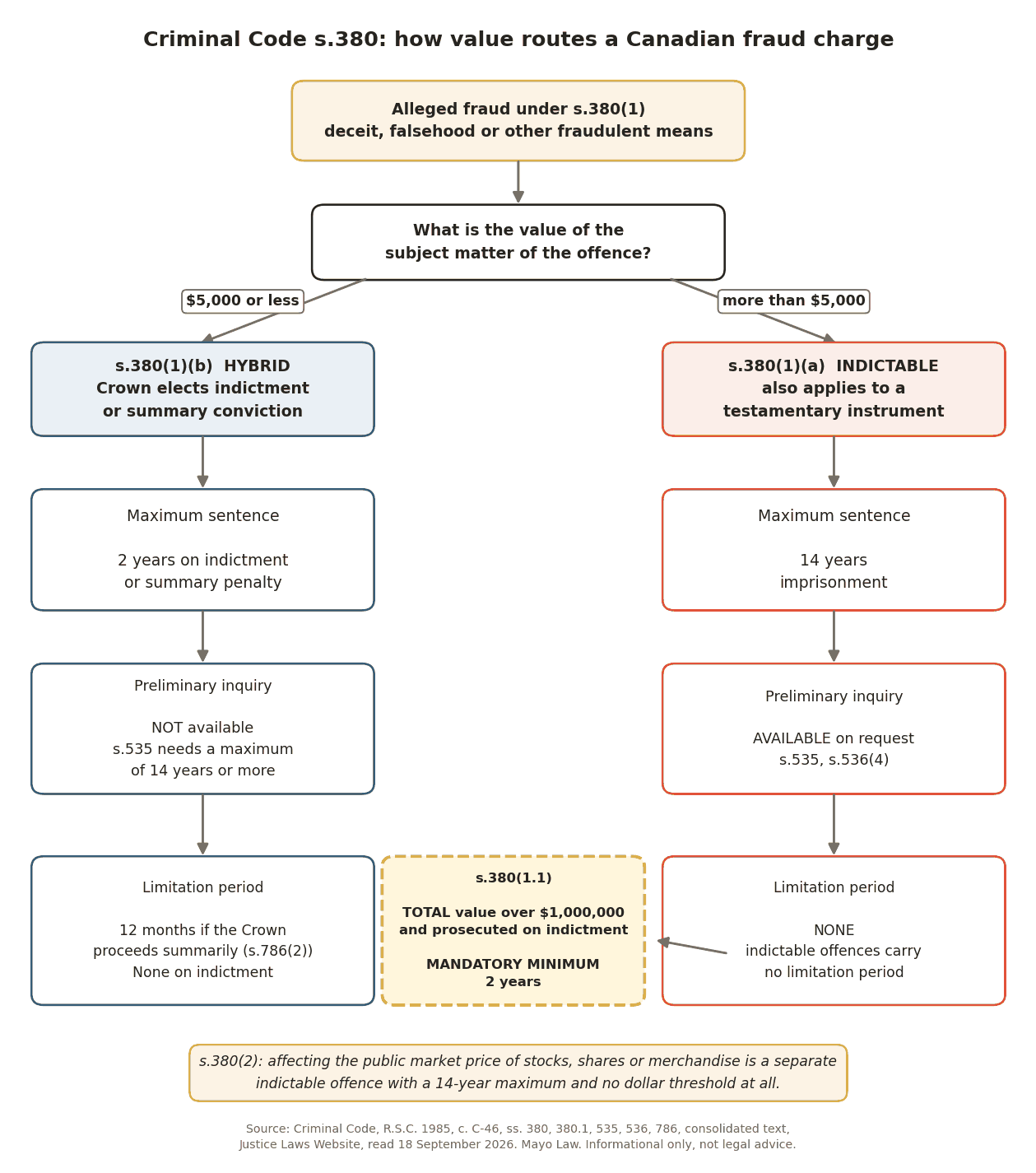
Fraud is one offence with two punishment routes, not two offences. The route is set by the value of the subject matter, and that single number drives almost everything that follows: the maximum sentence, whether the Crown can elect to proceed summarily, whether a preliminary inquiry is available, and whether a limitation period applies at all.
Separately, section 380(2) creates a distinct market offence. Anyone who, by the same means and with intent to defraud, “affects the public market price of stocks, shares, merchandise or anything that is offered for sale to the public” is guilty of an indictable offence with a 14-year maximum, with no dollar threshold at all.
How does the $5,000 line change a fraud charge?
Under section 380(1)(a), where the subject matter is a testamentary instrument or its value “exceeds five thousand dollars”, fraud is a straight indictable offence with a maximum of 14 years. Under section 380(1)(b), where the value “does not exceed five thousand dollars”, the offence is hybrid: indictable with a two-year maximum, or punishable on summary conviction.
The consequences run further than the maximum sentence. Section 535 allows a preliminary inquiry only where the accused is charged with an indictable offence “punishable by 14 years or more of imprisonment”. Fraud over $5,000 clears that bar. Fraud at or below $5,000 does not, on either election. For a business defendant, that is the difference between testing the Crown’s case before a judge in advance of trial and going straight to trial.
Section 786(2) adds a second consequence. Where the Crown proceeds summarily, no proceedings may be instituted “more than 12 months after the time when the subject matter of the proceedings arose”, unless both sides agree. Indictable fraud carries no equivalent limitation period. A historical file can therefore be charged years later, provided the Crown proceeds by indictment.
What penalties do fraud charges in Canada carry?
The statutory maximum for fraud over $5,000 is 14 years. That is a ceiling, not an expectation, and sentences in commercial cases are set by the sentencing provisions rather than by the maximum.
One provision removes judicial discretion entirely. Section 380(1.1) requires that where a person is prosecuted on indictment and convicted of one or more section 380(1) offences, the court “shall impose a minimum punishment of imprisonment for a term of two years if the total value of the subject-matter of the offences exceeds one million dollars”. The word “total” is doing real work: counts are aggregated, so several mid-sized transactions can cross the threshold that no single count would reach.
Section 380.2 adds a penalty that is often more disruptive to a career than the sentence. On conviction or discharge, a court may prohibit the offender from “seeking, obtaining or continuing any employment, or becoming or being a volunteer in any capacity, that involves having authority over the real property, money or valuable security of another person”, for any period the court considers appropriate. Breaching that order is itself an offence carrying up to two years.
Two further orders commonly follow a commercial fraud conviction. Section 738 allows a restitution order requiring payment to a person who suffered loss or destruction of property, where the amount is readily ascertainable. Section 462.37 requires forfeiture of property the court is satisfied, on a balance of probabilities, is proceeds of crime obtained through the offence. Restraint of that property can happen much earlier: section 462.33 lets the Attorney General apply, ex parte, to restrain property believed to be proceeds of crime while the matter is still under investigation.
What aggravates a fraud sentence, and what cannot reduce it?
Section 380.1(1) lists aggravating circumstances a court must consider on a fraud sentence. They read like a description of corporate fraud rather than opportunistic theft:
- that “the magnitude, complexity, duration or degree of planning of the fraud committed was significant”
- that the offence adversely affected, or had the potential to adversely affect, “the stability of the Canadian economy or financial system or any financial market in Canada or investor confidence in such a financial market”
- that the offence involved a large number of victims, or had a significant impact on victims given their age, health or financial situation
- that the offender “took advantage of the high regard in which the offender was held in the community”
- that the offender did not comply with a licensing requirement or professional standard normally applicable to the conduct
- that the offender “concealed or destroyed records related to the fraud” or to the disbursement of its proceeds
Section 380.1(2) then closes a door that defence submissions used to walk through. A court “shall not consider as mitigating circumstances the offender’s employment, employment skills or status or reputation in the community if those circumstances were relevant to, contributed to, or were used in the commission of the offence”. The standing in the business community that made the fraud possible cannot be offered as a reason for leniency.
One point here is widely stated incorrectly. Section 380.1(1.1) makes a fraud value exceeding one million dollars an aggravating circumstance, but it applies by its own terms only to “an offence referred to in section 382, 382.1 or 400”. Section 380 is not in that list. For section 380 the million-dollar figure operates through the mandatory minimum in section 380(1.1) instead, which is a different mechanism with a different effect. Sources that present 380.1(1.1) as a general million-dollar aggravator for all fraud are quoting the wrong subsection.
How does a corporate or executive fraud investigation actually start?
Most fraud charges in Canada against a business do not begin with an arrest. They begin with document collection, and often with documents held by someone other than the suspect.
Section 487.014 lets a justice or judge order a person to produce copies of documents, or to prepare and produce a document containing data, in their possession or control. The application is made ex parte by a peace officer or public officer, and the threshold is reasonable grounds to believe an offence “has been or will be committed” and that the material will afford evidence. A production order served on a bank, a payroll provider or an accounting firm can therefore assemble a detailed picture of a company’s transactions before anyone at that company knows a file exists.
A charge is laid when an information is sworn. Section 504 provides that anyone who on reasonable grounds believes a person has committed an indictable offence may lay an information in writing and under oath before a justice, and the justice “shall receive” it. That is a low bar by design, and it is the reason a charge cannot be read as a finding.
The practical lesson for a business is about sequencing. Internal reviews, board minutes, forensic accounting engagements and employee interviews all create documents, and the question of which of them are protected is decided by how the work was commissioned, not by what it is called afterwards. That is worth understanding before the review starts, and our note on work product privilege covers the distinction. The other early decision is preservation: instructing staff to stop routine deletion is unglamorous, and section 380.1(1)(f) makes destroyed records an aggravating circumstance.
Is being charged with fraud the same as being convicted?
No, and the gap between the two is wider in fraud than in most offences.
Fraud charges in Canada are laid when an information is sworn, and that step records an allegation supported by reasonable grounds rather than a finding. A conviction requires the Crown to prove every element beyond a reasonable doubt, including the dishonest conduct, the deprivation and the accused’s state of mind. In a commercial file those elements are frequently contested on documents rather than on credibility, which is why these cases turn on reconstructing what a spreadsheet, an approval chain or a revenue recognition policy meant at the time.
Where the charge is fraud over $5,000, section 535 makes a preliminary inquiry available on request. Where the charge falls under section 380(1)(b), it is not. That procedural asymmetry, driven entirely by the dollar value alleged, is one reason the quantum in the charging document deserves early attention.
The reputational timeline runs on its own schedule. Lenders, insurers, counterparties and professional regulators generally react to the charge, not to the verdict. Businesses that handle this well plan the commercial response and the legal response at the same time, and they do it before the first court date rather than after it.
When is the company charged, not just the executive?
Canadian law treats corporations as capable of committing fraud in their own right. Section 2 of the Criminal Code defines an “organization” to include a “public body, body corporate, society, company, firm, partnership, trade union or municipality”, as well as an association of persons created for a common purpose that has an operational structure and holds itself out to the public as an association.
Fraud requires proof of subjective fault, so the governing provision is section 22.2. An organization is a party to the offence if, “with the intent at least in part to benefit the organization”, one of its senior officers either is a party to the offence while acting within the scope of their authority, or directs the work of other representatives so that they carry out the offence, or, “knowing that a representative of the organization is or is about to be a party to the offence, does not take all reasonable measures to stop them”.
That third branch is the one most businesses underestimate. It does not require the senior officer to have participated, planned or benefited personally. Knowing and failing to take all reasonable measures is enough.
Who counts as a senior officer is broader than the boardroom. Section 2 defines a senior officer as a representative “who plays an important role in the establishment of an organization’s policies or is responsible for managing an important aspect of the organization’s activities” and, for a body corporate, includes a director, the chief executive officer and the chief financial officer. A regional manager or a head of sales can meet that definition on the responsibility branch without holding any title suggesting it.
Section 22.1 covers offences of negligence and works differently, turning on whether the responsible senior officer, or the senior officers collectively, departed markedly from the standard of care reasonably expected to prevent the conduct. Fraud is not a negligence offence, so section 22.1 is not the fraud provision, but the two sections together explain why compliance officer responsibilities and escalation procedures are a legal exposure question and not only a governance question.
Sentencing a convicted organization is its own regime. Section 735(1) provides that an organization convicted of an indictable offence is liable, in place of imprisonment, to a fine “in the discretion of the court”, with no statutory ceiling. Summary conviction fines are capped at $100,000. Section 718.21 then lists factors the court must weigh, including any advantage realised, whether the organization tried to conceal or convert assets to appear unable to pay, the impact of the sentence on its economic viability and continued employment of its employees, the cost of the investigation and prosecution, any regulatory penalty already imposed, and, on the other side of the ledger, any restitution made and “any measures that the organization has taken to reduce the likelihood of it committing a subsequent offence”.
Can a company resolve a fraud charge without a trial?
Sometimes. Part XXII.1 of the Criminal Code, added in 2018, allows a prosecutor to negotiate a remediation agreement with an organization: an agreement “to stay any proceedings related to that offence if the organization complies with the terms of the agreement” (section 715.3(1)). It is available only to organizations, and section 715.3(1) excludes a public body, trade union or municipality from the definition used in this Part.
Eligibility is limited to offences listed in the schedule to Part XXII.1. Fraud under section 380 is on that list, at paragraph 1(s) of the schedule. So is theft under section 322, misappropriation of money held under direction under section 332, false pretence under section 362, forgery under section 366 and fraudulent manipulation of stock exchange transactions under section 382.
Reaching negotiations requires four conditions under section 715.32(1): the prosecutor must be of the opinion that there is a reasonable prospect of conviction; that the conduct did not cause and was not likely to have caused serious bodily harm or death, or injury to national defence or national security, and was not committed for the benefit of or in association with a criminal organization or terrorist group; that negotiating is in the public interest and appropriate; and the Attorney General must consent.
The terms are demanding. Section 715.34(1) requires the agreement to include a statement of facts with an undertaking not to make or condone any public statement contradicting them, the organization’s admission of responsibility, an obligation to provide information identifying any person involved in the conduct, and an obligation to cooperate in any resulting investigation or proceeding in Canada or elsewhere. In other words, the company admits the conduct and commits to assisting prosecutions of its own people.
This route is not a reason to delay taking the underlying allegation seriously. It is a reason to understand early whether the organization and the individual have the same interests, because the remediation structure assumes they may not.
How does civil fraud differ from a criminal fraud charge?
The two can run in parallel on the same facts, and businesses are often on both sides at once: defending a charge while suing to recover, or suing a former employee while a police file proceeds separately.
Control is the first difference. A criminal prosecution belongs to the Crown, which decides whether to charge, what to charge and whether to withdraw. A victim cannot settle it. A civil claim belongs to the plaintiff, who controls scope, timing and settlement. Recovery is also more direct: a civil judgment is enforceable by the plaintiff, whereas criminal restitution under section 738 depends on a conviction and on the amount being readily ascertainable.
Timing is the second difference, and it is the one that costs businesses money. In Ontario, section 4 of the Limitations Act, 2002 bars a proceeding “after the second anniversary of the day on which the claim was discovered”. Section 5(1) sets discovery at the earlier of the day the claimant first knew of the loss, its cause, the identity of the person responsible and that a proceeding would be an appropriate remedy, and the day a reasonable person in the claimant’s circumstances ought to have known those things. Section 15(2) imposes an ultimate bar 15 years after the act or omission, regardless of discovery.
There is no equivalent clock on the criminal side for indictable fraud. A company that concludes it will wait for the criminal process to finish before deciding whether to sue can find the civil claim is already out of time while the prosecution is still running. That decision belongs at the start, with corporate litigation counsel involved alongside defence counsel.
The standard of proof is the third difference, and it is the reason the two proceedings can end differently on the same evidence. A criminal charge must be proved beyond a reasonable doubt. A civil claim is proved on the balance of probabilities, a materially lower threshold. An acquittal therefore does not decide a civil claim, and a civil judgment is not a finding of criminal guilt. The elements of the civil tort itself come from Canadian case law rather than from a statute, which is a further reason the two analyses do not track each other and need to be run separately from the outset.
How do Canadian fraud charges compare with US federal fraud charges?
Fraud charges in Canada and US federal fraud charges are built on different foundations, so for a business operating on both sides of the border the same conduct can be described very differently depending on where it is charged. Canada prosecutes a general fraud offence defined by dishonesty and deprivation. US federal prosecutors more often charge a scheme offence defined by the means of communication used to carry it out.
Under 18 U.S.C. 1343, wire fraud is committed by devising a scheme to defraud and transmitting “by means of wire, radio, or television communication in interstate or foreign commerce” any writing, sign, signal, picture or sound for the purpose of executing it. The maximum is 20 years. Where the violation “affects a financial institution”, or relates to a presidentially declared major disaster or emergency, the maximum rises to 30 years and a fine of up to $1,000,000 in US dollars. Our guide to wire fraud penalties in the United States covers that regime in detail, and this section does not repeat it.
| Canada, Criminal Code s.380 | United States, 18 U.S.C. 1343 | |
|---|---|---|
| Core conduct | Deceit, falsehood or other fraudulent means that defrauds a person of property, money, valuable security or a service | A scheme to defraud executed using interstate or foreign wire, radio or television communication |
| Value threshold in the offence | Yes. Over $5,000 under s.380(1)(a); $5,000 or less under s.380(1)(b) | None in the statute |
| Maximum imprisonment | 14 years over $5,000; 2 years on indictment at $5,000 or less | 20 years; 30 years where it affects a financial institution or relates to a declared disaster |
| Mandatory minimum | 2 years where the total value of the offences exceeds $1,000,000 and the Crown proceeds by indictment, s.380(1.1) | None in s.1343 |
| Maximum fine, organization | Discretion of the court, no ceiling, on indictment, s.735(1) | $500,000 for a felony, s.3571(c)(3), or twice the gross gain or gross loss, s.3571(d) |
| Market-related variant | s.380(2), affecting the public market price, 14 years, no dollar threshold | Charged under separate securities and commodities fraud provisions |
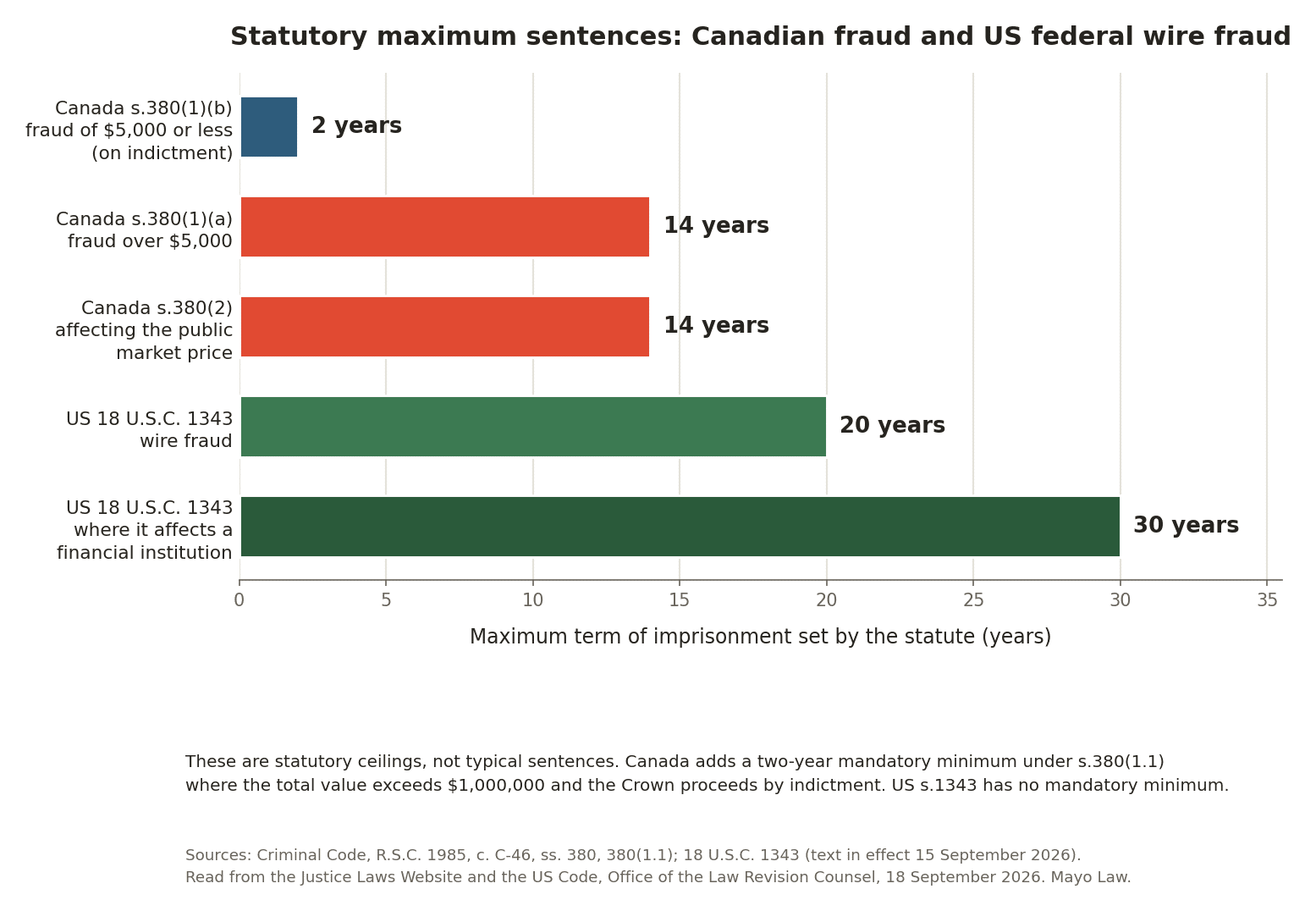
Two structural differences matter more than the numbers. First, the Canadian dollar threshold has no US counterpart: there is no $5,000 line in section 1343, and value drives the sentencing calculation rather than the charge. Second, corporate fines diverge sharply. A Canadian organization convicted on indictment faces a fine in the court’s discretion with no ceiling, under section 735(1). A US organization convicted of a felony faces a statutory maximum of $500,000 under 18 U.S.C. 3571(c)(3), or, under 3571(d), “twice the gross gain or twice the gross loss” where the offence produced pecuniary gain or loss. The alternative-fine provision is why the headline figure in US corporate cases so often exceeds $500,000.
A business with operations in both countries should assume that conduct exposed in one jurisdiction will be examined in the other. Sector regulators do the same: our note on healthcare fraud defence deals with providers facing exactly that overlap, and companies already mapping their Canadian obligations will find the groundwork in our guide to doing business in Canada as a US company.
What should a business do in the first two weeks?
Businesses facing fraud charges in Canada, or the investigation that precedes them, tend to get the same five things wrong. Preserve first. Suspend routine document destruction and automatic deletion policies across email, messaging and accounting systems, and record the instruction with a date. Destroyed records are an express aggravating factor under section 380.1(1)(f), and the inference drawn from a deletion is rarely the innocent one.
Separate the interests early. Section 22.2 means the organization and the individual can face charges arising from the same conduct with materially different exposure and different available outcomes. Where that is possible, one lawyer cannot advise both, and discovering this in month six is expensive.
Scope the review before commissioning it. Decide who instructs the forensic accountant, who receives the report and what is being asked, because those choices determine what protection attaches to the work.
Map the collateral obligations. Lending covenants, insurance notice provisions, securities disclosure duties, professional regulator reporting and customer contracts may each be triggered by a charge, by an investigation or by the company’s own internal finding, and they run on their own deadlines. A compliance review alongside the defence file is not duplication.
Fix the cause. Section 718.21(j) directs a sentencing court to consider measures taken to reduce the likelihood of reoffending. Controls implemented after the conduct but before sentencing are relevant, and for organizations they are one of the few factors still within the company’s control.
Frequently asked questions about fraud charges in Canada
Is fraud under $5,000 a criminal record in Canada?
Yes. Fraud at or below $5,000 under section 380(1)(b) is a hybrid offence, which means the Crown may proceed either by indictment or by summary conviction, but a conviction on either election is a criminal conviction and produces a criminal record. The election affects the maximum sentence, the availability of a preliminary inquiry and whether the 12-month limitation period in section 786(2) applies, not whether the result is a conviction.
Can a company be charged with fraud in Canada as well as the individual?
Yes. Section 22.2 makes an organization a party to a fraud offence where a senior officer, with the intent at least in part to benefit the organization, is a party to it, directs other representatives to carry it out, or knows a representative is or is about to be a party and does not take all reasonable measures to stop them. Charging the organization does not displace charges against the individuals involved.
What is the maximum sentence for fraud over $5,000 in Canada?
Fourteen years. Section 380(1)(a) makes fraud a straight indictable offence with a 14-year maximum where the subject matter is a testamentary instrument or exceeds $5,000 in value. Section 380(1.1) adds a mandatory minimum of two years where the accused is prosecuted on indictment and the total value of the offences exceeds $1,000,000. The maximum is a ceiling and is not a guide to the sentence a particular case attracts.
Does a fraud charge in Canada have a limitation period?
It depends on the Crown’s election. Where the Crown proceeds by summary conviction, section 786(2) bars proceedings instituted more than 12 months after the subject matter arose, unless the prosecutor and the defendant agree otherwise. Where the Crown proceeds by indictment, there is no limitation period, so historical conduct can be charged years after the fact.
Can a fraud charge be resolved without a criminal trial?
For an organization, sometimes. Part XXII.1 of the Criminal Code allows a prosecutor, with the consent of the Attorney General, to negotiate a remediation agreement staying proceedings if the organization complies with its terms. Fraud under section 380 is a listed offence at paragraph 1(s) of the schedule to that Part. The agreement requires an admission of responsibility and cooperation in resulting prosecutions, and it is not available to individuals.
What is the difference between criminal fraud and civil fraud in Canada?
A criminal prosecution is brought by the Crown and must be proved beyond a reasonable doubt, and the Crown controls whether it proceeds. A civil fraud claim is brought by the injured party, is proved on the balance of probabilities, and is controlled and settled by that party. In Ontario a civil claim is also subject to the two-year limitation period in section 4 of the Limitations Act, 2002, which the criminal process does not pause.
Who counts as a senior officer for corporate fraud liability?
Section 2 of the Criminal Code defines a senior officer as a representative who plays an important role in establishing the organization’s policies or is responsible for managing an important aspect of its activities, and for a body corporate the definition expressly includes a director, the chief executive officer and the chief financial officer. The responsibility branch reaches managers well below the executive team, which is why the definition is wider than most internal policies assume.
Can a Canadian fraud conviction stop someone from working in finance?
It can. Section 380.2 lets a sentencing court prohibit an offender from seeking, obtaining or continuing employment, or serving as a volunteer, in any capacity involving authority over another person’s real property, money or valuable security, for any period the court considers appropriate. Breaching the order is a separate offence carrying up to two years. Professional regulators and licensing bodies also run their own processes, independently of the criminal court.
Conclusion
Fraud charges in Canada are governed by one section with a simple structure and a long reach. The value of the subject matter sets the route, $5,000 divides straight indictable from hybrid, $1,000,000 in aggregate triggers a mandatory minimum, and section 22.2 puts the organization itself in scope whenever a senior officer knew and did not act. Around that core sit provisions that shape a business far more than the sentence does: employment prohibition, forfeiture, restraint of property during the investigation, and a sentencing regime for organizations with no fine ceiling.
For a cross-border business the comparison with US wire fraud is not academic. The offences are built on different foundations, the thresholds do not line up, and the corporate fine structures point in opposite directions. Conduct that looks like a single problem can produce two very different proceedings.
The early decisions, about preservation, about scope, about whether the company and the individual can share counsel, are the ones that are hard to revisit later.
How Mayo Law can help
Mayo Law is a cross-border firm with offices in Toronto and New York. Joseph Mayo, the principal attorney, is licensed in Ontario and New York, which means a matter with exposure on both sides of the border can be assessed without assembling a second firm to read the other half of it.
Our work in this area sits within a broader business practice: white collar matters for companies and executives, regulatory compliance, corporate litigation where recovery is the objective, and day-to-day counsel for small and mid-sized businesses. Related exposures often travel together, including trade secret misappropriation, beneficial ownership reporting and export control compliance.
If you are a business owner or executive trying to work out how serious an early-stage matter is, our business lawyers and corporate lawyers in Toronto can help you scope it, and our dual-licensed Ontario and New York capability is built for matters that do not stay in one country.
Disclaimer
This article is for general information only. It is not legal advice, and it does not create a lawyer-client or attorney-client relationship. Fraud allegations turn on their specific facts and on the jurisdiction in which they arise, and the law changes. Every statutory provision cited was read from the official consolidated text in September 2026, and you should confirm the current version before relying on it.
Mayo Law provides legal services in Ontario and New York. This material may be considered attorney advertising in some jurisdictions.