
Contents
- What Does a Healthcare Fraud Attorney Do?
- What Is Healthcare Fraud? Definition and Examples
- Common Types of Healthcare Fraud
- The Government’s Investigation and Enforcement Process
- What to Do If You Are Under Investigation for Healthcare Fraud
- When Should You Hire a Healthcare Fraud Lawyer?
- Defense Strategies and Potential Penalties
- Healthcare Fraud Defense for Canadian Providers Facing U.S. Investigations
- How Do I Choose the Right Healthcare Fraud Attorney?
- Frequently Asked Questions
- How Mayo Law Can Help
- Disclaimer
- Related Articles
An audit notice lands in your inbox. A Medicare contractor asks for records. A subpoena arrives. Or an agent wants to “just ask a few questions.” Most providers don’t panic because they know they’re guilty. They panic because they know billing, referrals, ownership, and documentation can get messy fast, even in a legitimate practice. A healthcare fraud attorney becomes important long before anyone says the word “indictment.”
At Mayo Law, we help providers, founders, and healthcare businesses in Toronto, the GTA, and across the border handle investigations that can touch both U.S. and Canadian operations, with experience licensed in both Ontario and New York on a process that often spans both sides of the border. The pressure is real. The U.S. Department of Justice reported 455 active health care-related fraud matters in recent annual statistics, as discussed in the National Law Review summary of DOJ figures.
What Does a Healthcare Fraud Attorney Do?
A healthcare fraud attorney is a legal professional who specializes in defending individuals and entities accused of civil or criminal misconduct tied to healthcare billing, referrals, reimbursement, and regulatory compliance. The work includes legal advice before trouble starts, defense during audits and investigations, and advocacy in settlement discussions or court.

A good one does two jobs.
First, prevention. That means reviewing billing systems, referral relationships, compensation structures, ownership arrangements, and internal reporting before they become government exhibits. In healthcare, ordinary business decisions can create legal risk if they affect federal program claims.
Second, defense. Once an audit, subpoena, civil investigative demand, interview request, or target letter appears, counsel steps in to control the record, preserve privilege where possible, and stop clients from making the kind of “helpful” statement that later gets framed as an admission.
Prevention matters more than most providers think
General business counsel may be strong on contracts and employment. General criminal defense counsel may be excellent in court. Healthcare fraud work sits in the middle of several technical regimes at once.
That includes the False Claims Act, the Anti-Kickback Statute, and the Stark Law, plus program guidance, billing rules, and documentation standards. A provider can face a civil overpayment dispute, a licensing problem, and a criminal inquiry at the same time.
Practical rule: The earlier counsel gets involved, the more options you usually have.
Cross-border providers need a wider lens
If your company bills into the United States, has U.S. owners, stores records in Canada, or moves personnel across the border, the legal problem rarely stays in one box. Data location, document collection, employee interviews, and parallel regulatory obligations can complicate the response.
That matters for clinics, telehealth companies, health-tech startups, labs, and management companies with operations split between Ontario and New York or broader U.S. markets.
What Is Healthcare Fraud? Definition and Examples
Healthcare fraud is knowingly submitting false or misleading claims, records, or statements to obtain payment from a healthcare program or insurer. In the U.S. federal system, the government enforces it mainly through the False Claims Act, the Anti-Kickback Statute, and the Stark Law, alongside general criminal fraud statutes.
The word that carries the weight is “knowingly.” An honest billing mistake is not fraud. But the line gets contested, and the government decides which side of it your file starts on. Repeated errors, copied notes, or warnings that went ignored can turn what felt like sloppiness into an enforcement theory.
Each of the three main U.S. federal statutes covers different ground. The False Claims Act is the government’s principal civil tool for false or tainted claims submitted to federal programs. The Anti-Kickback Statute is a criminal law aimed at payments tied to referrals involving federal healthcare programs. The Stark Law restricts physician self-referrals for designated health services and can impose liability without any proof of bad intent.
Common examples include:
- Billing for services that were never provided
- Upcoding, meaning billing a higher-paying code than the service supports
- Unbundling, meaning splitting one procedure into several separately billed parts
- Billing for services that were not medically necessary
- Paying or accepting anything of value for referrals involving U.S. federal healthcare programs, the core Anti-Kickback Statute concern
- Physician self-referrals for designated health services, the territory of the Stark Law
- Falsified, cloned, or backdated documentation used to support claims
Notice that several of these can begin as workflow shortcuts rather than schemes. That is exactly why documentation habits, not intentions, often decide how a matter is charged.
Common Types of Healthcare Fraud
The label “fraud” covers very different allegations. Some involve intent and deception. Others arise from strict technical rules that punish arrangements regulators consider improper even when no one thought of themselves as committing fraud.
False Claims Act cases
The False Claims Act, often called the FCA, is a major civil enforcement tool. It targets false claims submitted to federal programs and also claims that become false because they were tied to unlawful conduct, such as kickbacks.
A common trigger is a whistleblower suit. Under the FCA’s qui tam provisions, whistleblowers can receive 15 to 25% of the government’s recovery if the government intervenes, and 25 to 30% if the government declines to intervene and the case still succeeds, under 31 U.S.C. 3730(d) of the federal False Claims Act. That creates a strong incentive for insiders to report concerns rather than keep them internal.
A realistic scenario looks like this: a former billing manager leaves on bad terms, takes concerns about modifier use or medical necessity to counsel, and suddenly your practice is defending years of claims.
Anti-Kickback Statute problems
The Anti-Kickback Statute, or AKS, focuses on payments or benefits tied to referrals involving federal healthcare programs. The payment doesn’t have to look like a cash bribe. It can show up as consulting fees, marketing arrangements, free staffing, inflated rent, or compensation that doesn’t match real services.
Red flags often include:
- Referral-linked compensation: Payment rises when referral volume rises.
- Vague consulting contracts: The paper looks formal, but the work is hard to prove.
- Free or discounted benefits: Space, equipment, staff, or services provided without a clear commercial basis.
- Sales-driven arrangements: Marketing personnel are rewarded for steering federally insured patients.
One issue I see often is that owners focus on whether a relationship helped patients. Investigators focus on whether money influenced referrals.
Stark Law exposure
The Stark Law deals with physician self-referrals for certain designated health services. It is notoriously unforgiving because a provider can face liability even without proving bad intent. That surprises many physicians.
A simple example is an ownership or compensation arrangement that was set up for business reasons but doesn’t fit within a regulatory exception. The referrals may have been clinically appropriate. The paperwork may still fail.
For many groups, this is where pre-deal review and compliance officer responsibilities matter. The legal risk often starts in the structure, not the claim form.
Billing fraud and documentation mismatch
This is the category that initially springs to mind. It includes upcoding, billing for services not rendered, medically unnecessary services, duplicate billing, and using documentation that doesn’t support the code selected.
Two anonymized examples are common:
- A multi-provider clinic uses templates that copy forward findings. The records become cleaner than real life, and auditors start questioning whether the services happened as billed.
- A startup management company pushes aggressive coding guidance to improve revenue cycle performance. Physicians don’t see the legal issue until chart reviews begin.
A bad fact pattern isn’t always a criminal one. But a sloppy explanation can make it look criminal.
The Government’s Investigation and Enforcement Process
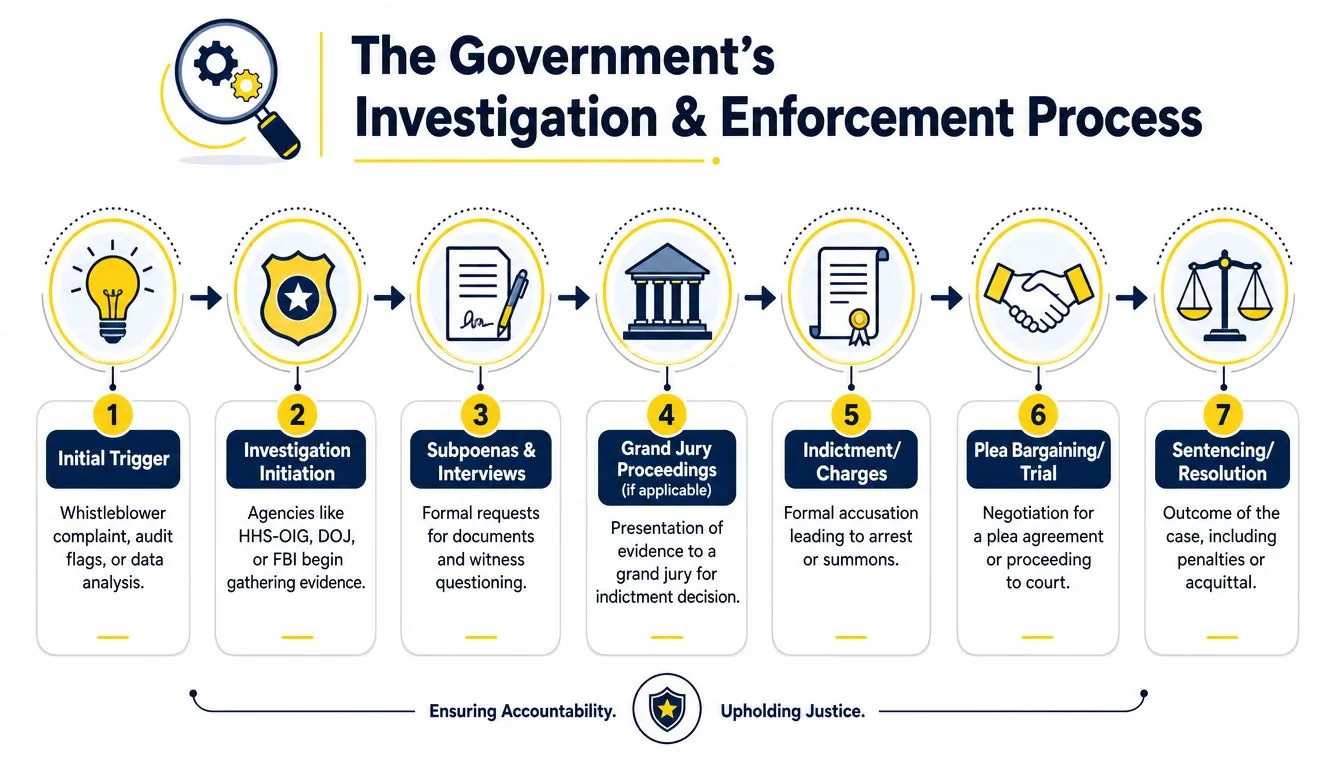
A physician group gets a routine records request from a Medicare contractor. The administrator assumes it is a billing clean-up issue. Two months later, agents want interviews, the date range has widened, and someone has asked for contracts tied to referral sources. That is often how a healthcare fraud case begins, well before any criminal notice arrives.
How a case usually starts
The government usually starts with a civil entry point. A payor audit, a UPIC request, a subpoena tied to billing data, or a whistleblower complaint under the False Claims Act can all open the file. For Canadian providers with U.S. billing exposure, telehealth activity, laboratory relationships, management agreements, and cross-border marketing arrangements can attract the same scrutiny if U.S. federal healthcare dollars are involved.
The early phase matters because investigators are still deciding what kind of case they have. A documentation problem can stay an overpayment dispute. It can also become an allegation that the provider knew the claims were false, paid for referrals, or structured compensation outside Stark exceptions. The facts do not change much during that period. The record around those facts does.
Another common trigger is an insider who frames an ordinary business dispute as fraud. Former employees often know which emails, spreadsheets, and contract terms will get an auditor’s attention.
What happens after the first notice
After the first contact, the process usually becomes more coordinated and more serious. Agencies compare billing patterns, interview staff, and test whether the explanation matches the documents. They also look for signs of intent, because intent often separates a civil resolution from a criminal theory.
Providers may see several pressure points at once:
- Record requests expanding in scope. What begins with charts can grow into compensation files, referral data, emails, text messages, and vendor agreements.
- Witness outreach. Agents may contact physicians, billers, compliance staff, marketers, and outside contractors before leadership understands the full issue.
- Parallel review. Civil auditors, HHS-OIG, DOJ, or state Medicaid investigators may be looking at the same conduct from different angles.
- Cross-border complications. Data stored in Canada, Canadian employees handling U.S. claims, or corporate entities on both sides of the border can create practical and legal problems about preservation, access, and who speaks for whom.
At that stage, counsel should be shaping the facts before the government hardens its view of the case. That means preserving records correctly, controlling witness communications, and conducting a protected internal review that answers the key question: is this a repayment issue, an FCA case, or the start of a criminal fraud investigation? Providers dealing with that escalation often need lawyers experienced in white-collar investigations and defense, not just reimbursement advice.
The pre-prosecution window providers often miss
The most underappreciated part of the process is the period before a target letter arrives. I have seen providers treat a civil audit as a compliance nuisance, only to learn later that their informal responses, careless interview prep, and incomplete productions supplied the theory for a much harder case.
That window is where good lawyering changes outcomes. Done well, it can frame a coding issue as negligence rather than fraud, separate a flawed contract from an unlawful kickback arrangement, and show prompt remediation before prosecutors see a pattern of concealment. Done badly, it gives the government inconsistent explanations, damaged privilege, and witnesses who sound unprepared or evasive.
How matters escalate
If investigators conclude the conduct was knowing, repeated, or tied to financial relationships, the matter can move toward Civil Investigative Demands, settlement demands, exclusion exposure, search warrants, or criminal charges. By then, providers are no longer just explaining claims. They are dealing with credibility, intent, and whether the organization can still be trusted to bill federal programs.
Early control over documents, witness accounts, and internal fact-finding often determines whether an investigation stays civil or becomes something much harder.
What to Do If You Are Under Investigation for Healthcare Fraud
If you’re under scrutiny, your first moves matter more than your first explanation. Most providers hurt themselves by talking too early, collecting facts too casually, or assuming an audit is “just civil.”

Act fast, but don’t improvise
Healthcare fraud enforcement runs on parallel civil and criminal tracks, and many matters begin as civil audits or False Claims Act investigations rather than criminal prosecutions. Early counsel during the audit stage can help negotiate settlements and implement compliance measures that may prevent criminal escalation. The HHS Office of Inspector General describes its civil and administrative enforcement tools, including exclusions and civil monetary penalties.
That single point changes strategy. If you wait for a target letter, you’ve probably missed the stage where the file was most controllable.
Five immediate steps
Stop informal explanations
Don’t call the investigator back just to “clear things up.” Don’t ask staff to do that either.Preserve records immediately
Lock down emails, billing records, texts, contracts, credentialing files, and audit trails. Destruction or selective cleanup creates a second problem.Identify the true source of risk
Is this coding, medical necessity, referrals, ownership, marketing, or compensation? Each requires a different defense posture.Channel communications through counsel
One point of contact lowers the chance of inconsistent statements and protects the process.Run an internal review the right way
The purpose is to learn what happened, who knew what, and what can be fixed now.
If you’re already facing federal contact, this practical guide on what to do if under federal investigation is worth reading alongside your case-specific advice.
What doesn’t work
Three instincts repeatedly make things worse:
- Self-investigating by email: Owners start asking “what happened?” in writing and create harmful records.
- Blaming one employee too early: Sometimes the system, not one person, created the problem.
- Treating the audit as a paperwork nuisance: By the time the tone changes, the agency may already have its theory.
A cross-border note matters here. If records, executives, or affiliated entities sit in both the U.S. and Canada, collection and interview planning should happen carefully from day one. You don’t want one team preserving evidence while another team casually creates new exposure.
When Should You Hire a Healthcare Fraud Lawyer?
The right time to hire a healthcare fraud lawyer is at the first formal contact from a government agency or its contractors. That includes an audit notice, a civil investigative demand, a subpoena, or a target letter. Each stage narrows your options, so the earlier a lawyer starts shaping the response, the more of the record you control.
Here is how the trigger points usually arrive, and what each one means for the five immediate steps outlined above.
- Audit notice. A Medicare contractor or private payer asks for records. This is the earliest and cheapest moment to bring in a lawyer. Preserve records immediately and resist the urge to attach a friendly explanation. Informal answers at the audit stage have a way of becoming exhibits later.
- Civil investigative demand. A CID is a U.S. Department of Justice tool used in False Claims Act investigations. It means the government is already testing a theory about your billing or referrals. This is the point to identify the true source of risk, whether that is coding, medical necessity, referrals, ownership, or compensation, and to route every communication through your lawyer.
- Subpoena. A grand jury or HHS-OIG subpoena signals the matter may be on a criminal track, or heading toward one. Lock down emails, billing records, texts, contracts, and audit trails before anyone touches them. Selective cleanup creates a second problem that is often worse than the first.
- Target letter. A target letter tells you the U.S. Department of Justice believes you committed a crime. If your first call to a lawyer happens here, you have skipped the pre-prosecution window where most of the quiet wins occur. Counsel still matters enormously at this stage, but the work shifts from framing the facts to defending against a theory the government has already built.
If you are unsure which stage you are in, that is itself a reason to call a lawyer. Providers routinely misread a civil records request as routine paperwork, then respond in ways that supply the government’s theory for a harder case.
Defense Strategies and Potential Penalties
Defense strategy is built in the audit phase, not the week a target letter arrives. By then, the record often already reflects how the practice responded, who spoke to investigators, what was preserved, and whether leadership treated a civil inquiry as a billing problem or a fraud problem.
That timing matters. In healthcare cases, the best result is often avoiding a criminal framing in the first place.
A strong defense starts with choosing the right theory early. If the issue is an FCA allegation, the focus may be falsity, knowledge, and whether the claim was material to payment. If the government is examining the Anti-Kickback Statute, the fight often turns on intent, compensation structure, referral patterns, and whether an arrangement fits a safe harbor. Stark cases are different again. Many are technical, strict-liability disputes about physician financial relationships, documentation gaps, or valuation problems rather than classic fraud.
Those differences shape the response.
What can work in defense
Some matters are defensible because the conduct was careless, inconsistent, or poorly supervised, but not knowingly false. That distinction matters in both civil and criminal settings. A provider with training records, compliance steps, outside advice, and a documented effort to fix errors stands in a better position than one whose files suggest concealment or indifference.
Other cases call for a narrower approach. Counsel may concede an overpayment issue, dispute intent, isolate a small claim set, challenge the government’s damages model, or show that a compensation or referral arrangement was lawful as structured or fixable once identified.
Common defense themes include:
- No knowing fraud: Errors, upcoding disputes, or weak documentation do not automatically prove intent to deceive.
- Reasonable interpretation of a rule: Medicare and Medicaid billing rules are not always clear, and ambiguity can matter.
- Medical necessity disagreement: A utilization dispute is not the same thing as a false claim.
- Referral or compensation structure defense: AKS and Stark analysis often depends on contract terms, fair market value support, actual workflow, and whether referrals drove compensation.
- Damages limitation: Even where repayment is appropriate, the government’s loss calculation may be overstated.
- Timely remediation: Refunding overpayments, revising contracts, retraining staff, and tightening controls can change settlement posture.
Settlement also requires judgment. Some providers should fight. Others should resolve a civil matter early, accept a repayment framework, and avoid facts that prosecutors could later characterize as concealment, kickbacks, or a broader scheme. I often tell clients that early restraint can preserve options that disappear once employees start talking loosely or records look curated after the fact.
Cross-border providers need a second layer of planning. A Canadian founder with U.S. billings, a management company in Ontario, or records stored across both countries can face privilege, data transfer, interview, and document collection issues that affect defense strategy long before any charging decision. The legal theory may be American, but the operational facts are often split.
For matters that could expand beyond healthcare-specific statutes, providers should understand how prosecutors use overlapping counts such as wire fraud penalties in the United States.
Potential penalties
The financial exposure can be severe even in matters that stay civil. Under the False Claims Act, the government can seek treble damages and per-claim penalties, as explained by the U.S. Department of Justice in its discussion of the False Claims Act. Add repayment demands, legal fees, compliance obligations, potential exclusion from federal healthcare programs, licensing consequences, reputational damage, and business interruption, and the pressure on the practice can become immediate.
If the case turns criminal, the stakes rise fast. The Office of Inspector General at HHS describes healthcare fraud enforcement as including exclusions, civil monetary penalties, and coordination with criminal prosecutors through its fraud enforcement authority and program exclusions resources. For an owner, physician, or executive, the practical penalties are not limited to the judgment. They can include frozen relationships with payors, lender concern, board action, employment fallout, and years of oversight.
The legal bill is rarely the largest cost. The larger cost is letting an audit mature into a criminal case without a defense plan.
Healthcare Fraud Defense for Canadian Providers Facing U.S. Investigations
A Canadian head office does not insulate you from U.S. enforcement. If your company billed U.S. programs, used U.S. entities, employed U.S. staff, or marketed into the U.S., American investigators can reach you. What a Canadian base changes is the logistics of the defense, and those logistics can go wrong in ways a purely domestic file never faces.
Cross-border records complicate every production
Records held in Ontario often contain personal health information governed by Ontario’s Personal Health Information Protection Act. Other business records may fall under Canada’s federal privacy legislation. A U.S. subpoena or civil investigative demand does not erase those Canadian obligations, and U.S. authorities can also pursue records through the mutual legal assistance treaty between Canada and the United States. A production has to satisfy the U.S. demand without breaching Ontario or Canadian federal privacy rules. That takes planning before the first document leaves the building, not after.
Parallel exposure on both sides of the border
The same conduct can draw scrutiny in both countries. On the U.S. side, the False Claims Act, the Anti-Kickback Statute, and federal criminal fraud statutes are the usual tools. In Canada, fraud is prosecuted under the federal Criminal Code, and regulated health professionals in Ontario answer to their regulatory colleges as well. A provider who also bills Ontario’s public health insurance plan can find that a U.S. matter prompts questions at home. Statements and documents produced in one country have a way of surfacing in the other, so the two responses need to be coordinated from the start rather than run as separate files.
Why dual Ontario and New York licensing matters
Privilege rules, disclosure obligations, and regulatory reporting duties differ between Ontario and New York. A lawyer licensed in only one country sees half the field and has to guess at the rest or hand the file back and forth between firms. Joseph Mayo is licensed in both Ontario and New York, which means one office can weigh U.S. enforcement exposure and Canadian consequences together, keep the record consistent across both borders, and avoid the gaps that open up when two firms coordinate after the fact.
How Do I Choose the Right Healthcare Fraud Attorney?
A provider usually hires counsel at the loud stage. The subpoena arrives, agents ask for interviews, or a payor freezes payments. The better time is earlier, during the audit, overpayment review, or civil demand that still looks manageable on paper. The right healthcare fraud attorney knows how to use that pre-prosecution window to contain facts, protect privilege, and keep a billing dispute from hardening into a criminal theory.
What to look for first
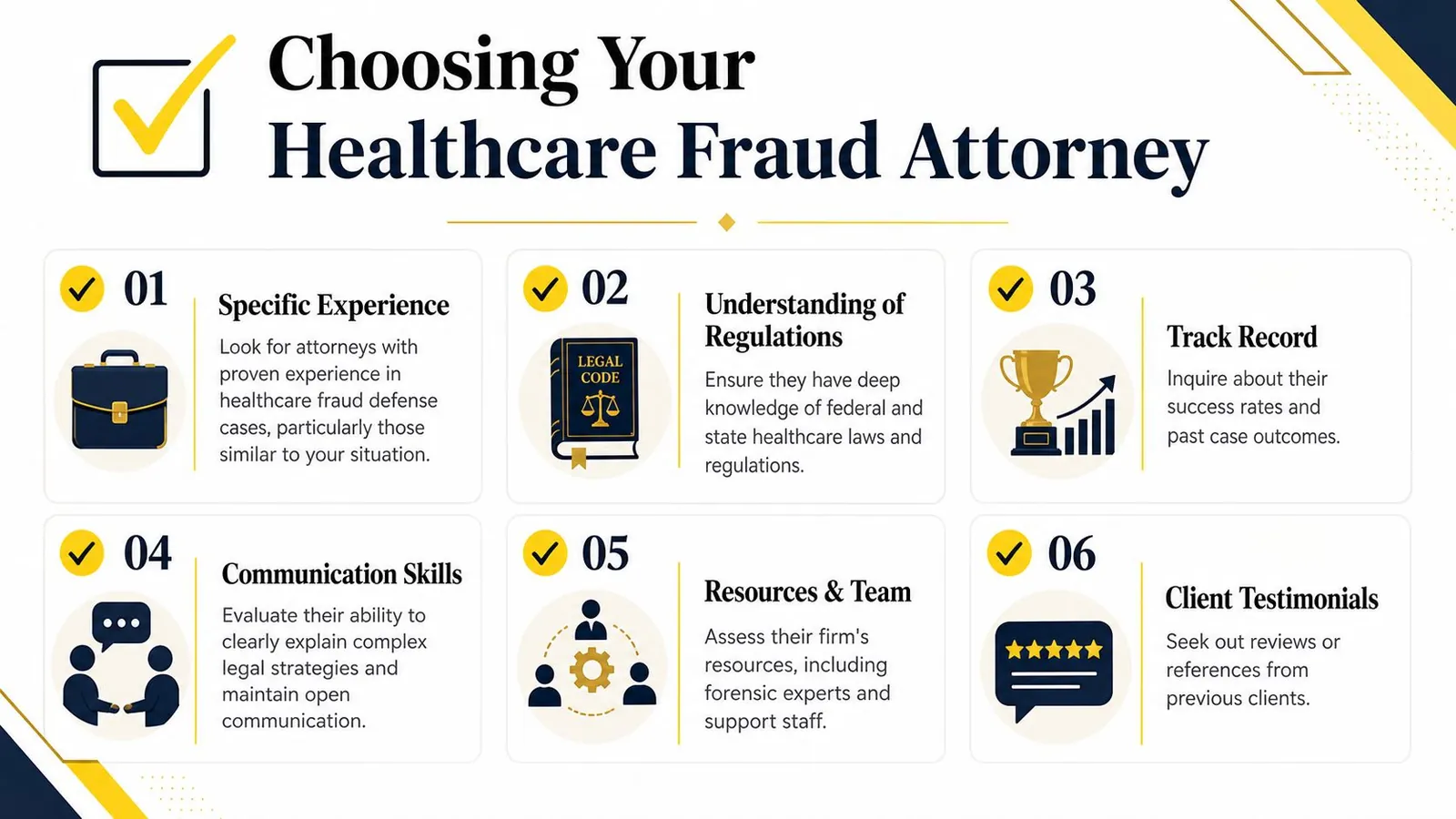
Look for direct experience with healthcare investigations tied to Medicare, Medicaid, TRICARE, commercial payors, and referral relationships. Ask whether the lawyer has handled civil investigative demands, subpoenas, data requests, witness interviews, overpayment disputes, and settlement discussions in cases involving billing, medical necessity, kickback exposure, or Stark issues.
Ask a harder question too. What does the lawyer do before indictment is even on the table? In many cases, the job is not courtroom defense yet. It is shaping the record early, managing employee communications, correcting bad assumptions in the agency’s file, and deciding whether an internal review will help or hurt.
You also need a lawyer who can translate the statutes. FCA exposure means false or unsupported claims. AKS exposure means money or benefits tied to referrals can be treated as corrupt intent. Stark is different. It is a technical physician self-referral law, and a case can become expensive even without proof of intent. If counsel cannot explain those differences clearly, that is a warning sign.
Use this checklist:
| Question | Why it matters |
|---|---|
| Has the lawyer handled healthcare fraud investigations specifically? | Healthcare billing and referral rules drive early strategy |
| Does the lawyer manage audit-stage matters, not only indictments? | Many bad outcomes could have been reduced months earlier |
| Can the lawyer assess civil and criminal exposure together? | FCA, AKS, and Stark issues often overlap |
| Is the fee structure explained clearly? | You need to know what the initial scope covers |
| Can the lawyer coordinate U.S.-Canada issues? | Shared staff, records, entities, and payments can widen exposure |
Cross-border matters require planning
For Canadian founders, physicians, clinic owners, and healthcare executives with U.S. operations, the right attorney needs more than general fraud experience. A U.S. billing audit can pull in a Canadian parent, management company, offshore billing team, shared compliance staff, or data stored outside the United States. Those facts affect document collection, interview preparation, and how quickly a civil matter can expand.
Privilege should be discussed at the start, not after staff start emailing theories back and forth. Internal reviews need structure, defined recipients, and a clear legal purpose. This explanation of work-product privilege in internal investigations shows why casual fact-gathering can create evidence instead of protecting the analysis.
What should make you cautious
Be cautious if a lawyer promises a quick fix or treats the case as a standard white-collar file without asking how claims were generated, who coded them, who approved referral relationships, and what happened after warnings were raised internally. Healthcare cases turn on operations.
Location matters less than fit. If your practice is in Toronto, North York, Mississauga, Vaughan, or near University Avenue, convenience should not decide the hire. Choose counsel who understands how a civil audit can become a DOJ matter, and who knows when to fight, when to disclose, and when to keep the review narrow until the facts are tested.
Frequently Asked Questions
What is the difference between fraud and a billing error?
A billing error is a mistake. Fraud involves knowingly false claims or deceptive conduct. In practice, the line gets contested. Repeated errors, copied documentation, ignored warnings, or questionable referral payments can make the government argue the conduct was not accidental. Context, records, and intent usually decide how the matter is treated.
How much does a healthcare fraud defense cost?
Costs vary with the stage of the matter, document volume, number of witnesses, and whether the issue stays civil or turns criminal. The right question isn't only price. It's scope. Ask for a clear explanation of what the retainer covers, what triggers extra work, and whether internal review, agency response, and negotiations are included.
How long does a healthcare fraud investigation typically take?
There is no reliable one-size-fits-all timeline. Some audit-stage matters move quickly. Others continue for months or longer while agencies review records, interview witnesses, and test billing data. Delay does not mean the case disappeared. It often means the government is building its theory while expecting the provider to keep producing information.
Can I be investigated for conduct in the U.S. if I am based in Canada?
Yes. If your company billed U.S. programs, used U.S. entities, employed U.S. staff, marketed into the U.S., or touched U.S. healthcare funds, a Canadian base will not insulate you. Cross-border ownership and data storage can complicate the response, but they do not prevent U.S. scrutiny.
What is the risk of ignoring an audit request?
Ignoring an audit is a serious mistake. It can escalate agency suspicion, reduce your chance to frame the facts early, and make settlement harder. It also signals poor compliance culture. Even if the issue began as a civil overpayment review, silence or delay can push the matter toward a broader enforcement response.
If you're dealing with an audit, subpoena, or internal report that could become a healthcare fraud matter, Mayo Law can help you assess the risk early and respond before the file hardens against you.
A provider under scrutiny usually needs two things at once. A defense strategy for today, and a compliance plan that keeps tomorrow from getting worse. Acting early gives you the best chance to protect records, control communications, and keep a civil problem from becoming a criminal one.
How Mayo Law Can Help
A healthcare fraud case is often won or lost before anyone uses the word "prosecution." The right legal work starts during the audit, the document request, the repayment inquiry, or the internal complaint, when facts are still being sorted out and the government has not fixed its theory.
Mayo Law helps healthcare providers address that stage with discipline. That means assessing billing risk early, controlling how records are collected and produced, preparing leadership for interviews, and separating a coding problem, overpayment issue, or referral concern from conduct the government may try to frame as fraud. For providers with U.S. exposure and operations, owners, or staff in Canada, that also means handling cross-border records, privacy concerns, and regulator expectations without creating new problems in either country.
The goal is practical. Reduce the chance that a civil review turns into a criminal case. Put the provider in a position to respond accurately, protect the business, and make informed decisions about disclosure, repayment, negotiation, and defense.
Disclaimer
This article is for informational purposes only and does not constitute legal advice. Every situation is different. Consult a licensed lawyer about your specific circumstances. Mayo Law provides legal services in Ontario and New York.
Related Articles
Providers usually start calling counsel after a subpoena, a CID, or a search warrant. The better time is earlier, during the audit, repayment review, or internal complaint stage, when a billing problem can still be framed as a compliance issue instead of evidence of intent.
Related reading on this topic includes articles on compliance oversight, cross-border business risk, and white-collar investigations, as discussed earlier in this guide.
- Compliance programs for clinics, physician groups, and health companies
- Cross-border legal issues for U.S. and Canadian healthcare businesses
- White-collar defense issues that often begin with civil enforcement activity