

Contents
- What does a corporate lawyer in Toronto do?
- When should you hire a corporate lawyer in Toronto?
- Corporate lawyer, small business lawyer, or litigator: who do you actually need?
- Should you incorporate in Ontario or federally?
- How much does a corporate lawyer in Toronto cost?
- What should cross-border US and Canada businesses look for?
- How to choose a corporate lawyer in Toronto
- Frequently asked questions
- The bottom line
- How Mayo Law can help
- Disclaimer
A corporate lawyer in Toronto advises companies on how they are formed, financed, governed, and eventually sold or wound down. If you run a business that operates in Ontario, or one that crosses the Canada and United States border, a corporate lawyer helps you make the early decisions that are expensive to undo later. This guide explains what a corporate lawyer in Toronto does, when hiring one is worth the cost, how Ontario and federal incorporation compare on verified 2026 government fees, and what cross-border founders should look for before they sign anything.
Quick answer: A corporate lawyer in Toronto handles business formation, share structures, shareholders’ agreements, commercial contracts, governance, financing, and transactions such as a merger or a sale. Hire one when ownership, outside money, or cross-border operations are involved. Ontario incorporation carries a $300 government filing fee, and federal incorporation carries a $200 fee.
What does a corporate lawyer in Toronto do?
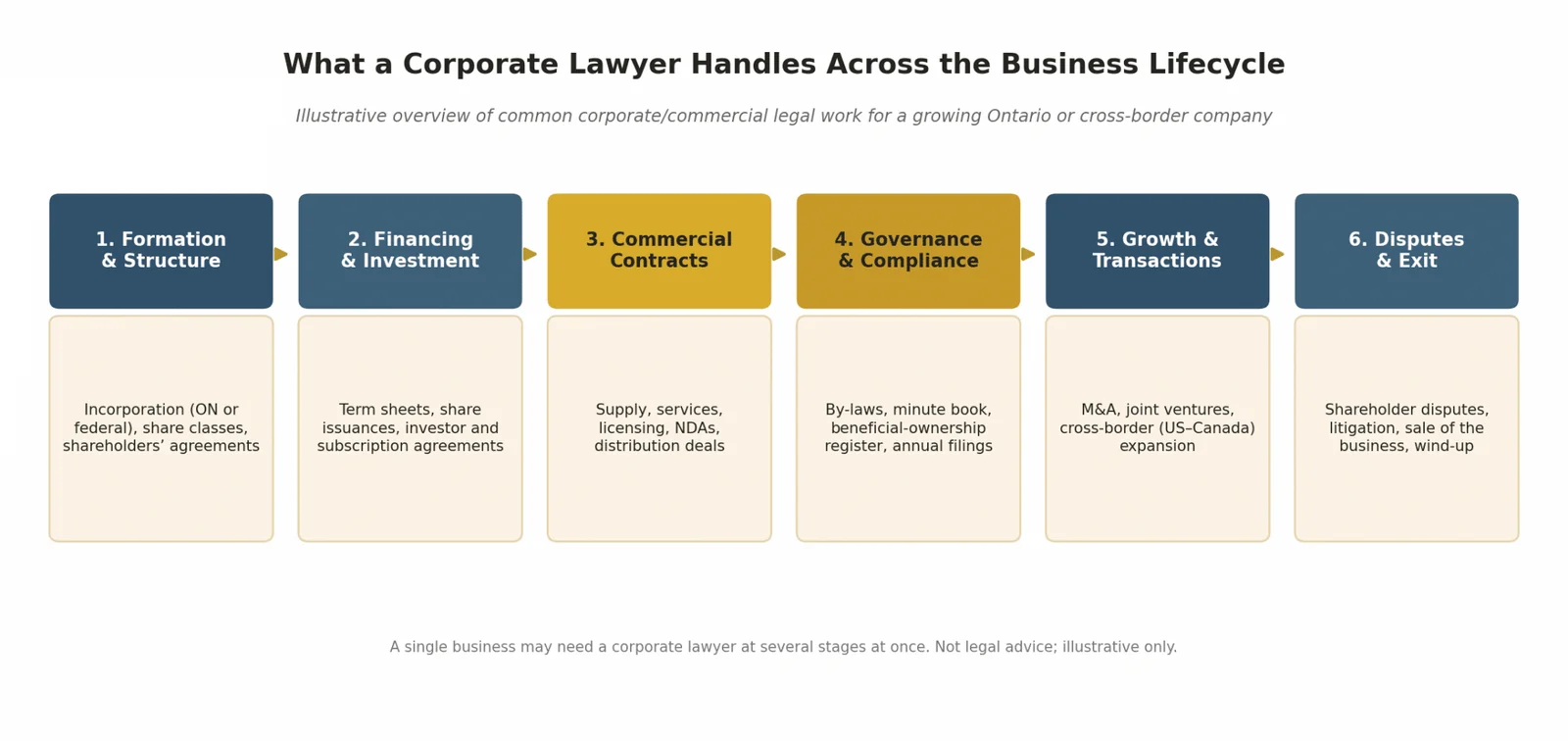
A corporate lawyer, sometimes called a business or commercial lawyer, works on the legal side of running a company rather than on personal or family matters. The work covers the full life of a business. It starts with choosing a structure and incorporating, continues through financing, contracts, and day-to-day governance, and reaches into growth transactions and, eventually, a sale or wind-down.
The figure below shows the kinds of work a corporate lawyer in Toronto typically handles as a company grows.
Most corporate work is preventive. A lawyer prepares the shareholders’ agreement before a co-founder leaves, sets up the share structure before an investor asks hard questions, and reviews a supply contract before a disagreement starts. That is different from a courtroom lawyer, who steps in once a conflict has already become a claim. If your problem is an active lawsuit rather than a document to prepare, you likely need a litigator instead. Mayo Law’s business and corporate law practice covers the range of matters a corporate team handles.
When should you hire a corporate lawyer in Toronto?
Not every business needs a corporate lawyer on day one. A single-owner venture testing an idea with little revenue and low risk can often begin as a sole proprietorship and add legal support later. The calculation changes as soon as other people, other money, or another country enters the picture.
Common signs it is time to hire a corporate lawyer include:
- more than one founder or owner will hold shares;
- you are raising money from investors or lenders;
- valuable intellectual property needs to be owned by the company rather than by an individual;
- you are signing significant customer, supplier, or partnership contracts;
- the business is expanding outside Ontario or outside Canada;
- you are bringing on employees and need proper agreements; or
- a disagreement among owners is starting to form.
The common thread is consequence. When a decision affects who owns the company, who controls it, or who is liable when something goes wrong, the cost of getting it wrong usually dwarfs the cost of advice. For an overview of why early legal help matters, see Mayo Law’s guide to hiring business lawyers and its startup business attorney resource.
Corporate lawyer, small business lawyer, or litigator: who do you actually need?
These titles overlap, and the right fit depends on your situation.
A corporate or commercial lawyer focuses on the structure and transactions of established or growing companies: share reorganizations, investor deals, commercial agreements, and mergers or acquisitions. If your business is smaller and you mainly need incorporation, everyday contracts, and general counsel, a small business lawyer in Toronto may be the better match and a more efficient use of your budget. If your issue is already a dispute, such as a shareholder fight or a breached contract heading toward court, a corporate litigation lawyer handles that work.
Many firms, including Mayo Law, cover more than one of these areas, so the practical question is not the label but whether the lawyer has done the specific kind of work your company needs.
Should you incorporate in Ontario or federally?
One of the first decisions a corporate lawyer helps with is where to incorporate. A business operating in Ontario can incorporate provincially under the Ontario Business Corporations Act, or federally under the Canada Business Corporations Act. The choice affects cost, name protection, director requirements, and filing obligations.
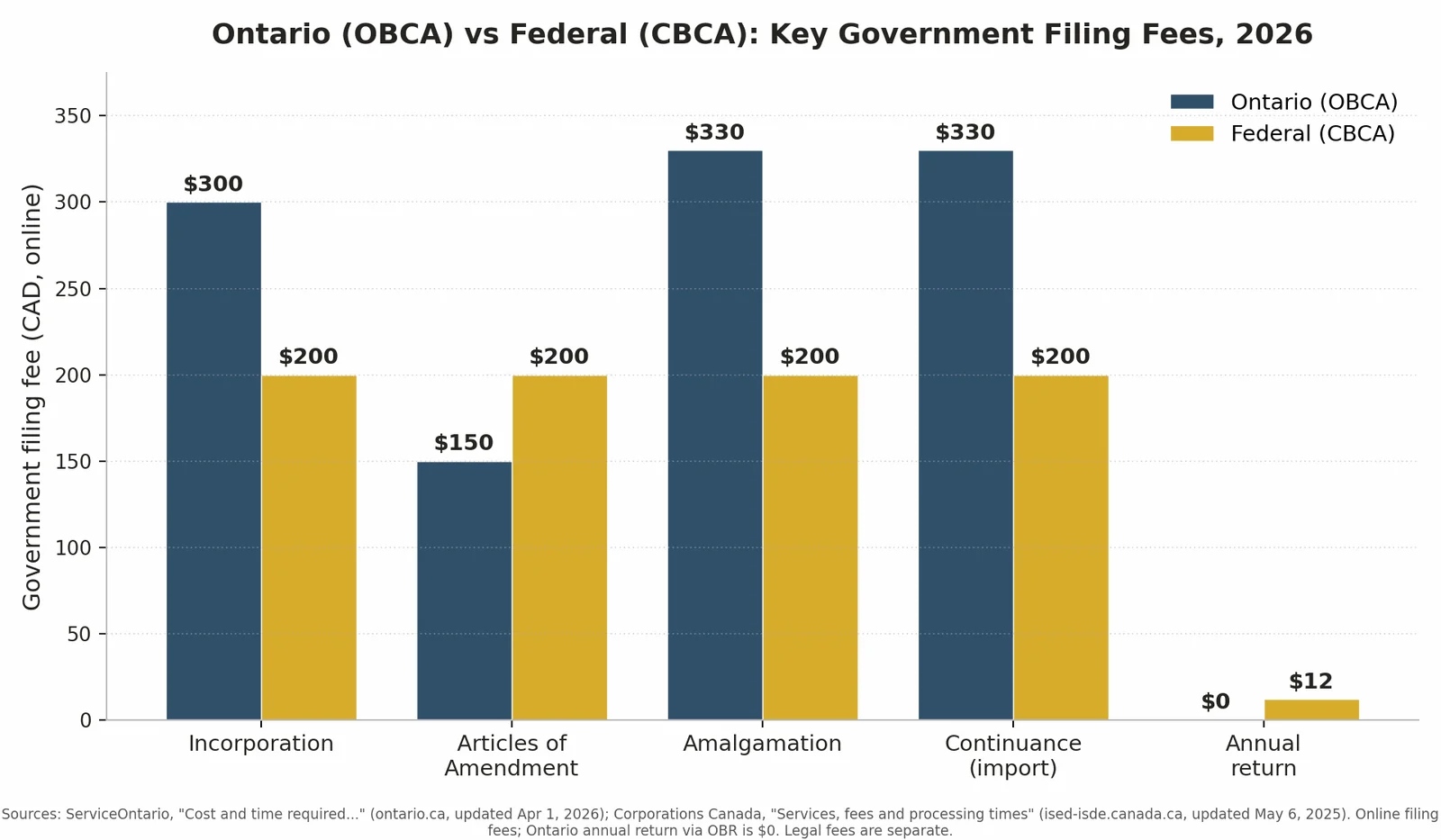
Ontario incorporation suits a company that will operate mainly in Ontario and wants a straightforward local setup. An Ontario corporation is created through the Ontario Business Registry, which launched on October 19, 2021, and a complete online filing is often processed immediately. The government fee for filing articles of incorporation in Ontario is $300, according to ServiceOntario’s fee schedule as of April 2026.
Federal incorporation suits a company that expects to operate in several provinces or wants nationwide use of its corporate name. The federal government fee for filing articles of incorporation online is $200, with a one-day standard processing time and an optional paid express service, according to Corporations Canada as of May 2025. A federal corporation that carries on business in Ontario generally still has to register in Ontario, where the extra-provincial licence fee is $330.
A key difference for founders who live outside Canada is director residency. Under the federal Canada Business Corporations Act, ordinarily at least 25 percent of a corporation’s directors must be resident Canadians, and if the board has fewer than four directors, at least one must be a resident Canadian. Corporations Canada describes a resident Canadian, broadly, as a Canadian citizen ordinarily resident in Canada or a permanent resident under the Immigration and Refugee Protection Act. Ontario corporations under the Business Corporations Act do not carry a Canadian-resident director requirement, which can make Ontario incorporation more practical for foreign-owned businesses.
The table below compares the two routes on the points founders ask about most.
| Consideration | Ontario (OBCA) | Federal (CBCA) |
|---|---|---|
| Government filing fee (online) | $300 | $200 |
| Standard processing | Often immediate | About 1 business day |
| Directors’ Canadian-residency rule | None | At least 25% resident Canadians (at least one if fewer than four directors) |
| Corporate name protection | Ontario | Across Canada |
| Operating in another province | Register there separately | Register there; may also register in Ontario ($330 extra-provincial licence) |
| Annual return | Filed via the Ontario Business Registry ($0 fee) | Filed with Corporations Canada ($12) |
Choosing between them is rarely only about the filing fee. Name strategy, where you plan to operate, who your directors are, and your privacy preferences all matter, which is where legal advice earns its cost. Mayo Law’s guide to Ontario business structures and its how to incorporate a business in Ontario walkthrough cover the mechanics in detail.
How much does a corporate lawyer in Toronto cost?
There are two different costs to keep separate: the government’s fees and the lawyer’s fees.
Government fees are fixed and public. As shown above, incorporating costs $300 in Ontario or $200 federally, an Ontario annual return carries no government fee, and a provincial certificate of status costs $26. These amounts do not change based on which lawyer you hire.
Legal fees are separate and vary with the work. Corporate lawyers in Toronto commonly charge in one of three ways: a flat fee for a defined task such as an incorporation package with a minute book and organizing resolutions; an hourly rate for open-ended matters such as negotiating an investment; or a monthly retainer for ongoing general counsel. The right structure depends on how predictable the work is. A simple incorporation is a good candidate for a flat fee, while a financing round or an acquisition is usually billed hourly because the scope shifts as the deal moves.
The cheapest option is not always the least expensive over time. Correcting an unsuitable share structure or an undocumented ownership arrangement after the fact often costs far more than setting the company up properly at the start. Mayo Law’s incorporation lawyer resource explains what a proper incorporation package should include.
What should cross-border US and Canada businesses look for?
For companies that operate on both sides of the border, the corporate questions rarely stop at Ontario. A US company opening a Canadian subsidiary, or a Canadian company expanding into the United States, has to coordinate two legal systems at once: entity structure, tax residency, contracts governed by different law, and immigration for the people who will run the operation.
This is where a cross-border practice differs from a purely local one. Joseph Mayo, the principal attorney at Mayo Law, is licensed in both Ontario and New York, and the firm keeps offices in Toronto and New York. That lets one team coordinate the Ontario and United States sides of a structure rather than leaving a founder to assemble advice from two unconnected firms. The federal director-residency rule described above is a good example: a United States founder who wants to incorporate in Canada needs to plan for it in advance, and a lawyer who works across the border will raise it before it becomes a filing problem.
If your plans involve moving people as well as entities, corporate structuring often runs alongside business immigration. Mayo Law’s cross-border legal support for Canada and US business and its international business lawyer guide describe how the two fit together.
How to choose a corporate lawyer in Toronto
A short, practical checklist:
- Confirm the licence. Lawyers in Ontario are licensed and regulated by the Law Society of Ontario, and you can verify a lawyer’s status in the Law Society’s public directory.
- Match the experience to your need. Ask whether the lawyer has handled your specific situation, such as a shareholders’ agreement, a financing, or a cross-border expansion, rather than corporate work in general.
- Ask about cross-border capability if you operate in both Canada and the United States, since coordinating two systems is a distinct skill.
- Get the fee arrangement in writing before the work begins, including whether it is a flat fee, hourly, or a retainer.
- Check for conflicts and responsiveness. A lawyer who cannot act because of a conflict, or who is slow to respond during a live deal, is a poor fit regardless of skill.
You can learn more about the firm’s background on the Mayo Law about page.
Frequently asked questions
Do I need a corporate lawyer to incorporate in Ontario?
No. A person can file articles of incorporation through the Ontario Business Registry without a lawyer, and the government fee is $300. The greater risk is usually not the filing itself but the decisions behind it, such as the share structure, ownership split, and governance terms. Legal help matters most where there are multiple owners, investors, intellectual property, or cross-border operations.
What is the difference between a corporate lawyer and a business lawyer?
In practice, the terms are used interchangeably. Both describe a lawyer who advises companies on formation, contracts, governance, financing, and transactions rather than on personal legal matters. Some lawyers use “corporate” to signal a focus on larger transactions and “business” for smaller, owner-operated companies, but there is no fixed rule, and the same person often does both kinds of work.
How much does it cost to incorporate a business in Toronto?
The government filing fee is $300 for an Ontario corporation or $200 for a federal corporation filed online, based on ServiceOntario and Corporations Canada fee schedules. Legal fees for preparing customized articles, a minute book, and organizing resolutions are separate and vary by firm and by the complexity of the ownership structure you need.
Can a corporate lawyer in Toronto help a US company expand into Canada?
Yes. A corporate lawyer helps a US company choose and set up a Canadian entity, register to operate in Ontario, plan for the federal director-residency rule where it applies, and align Canadian contracts and governance with the parent company. A firm with lawyers licensed in both Canada and the United States can coordinate both sides of the structure together.
Do Ontario corporations need Canadian-resident directors?
Ontario corporations under the Business Corporations Act are not required to have Canadian-resident directors. Federal corporations under the Canada Business Corporations Act are different: ordinarily at least 25 percent of directors must be resident Canadians, and at least one director must be a resident Canadian if the board has fewer than four members. This difference often matters to founders based outside Canada.
What does a corporate lawyer do after a company is incorporated?
Incorporation is the start, not the finish. After the certificate issues, a corporate lawyer helps issue shares, adopt by-laws, appoint officers, prepare the minute book and registers, record beneficial-ownership information, and put a shareholders’ agreement in place. These records establish who owns and controls the company, and they are often examined closely when the business seeks financing or is sold.
Is hiring a corporate lawyer worth it for a small business?
It depends on risk and complexity. A very small, low-risk business may not need ongoing corporate counsel at first. Once there are co-owners, contracts, employees, or outside money, targeted legal help usually prevents problems that cost far more to fix later. Many owners start with a defined, flat-fee incorporation and add support as the company grows.
The bottom line
A corporate lawyer in Toronto exists to make the structural decisions of a business sound: how it is owned, how it is governed, how it contracts, and how it grows or exits. The government fees are modest and public, at $300 to incorporate in Ontario and $200 federally, but the decisions around those filings carry the real weight. For companies that operate across the Canada and United States border, the value of a lawyer who works in both systems is coordination that a single-jurisdiction firm cannot offer.
How Mayo Law can help
Mayo Law is a cross-border firm focused on business and corporate law and business immigration between Canada and the United States. Principal attorney Joseph Mayo is licensed in Ontario and New York, and the firm works from offices in Toronto and New York. The corporate practice assists Ontario and international founders with Ontario and federal incorporations, share structures, shareholders’ agreements, commercial contracts, governance, and cross-border business planning. To discuss your company, you can contact Mayo Law to arrange a consultation.
Disclaimer
This article is provided for general information only and does not constitute legal advice. Reading it or contacting Mayo Law through this website does not create a lawyer-client relationship. Government fees, statutes, and processing times change, and the figures here were current as of the government sources cited in July 2026; confirm the current position for your situation before acting. Mayo Law provides legal services in Ontario and New York.