

Contents
- Quick Answer
- What happens at the E-2 visa interview?
- What questions do consular officers ask at the E-2 interview?
- How do you prepare in the weeks before the interview?
- What should Canadian investors know about the E-2 interview?
- What happens after the E-2 visa interview?
- What mistakes weaken E-2 interview answers?
- Frequently asked questions about the E-2 visa interview
- Conclusion
- How Mayo Law can help
- Disclaimer
The E-2 visa interview is the final step between your investment and your visa. You have built the business plan, moved the funds, and filed the forms. Now everything depends on a short conversation with a consular officer. The good news is that E-2 visa interview questions follow a predictable pattern, because officers test the same eligibility requirements in almost every case. That means you can prepare for nearly everything they will ask.
This guide covers the questions officers ask most often, the legal standard behind each one, and the preparation steps that separate a smooth approval from a stressful refusal. Every fee and procedural step below comes from US Department of State guidance on travel.state.gov, current as of August 2026. If you are still assembling your application, start with our guide to the E-2 visa application process, then return here once your interview is on the calendar.
Quick Answer
E-2 visa interview questions focus on five areas: your investment and source of funds, how the business operates, your role in directing it, your treaty nationality and ties outside the United States, and the company’s plans for growth. Officers use your answers to confirm each E-2 eligibility requirement, so prepare short, specific, documented responses for every area.
What happens at the E-2 visa interview?
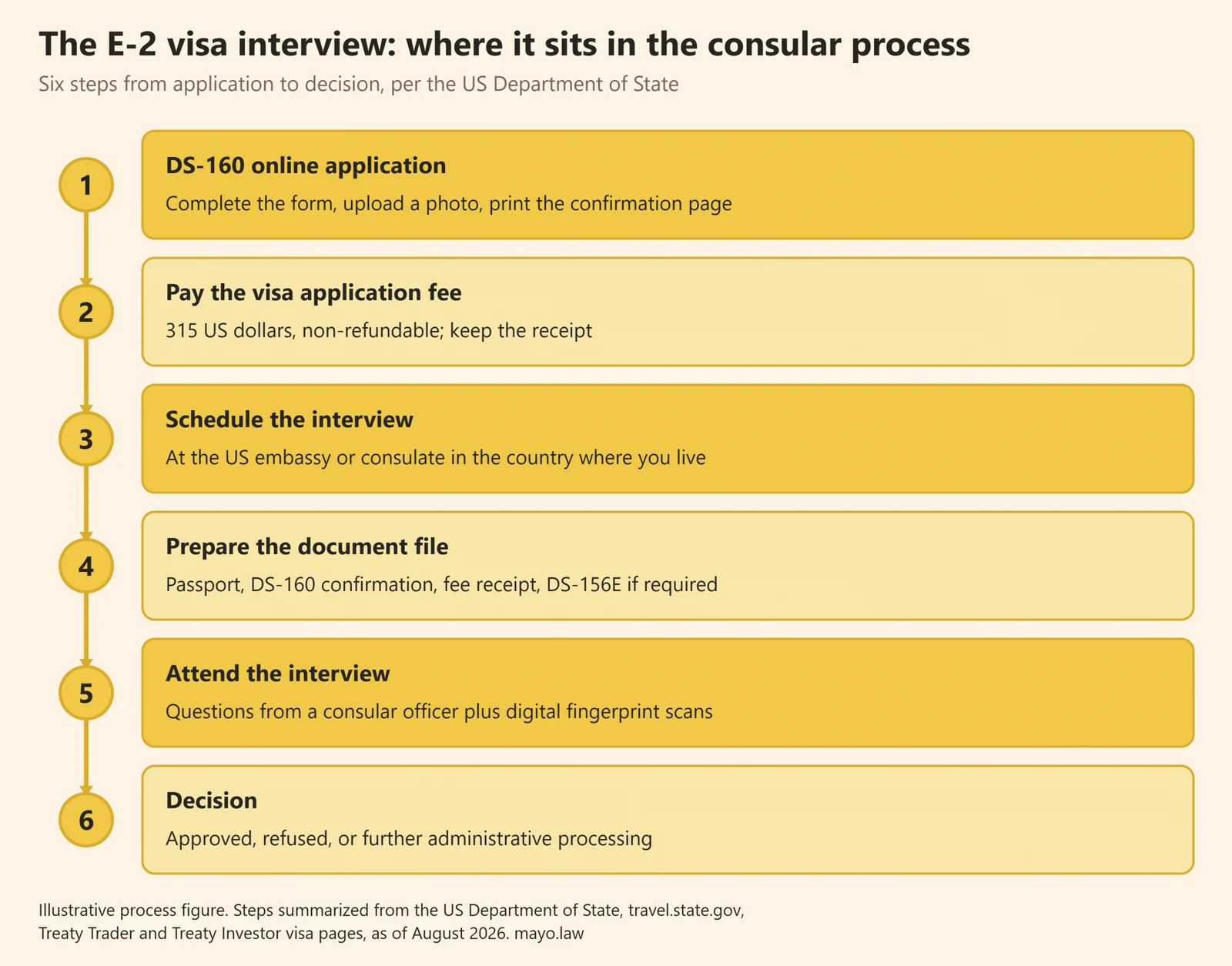
The interview is one step in a longer consular process. By the time you sit down with an officer, you will have completed Form DS-160 online, uploaded a photo, printed the confirmation page, and paid the 315 US dollar non-refundable visa application fee. You schedule the interview at the US embassy or consulate in the country where you live. Scheduling in a third country is possible, but the Department of State cautions that qualifying for a visa outside your place of residence can be more difficult, and appointment wait times vary by post, so book early.
On interview day, you bring your passport, your DS-160 confirmation page, your fee receipt, and your supporting evidence. Executives, managers, and essential employees also file Form DS-156E. During the appointment, a consular officer reviews your file, takes ink-free digital fingerprint scans, and asks questions to decide whether you qualify for the visa. The decision rests with that officer, which is why interview preparation deserves the same attention as the application itself.
What questions do consular officers ask at the E-2 interview?
Officers rarely improvise. Nearly every question maps to one of the standards described in our guide to E-2 visa requirements. If you know which requirement a question is testing, you can answer it directly and point to the evidence in your file.
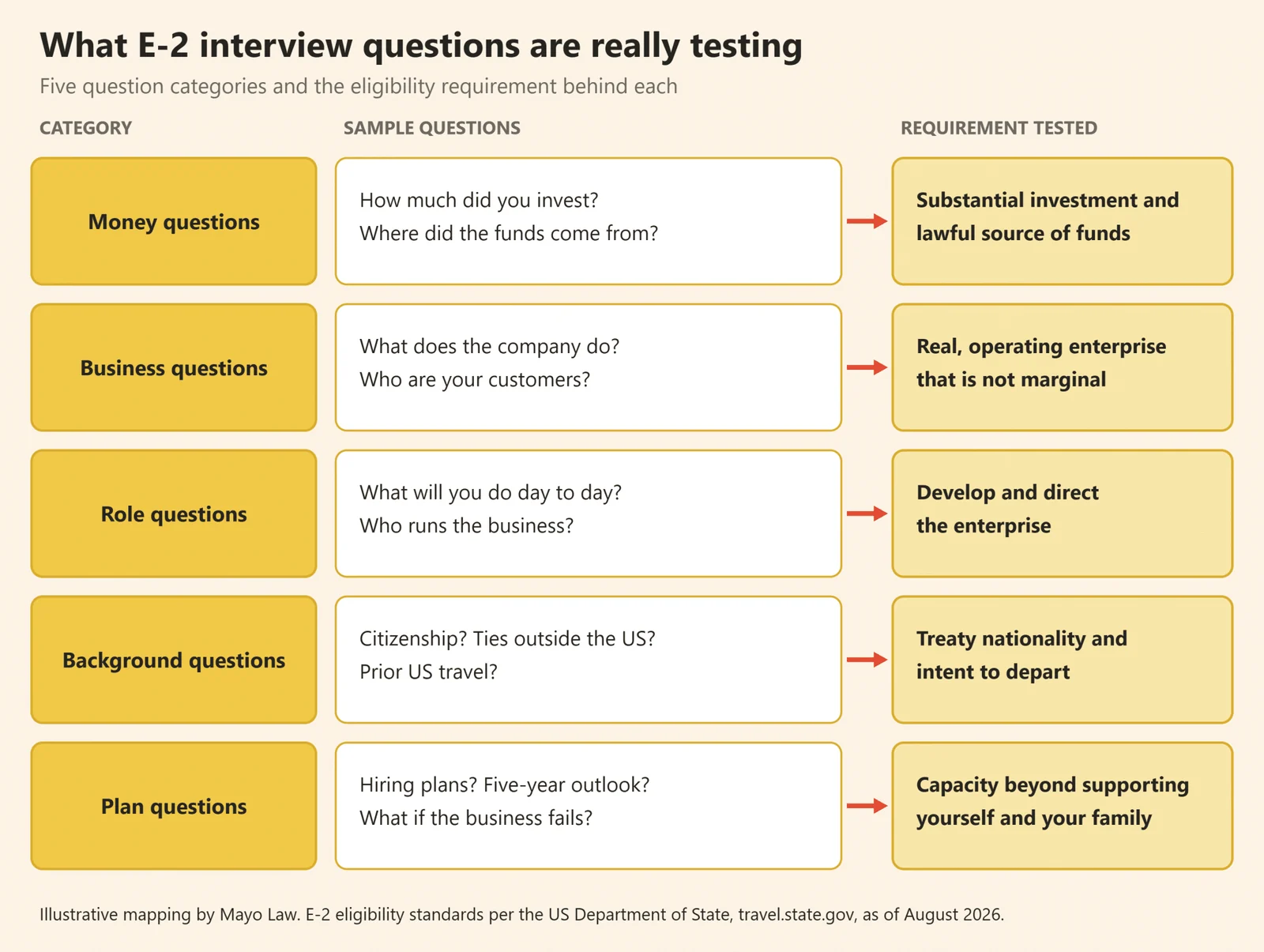
| Question category | Sample questions | What the officer is testing |
|---|---|---|
| Money | How much did you invest? Where did the funds come from? | Substantial investment and a lawful source of funds |
| Business | What does the company do? Who are your customers? | A real, operating enterprise that is more than marginal |
| Role | What will you do day to day? Who runs the business when you are away? | Your ability to develop and direct the enterprise |
| Background | What is your citizenship? What ties do you keep outside the US? | Treaty nationality and intent to depart when your status ends |
| Plans | How many people will you hire? Where will the business be in five years? | Capacity to generate more than a living for you and your family |
Money questions
Expect the officer to ask exactly how much you invested, what the money bought, and where it came from. Have a clean answer for each: the total figure, the breakdown between equipment, leases, inventory, and working capital, and the documented trail from the source of the funds to the business account. If your investment sits at the lower end for your industry, review our analysis of the E-2 visa minimum investment amount before the interview so you can explain why the amount is substantial for this specific business.
Business questions
Officers want evidence that the enterprise is real and operating, not an idea on paper. Be ready to describe what the company sells, who buys it, your current revenue or signed contracts, and your physical or online presence. Some business models present better than others at this stage. Our review of the best businesses for E-2 visa approval explains which characteristics tend to make the strongest case.
Role questions
The E-2 category is for investors who develop and direct the enterprise. Questions such as what you will actually do each day, who manages staff, and who signs contracts test whether you control the business rather than passively fund it. Answer with specifics: the decisions you make, the people who report to you, and your ownership stake.
Background questions
Citizenship questions confirm treaty nationality, since only nationals of treaty countries qualify for the E-2 visa. Questions about property, family, or business interests outside the United States test your intent to depart when your E-2 status ends. The E-2 is a nonimmigrant category, so officers listen for a credible plan to leave, even though the visa can be renewed.
Plan questions
Marginality questions look forward. The enterprise must have the present or future capacity to generate more than enough income to provide a living for you and your family. Officers often ask about hiring plans and revenue projections to gauge that capacity. Bring your financial projections, know the key numbers without reading them, and make sure everything matches the business plan you filed with the application.
How do you prepare in the weeks before the interview?
Preparation is mostly about making the file and the story match. Work through this sequence in the two to three weeks before your appointment:
- Re-read your DS-160 and business plan. Officers have your file in front of them, and the fastest way to draw follow-up questions is to contradict your own paperwork.
- Check your passport. It must be valid for at least six months beyond your intended period of stay in the United States. Some countries have agreements that modify this rule, so confirm with the post where you will interview.
- Confirm which forms apply. Executives, managers, and essential employees must file Form DS-156E in addition to the DS-160.
- Assemble the evidence binder: corporate documents, the funds trail, financial statements, the lease, key contracts, and your organizational chart, tabbed so you can hand the officer any document within seconds.
- Rehearse out loud. Practice one-sentence and three-sentence versions of your answers to the five question categories above. Long, rambling answers invite more questions.
What should Canadian investors know about the E-2 interview?
Canada is an E-2 treaty country, so Canadian citizens can pursue the visa on the strength of a qualifying US investment. If you live in Canada, you schedule the interview at the US embassy or consulate serving your area, and appointment availability varies by post, so check current wait times as soon as your application is ready.
The preparation itself has a cross-border layer. Your source-of-funds trail may run through Canadian accounts and entities, your corporate records may span an Ontario company and a US operating entity, and your tax position changes once the visa is approved. Our complete guide to the E-2 visa from Canada covers the application from a Canadian starting point, including how the consular process in Canada works.
What happens after the E-2 visa interview?
Three outcomes are possible. The officer may approve the application, in which case your passport is returned with the visa inside, and you pay a visa issuance fee only if one applies to your nationality. The officer may refuse the application. Or the case may go into further administrative processing, which delays the decision until additional review is complete.
A refusal at the interview stage is not always the end. Many applicants address the gap the officer identified, often the funds trail or the marginality evidence, and reapply with a stronger file. For context on how often E-2 applications succeed and what the refusal data shows, see our breakdown of the E-2 visa approval rate.
What mistakes weaken E-2 interview answers?
Most interview problems trace back to a few avoidable habits:
- Contradicting the file. If the DS-160 says one investment figure and you say another, the officer will stop and dig.
- Vague answers about money. Not knowing your own investment total or funds trail reads as a lack of control over the enterprise.
- Reciting the business plan. Officers want to hear that you understand the business, not that you memorized a document someone else wrote.
- Overexplaining. Answer the question asked, then stop. Volunteering unrelated detail creates new lines of questioning.
- Guessing. If you do not know an answer, say so and offer to point to the document that has it. A wrong guess is worse than an honest pause.
Frequently asked questions about the E-2 visa interview
What are the most common E-2 visa interview questions?
The most common questions cover five areas: how much you invested and where the funds came from, what the business does and who its customers are, what your day-to-day role will be, your citizenship and ties outside the United States, and your hiring and growth plans. Each area maps to an E-2 eligibility requirement, which is why officers return to them in almost every interview.
How much does the E-2 visa interview cost?
The visa application fee for treaty investor visas is 315 US dollars as of August 2026, paid before the interview is scheduled, and it is non-refundable even if the visa is refused. If the application is approved, you pay an additional visa issuance fee only if one applies to your nationality.
What is Form DS-156E and who must complete it?
Form DS-156E is the treaty trader and investor application form. The Department of State requires it for all E-1 treaty trader applicants and for E-2 applicants who are executives, managers, or essential employees. If you are the principal investor applying on your own investment, confirm current form instructions with the post where you will interview, since requirements can vary.
What documents should I bring to the E-2 visa interview?
Bring your passport, valid for at least six months beyond your intended stay, the printed DS-160 confirmation page, your fee receipt, Form DS-156E if it applies to your category, and your evidence file: corporate records, the investment funds trail, financial statements, your lease or key contracts, and your business plan. Organize the file so you can produce any document quickly.
What happens if my E-2 visa is refused at the interview?
The consular officer decides eligibility, and some cases are refused or placed in further administrative processing for additional review. A refusal is not always permanent. Many applicants strengthen the weak point the officer identified and reapply with better evidence. Reviewing the refusal reasons with a lawyer before reapplying usually saves both time and money.
Can I attend my E-2 interview in a country where I do not live?
Usually you schedule the interview at the US embassy or consulate in the country where you live. Scheduling in a third country is sometimes possible, but the Department of State cautions that it can be more difficult to qualify for a visa when you apply outside your place of residence, so most applicants should book at their home post.
How early should I schedule my E-2 visa interview?
As early as your application is genuinely ready. Appointment wait times vary from one embassy or consulate to another and change through the year, so the Department of State advises applying well in advance of your planned travel date. Building the interview date into your business timeline avoids pressure to attend before your evidence file is complete.
Conclusion
The E-2 interview rewards preparation over polish. Officers ask predictable questions because they are testing fixed requirements: real money, lawfully sourced, invested in a real business that you direct and that will do more than support you. Know your numbers, know your file, keep your answers short, and make sure every claim matches the documents. Do that, and the interview becomes what it should be: a confirmation of the case you have already built.
How Mayo Law can help
Mayo Law is a cross-border business and immigration firm with offices in Toronto and New York. Principal attorney Joseph Mayo is licensed in both Ontario and New York, which matters for E-2 cases that start in Canada and finish at a US consulate. The firm prepares E-2 applications end to end: structuring the investment, documenting the source of funds, building the business plan, and running mock interviews built around the question categories in this guide. If your interview is approaching, or you are still deciding whether the E-2 route fits, an E-2 visa lawyer can review your file and flag the gaps an officer would notice first. Contact us to get started.
Disclaimer
This article is for informational purposes only and does not constitute legal advice. Reading it does not create an attorney-client relationship. Immigration outcomes depend on the facts of each case, and consular processes change. Mayo Law provides legal services in Ontario and New York. For advice on your specific situation, consult a licensed attorney.