
Contents
- What is the green card application process
- Eligibility under family based and employment based categories
- Navigating required forms and evidence checklist
- Understanding fees timelines and biometric requirements
- Comparing consular processing and adjustment of status
- Employer compliance tips for cross-border hires
- Common pitfalls for startups and executives
- Frequently Asked Questions
- Conclusion
- How Mayo Law Can Help
- Disclaimer
- Related Articles
You may be dealing with this right now: a founder relocating to New York while keeping a Toronto company, a U.S. employer sponsoring a Canadian executive, or a family trying to decide whether to file inside the U.S. or at a consulate abroad. The problem usually isn’t just eligibility. It’s sequencing, documentation, and what happens if work or residence shifts across the border mid-process.
At Mayo Law business immigration services, we help startups, SMEs, and cross-border professionals in Toronto and the GTA handle the green card application process with experience licensed in both Ontario and New York on a process that often spans both sides of the border. If you’re trying to avoid delay, preserve a priority date, or keep an employer case compliant, the details matter early.
What is the green card application process
The green card application process is the legal path to U.S. permanent residence through a qualifying category, usually family-based or employment-based, followed by petition filing, documentary review, biometrics where required, and final approval through adjustment of status or consular processing.
For cross-border businesses, that simple definition hides the underlying difficulty. One case may involve a U.S. employer, a Canadian affiliate, payroll records on both sides of the border, and timing decisions that affect work authorization and travel.
A lot of applicants focus on the final filing and ignore the upstream issues. That’s a mistake. In practice, the strongest cases are built backwards from the end point. You identify the category first, confirm who can sponsor, map the forms, and collect evidence in the order USCIS or the consulate will expect to see it.
Practical rule: If you can’t explain who the sponsor is, what form starts the case, and where the applicant will finish the process, you’re not ready to file.
For business owners and executives, this process also carries planning questions that generic guides skip. If you leave the U.S. during a job transition, does your priority date stay protected? If your income comes from a Canadian corporation or licensing revenue instead of a U.S. salary, how do you present financial self-sufficiency? Those are often the issues that decide whether a file stays on track.
Eligibility under family based and employment based categories
A founder in Vancouver marries a U.S. citizen. A product lead in Toronto is sponsored by a U.S. startup. Both want permanent residence, but the legal analysis starts in different places. One case turns on the qualifying family relationship and visa availability. The other turns on the job offer, the employer’s structure, and whether a priority date can be preserved if the role or entity changes.
Family-based cases usually start with Form I-130. Employment-based cases usually start with Form I-140, sometimes after PERM labor certification. That split affects who files, what evidence matters, and how much flexibility the applicant has if life or business plans change mid-process.
Family-based eligibility
Family-based eligibility depends on a qualifying relationship to a U.S. citizen or lawful permanent resident. Immediate relatives of U.S. citizens are treated differently from preference categories, and that difference matters because some applicants can move to the final stage faster while others wait for a current priority date.
The proof is relationship-driven. That usually means civil documents such as birth certificates, marriage certificates, divorce records, and, in marriage cases, evidence that the couple built a real life together. For cross-border families, I also watch for documents issued in more than one country, prior periods of U.S. work or study, and travel patterns that need a clean explanation.
Priority dates matter here too, especially in family preference categories. A Canadian spouse of a permanent resident may assume the case is simple because Canada-based processing often feels orderly. The primary issue is often visa availability, not paperwork. If the petitioner later naturalizes, the category may improve. If the relationship changes before approval, the case may end entirely.
Employment-based eligibility
Employment-based eligibility is more technical. Some cases require PERM. Others, such as certain multinational managers, extraordinary ability applicants, national interest waiver cases, or some physicians, follow different rules. The right category depends on the job, the company’s history, the worker’s credentials, and whether the facts support the classification you want to use, not just the one that looks fastest on paper.
If you want a practical explanation of that path, this guide on how to get a green card through employment is a useful starting point.
For startups and SMEs, the hard part is often not basic eligibility. It is proving the business can support the case and that the role is real, consistent, and documented the same way across the immigration file, payroll records, corporate chart, and offer letter. Cross-border companies get into trouble when the Canadian parent, U.S. subsidiary, and payroll provider all describe the employee differently.
Why priority dates matter more in cross-border cases
A priority date sets the applicant’s place in line for an immigrant visa. In backlogged categories, that date can be one of the most valuable parts of the file.
The analysis changes when cross-border planning is involved. A worker may start with a U.S. petitioner, spend time back in Canada, then return under a different affiliate or in a revised executive role. Sometimes the priority date can still help. Sometimes the move breaks the strategy because the new filing rests on a different job, a different employer, or a timeline that no longer supports portability. The answer depends on the category, the filing posture, and the paper trail.
I see this often with executives. A company restructures, the U.S. entity changes, and the individual assumes the old filing still protects the case. It may not. If the original immigrant petition was tied to a position that no longer exists, or if the worker changes employers before the case reaches the stage where portability rules can apply, the business may need to start over.
Public-charge planning is often overlooked
General guides also miss a separate point. Public-charge review is not limited to low-income cases, and cross-border applicants can present finances in ways that confuse the record if they are not organized from the start.
For example, an applicant may have Canadian income, retained earnings from a corporation, dividend payments, or support from a U.S. family sponsor. Those facts are not disqualifying. They do need to be documented in a way that shows current resources, lawful support, and financial stability in the United States. A file that looks thin on U.S. income can still be approvable, but it should not leave the officer guessing how the applicant will support himself or herself after admission or adjustment.
The category gets the case in the door. The priority date strategy and financial presentation often determine whether it stays on track.
Navigating required forms and evidence checklist
The forms are only half the job. The other half is presenting evidence in a way an officer can review without hunting for missing pieces. That sounds basic, but many delays come from disorganized submissions rather than weak eligibility.
Core forms by pathway
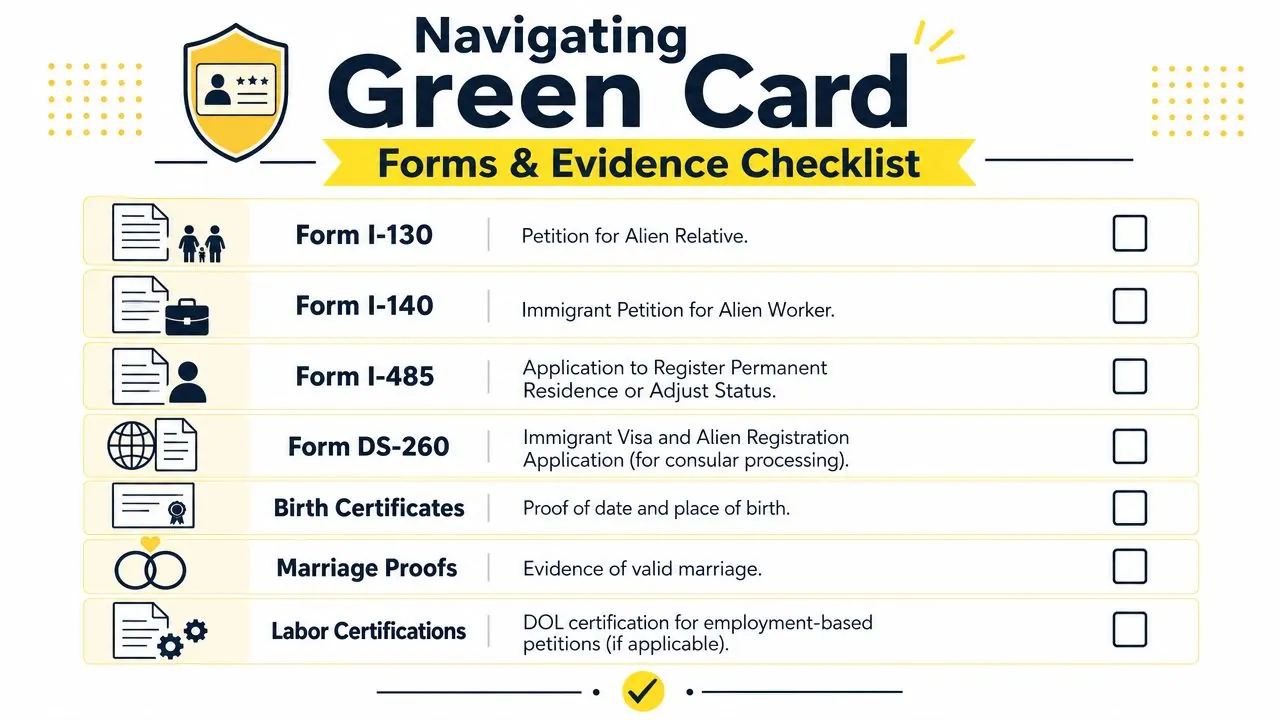
Family-based green cards use Form I-130 while employment-based green cards require Form I-140, dictating the evidentiary burden for subsequent stages, as set out on the USCIS pages describing the green card process.
After the petition stage, many applicants file Form I-485 if they’re eligible to adjust status inside the United States. Others complete Form DS-260 for immigrant visa processing through a U.S. consulate abroad. If a marriage-based case is involved, interview preparation often becomes its own project, especially where the couple has lived or worked in more than one country. In those situations, guidance on the marriage interview for green card can help frame what evidence should already be in the file.
Evidence that should be grouped together
I tell clients to build the package as if a reviewer has never met them and has only a short window to understand the case.
- Identity records: Birth certificates, passports, prior immigration documents, and any civil records that establish name history.
- Relationship evidence: Marriage certificates, divorce records if any, and proof the relationship is genuine where that issue matters.
- Employment evidence: Offer letters, organizational charts, wage records, job descriptions, and PERM-related materials where applicable.
- Status evidence: Entry records, prior approval notices, and proof the applicant remained in lawful status if adjustment is planned.
- Translation support: Any non-English document should be translated clearly and consistently.
Practical filing habits that help
The filing system should be boring. That’s the point.
Use one naming convention for digital files. Match names and dates across passports, corporate records, and civil documents. If a person has used a shortened name in Canada and a full legal name in U.S. filings, explain that directly rather than hoping the officer will infer it.
Clean indexing often prevents avoidable questions. A strong case can still get bogged down if the evidence arrives as a pile instead of a record.
For cross-border families and businesses, notarization can also come up when affidavits or supporting documents need formal execution. If documents will move between jurisdictions, cross-border notarization support may be part of the logistics, even though notarization itself doesn’t replace the substantive evidence USCIS wants.
Understanding fees timelines and biometric requirements
A common startup scenario looks like this. The founder is ready to file, HR has budgeted for the government fee, and then pressing questions start. Can this person travel to Canada next month. Will a delay affect work authorization. Is the listed filing fee the true cost of getting the case to decision.
Filing fees and biometrics
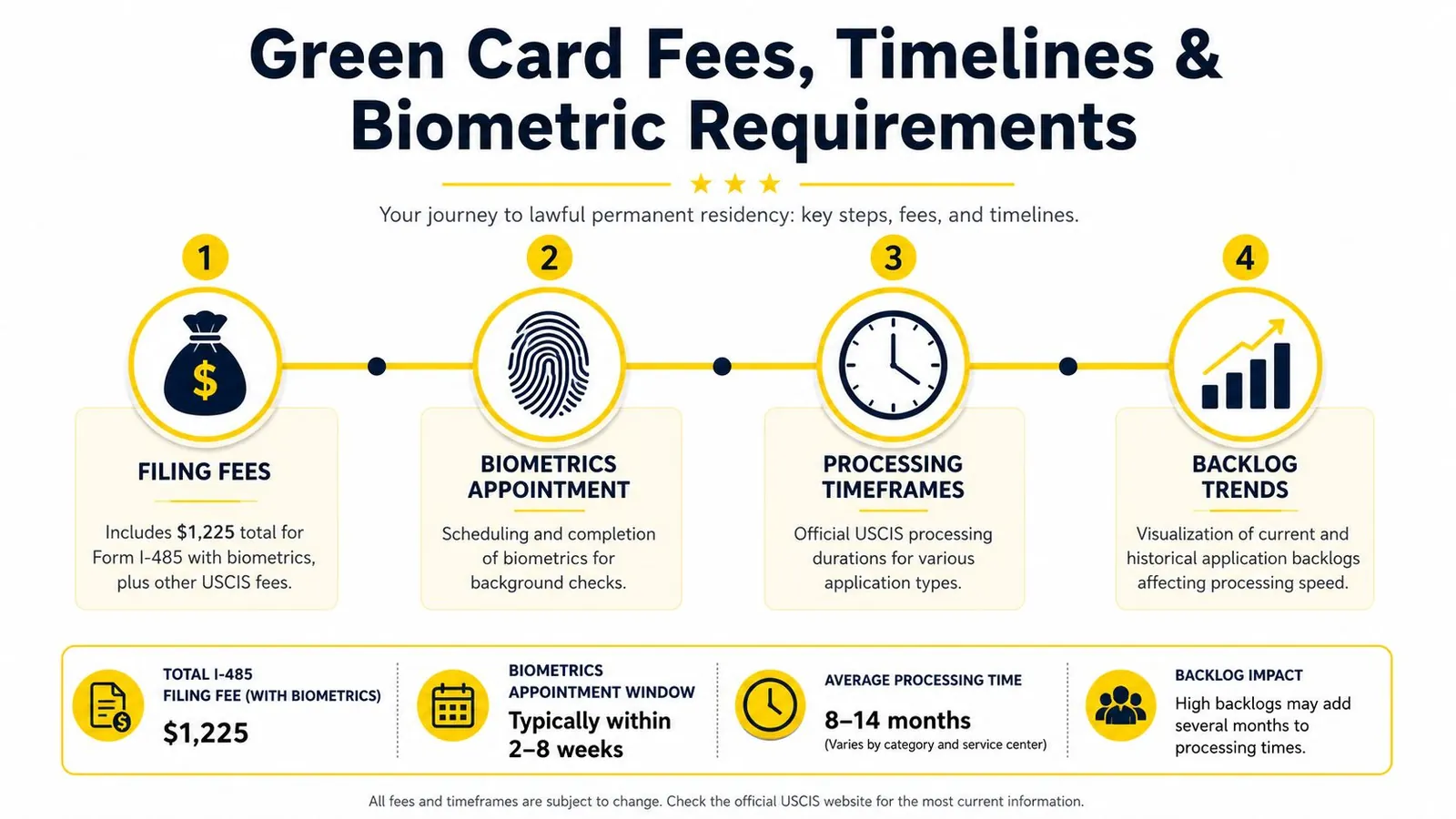
Government filing fees are only one part of planning. The amount can change, the fee depends on the form package being filed, and cross-border cases often carry extra practical costs such as medical exams, document procurement, translations, and travel tied to appointments or interviews. The safest practice is to confirm the current fee and edition requirements directly with USCIS immediately before filing, not when the case strategy is first discussed.
Biometrics usually functions as a case-processing step, but it still creates real risk if the applicant splits time between the United States and Canada. Missed mail, an outdated address, or poorly timed travel can turn a routine appointment into weeks of avoidable delay. I tell clients to treat every receipt notice and appointment notice as deadline-sensitive, even if the appointment itself looks routine.
For adjustment applicants, biometrics can also affect timing around work and travel documents. A filing receipt does not solve travel planning by itself.
Timeline reality
Published processing times are a reference point, not a schedule you can safely build around. Backlogs, staffing patterns, transfer between service centers, interview capacity, and security checks all affect the case. The pressure is often greater than the public estimate suggests, especially for applicants whose file includes status history across both countries.
Cross-border timing gets more complicated once priority dates enter the picture. For employment-based applicants born in countries with visa backlogs, the underlying petition may be approved while the green card application still cannot move to final approval because the priority date is not current. That issue is easy to miss in general guides, and it matters for Canadian employers hiring executives or technical talent who were born elsewhere. A worker may live in Canada, hold Canadian status, and still face a long U.S. immigrant visa queue tied to country of birth rather than current residence or citizenship.
That is one reason broad averages are not enough. Employers should build plans around the employee’s category, chargeability, filing posture, and travel needs. For a more practical planning model, see this guide on how long the green card process takes for employers and cross-border applicants.
Public-charge and budget planning
Fees and timing also intersect with the public-charge analysis more often than applicants expect. Family-based cases and some adjustment cases can draw extra scrutiny if the financial record is thin, inconsistent, or poorly documented. A rushed filing that technically includes the right forms can still create avoidable questions if tax returns, income proof, household size, and sponsor documents do not line up cleanly.
For founders and small companies, this usually shows up in two places. First, a sponsor may rely on fluctuating income or recent business growth that needs better explanation. Second, a cross-border household may have assets or income sources in Canada that are real but not presented clearly in the U.S. filing record. Good strategy here is simple. Verify the financial evidence early, explain foreign-source assets carefully, and do not assume the officer will fill in gaps.
What works in practice
- Confirm fees and form editions right before filing.
- Use one reliable mailing address and update it immediately if it changes.
- Keep travel limited around biometrics until the notice is issued and the appointment is completed.
- Review priority date exposure early in employment-based cases, especially where the employee was born outside Canada.
- Treat sponsor financial evidence as part of case strategy, not clerical cleanup.
The cases that move most smoothly usually have one thing in common. Someone is watching the calendar, the mail, and the cross-border details before USCIS asks questions.
Comparing consular processing and adjustment of status
A Canadian executive is working in New York during the week, flying back to Toronto twice a month, and planning a green card through a U.S. employer. The category may be clear. The harder question is where to finish the case. That choice affects travel, work continuity, timing, and in some cases how a priority date delay plays out in real life.
Consular Processing vs Adjustment of Status
| Aspect | Consular Processing | Adjustment of Status |
|---|---|---|
| Interview location | U.S. consulate or embassy outside the United States | USCIS interview inside the United States if scheduled |
| Main final form | DS-260 | I-485 |
| Travel posture | International travel is built into the process | Travel planning is more sensitive once the case is filed |
| Best fit | Applicants based abroad or spending substantial time outside the U.S. | Applicants already in the U.S. with a workable status strategy |
| Cross-border concern | Consulate logistics, document collection, border timing | Maintaining status, travel authorization, and filing consistency |
| Sponsor evidence focus | Petition approval plus civil and admissibility records | Petition approval plus status history and adjustment eligibility |
The usual summary is too simple. Consular processing is not just the "outside the U.S." option, and adjustment is not always the easier "inside the U.S." option. For cross-border clients, the better route often depends on three practical points: whether the priority date is current, whether the applicant can stay in valid U.S. status long enough to file adjustment, and whether travel to Canada is routine or unavoidable.
When consular processing fits better
Consular processing often fits a founder or employee whose life is still anchored in Canada. If the person lives in Toronto, enters the U.S. for meetings or temporary work, and does not have a clean path to remain in the United States through the full adjustment period, consular processing is often the cleaner route.
It also deserves a closer look when the priority date is not current. In employment-based cases, a Canadian passport does not solve chargeability issues if the person was born in a backlogged country. I regularly see applicants assume they can file quickly because they live in Canada. The determining factor is country of birth, unless a cross-chargeability strategy applies through a spouse. If the case cannot move to final filing soon, consular processing may be easier to manage than trying to preserve U.S. status for an extended period.
Another benefit is procedural clarity. The applicant remains outside the adjustment framework, which can reduce problems tied to domestic travel restrictions, status maintenance questions, or filing while on a visa category that does not match the long-term plan well.
When adjustment of status fits better
Adjustment usually makes more sense for someone already living and working in the United States in a category that supports the filing strategy. A New York-based executive with stable U.S. status, a current priority date, and limited need for international travel may prefer to complete the process without departing for a consular interview.
The trade-off is control versus flexibility. Adjustment can offer useful interim benefits, such as work and travel authorization tied to the pending case, but those benefits do not arrive on day one. If the applicant expects frequent trips to Canada, the filing has to be timed carefully. I have seen strong cases become harder than necessary because the applicant filed first and sorted out travel later.
Public-charge planning can also differ in practice. Consular cases and adjustment cases both require careful financial documentation, but adjustment filings tend to put the full package, including status history and financial evidence, under one domestic review process. Where income is variable, assets are partly in Canada, or the household includes cross-border financial support, the record should be organized with that scrutiny in mind before choosing the filing path.
A good rule is simple. Choose the route that matches how the person lives and works, not the route that sounds faster in the abstract.
For startups and smaller employers handling sponsorships, an employment immigration attorney for cross-border hiring can help compare these options before the company commits to a filing strategy that creates avoidable travel, status, or timing problems.
Mayo Law works with startups, founders, and employers across the GTA and on cross-border matters. Joseph Mayo is licensed in Ontario and New York, so clients with U.S. ties can coordinate legal work in one place rather than splitting strategy between two firms.
Employer compliance tips for cross-border hires
The employer side of the green card application process is where preventable mistakes often start. A company may have a genuine role, a qualified employee, and a real need. That still won't save a file if the records are thin or inconsistent.
Build the PERM record before you need it
The PERM process requires prevailing wage determinations, documented recruitment, and Form ETA-9089 submissions. If USCIS or the Department of Labor asks for missing recruitment records, RFE response windows are typically capped at 84 days, as described in Cornell Law School's summary of the employment-based green card process via PERM.
That means HR should preserve recruitment evidence as a routine practice, not as an afterthought. If your company is sponsoring talent, keep the interview notes, posting details, wage support, and job requirement rationale in one controlled file.
Two practical scenarios
A Toronto software company opened a small U.S. operation and wanted to move a senior engineer into a long-term U.S. role. The problem wasn't eligibility. It was that the company had changed job titles twice and hadn't preserved a clean record explaining why the U.S. role required the listed minimum qualifications.
A New York manufacturer hired a Canadian manager who traveled back and forth constantly. The immigration filing itself was workable, but internal records on reporting lines, payroll location, and actual worksite varied across departments. That kind of inconsistency invites questions.
Compliance habits worth adopting
- Use one HR file owner: Someone should control the immigration record and version history.
- Match the business story: Offer letters, PERM filings, payroll records, and org charts should tell the same story.
- Track border-sensitive changes: Job location, remote work shifts, and employer changes can affect portability analysis.
- Escalate early: If there's a restructuring, merger, or role change, review immigration consequences before the move.
For employers formalizing these systems, employment immigration attorney support is one option. Some companies also need parallel internal controls, especially where immigration records overlap with broader cross-border compliance planning.
Common pitfalls for startups and executives
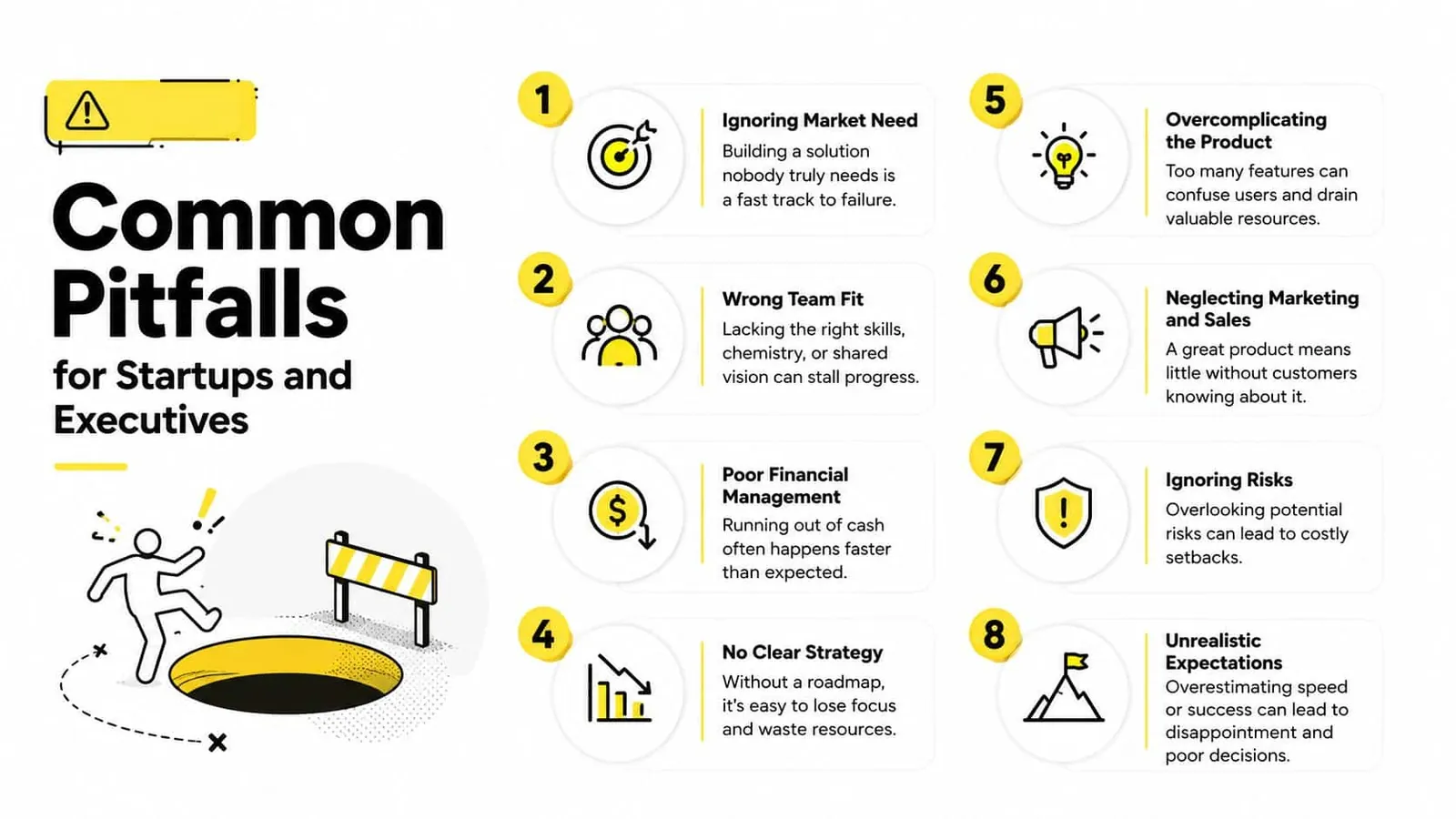
Startups often assume the main risk is denial. More often, the risk is drift. The case slowly moves off course because no one is watching the details.
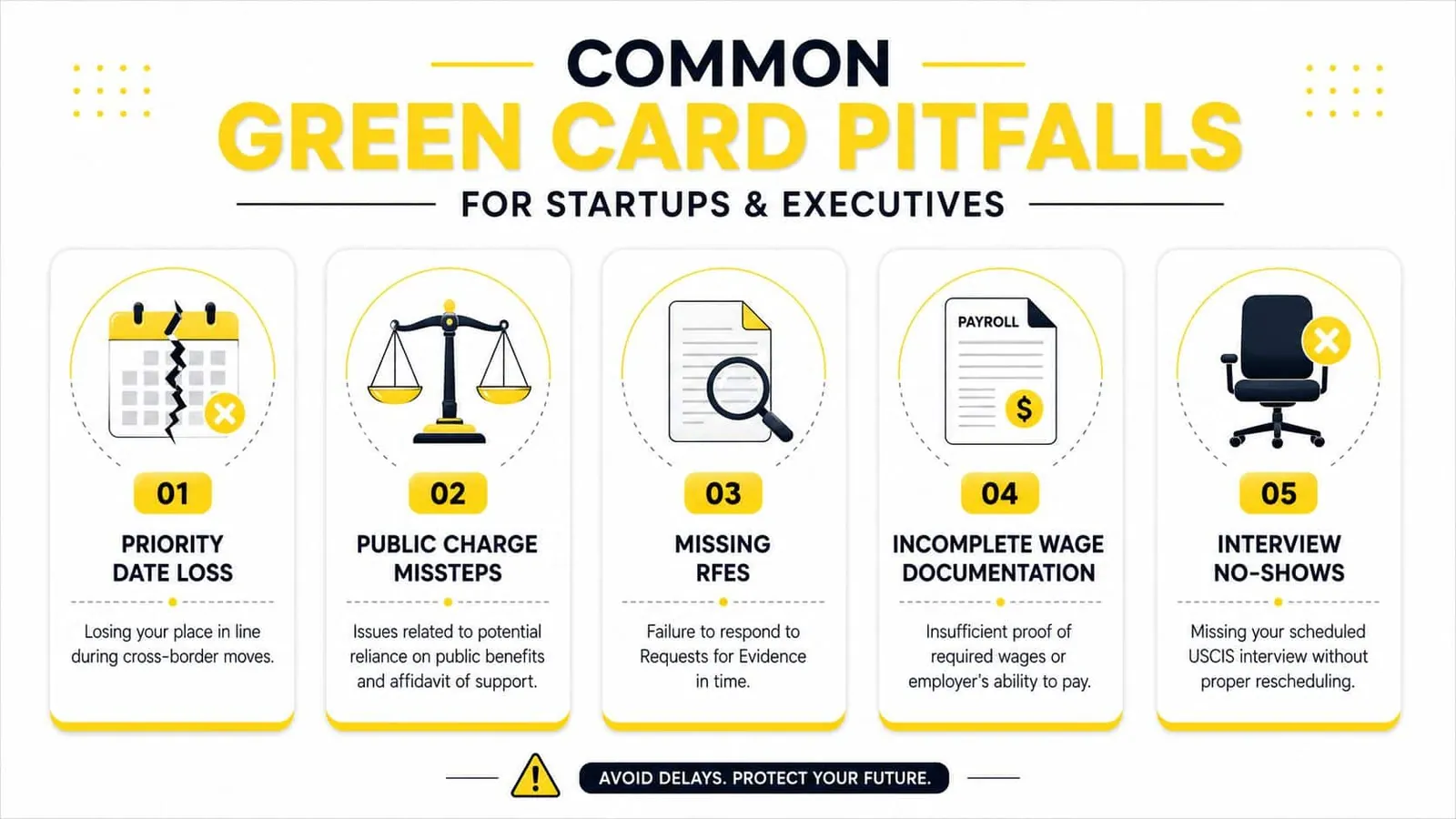
Most guides overlook how cross-border breaks can invalidate a priority date, risking a multi-year reset under AC21 portability, as noted by the University of Michigan resource on priority date issues. That's one of the biggest traps for executives who split time between Canada and the U.S.
Other common mistakes follow the same pattern:
- Public charge framing: Entrepreneurs with assets but limited W-2 income should present financial self-sufficiency clearly.
- Missed RFEs: A good case can still fail if the response window is missed.
- Weak wage support: Employers need consistent wage and ability-to-pay documentation.
- Interview gaps: If facts have changed since filing, prepare the explanation before the interview.
If your case has a U.S.-Canada dimension, a U.S.-Canada immigration lawyer can help assess whether the issue is procedural, strategic, or both.
If you're balancing a move, a business expansion, and a permanent residence filing at the same time, the process usually needs more than a form checklist. Mayo Law advises on the immigration and cross-border planning issues that sit behind the filing itself, especially where employers, founders, and executives need one coordinated approach.
Frequently Asked Questions
What is the green card application process in simple terms
It's the legal process for becoming a U.S. permanent resident through an approved category. Usually that means a sponsor files the first petition, the applicant submits supporting records, and the case finishes either inside the United States through adjustment of status or outside the country through consular processing.
How much does the green card application process cost
The filing fee point most applicants ask about is Form I-485. As of July 2026, USCIS lists the Form I-485 filing fee at $1,440 for paper filing, or $1,390 for filing online, with no separate biometrics fee; a child under 14 filing together with a parent pays $950 by paper or $900 online. These amounts come from the current USCIS G-1055 fee schedule (edition dated May 29, 2026), and you should confirm them on the day you file. That doesn't answer every cost question, because some matters also involve petition-stage filings, document gathering, translations, medical exams, or legal fees.
How long does the green card application process take
There isn't one timeline for every case. Timing depends on the category, visa availability, where the case is filed, and whether the evidence is complete. In practice, delay often comes from backlog pressure, sponsor-side preparation problems, or a mismatch between the applicant's travel and status history and the path chosen.
Can a Canadian living in Toronto start a U.S. green card case
Yes, in many situations. The key question is the legal basis for the case and whether the person will finish through consular processing or eventually adjust status in the U.S. For Canadian-based founders and executives, that planning should happen before frequent U.S. travel creates inconsistencies in the record.
What is the biggest risk in a cross-border employment-based case
Often it's not the initial filing. It's a later change in employer, job duties, work location, or U.S.-Canada residence pattern that wasn't analyzed properly. Priority date preservation, portability questions, and internal HR inconsistencies can all create avoidable disruption if they're ignored early.
Conclusion
If you're in the middle of a relocation, a sponsorship, or a family filing, the green card application process can feel less like one application and more like a chain of decisions. That's especially true when work, residence, and company structure cross the U.S.-Canada border. The cases that hold up best are usually the ones that clarify category, route, and evidence before anyone rushes to file. Careful planning won't remove every delay, but it does cut down avoidable ones.
How Mayo Law Can Help
Cross-border green card matters often break down at the handoff points. Employer to employee, Canada to U.S., petition stage to final processing. Mayo Law serves clients across Toronto, the GTA, and on cross-border matters. To discuss your situation, visit business immigration services.
Disclaimer
This article is for informational purposes only and does not constitute legal advice. Every situation is different. Consult a licensed lawyer about your specific circumstances. Mayo Law provides legal services in Ontario and New York.