

Contents
- Quick answer
- Which law controls imports and exports?
- When do you need a Canadian export permit?
- Do exports to the United States need a permit?
- When do you need a Canadian import permit?
- How do you apply for an export permit?
- Import/export permit: Canada vs US licences
- What happens if you export without a permit?
- Frequently asked questions
- Conclusion
- How Mayo Law can help
- Disclaimer
Before a shipment leaves or enters the country, a business should ask one question: does this move need an import/export permit? Canada requires one for a defined set of goods and technology, and the list is narrower than many owners fear but wider than many assume. Controlled exports include military and dual-use goods, nuclear and missile items, US-origin goods and some forest and farm products. Controlled imports include some agricultural, steel, apparel and weapons products. One destination is controlled no matter what is shipped.
This guide is for US and Canadian small and mid-sized businesses. It explains which federal lists trigger a permit, how exports to the United States are treated, who is allowed to apply, how the application works, and what happens if a company ships without one. The statutes, regulations and government guidance below were checked against official sources as of September 2026.
Quick answer
Canada requires an export permit when goods or technology are on the Export Control List, go to an Area Control List country (currently North Korea), or are US-origin goods leaving for another country, often under a general permit. Imports need a permit only for Import Control List goods. Global Affairs Canada issues both under the Export and Import Permits Act.
Which law controls imports and exports?
The main statute is the federal Export and Import Permits Act (the EIPA), R.S.C. 1985, c. E-19, current on the Justice Laws Website to September 3, 2026. The Act does not list products itself. It lets the federal Cabinet set up lists, and it makes it an offence to move a listed item without a permit. Four lists matter to most businesses:
- Export Control List: goods and technology whose export or transfer is controlled (s. 3). It is set out in regulations (SOR/89-202) that incorporate A Guide to Canada's Export Control List, which Global Affairs Canada generally updates each year.
- Area Control List: countries to which the export or transfer of any goods or technology is controlled (s. 4). The list (SOR/81-543) names one country today: the Democratic People's Republic of Korea.
- Import Control List: goods whose import is controlled (s. 5), for purposes such as supporting farm marketing programs, implementing trade agreements, and restricting arms and munitions.
- Brokering Control List: controlled items whose brokering between two foreign countries needs a permit (s. 4.11), a regime in force since 2019.
Section 13 prohibits exporting or transferring anything on the Export Control List, or anything at all to an Area Control List country, except under an export permit. Section 14 does the same for imports of goods on the Import Control List. The Act defines "transfer" of technology as disposing of it or disclosing its content in any manner from a place in Canada to a place outside Canada, so an email attachment or a file upload can be an export.
Global Affairs Canada (GAC) administers the permits. The Canada Border Services Agency (CBSA) handles the border side, including export reports. Other federal bodies run their own permit systems for specific products, including the Canadian Food Inspection Agency for food, plants and animals, Health Canada for drugs and cannabis, the Canadian Nuclear Safety Commission for nuclear substances, Canadian Heritage for cultural property, and Natural Resources Canada for explosives. This guide covers the EIPA permits that GAC issues. Economic sanctions are a separate regime with separate lists; our guide to the Canada sanctions list covers them.
When do you need a Canadian export permit?
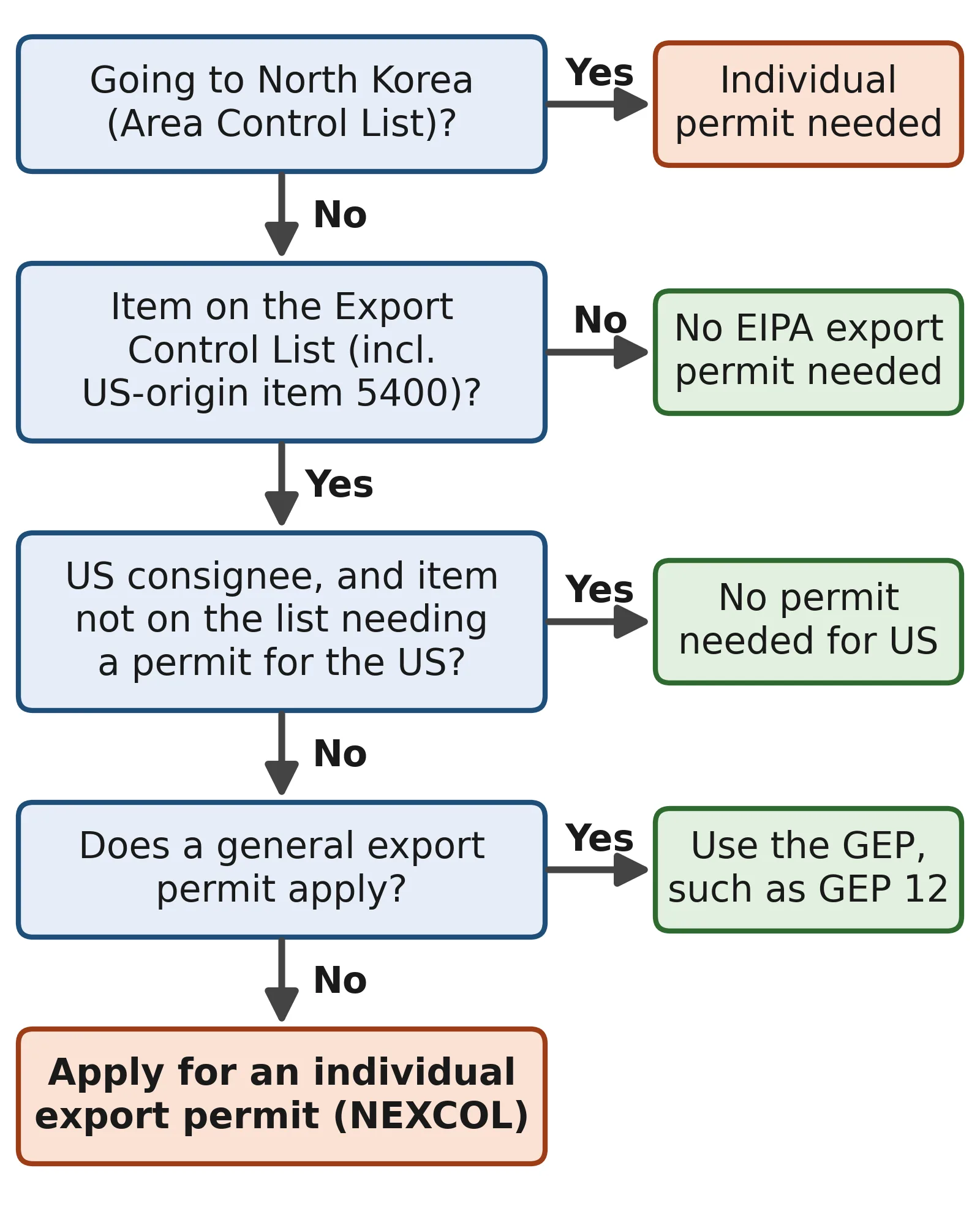
An export needs a permit in three situations. The item is on the Export Control List, the destination is on the Area Control List, or the item is a US-origin good covered by item 5400. The Export and Brokering Controls Handbook, GAC's main guidance document (page last modified June 12, 2026), says that the nature, characteristics, origin or destination of the goods or technology affect whether a permit is required.
Items on the Export Control List
The Export Control List is organized in groups, each tied to an international regime or a Canadian policy:
- Group 1: dual-use goods and technology (Wassenaar Arrangement).
- Group 2: munitions (Wassenaar Arrangement).
- Groups 3 and 4: nuclear and nuclear-related dual-use items (Nuclear Suppliers Group).
- Group 5: miscellaneous goods, including US-origin goods, strategic goods and some forest, agricultural and food products.
- Group 6: missile technology (Missile Technology Control Regime).
- Group 7: chemical and biological weapons non-proliferation items (Australia Group).
- Group 9: Arms Trade Treaty items. Group 8 was repealed in 2006.
Group 1 is the one that surprises commercial businesses. Dual-use items are goods and technology originally designed for civilian purposes that could have a military use or be used to produce military items. Recent changes show how commercial the list has become: a March 2025 order amending the list dealt with quantum computing, advanced semiconductor manufacturing, metal additive manufacturing machines and high temperature coatings. GAC's guidance also says that cryptographic products meeting the Group 1 information security criteria need a permit for any destination other than the United States. A company that is not sure whether a product is listed can ask GAC for an advisory opinion, but the handbook says there is no service standard for one, and it recommends filing a permit application when an export is urgent.
Destinations on the Area Control List
For an Area Control List country, every export or transfer needs a permit, whatever the item. The current list, as consolidated to September 3, 2026, names only North Korea. Other countries are subject to sanctions or to export policies that GAC publishes by destination, but those rules come from other instruments.
US-origin goods and technology
Item 5400 of the Export Control List covers all goods and technology of United States origin that are not listed elsewhere, unless they have been further processed outside the United States so that their value, form or use has changed substantially. "Origin" means made in the United States, not last shipped from there. For most destinations, General Export Permit No. 12 authorizes these exports without an individual application. It does not cover Area Control List countries, Cuba, North Korea, Iran or Syria; those exports need an individual permit. Where the export must be reported to the CBSA, the exporter inserts "GEP-12" in the report. The handbook adds that US law may still require US re-export authorization for the same item, which is why our guide to export control compliance covers the US rules separately.
Do exports to the United States need a permit?
Usually not. The handbook states that export permits are not required for many items on the Export Control List when they go to a consignee in the United States. The exceptions are items whose control applies to "All Destinations". GAC's reference table of items that need a general or individual permit for the United States, dated September 1, 2019 in the current handbook, includes all of Groups 3, 4 and 9, and specific items in Groups 2, 5, 6 and 7, such as certain firearms and munitions, some forest and agricultural products and some strategic goods. Non-restricted and restricted firearms and ammunition in items 2-1 and 2-3, and Group 9 items, can go to the United States under General Export Permit No. 47, which requires written notice to GAC before first use and twice-yearly reports on permanent exports of Group 9 items.
Three points trip up cross-border shippers:
- Transit is not a US export: goods moving through the United States to a third country need the Canadian permit for that third country when they leave Canada.
- US rules follow the goods: once in the United States, the goods are subject to US export controls whether or not a Canadian permit was needed. GAC advises exporters to get written assurances from US consignees.
- Reporting is separate from permits: the CBSA does not require an export declaration for non-restricted goods exported for consumption in the United States. Restricted goods going to the United States also need no declaration, but the permit, certificate or licence must be presented.
Under CBSA Memorandum D20-1-1 (October 24, 2024), goods leaving Canada are reported on an export declaration unless an exception applies. The CBSA's list of exceptions includes non-restricted goods exported for consumption in the United States and non-restricted commercial goods worth less than CAD 2,000. Goods shipped under a general export permit carry the GEP number on the declaration or, where no declaration is needed, as for exports to the United States, on the manifest or other documents. Declarations are generally submitted electronically through the CBSA's Canadian Export Reporting System (CERS) portal or by electronic data interchange, and the exporter needs a business number with an active export program account (the BN15). A US business that also imports into Canada should read our guide on how a US company does business in Canada for the non-resident importer rules.
When do you need a Canadian import permit?
An import permit is needed only for goods on the Import Control List. The Government of Canada's import permits page points importers to GAC controls for product groups such as controlled agricultural products, steel, and textiles and clothing. According to GAC's import controls page (modified December 4, 2025), items 70 to 74 and 91 of the list deal with military goods, firearms and Chemical Weapons Convention chemicals, and applications for those go to GAC's Export Controls Division directly. GAC states that every handgun imported into Canada needs an import permit, while most non-restricted and restricted firearms and their parts destined for sporting or recreational use do not.
For other controlled products, the process runs through GAC's New Export and Import Controls System (New EICS):
- EIPA number: the importer needs an Export and Import Permits Act file number, obtained by filing GAC's application form.
- Quota first: an importer relying on a quota allocation must have applied for and received it before applying for the permit.
- Timing: requests are accepted within 30 days before the shipment's expected arrival, and a permit is normally valid for 30 days around the arrival date (5 days before and 24 after).
- One shipment, one permit: an individual permit is required for each shipment unless a notice to importers says otherwise.
- Brokers: licensed customs brokers can apply directly in New EICS; other importers apply through the New EICS help desk.
Section 8 of the EIPA allows import permits to be issued only to a resident of Canada, so a foreign seller shipping controlled goods into Canada needs a Canadian resident to hold the permit.
How do you apply for an export permit?
Who can apply
Not every business can hold an import/export permit. Canada's Act limits who applies: section 7(1) lets the Minister issue an export permit to a "resident of Canada". The Act defines that as a person who ordinarily resides in Canada or a corporation with its head office or a branch office in Canada. The handbook states that the exporter may be a non-resident, but the applicant must always be a resident of Canada, and in that case the applicant accepts legal responsibility for the permit and for potential violations. Section 21 backs this up: an applicant who applied on behalf of a non-resident can be guilty of the non-resident's offence if it knew of or consented to the act, or failed to exercise due diligence to prevent it. A US company exporting from a Canadian warehouse should therefore decide early who the Canadian applicant will be and what that party is agreeing to.
The steps
- Step 1: Classify the item. Check the goods, software and technology against A Guide to Canada's Export Control List, including item 5400 for US-origin content. Keep the reasons for the classification on file.
- Step 2: Check the destination and the end user. Review the Area Control List, GAC's destination guidance and Canadian sanctions. The handbook expects exporters to do due diligence on actual and potential foreign customers.
- Step 3: Look for a general export permit. If one applies, such as GEP 12 or GEP 47, follow its conditions instead of applying for an individual permit.
- Step 4: Apply online. The export permit application is filed through Export Controls Online (NEXCOL), GAC's web-based system for export permit applications and amendments, with the supporting documents the handbook lists for the item.
- Step 5: Ship under the permit and report. Quote the permit on the CBSA export declaration, keep exports within the quantities, values, destinations and consignees on the permit, and meet any reporting conditions.
- Step 6: Keep records. The handbook states that exporters must keep all records of exports made under an EIPA permit for six years, including exports by intangible means.
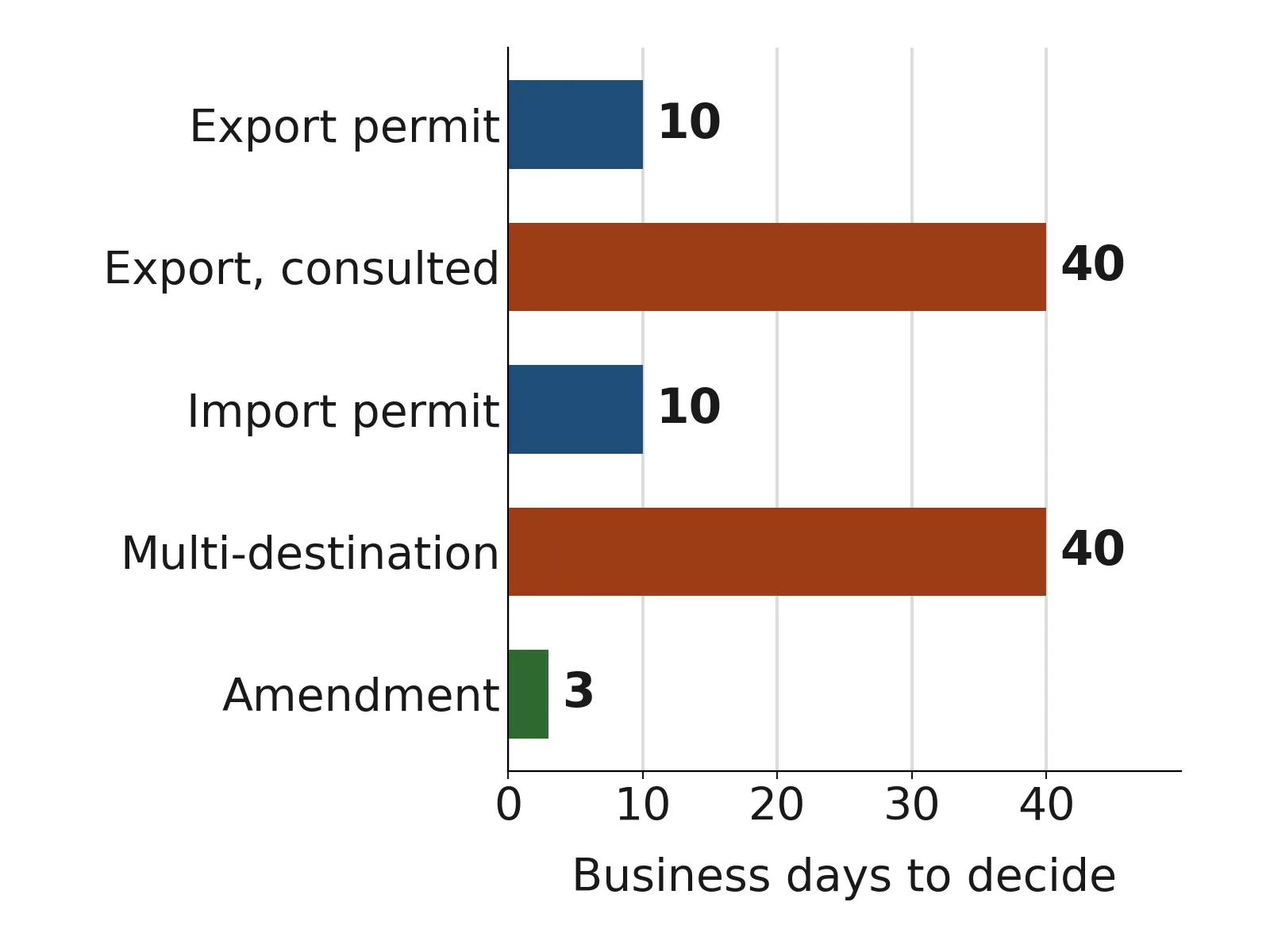
GAC's service standards, in the handbook, are 10 business days for an export permit that does not need consultation outside the Export Controls Division and 40 business days when it does, each with a 90 percent target. Import permits handled under the handbook have a 10 business day standard, multiple destination permits 40 business days, and permit amendments 3 business days. The clock runs from the date GAC receives a complete application.
Permits to export military, strategic and dual-use items are issued free of charge. The handbook lists a fee of $14 for each permit to export goods in items 5101 to 5204 (forest, agricultural and food products), and $9 for softwood lumber products (item 5104). Those are Government of Canada fees, so they are in Canadian dollars.
Import/export permit: Canada vs US licences
US readers often search for an export license. Canada calls it an export permit, and the two systems control similar items for similar reasons, but they use different lists, and each treats the other country lightly for many dual-use items. The table compares the main features. For the US side in detail, see our export control compliance guide.
| Feature | Canada | United States |
|---|---|---|
| Main rules | EIPA and its lists | EAR and ITAR |
| Issuing agency | Global Affairs Canada | BIS (EAR), DDTC (ITAR) |
| Control list | Export Control List | CCL and USML |
| Dual-use to neighbour | Often no permit to US | NS:1 exempts Canada |
| Military to neighbour | Permit or GEP 47 | ITAR 126.5 exemptions |
On the US side, the Export Administration Regulations are administered by the Commerce Department's Bureau of Industry and Security, and the International Traffic in Arms Regulations by the State Department's Directorate of Defense Trade Controls. Under 15 CFR 742.4(a)(1), items controlled for national security under column 1 need a licence to all destinations except Australia, Canada and the United Kingdom. 22 CFR 126.5 sets out Canadian exemptions under the ITAR, subject to conditions and exceptions. Neither rule removes the need for a Canadian permit when the goods leave Canada again.
What happens if you export without a permit?
Under section 19 of the EIPA, a person or organization that breaks the Act or its regulations commits an offence. On summary conviction, the maximum is a fine of $250,000, 12 months in prison, or both. On indictment, the fine is at the court's discretion and the prison term can reach ten years. A summary prosecution must start within three years. These are federal Canadian penalties, so the amounts are in Canadian dollars. Section 20 makes any officer or director who directed, authorized, assented to, acquiesced in or participated in an organization's offence a party to it, whether or not the organization is prosecuted.
The Act also makes it an offence to knowingly give false or misleading information in a permit application (s. 17), to knowingly help divert controlled items to an Area Control List country (s. 15), and to knowingly induce, aid or abet a breach (s. 18). There is one narrow exception. Under section 14.1, an export or import is not an offence if the permit would have been issued had the person applied, and the permit is in fact issued afterwards.
GAC encourages exporters to disclose non-compliance as soon as possible. Its handbook says the division looks favourably on disclosures when the exporter has fully cooperated, but it may still refer a case to the CBSA or the RCMP. A disclosure must come with a cover letter signed by a senior company officer. Because a breach can lead to charges against the company and its managers, a disclosure is a decision to make with counsel, and it may overlap with white collar defense if an investigation is already under way. Our guide to compliance officer responsibilities covers who inside a business should own this process.
Frequently asked questions
Do I need an export permit to ship goods from Canada to the United States?
Usually not. Global Affairs Canada's handbook says many Export Control List items need no permit when the consignee is in the United States. Items controlled to "All Destinations" still need one, including all nuclear and Arms Trade Treaty items and certain firearms, munitions and strategic goods. Goods passing through the United States to a third country need the permit for that third country.
Can a US company get a Canadian export permit?
Only a resident of Canada can apply. The Act treats a corporation with its head office or a branch office in Canada as a resident. A US company can be named as the exporter, but a Canadian resident must be the applicant, and that applicant accepts legal responsibility for the permit and can be liable if the non-resident breaks the Act.
How long does it take to get a Canadian export permit?
Global Affairs Canada's service standard is 10 business days for an export permit that needs no consultation outside the Export Controls Division, and 40 business days when outside consultation is needed, with a 90 percent target for each. Amendments have a 3 business day standard. The time runs from the date a complete application is received.
How much does an export permit cost in Canada?
Permits to export military, strategic and dual-use items, including exports to Area Control List countries, are free. According to the handbook, the fee is $14 per permit for goods in Export Control List items 5101 to 5204, which cover forest, agricultural and food products, and $9 per permit for softwood lumber products under item 5104.
Does sending software or technical data outside Canada count as an export?
It can. The Act defines a transfer of technology as disposing of it or disclosing its content in any manner from Canada to a place outside Canada. The Export Control List covers controlled software and technology sent electronically, and Global Affairs Canada has issued guidance on storing controlled technology in the cloud. Export records must be kept for six years, including intangible exports.
What is General Export Permit No. 12?
It is a general permit that lets any person export US-origin goods covered by Export Control List item 5400 without an individual application. It does not apply to Area Control List countries, Cuba, North Korea, Iran or Syria. When the export must be reported to the CBSA, the exporter inserts "GEP-12" in the appropriate field of the export declaration.
What should a business do if it already exported without a permit?
Stop further shipments of the item, preserve the records and work out whether a permit was actually required. Global Affairs Canada encourages early disclosure of non-compliance and says it views full cooperation favourably, though it can refer a case to the CBSA or the RCMP. Because officers and directors can be personally liable, legal advice before disclosure is prudent.
Conclusion
Most businesses will never need an import/export permit. Canada controls a defined set of items and one destination, and most shipments to the United States are exempt. The exposure sits in the exceptions: dual-use technology sent abroad by email or cloud upload, US-origin parts resold outside North America, goods routed through the United States to a third country, and controlled imports such as steel, apparel or some farm products. Classify first, check the destination and the end user, use a general permit where one applies, and make sure a Canadian resident is the applicant. Keep six years of records, and treat any gap as a disclosure question rather than something to fix quietly.
How Mayo Law can help
Mayo Law is a cross-border firm with offices in Toronto and New York. Joseph Mayo, our principal attorney, is licensed in Ontario and New York. We advise US and Canadian businesses on export and import controls, sanctions screening and compliance programs, and we review contracts that allocate who applies for permits and who carries the risk. Learn more about our compliance practice and our international business law practice.
Disclaimer
This article is for general information only and is not legal advice. Reading it does not create a solicitor-client or attorney-client relationship. Export and import controls, control lists and government guidance change often, and whether a permit is needed depends on the exact item, destination and end user, so obtain advice on your specific situation before shipping. Mayo Law provides legal services in Ontario and New York.