A notice arrives. It might be a Notice to Appear, a hearing notice, or a document that tells you the government believes you violated the terms of your status. If you're a founder, investor, executive, or sponsored employee working between the U.S. and Canada, that letter can feel surreal. You thought you were handling a business immigration issue. Now you're dealing with court.
The first mistake people make is treating this like an application problem that can be fixed with a form and a short explanation. Immigration court is different. It is formal, adversarial, and time-sensitive. A government lawyer may be arguing that you should be removed from the country. Your job is not to guess your way through that process.
At Mayo Law, we help clients navigate cross-border immigration issues where business, compliance, and immigration consequences often overlap. For executives and companies with U.S. and Canadian ties, that overlap matters. A court problem in one country can affect travel, work authorization, admissibility, and future filings in the other.
TL;DR: An immigration court lawyer defends people in removal or admissibility proceedings, prepares legal arguments and evidence, appears before the tribunal or judge, and protects the client's procedural rights. For business professionals, that often means addressing not just immigration facts, but employment records, corporate documents, prior filings, and cross-border strategy.
An Immigration Court Lawyer's Guide to Removal Proceedings
Most readers looking for an immigration court lawyer are already under pressure. They have a hearing date. Their employer is asking what happens next. Their spouse wants to know if travel is still possible. Their business partner is worried a compliance issue is becoming a deportation case.
Removal proceedings in the United States usually start when the government files a charging document with the immigration court. In Canada, proceedings can arise through different enforcement and admissibility mechanisms. In both systems, the practical problem is the same. The stakes are no longer administrative only.
Why business professionals get caught off guard
A businessperson often expects immigration risk to look like a delayed visa, an RFE, or a border refusal. Court is different. Court can follow a visa overstay, a denied extension, an allegation that a business role was mischaracterized, a work authorization issue during a restructuring, or a compliance problem that attracts wider scrutiny.
Two patterns come up often:
- The expanding company problem: A founder starts in one role and drifts into another. The business grows, payroll changes, and the original visa theory no longer matches daily reality.
- The transaction problem: A merger, acquisition, or internal transfer changes ownership or control. The immigration consequences don't get reviewed early enough.
What an effective response looks like
An effective response starts with discipline, not panic.
- Read every page carefully. Dates, hearing location, alleged violations, and filing instructions matter.
- Preserve your records. Keep prior petitions, approval notices, payroll records, tax documents, job descriptions, and company communications.
- Stop casual explanations. Don't improvise facts to HR, border officers, or government agencies.
- Build one timeline. A lawyer will need a clean chronology of entries, filings, status changes, and employment events.
A strong defense often begins with document control. Weak cases become harder when the facts are scattered across email threads, old filings, and inconsistent explanations.
What Is an Immigration Court Lawyer and Why Do They Matter
An immigration court lawyer is not just someone who files petitions with immigration agencies. Court work is litigation. The lawyer appears before a judge or tribunal, responds to government allegations, raises legal defenses, prepares testimony, files motions, and decides what evidence helps or hurts the case.
That distinction matters because many lawyers handle applications but not hearings. A lawyer who is excellent at preparing an E-2, TN, or green card filing may not be the right person to defend a removal case. Litigation requires a different skill set, a different rhythm, and a different tolerance for evidentiary conflict.

Court is adversarial
In U.S. immigration court, the government is represented by counsel. That alone changes the dynamic. You are not asking an officer to approve a benefit. You are responding to a legal case against you.
The numbers show why representation matters. A national study discussed by the Civil Right to Counsel update on immigration representation found that immigrants with attorneys were 15 times more likely to seek relief from removal and 5.5 times more likely to obtain that relief than those without counsel. The same source reports that from FY 2019 to 2024, 62% of immigrants without a lawyer were ordered deported, compared with 27% of those with legal representation.
Those figures don't mean every represented case wins. They do show that representation changes what arguments get made, what relief is requested, and what mistakes are avoided.
What a court lawyer actually does
A real defense involves much more than showing up to a hearing. It usually includes:
- Reviewing the charging theory: Is the government alleging overstay, status violation, fraud, criminal grounds, or something else?
- Testing the record: Do the prior filings, border entries, and employer records support the government's position?
- Choosing the right relief: That may involve challenging removability, applying for relief, seeking termination, or preserving issues for appeal.
- Preparing testimony: Good testimony is organized, specific, and consistent with the documents.
- Managing collateral consequences: A court case can affect visas, future entries, employer sponsorship, and Canadian admissibility.
Why the business context changes the defense
Business clients often carry a documentary footprint that can help or hurt them. Employment agreements, cap tables, board minutes, ownership changes, payroll records, and tax filings can all become relevant. These cases aren't always about humanitarian claims. Sometimes they're about whether the legal theory of your work matched what the business was doing.
For readers comparing options, this is one reason broad online searches for immigration attorneys near me can be misleading. Proximity matters less than whether the lawyer handles removal defense and understands the business facts driving the case.
Practical rule: Ask any lawyer you're considering whether they personally appear in immigration court, prepare witnesses, and handle contested hearings. If the answer is vague, keep looking.
Navigating the Immigration Court Process in the US and Canada
A common business case starts this way. An executive lands for a routine trip, answers a few questions about job duties or ownership, and learns that prior filings, payroll records, or company structure are now under scrutiny. In the United States or Canada, that moment can turn a compliance issue into a removal or admissibility case faster than many companies expect.
The process becomes easier to handle once the stages are clear. The U.S. and Canadian systems use different tribunals and different terminology, but both reward early control over the record, disciplined hearing preparation, and a realistic cross-border strategy.
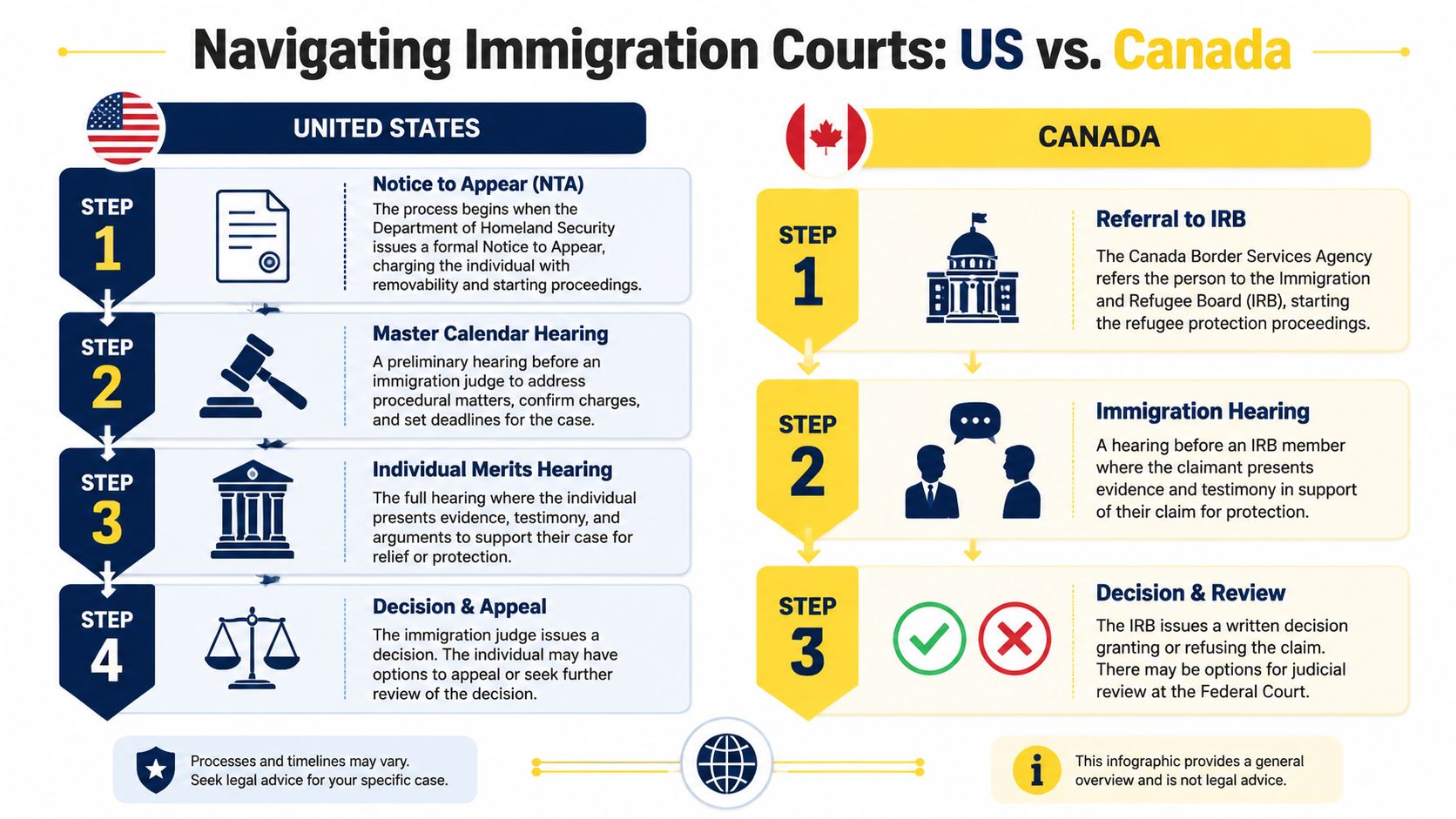
The United States process
In the U.S., removal proceedings are generally handled by the Executive Office for Immigration Review. DHS and USCIS may still matter because their prior filings, site visits, petitions, and interview notes often shape the court record, but the case itself proceeds before an immigration judge.
For official agency information, readers should review USCIS immigration court and removal process information and EOIR court procedures through the U.S. Department of Justice.
Notice to Appear
The Notice to Appear starts the formal case. It lists the government's factual allegations and the legal charge of removability.
For executives, investors, and cross-border managers, the issue is often narrower than the document first suggests. The dispute may center on whether the person performed the role described in an L-1 petition, whether an E-2 enterprise remained active and operating, whether compensation matched the filing record, or whether an ownership change undercut a prior visa theory. Those are record-driven disputes. They can sometimes be corrected or narrowed, but only if someone reviews the file carefully before admissions are made in court.
Master Calendar Hearing
The Master Calendar Hearing sets the framework of the case. The court addresses pleadings, deadlines, scheduling, and the appearance of counsel.
This hearing is brief, but the choices made there carry weight. Counsel may admit or deny allegations, identify available relief, request time to gather records, or raise defects in service and notice. For business clients, this is also the point where the theory of the case should be tied to the company documents. Organizational charts, payroll records, investment documents, and internal role descriptions often matter more than people expect.
Judges run the calendar. They do not explain how to defend a visa compliance case built around a multinational company or founder-led business.
Individual Merits Hearing
The Individual Hearing is where the case is tried. Testimony, exhibits, and legal argument have to fit together.
In employment-based and investor cases, small inconsistencies become major problems. A founder may describe broad strategic work while tax records show a different operational role. A U.S. affiliate may claim managerial need while internal emails suggest the transferee mainly performed hands-on production work. An investor may testify that funds were committed and at risk, but the banking record may show something less clear. These are not abstract technicalities. They are the facts the judge uses to decide whether the original status was valid and whether any defense still stands.
Many contested cases are decided by preparation well before the hearing date. The hearing usually exposes whether the documents, witnesses, and legal theory were built to support each other.
Decision and appeal
The judge may issue a decision from the bench or in writing later. If the result is unfavorable, appeal rights may exist, but deadlines are short and the best next step depends on the problem in the record.
Some cases call for an appeal to preserve legal error. Others call for a motion to reopen or reconsider. In business cases, there is often another layer. Court strategy may need to be coordinated with a pending petition, a compliance response, corporate restructuring, or a consular plan for future travel.
The Canadian process
Canada uses a different structure and different forums. Depending on the issue, proceedings may involve the Immigration and Refugee Board, an admissibility hearing, a detention review, or related enforcement action under Canadian immigration law.
Readers should consult the Immigration and Refugee Board of Canada and Government of Canada immigration enforcement information for procedural guidance.
Referral and admissibility issues
A Canadian case may begin with an enforcement referral based on alleged misrepresentation, status non-compliance, criminal inadmissibility, or another statutory ground.
For business owners and foreign nationals working through Canadian entities, the pressure point is often the prior application history. Work permit filings, investor records, corporate ownership documents, and statements made at the border can all become evidence. A filing prepared for a growth-stage company two years ago may no longer match the business as it operates today. That mismatch is where many admissibility problems begin.
Hearing preparation
Preparation in Canadian proceedings usually turns on four practical questions:
- What legal ground is being alleged
- Which records support or weaken that ground
- Whether procedural fairness problems can be raised
- What the finding will affect beyond Canada, including U.S. travel and future filings
Cross-border clients need a coordinated approach. A Canadian finding can affect future U.S. entries, visa applications, and inspection history. The reverse is also true. I have seen cases where a company focused only on fixing one country's file, then created a fresh inconsistency for the other.
Decision and review
Canadian decisions may be open to appeal or judicial review, depending on the forum and the issue. Those remedies are technical and time sensitive.
Informal explanations rarely solve a record problem after the fact. The better course is to build the file as if review may be needed later, with a clear documentary trail and a precise account of what the business does.
Cross-border strategy matters early
For professionals, executives, and investors, immigration court issues rarely stay inside one legal box. The hearing record may depend on corporate governance, tax filings, headcount, source of funds, or how a foreign parent and local affiliate operate in practice. That is why a general answer to a government allegation is often not enough.
The first consultation should test whether counsel understands both the court process and the business facts behind the visa history. Readers comparing firms can use this Toronto immigration lawyer consultation guide to frame the right questions before that meeting.
When and How to Hire Your Immigration Court Lawyer
The right time to hire an immigration court lawyer is usually the moment you receive notice of proceedings, or the moment you have reason to believe proceedings are likely. Waiting rarely improves your options. It usually reduces them.
That urgency is not just personal intuition. The shortage of counsel is real. According to TRAC's immigration court quick facts, as of March 2026 only 32.8% of immigrants had legal representation when removal orders were issued. The same source reports 18,417 immigration law practices in the United States, but says that supply remains insufficient relative to the 3.2 million case backlog described there.

When waiting hurts the case
Delay creates practical problems fast. Documents get harder to collect. Witnesses become less available. Employers become nervous. Prior counsel may need time to release files. Meanwhile, court deadlines continue running.
A delayed hire also leads to bad strategic habits. People start emailing agencies on their own, making casual admissions, or filing forms that conflict with the defense theory.
What to look for in counsel
Not every immigration lawyer is a court lawyer, and not every court lawyer is comfortable with business-related facts. Use a shortlist and be direct.
Questions worth asking in the first consultation
- Do you handle removal defense regularly? Ask about actual hearing work, not just applications.
- Who will appear in court? Make sure the person you meet isn't handing off the contested work to someone else without explanation.
- Have you handled cases involving employers, investors, or executives? Business records create their own issues.
- How do you charge? Ask whether the fee is flat, staged, hourly, or mixed.
- What records should I gather now? A practical lawyer will give you a clear first list.
What a good answer sounds like
A good answer is specific. It identifies the immediate risks, the likely first steps, the key documents, and the uncertainty forthrightly.
A weak answer sounds generic. If the lawyer talks in slogans, promises a quick fix, or avoids discussing the hearing process, that is a warning sign.
Verify credentials and fit
For Canadian matters or Ontario-based advice, readers can confirm a lawyer through the Law Society of Ontario lawyer directory. For U.S. matters, licensing and court admission should also be verified through the relevant state or federal systems as applicable.
Use a simple comparison table when you're choosing between firms:
| Issue | Good sign | Red flag |
|---|---|---|
| Court experience | Explains hearings, motions, evidence, and testimony prep | Talks only about filing forms |
| Business understanding | Asks for payroll, ownership, job duty, and compliance records | Treats the case as if all facts are personal only |
| Fees | Clear engagement terms and billing structure | Vague estimates with no scope |
| Cross-border awareness | Flags Canadian and U.S. consequences early | Ignores effects outside one country |
If your concern also affects long-term status planning, it's sensible to ask how the court case may interact with future permanent residence options or sponsorship strategy. That is one reason some readers compare removal counsel with broader immigration planning through a green card attorney before deciding who should lead the matter.
Hire for the case you actually have, not the case you wish you had. A hearing notice is litigation. Treat it that way.
Common Defenses and Potential Outcomes in Removal Proceedings
A business immigration court case often starts with a familiar problem. A company grows, roles shift, ownership changes, and the paperwork does not keep pace. Then a visa compliance issue that looked administrative turns into an allegation that the executive, manager, or investor is removable.
That is the point where defense strategy has to get precise.
In removal proceedings, there are usually two paths. One is to contest the government's charge. The other is to ask for relief that allows the person to remain in the country despite the charge. Good counsel evaluates both at the same time, because the strongest court strategy is not always the most obvious one on the Notice to Appear.
Challenging the government's case
Some cases should be fought at the front end. The government may be relying on an overbroad reading of a prior filing, an incomplete record, or a theory of status violation that does not hold up once the business documents are reviewed carefully.
For executives, founders, and investors, the facts usually live in records, not in a simple personal timeline. Job duty breakdowns, cap tables, payroll records, board minutes, investment transfers, intercompany agreements, and prior border statements can all matter. Small inconsistencies can create a removability argument. Clear documentation can also defeat one.
I often see this in L-1 and E-2 matters. An executive enters to direct a qualifying business. Six months later, the company is smaller than projected, the officer is handling sales directly, or a financing round changes ownership percentages. None of that automatically proves a violation. But if the later filings gloss over those changes, the government may argue that the original classification no longer fits or was misrepresented.
Those cases are won or lost on detail.
Seeking relief from removal
If the charge itself is difficult to beat, the focus shifts to what relief is legally available and realistically provable. That depends on the person's immigration history, family ties, length of residence, prior filings, and whether any discretionary factors will help or hurt.
Possible avenues can include:
- Applications based on protection or humanitarian grounds
- Relief tied to family relationships or long-term residence
- Waivers where the statute allows them
- Motions that affect how or when the court decides the case
Naming a form of relief is only the start. The harder task is presenting a consistent record that supports it without creating new problems elsewhere, especially for business clients who may still have viable employer-sponsored options. If long-term planning remains possible, court strategy should be coordinated with any future employment-based green card process rather than handled in isolation.
The overlooked business scenario
Public guidance on immigration court usually centers on asylum claims or family hardship cases. Those are important cases, but they do not answer the questions a cross-border company asks when a founder on an E-2 visa or an affiliate executive on an L-1 is placed in proceedings after a compliance review, a border inspection, or a petition discrepancy.
That gap matters. The National Immigrant Justice Center page on access to counsel discusses the broader representation problem, and post-2024 policy shifts increased removal referrals for investor visas by 28% according to that source, which puts more business visa holders in a court system that is not designed around corporate fact patterns.
A typical example looks like this. A Canadian executive is sent to the United States to launch operations for an affiliated company. The company expands quickly. Day-to-day duties start crowding out executive oversight, and a later financing event changes the ownership structure. If those developments are not documented and reconciled properly in later filings, the government may frame the issue as a status violation, or worse, a misrepresentation case.
A serious defense in that setting usually requires coordinated review of:
- Corporate governance records
- Payroll and compensation documents
- Investment source and structure
- Prior petition filings and border statements
- Any related fraud, tax, or compliance concerns
Mayo Law works with clients across the GTA and on cross-border matters. Joseph Mayo is licensed in Ontario and New York, which helps clients address U.S. court issues and Canadian consequences in a coordinated way instead of splitting the file between separate firms.
Outcomes vary. Proceedings can end with termination, relief being granted, voluntary departure in some cases, or a removal order. The practical goal is to choose the path that protects legal status, preserves future options where possible, and avoids turning a fixable compliance problem into a permanent immigration record.
Costs, Timelines, and What to Expect at Your Hearing
People usually want three practical answers right away. How much will this cost. How long will this take. What will happen when I walk into court.
There is no single price for an immigration court case, and I won't pretend otherwise. Some matters are narrow and document-driven. Others require multiple hearings, witness preparation, expert evidence, or appeals. The honest way to discuss fees is by structure, not by invented averages.

How fees are commonly structured
Lawyers often use one of these billing approaches:
- Stage-based flat fees: One fee for the initial court phase, another for applications or merits hearing prep.
- Hourly billing: More common where the factual record is messy or business documents need deep review.
- Hybrid arrangements: A defined initial scope, then hourly work for contested issues or appeals.
Government filing fees, when they apply, should be checked through official sources such as USCIS forms and filing fees and relevant Canadian government pages on immigration applications and enforcement processes through Immigration, Refugees and Citizenship Canada. Court defense costs and government filing fees are separate things. Ask for both.
Why timelines are hard to predict
Delay is built into the current system. According to the verified data drawn from Docketwise's discussion of immigration court statistics, the U.S. immigration court system had over 3.7 million cases pending as of late 2024. The same source says courts completed 914,812 cases in 2024, yet backlog growth still left wait times long and unpredictable, with business and visa planning affected by 18 to 36 months.
That creates a difficult reality for employers and executives. A case can move slowly overall, then suddenly require fast action on a filing, witness list, or hearing date. Clients should plan for both long uncertainty and short deadlines.
Don't build a business timeline around hope. Build it around contingency planning, document readiness, and the possibility that hearing schedules will shift.
What the hearing feels like
Most hearings are more formal than clients expect, but less theatrical than television suggests. The key participants are usually the judge, government counsel, your lawyer, and you. If there are witnesses or interpreters, they become part of the hearing structure as well.
What helps most is preparation:
- Know the purpose of that hearing. Not every date is a full trial.
- Review your timeline carefully. Small inconsistencies can become large credibility problems.
- Dress and act professionally. Court isn't the place for improvisation.
- Answer what is asked. A concise truthful answer is usually better than a long defensive one.
If you're a business owner or executive, expect questions that test whether your real-world role matched your immigration story. That is why employment and corporate records have to be reviewed with care before anyone takes the stand.
Frequently Asked Questions About Immigration Court
Do I get a free government-appointed lawyer in immigration court
Usually, no. In immigration court, people generally have the right to retain counsel, but not to have counsel appointed at government expense in the way many people expect from criminal court.
What happens if I miss a hearing
Missing a hearing can be extremely serious. The court may proceed without you and issue an adverse result. If you have notice of a hearing, treat attendance as mandatory unless your lawyer has obtained a valid change or other formal relief.
Can I keep working while my case is pending
That depends on your procedural posture and whether you have independent work authorization or eligibility to apply for it. Don't assume that a pending court case itself gives you permission to work.
Can a business compliance problem really lead to removal proceedings
Yes. Problems tied to status compliance, job duties, ownership structure, or prior representations can escalate beyond an application denial. For executives and investors, immigration issues often overlap with employment and corporate records.
Will a U.S. removal issue affect Canada, or the reverse
It can. Cross-border travel, admissibility, future visa applications, and disclosure obligations may all be affected. Anyone with ties to both countries should assess the downstream consequences before taking procedural steps in either system.
Should I keep filing applications while the court case is pending
Sometimes yes, sometimes no. The answer depends on jurisdiction, timing, eligibility, and overall strategy. Uncoordinated filings can undermine the defense if they contain inconsistent facts or legal positions.
If you're facing proceedings and your facts involve business operations, investor status, executive employment, or U.S.-Canada mobility, get advice early. Mayo Law serves clients across Toronto, the GTA, and on cross-border matters between Canada and the U.S. To discuss your situation, visit mayo.law.
Joseph Mayo is the principal lawyer at Mayo Law, licensed in Ontario and New York, with a Master's degree from NYU School of Law. He advises clients on immigration, business, and cross-border matters across the GTA and between Canada and the U.S. Learn more on the Joseph Mayo profile.
Related articles:
- Visa overstay in the U.S. myths, facts and what you need to know
- Immigration lawyer Toronto free consultation
- How to get a green card through employment
This article is for informational purposes only and does not constitute legal advice. Every situation is different. Consult a licensed lawyer about your specific circumstances.