You're likely here because the process already feels bigger than a forms exercise. Maybe you're a Canadian professional working in the U.S. on a TN, a founder planning a move south, or a spouse trying to decide whether consular processing or adjustment of status makes more sense. The hard part usually isn't finding the forms. It's choosing a strategy that won't create avoidable delay, status problems, or a denial you could have seen coming.
A good green card attorney helps with more than paperwork. The lawyer's real value is spotting the issue you didn't know was an issue: immigrant intent on a temporary visa, a prior overstay that changes the filing path, a weak employment timeline, a missing civil document, or a family sponsorship step that looks simple until the case stalls. For Canadians and others with U.S.-Canada ties, those strategic decisions matter even more because travel, work authorization, and timing often overlap.
Short answer: If your case is straightforward, some people do file on their own. But once the case involves employment sponsorship, cross-border travel, prior status issues, family complications, or any past inadmissibility concern, hiring a green card attorney becomes a practical risk-management decision, not a luxury.
When to Hire a Green Card Attorney vs Going It Alone
People often ask the wrong first question. They ask whether they can file without a lawyer. The better question is whether they should.
For a narrow set of cases, self-filing may be manageable. If the facts are clean, the relationship evidence is strong, there are no past immigration problems, and the filing route is clear, some applicants do complete the process on their own. That doesn't mean it's low stakes. It means the legal analysis may be more limited.
Most cases that land on a lawyer's desk are not that simple. They involve timing issues, prior entries and exits, employer sponsorship, cross-border work, dependants, or records that need explanation rather than just submission.

Cases that usually justify legal help
If any of the following apply, going alone becomes riskier:
- Past status problems: overstays, unauthorized work, prior refusals, or border issues can affect eligibility and filing strategy.
- Any criminal history: even a charge that seems minor under Canadian law can require careful analysis under U.S. immigration law.
- Employment-based sponsorship: PERM, I-140 strategy, job duty framing, and timing between temporary work status and permanent residence all require coordination.
- Cross-border families: where one spouse lives in Canada, the other works in the U.S., and children may have different status histories.
- Medical, disclosure, or misrepresentation concerns: these are not areas for guesswork.
One recurring mistake is assuming that a case is simple because the relationship or job offer is real. Authentic facts help, but they don't eliminate procedural risk. USCIS and consular officers still expect the right category, the right evidence, and consistent answers across the full record.
The cost question is real, but so is the risk
Some people hesitate because they don't want to spend money on legal fees when filing fees are already significant. That concern is understandable. But with immigration, the cheapest first step is not always the lowest-cost path overall.
The strongest evidence for that comes from broader immigration outcomes. Immigration court data summarized by MyCase states that 62% of immigrants without a lawyer were ordered deported, compared to 27% of those with legal representation in FY 2019 to 2024. The same report states that among detained individuals, only 3% received removal orders when they had an attorney.
Those numbers are from removal proceedings, not green card filings. Still, they show a larger truth that also applies in benefit cases: representation changes outcomes because lawyers identify legal problems early, prepare evidence in a usable way, and keep applicants from making avoidable procedural mistakes.
Practical rule: Hire counsel when the consequence of being wrong is bigger than the cost of getting advice.
What works and what doesn't
What works is early review. A lawyer who sees the file before anything is submitted can shape the case around eligibility, timing, and proof. That is very different from hiring counsel after a denial, after inconsistent forms have already been filed, or after someone has made a damaging statement at the border.
What doesn't work is partial DIY with occasional internet research. Immigration law is full of details that look interchangeable but are not. Consular processing and adjustment of status are not the same. A TN is not the same as a dual-intent visa. A marriage case with clean records is not the same as one involving prior status lapses.
If you're on the fence, a consultation is often enough to answer the central question: is this really a forms case, or is it a strategy case? Many readers who are weighing that issue also look for local immigration counsel options before deciding how to proceed.
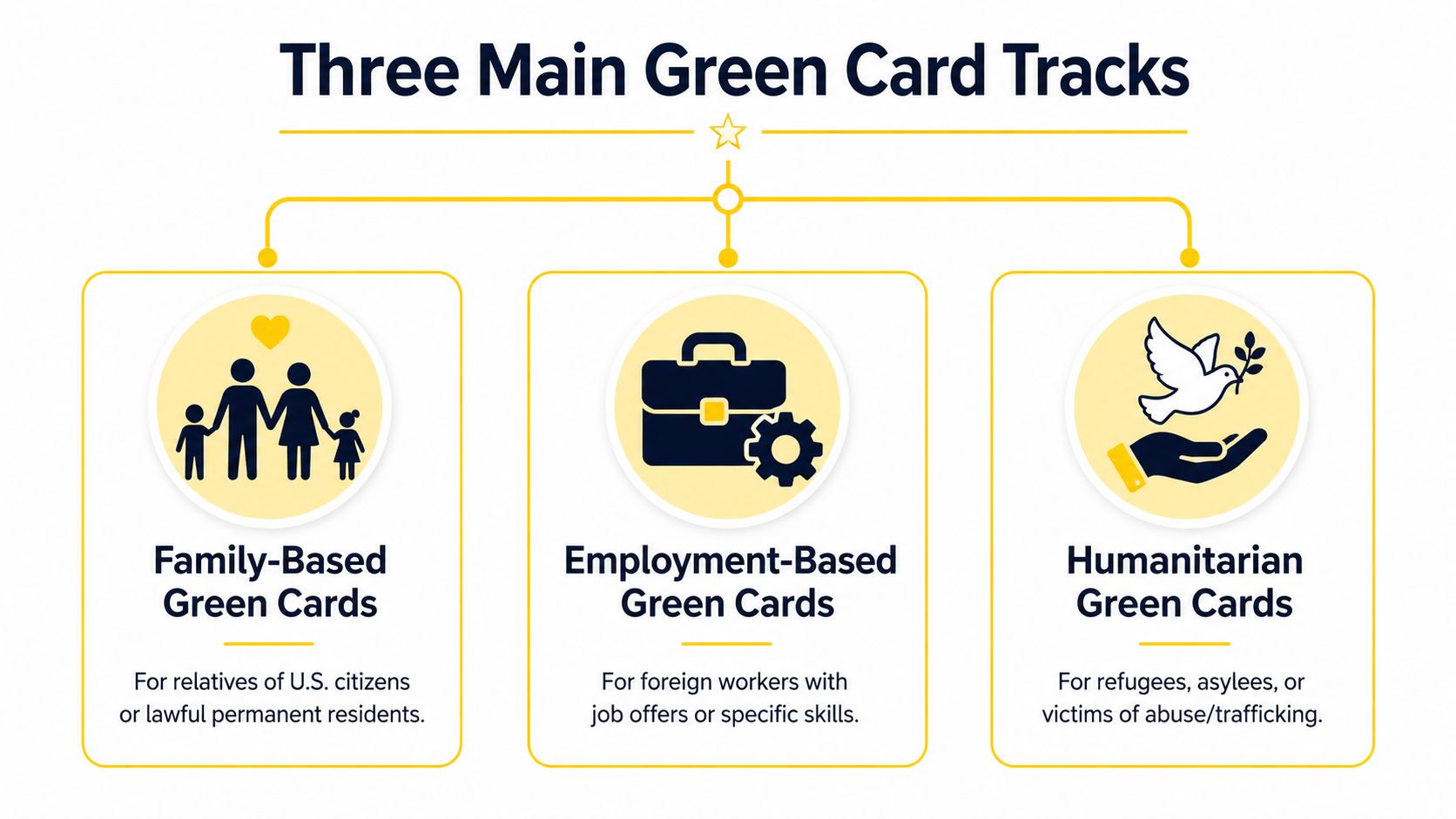
Understanding the Three Main Green Card Tracks
Many applicants do not require a full taxonomy of immigration law. They need to know which path they are on, what that path requires, and where it tends to become technically difficult.
The three tracks most readers think about are family-based, employment-based, and investment-based. There is also a humanitarian side of the system, and you'll see that reflected below because it matters to the larger structure of U.S. permanent residence.
The employee track
This is the path for the sponsored professional, executive, researcher, or other worker whose eligibility is tied to employment. For Canadians, this often connects to an earlier temporary status such as TN or L-1, followed by a permanent residence strategy when the employer wants a longer-term solution.
Employment-based cases can be highly document-driven. The legal work may involve labor certification, the employer's offered role, proof of qualifications, wage and job classification issues, immigrant visa availability, and filing timing if the person is already inside the U.S.
There's a useful reason not to confuse “strict” with “unlikely.” Docketwise reports that employment-based green card applications had a 91% approval rate in fiscal year 2024, with an average processing time of 6.7 months. That tells me two things. First, the standards are serious. Second, well-prepared filings can succeed at a high rate.
If your path is job-based, it helps to understand the process in detail before choosing the route. This guide on how to get a green card through employment is a useful starting point.
The family track
This is the path for close relatives of U.S. citizens or lawful permanent residents. In practice, family-based cases range from very direct to highly sensitive.
A straightforward spousal case may still require careful handling if there was a prior visitor entry, a long-distance relationship history, children from earlier relationships, prior marriages, or concerns about intent at entry. Cases involving parents, adult children, or permanent resident sponsors can present different timing and procedural issues.
Family cases are often emotionally easier to explain than employment cases, but not always easier to prove cleanly. The challenge is usually consistency. Dates, addresses, prior marriages, travel records, divorce documents, and supporting affidavits need to align.
A family-based filing often succeeds or fails on organization. The relationship may be genuine, but if the record is scattered, the case becomes harder than it needs to be.
The investor track
This is the route people often ask about after building a business, selling one, or planning a U.S. expansion. In conversation, many people use “investor green card” broadly, even when they are really talking about a temporary investor visa as a bridge to later permanent residence.
That distinction matters. A temporary business immigration plan may support eventual permanent residence, but it is not automatically the same thing as a green card filing. Investors, founders, and owner-operators need a sequence that fits the business reality, ownership structure, and personal travel needs.
For cross-border entrepreneurs, the legal problem is usually not just eligibility. It is choreography. The business plan, the visa strategy, the timing of relocation, and the permanent residence goal all need to work together.
Consular processing and adjustment of status
These aren't separate green card categories. They are the two main ways people complete the final permanent residence process.
Consular processing is usually the route for someone outside the U.S. The person applies through a U.S. consulate abroad after the immigrant petition phase and document processing are complete. For many clients living in Toronto or elsewhere in Canada, this is the practical path.
Adjustment of status is usually for someone already in the U.S. who is eligible to apply for permanent residence from inside the country. This can be convenient, but only if the person's current status, entry history, and timing support it.
A green card attorney earns their fee here by deciding not just whether you qualify, but which process better fits your facts. I've seen applicants choose adjustment because it sounded easier, when consular processing was cleaner. I've also seen people assume they had to leave the U.S. when an in-country filing would have preserved continuity better.
How to Select and Vet Your Immigration Lawyer
A common cross-border scenario goes like this. You live in Toronto, work in the U.S. on TN status, and decide it is time to pursue permanent residence. One lawyer says, “file now.” Another says, “wait.” A third barely asks about travel history, prior entries, or whether your spouse may be the stronger principal applicant. That is the point to slow down and vet carefully, because the lawyer you hire will shape both timing and risk.
Choosing counsel is a judgment call about fit, not just credentials. A lawyer who handles straightforward marriage-based filings every week may not be the right person for a PERM case, a self-sponsored petition, or a file with prior refusals, border issues, or possible inadmissibility. For clients with U.S.-Canada ties, the screening standard should be even tighter. The legal strategy often turns on facts that are easy to miss if the lawyer does not regularly work with TN status, commuter patterns, consular interviews in Canada, or parallel Canadian obligations.

Start with licensing, discipline history, and actual case fit
Verify the lawyer's license before you discuss strategy in any detail. If the matter has both U.S. and Canadian dimensions, check both where applicable. A dual-licensed lawyer will not change the legal standard, but can often spot planning issues earlier because the same fact pattern may affect U.S. immigration steps, Canadian residency ties, tax coordination, or document collection on both sides of the border.
Use primary sources, not marketing copy:
- USCIS information on green cards and procedures
- U.S. Department of State immigrant visa process information
- Law Society of Ontario lawyer directory
It also helps to review immigration attorneys near you who handle green card matters and then compare lawyers by licensing, case type, and whether they regularly advise on U.S.-Canada fact patterns.
Questions that tell you how the lawyer thinks
A good consultation should produce a working theory of the case, even if the lawyer still needs records before giving firm advice. Immigration law is full of details that seem interchangeable but are not. Entry classification, immigrant intent, maintenance of status, where the applicant lives, and where the interview will occur can all change the recommended path.
Ask questions that test analysis, not confidence:
- What facts would change your recommendation? Strong lawyers usually identify the missing pieces before giving a final answer.
- How often do you handle this category? Ask specifically about TN holders, consular processing in Canada, family-based adjustment, PERM-based cases, or waivers, depending on your file.
- Who is the better principal applicant, if there is more than one option? In married couples and some employment cases, the wrong principal can add delay or create avoidable problems.
- What are the pressure points in my timeline? For Canadians, that may include TN renewals, travel to and from the U.S., expiring status documents, or whether a consular interview in Montreal makes more sense than an in-country filing.
- Who will run the file? Some firms delegate almost everything after intake. That is not always a problem, but clients should know whether the lawyer remains involved in strategy and review.
- What does the fee cover, and what falls outside scope? Ask about RFEs, interview prep, motions, responses to government notices, and post-filing strategy.
Short answers are not always bad. Vague answers usually are.
Red flags that should make you pause
Some warning signs are obvious. Others show up only after you ask a few practical questions.
| Issue | Why it matters |
|---|---|
| Guaranteed approval | No lawyer controls the final decision |
| Vague fee terms | You need to know what the fee includes, and what will cost more |
| No discussion of risk | A careful lawyer should identify weak points early |
| Push to sign before review | Urgency can be real, but pressure is not a substitute for analysis |
| Generic advice | Good strategy should reflect your entries, status history, family facts, and travel pattern |
| No cross-border awareness | For Canadian clients, overlooking TN intent issues or consular logistics can create avoidable problems |
One practical test matters more than many clients realize. Does the lawyer ask for a full timeline early, or do they jump straight to forms and filing fees? In my experience, lawyers who do the former usually catch the issues that matter. Lawyers who do the latter often discover the actual problems after the case is already in motion.
The right attorney should make the process clearer. They should explain the trade-offs, flag the facts that need review, and tell you where the case is strong, where it is exposed, and what can be done about it.
What to Expect After You Hire Your Green Card Attorney
Once you hire counsel, the process should become more structured. Not faster by magic, and not stress-free, but more predictable.
A good attorney-client relationship usually starts with a deeper intake than the initial consultation. The lawyer will want a full timeline, not just the headline version. They need prior U.S. entries, past visas, prior refusals, family relationships, addresses, employment history, and any issue that could affect admissibility or eligibility.
The first phase is fact gathering
Most clients underestimate how much the case turns on documents that seem routine. Birth certificates, marriage certificates, divorce records, passports, I-94 travel records, employer letters, tax records, police or court documents if applicable, and immigration notices all matter because they create the file's internal consistency.
An employment-based case may also require the employer to provide detailed position information and supporting corporate records. A family-based case may require proof that the relationship is both genuine and well-documented over time.
Here's what that usually looks like in practice:
- Timeline review: every entry, status change, and major life event goes onto one coherent chronology.
- Document checklist: civil records, identity records, status records, and category-specific evidence are gathered.
- Strategy confirmation: the lawyer confirms filing path, principal applicant, dependants, and timing.
- Drafting and review: forms are completed and checked against the source documents.
- Submission and follow-up: after filing, the case moves into receipts, biometrics or interview preparation, and any response work if the agency asks for more.
A practical cross-border example
Consider a Toronto-based marketing manager who works for a U.S. company and travels frequently for meetings. The employer now wants to sponsor permanent residence. The core legal work is not just preparing forms. It is deciding whether the person should remain primarily in Canada and complete processing abroad, or whether a U.S.-based filing makes sense if they are eligible and the timing works.
That decision can affect travel, work continuity, and stress level for the applicant and the employer. It can also affect spouses and children if the family is split between countries during processing.
Fees, timelines, and what your lawyer controls
Your lawyer controls preparation quality, legal analysis, and response strategy. Your lawyer does not control USCIS adjudication speed, consular scheduling, or visa number movement.
That's why clients should verify official procedural information directly. USCIS maintains its own filing fee information and case processing times. Those are the right places to check current government timelines and costs.
If your long-term plan includes naturalization after permanent residence, it's also worth understanding the later stage early. This overview of how to get U.S. citizenship helps many clients see the green card as part of a longer immigration plan rather than a one-off filing.
Avoiding Common Pitfalls and Navigating US-Canada Issues
Some green card problems come from bad facts. Many come from avoidable decisions.
The most common pattern I see is not fraud or recklessness. It's underestimating how one step affects the next one. A border conversation affects a later filing. A temporary visa choice affects immigrant intent analysis. A rushed package creates inconsistencies that later have to be explained under pressure.

The notario problem is real
Unauthorized immigration consultants often present themselves as affordable alternatives. For basic form entry, that may sound harmless. It isn't.
CLINIC explains unauthorized practice in immigration matters, including that unauthorized consultants, often called notarios, are barred from giving legal advice under 8 C.F.R. § 1.1(i). The same source notes that a botched application can lead to rejection, restarted timelines costing 18 to 24 months, and over $10,000 in remedial legal fees to fix.
That is not a bargain. It is deferred cost plus added legal risk.
If someone is choosing your category, telling you what to disclose, or advising you how a prior issue affects eligibility, that is legal advice. In immigration, getting that advice from the wrong person can damage the case before a real lawyer ever sees it.
Problems that often surface too late
A few examples come up repeatedly:
- Inconsistent records: addresses, travel dates, marital history, and job titles don't match across forms and source documents.
- Status complacency: the applicant assumes a pending case solves every travel or work issue. It often doesn't.
- Overconfidence about old issues: a prior charge, old overstay, or border note is dismissed as irrelevant without analysis.
- Temporary visa misunderstanding: the person treats a nonimmigrant visa as if it were neutral to future immigrant intent questions.
For family-based applicants, interview preparation matters too. Readers dealing with relationship-based filings often benefit from reviewing practical questions around marriage-related immigration concerns.
Special issues for Canadians and cross-border applicants
Canadian applicants often have one practical advantage. Travel between Canada and the U.S. can be relatively frequent and business-driven. That convenience can also create legal risk if the person starts using a temporary status in a way that no longer matches the actual plan.
The classic example is the TN visa. It can be an excellent professional entry route, but it is not generally treated the same way as a dual-intent category. That means timing matters if permanent residence is being considered. You can often build a lawful path from temporary work status to a green card, but the sequence has to be thought through carefully.
The same is true for L-1 holders, founders, and executives transferred within related entities. The business story, payroll reality, job duties, and permanent role all need to align. A lawyer who understands both border practice and green card planning can help avoid the trap of solving today's entry issue in a way that complicates next year's permanent residence strategy.
Frequently Asked Questions About the Green Card Process
Can I change lawyers after my case has already started
Yes, you usually can. The practical issue is transition. Your new lawyer will need the prior filings, notices, and any correspondence to assess what has already been submitted and whether anything needs to be corrected or clarified.
What happens if USCIS denies the case
A denial does not always end the matter. The next step depends on the reason for the denial, your current status, whether a motion or appeal is available, and whether refiling is the cleaner option. The answer is case-specific.
Do I need to renew a green card forever
Not necessarily. Some people remain permanent residents long term and renew as required. Others later apply for naturalization if they meet the eligibility rules and want U.S. citizenship.
Can my spouse and children be included
Often yes, but it depends on the category and timing. Derivative benefits are common in many employment-based matters. In family cases, the structure is different, and each family member's facts still need to be reviewed carefully.
Is consular processing better than adjustment of status
Neither is automatically better. The cleaner route depends on where you are living, your immigration history, your current status, travel needs, and whether filing inside the U.S. is legally available and strategically wise.
How should I prepare for a marriage-based interview
Prepare by reviewing your timeline, your documents, and the details of your relationship carefully and thoroughly. If you have concerns about a spousal case, this guide to the marriage interview for a green card can help you understand the issues that often come up.
If you're weighing a family-based case, an employment sponsorship, or a cross-border strategy involving Canada and the U.S., Mayo Law is one option to consider. Joseph Mayo is licensed in Ontario and New York, which can be useful where immigration planning overlaps with cross-border work, business structure, or travel realities. Book a consultation at mayo.law if you want a case-specific assessment rather than general information.
Joseph Mayo is the principal lawyer at Mayo Law, licensed in Ontario and New York, with a Master's degree from NYU School of Law. He advises clients on immigration and cross-border matters across the GTA and between Canada and the U.S. Learn more on the Joseph Mayo profile.
This article is for informational purposes only and does not constitute legal advice. Every situation is different. Consult a licensed lawyer about your specific circumstances.