


Published: May 21, 2026 | Updated: May 21, 2026 | Read time: 12 minutes
You may be sitting in Toronto, New York, or anywhere else outside California, ready to hire a California-based “consultant” for sales, design, software, marketing, or operations. The contract says independent contractor. The person has an invoice template. Everyone wants speed.
That’s exactly where the California Assembly Bill 5 or as more commonyl known AB 5 law, becomes a real business risk.
For cross-border companies, the mistake usually isn’t bad intent. It’s assuming that a clean contract and a familiar freelancer model will hold up everywhere. In California, that assumption can fail quickly if the worker is doing part of your core business. At Mayo Law’s international business practice, we help businesses in Toronto, the GTA, and across the border handle this kind of expansion issue on a process that often touches both Canadian and U.S. rules at once.
A practical point matters from the start. Federal contractor concepts and your home-jurisdiction habits don’t override California’s worker-classification rules. If the worker is in California, you need to test the relationship under California law before you onboard them.
An Introduction to AB 5 for Expanding Businesses
A founder in Toronto hires a California-based sales lead on commission. A Montreal software company brings on a California product designer through a monthly contractor agreement. A U.S. parent company asks a California marketing consultant to join weekly team meetings and report to an internal manager. Each arrangement can look ordinary from the home office. In California, each one can trigger employee-classification risk fast.
That risk is easy to miss in cross-border growth. Teams are focused on market entry, tax setup, IP ownership, payment flows, and hiring speed. Worker classification often gets pushed down the list. That is a mistake. If the person is working in California, California’s rules can apply even if your company is based in Canada or elsewhere in the U.S.
The practical problem is straightforward. A contractor agreement is evidence, not protection. If the day-to-day relationship looks like employment, labels and invoices will not carry much weight.
I see this most often with companies expanding into California before they have local HR or legal infrastructure. They use the same contractor model that worked in Ontario, British Columbia, or New York, then discover that California applies a much stricter test, especially where the worker supports the business’s core service. For businesses handling U.S.-Canada expansion issues, that is exactly the kind of cross-border compliance problem Mayo Law’s international business practice is built to address.
The consequences are not limited to a contract dispute. A bad classification decision can pull in payroll obligations, overtime exposure, meal and rest break claims, workers’ compensation issues, unemployment insurance, and penalties tied to wage and hour rules. Those costs often appear later, after the relationship sours or the company is already scaling.
A simple screen helps at the start:
- Core business work: The worker is doing the same kind of work your company sells to customers.
- Manager control: Your team sets hours, approvals, reporting lines, or methods of work.
- Economic dependence: The worker relies heavily on your company and does not operate like a separate business.
- Delayed review: No one assesses California classification risk until after onboarding.
If those facts are present, treat the arrangement as high risk on day one. For a cross-border employer, AB 5 is not a paperwork issue. It is an early hiring decision that affects cost, structure, and whether you should use a contractor at all.
What is the ABC Test Under California’s AB 5 Law?
California’s AB 5 law is a default employee-classification rule. It presumes a worker is an employee unless the hiring entity proves all three parts of the ABC test. Under the test, the business must show that (A) the worker is free from control and direction, (B) the work is outside the usual course of the hiring entity’s business, and (C) the worker is customarily engaged in an independently established trade or business of the same nature, as summarized by the California Franchise Tax Board AB 5 FAQ.

A means freedom from control
This part asks whether the worker is free from your control, both in the contract and in real life. If you dictate the person’s schedule, methods, approvals, training, and day-to-day process, you have a problem.
A project-based copy editor with autonomy over timing and workflow may fit better here than someone who attends daily standups and follows a manager’s instructions like staff.
B means outside your usual business
This is often the hardest part. If your company sells software development and your “contractor” develops the software, prong B becomes difficult. If your company is a marketing agency and the contractor performs client-facing marketing services, same issue.
For many businesses, prong B is the pressure point because California requires all three prongs, not two out of three.
If the contractor is doing the same thing your company markets to customers, assume this needs a hard legal review before onboarding.
C means an established independent business
This part looks for signs that the worker is operating a real standalone business of the same kind. Think multiple clients, business registrations, independent branding, separate invoicing, and a market presence that exists apart from your company.
Someone who has one client, uses your systems, and depends on your managers for direction is much harder to defend as independent.
What works and what doesn’t
A quick comparison helps:
| Situation | Better for contractor status | Worse for contractor status |
|---|---|---|
| Work structure | Project-based deliverables | Ongoing open-ended duties |
| Control | Worker chooses method | Company directs daily process |
| Business role | Ancillary to your business | Core to what you sell |
| Market presence | Multiple clients and branding | Works only for you |
The biggest takeaway is blunt. Fail one prong, and the relationship is treated as employment for these statutory purposes.
The History and Evolution of California's Worker Classification Rules
AB 5 did not appear out of nowhere. It came out of a broader California shift toward stricter worker-classification rules and a policy choice to place more of the burden on hiring businesses. For employers, the important part isn't just history. It's understanding why California built the rule this way and why it has remained politically and commercially contentious.
California enacted AB 5 in 2019, Governor Gavin Newsom signed it on September 18, 2019, and it became effective on January 1, 2020. That date matters because many companies still treat AB 5 as if it were a niche gig-economy rule, when it was a much broader statutory reset.
The scope was substantial from the start. A UC Berkeley Labor Center analysis estimated that the ABC test would apply to 64% of workers who are independent contractors at their main job, would apply except when strict criteria are met to 27%, and would not apply to 9%, according to the UC Berkeley Labor Center analysis of AB 5 coverage.
Why the law changed business planning
Those figures explain why AB 5 became one of the most consequential worker-classification reforms in the United States. It wasn't aimed only at app-based labor. It reached into media, logistics, professional services, and other sectors where businesses had long used freelance or project-based models.
For cross-border companies, that means California is not a state where you can casually import your existing contractor playbook. If you benchmark U.S. hiring risk based on federal concepts alone, California can break that model.
Why the law did not stay static
AB 5 also changed quickly in practice. In September 2020, AB 2257 revised and added many exemptions. One legal analysis noted that the ABC test could affect up to two million independent contractors in California for wage-and-hour and related laws, and an industry summary reported 109 categories of workers exempted from the ABC test after the revisions, as discussed in the Ogletree summary of AB 2257 changes.
That combination tells you a lot. The law was broad enough to reshape business behavior, then controversial enough to generate a large exemption architecture almost immediately.
The practical lesson is not “AB 5 bans contractors.” The real lesson is that California created a default rule, then layered a complicated exception system on top of it.
That is why so many businesses get this wrong. They either overreact and assume no contractor relationship can work, or underreact and assume a title like “consultant” will solve the problem.
Who AB 5 Covers and Key Professional Exemptions
AB 5 starts with a broad default. Many workers are presumed to be employees unless the hiring business can satisfy the applicable standard. But the law does not operate as a flat ban on independent contracting. The challenge, however, is that the exemption structure is technical, detailed, and constantly misunderstood.
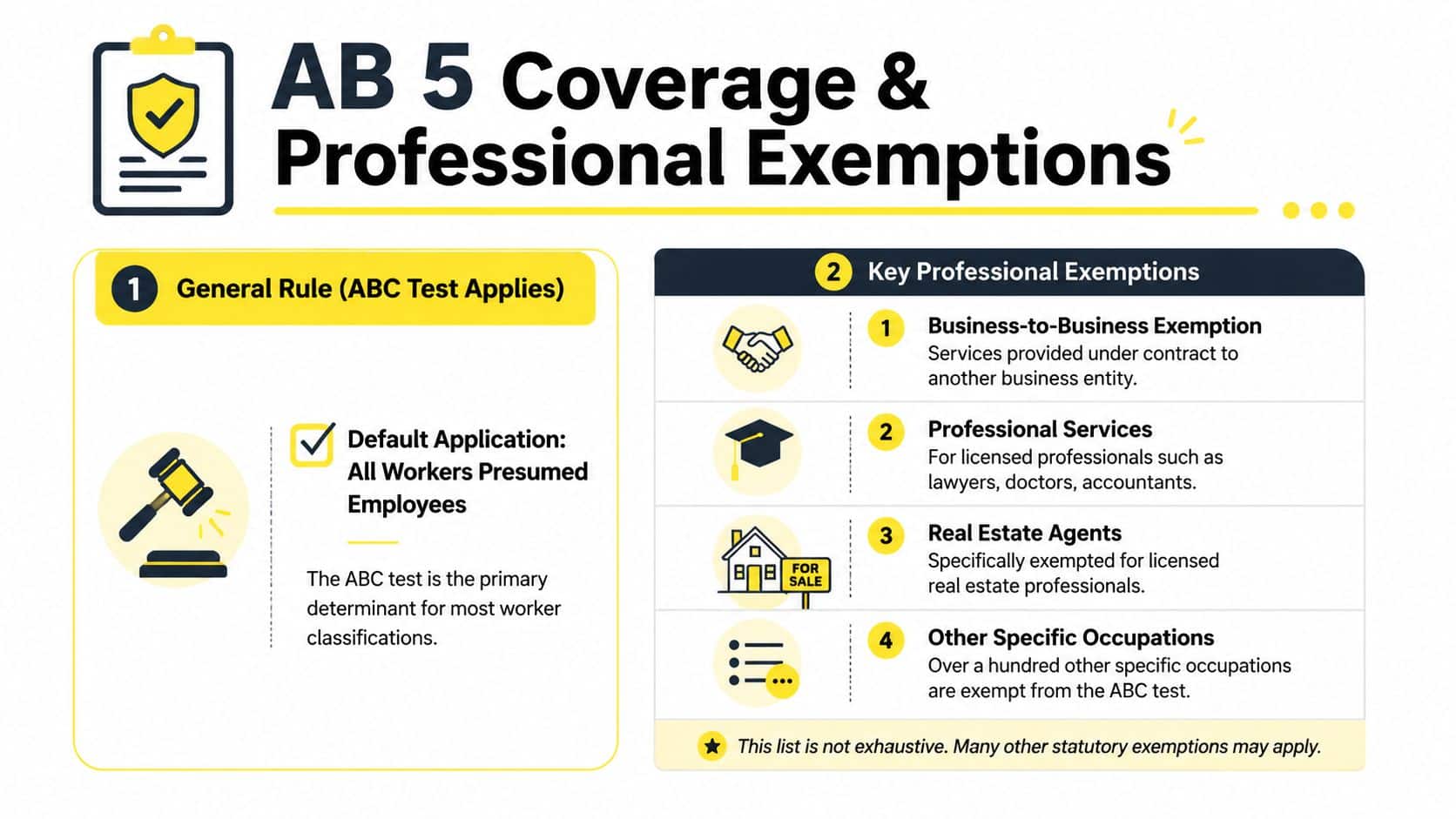
By September 2020, AB 2257 had revised and expanded the exemption scope, and one industry summary reported 109 exempted categories. That's one reason simplified online guides often mislead business owners. The better question is usually not “contractor or employee?” in the abstract. It's “does this relationship fit a specific carveout, and can I prove it?”
Licensed professionals are not automatically exempt
Certain licensed California professionals, including architects, engineers, lawyers, and accountants, may be carved out of AB 5 and generally revert to the older Borello test, but only if they are actively licensed and practicing within that profession, as explained in this California practice advisory on employee or independent contractor status.
That last point matters. A title doesn't decide the issue. Function does.
If your worker is a licensed engineer but is really performing a business-development role, the exemption analysis may look very different from a straightforward engineering engagement.
Professional-services exemptions require proof
Other professional-services exemptions can require meeting up to 11 distinct criteria. The same practice advisory highlights examples such as:
- Separate business presence: A real business location or independent operating setup.
- Business formalities: Appropriate licensing or registrations where required.
- Rate setting: The worker sets their own rates rather than accepting payroll-style compensation.
- Control over time: The worker controls hours and how the work is performed.
- Multiple clients: The worker markets services to others, not just to one company.
That's why documentation matters as much as the contract language. Preserve invoices, business registrations, proof of advertising, and records showing the worker holds themselves out to the market independently.
Some creative and consulting roles may qualify
AB 2257 expanded or clarified exemptions for some occupations and freelance categories, including graphic design, web design, photography, consulting, tutoring, and certain publisher-related contributor roles where statutory conditions are met. It also expanded exemptions to categories such as certain musicians, performance artists, fine artists, home inspectors, insurance-related inspection work, and feedback aggregators, according to this summary of AB 5 exemption additions.
That doesn't mean every designer, consultant, or photographer is safely exempt. It means the role may fall into a carveout if the conditions are satisfied.
Exemption analysis is evidence-driven. If your file contains only a short contract and monthly invoices, your defense is usually thin.
What cross-border companies often miss
Foreign or out-of-state companies often assume exemptions are easier to use because the worker already has an incorporated business or issues invoices through a company. That helps only at the margins. California looks past labels and entity wrappers.
A simple checklist is useful before you proceed:
- Match function to exemption: Start with the actual work, not the title.
- Check California-specific licensing: An Ontario or New York credential doesn't automatically answer a California exemption question.
- Review working reality: Look at meetings, supervision, exclusivity, tools, and reporting lines.
- Save proof early: You won't build a defense after the dispute starts.
Some businesses also benefit from reviewing broader wage-and-hour distinctions when structuring roles. Even though it addresses a different issue, this discussion of exempt vs non-exempt classification is a useful reminder that U.S. worker-status rules often depend on function and documentation, not labels.
Practical Compliance for U.S.-Canada Cross-Border Employers
If your company is based in Ontario or New York, AB 5 can still matter the moment the worker is in California. Physical headquarters elsewhere do not erase California risk when labor is being performed there.
That's the first mindset shift. The second is operational. Once a California role starts looking like employment, you need a compliant way to hire and pay that person, not just a revised contract.

Does AB 5 matter if you have no California office
Often, yes. The worker's location and the services performed in California can trigger the practical need to comply with California rules even if your company is organized elsewhere and has no local storefront, warehouse, or branch.
That's why cross-border employers should avoid treating California engagements as informal “test hires.” A trial period with contractor invoices can create the same classification problem as a long-term engagement.
What a workable cross-border process looks like
The safest process usually starts before the offer goes out.
-
Classify the role first
Ask whether the worker is doing work outside your usual business, how much control your managers will exercise, and whether the person operates an independent business. -
Decide on the hiring path
If contractor status is weak, consider employee onboarding through your U.S. entity, a registered payroll setup, or an employer-of-record structure where appropriate. -
Map supporting obligations
Once the role looks like employment, you need a payroll, tax, and workers' compensation plan that fits California requirements. -
Align documents and reality
Offer letters, service agreements, IP assignments, confidentiality terms, and payment practices should all point in the same direction.
The biggest cross-border trap
The biggest trap is mixing employee reality with contractor paperwork. A Canadian company hires a California “consultant,” sets business hours, requires attendance at recurring internal meetings, gives a company email, and assigns ongoing work that mirrors staff responsibilities. The business then pays monthly against invoices and assumes the foreign head office makes the arrangement less visible.
It doesn't.
Mayo Law works with businesses across the GTA and on cross-border matters. Joseph Mayo is licensed in Ontario and New York, so clients with U.S. ties can coordinate legal work in one place rather than splitting the issue between separate firms.
Two anonymized scenarios
Scenario one. A Toronto software company retains a California developer as an “independent contractor.” The developer works full time on the company's flagship product, attends sprint meetings, and reports to the CTO. On these facts, prong B is a serious problem because the person performs the same service the business effectively sells.
Scenario two. A New York importer hires a California-based photographer for occasional product shoots, with the photographer using her own equipment, setting rates, and serving multiple brands. That arrangement may be easier to support, but only if the facts and records show independent business activity.
Cross-border compliance is rarely about one document. It's a system of classification, payment, supervision, tax handling, and recordkeeping.
If your internal team is building that system, this overview of compliance officer responsibilities is a helpful reference point for assigning ownership inside the business.
Contract Best Practices to Defend Contractor Classification
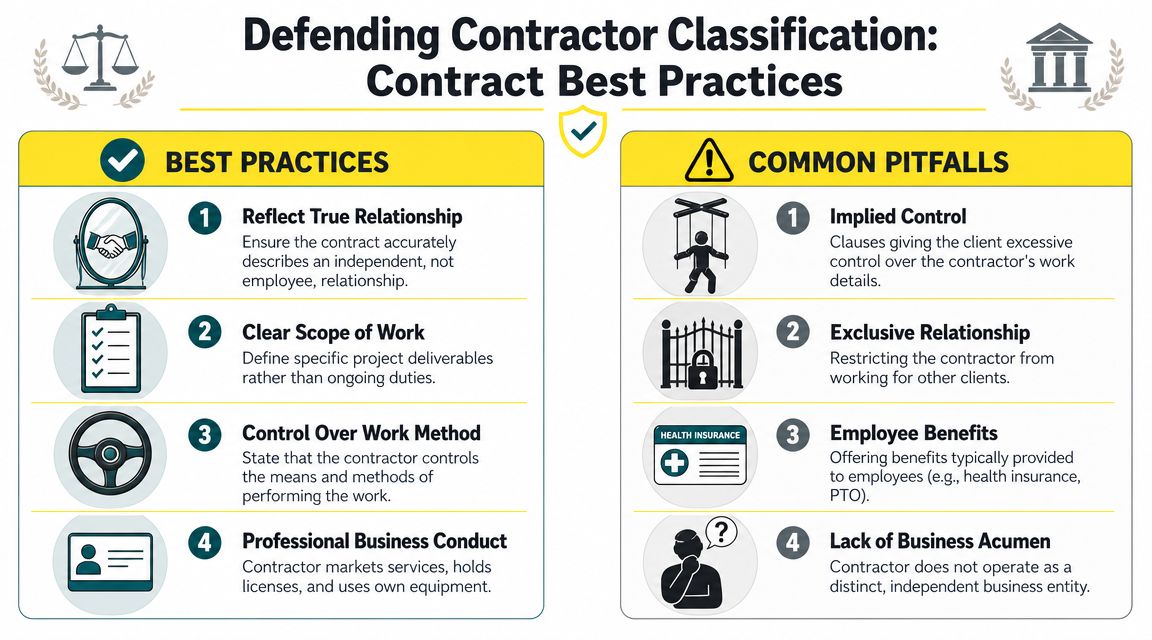
A contract cannot fix a bad factual relationship. But a weak contract can make a borderline situation much worse. Good drafting does two things. It reflects the actual working arrangement, and it preserves evidence that supports independence.
What stronger contractor agreements usually include
A defensible agreement usually focuses on deliverables, not open-ended job duties. It describes the project, timing, payment structure, and acceptance criteria without reading like an employee handbook.
Useful features often include:
- Project scope: Defined services or outputs, not “other duties as assigned.”
- Method independence: The contractor controls means and methods, subject to agreed results.
- Non-exclusive language: The contractor may serve other clients.
- Business representations: The contractor confirms separate operations, licenses, and tax handling where appropriate.
- Own tools and expenses: The agreement reflects that the contractor runs their own business.
Clauses that often create trouble
Some clauses undermine contractor status even if they seem commercially sensible.
| Clause style | Lower-risk approach | Higher-risk approach |
|---|---|---|
| Work obligations | Specific project deliverables | Ongoing role with broad internal duties |
| Supervision | Outcome review | Daily direction and required methods |
| Availability | Reasonable project deadlines | Fixed office hours and attendance rules |
| Exclusivity | Limited conflict rules | Near-total bar on other clients |
A few red flags show up repeatedly:
- Employee-style control: Requiring fixed shifts, detailed approvals, or mandatory internal process compliance.
- Core-business integration: Writing the role as if the contractor is part of your production team or revenue engine.
- Exclusive dependence: Preventing the person from taking other clients.
- Benefits by another name: Offering paid time off, broad reimbursement, or perks that look like employment.
A contract should read like a relationship between two businesses, not a relabeled offer letter.
Match the contract to the rest of the file
Even a solid agreement can be damaged by sloppy surrounding documents. Statement-of-work forms, onboarding emails, Slack access, internal org charts, and manager instructions often become the true story.
For that reason, review connected documents too:
- onboarding checklists
- IP ownership terms
- confidentiality provisions
- invoice and approval workflows
- termination language
Where intellectual property matters, businesses should also make sure ownership clauses are drafted carefully. This discussion of an assignment of contract touches a related drafting discipline. Rights and obligations should be clear, deliberate, and consistent across the deal documents.
Managing AB 5 Risks and Enforcement Actions
A Canadian founder hires a California-based contractor for product work, pays monthly, gives them a company email, and loops them into weekly team meetings. Six months later, the relationship ends. The contractor asks about overtime, expenses, and missed breaks. At that point, the problem is no longer just a contract dispute. It can turn into a wage claim, payroll exposure, tax issues, and questions about who should have been treated as an employee from day one.
That is the practical AB 5 risk for cross-border businesses. The trouble often starts small and then pulls in parts of the company that were never involved in the original hiring decision.
What usually triggers trouble
Enforcement rarely begins with an abstract legal review. It usually starts after a routine event puts the relationship under a microscope:
- The engagement ends poorly
- The worker raises pay, overtime, or expense concerns
- A tax, payroll, or insurance issue surfaces
- A diligence review, investor question, or internal audit spots a California role that was never properly assessed
For U.S.-Canada employers, one added problem is false comfort. A business may assume a Canadian contract template or a foreign parent company structure reduces California exposure. It usually does not. If the person works in California, California facts tend to drive the risk analysis.
What a better response looks like
A sound risk plan is operational, not just legal. It should include:
- Role-by-role review: Check every California contractor relationship separately. Sales, product, operations, and client-facing roles deserve close attention.
- Consistent records: Make sure contracts, invoices, payment flow, onboarding records, and day-to-day management practices tell the same story.
- Manager controls: Require legal or HR review before a manager hires or expands a California contractor into a role tied closely to revenue or delivery.
- Dispute response: Decide in advance who handles worker complaints, agency notices, and demand letters, and where the supporting records sit.
Dispute planning matters too. A well-drafted process for resolving employment disputes can reduce chaos later, even though it does not fix a bad classification decision. This discussion of arbitration agreements in employment contracts covers one part of that planning.
The key trade-off is simple. Speed at the hiring stage often creates cost at the cleanup stage. I have seen cross-border companies spend far more fixing one California misclassification problem than they would have spent reviewing the role properly before work began.
Prevention is cheaper. It is also far easier to defend.
Frequently Asked Questions
Does the ab 5 law apply to a Canadian company hiring one person in California?
It can. If the worker is performing services in California, you should assume California worker-classification rules need to be analyzed even if your company is based in Canada and has no office there. The worker's location and the nature of the work matter more than where your founders sit.
Is every California freelancer covered by AB 5?
No. AB 5 sets a default rule, but there are exemptions and carveouts for certain professional and business relationships. The hard part is that exemptions are narrow and fact-specific. A job title alone usually isn't enough. You need to test the actual work and preserve records that support the exemption.
How much does it cost to fix a misclassification problem?
There is no single published amount because exposure depends on the facts, the worker's role, and what obligations were missed. The practical cost often includes legal review, payroll correction, contract cleanup, management time, and possible agency or private claims. Businesses should budget for prevention rather than assume cleanup will be minor.
How long does an AB 5 review take before hiring?
A focused review can move quickly when the facts are clear and the role is well defined. It takes longer when the business has reused an old contractor model, the worker performs core services, or the company needs a compliant payroll and onboarding structure. Delay usually comes from unclear facts, not from the law itself.
Can a contract alone protect contractor status under AB 5?
No. The contract helps, but California looks at the actual relationship. If the business controls the worker like staff or uses the person in its core service line, a carefully worded agreement may carry little weight. The document must match the operational reality.
Does a worker's corporation or LLC solve the issue?
Usually not by itself. A company wrapper, invoice format, or foreign business registration may support the appearance of independence, but California still looks at function, control, and whether the worker operates an independent business. Entity form is relevant, but it is not the whole analysis.
Conclusion
If you're hiring in California from Toronto, New York, or anywhere else outside the state, the ab 5 law turns a routine contractor decision into a real compliance issue. The risk usually comes from ordinary business habits. Fast hiring, core-role outsourcing, and employee-style supervision wrapped in contractor paperwork.
The better approach is disciplined and practical. Classify the role before onboarding, test any claimed exemption carefully, and make sure your documents match how the relationship will work. That costs far less than defending the arrangement after a dispute begins.
Footer
For a U.S.-Canada employer, AB 5 is rarely an isolated California problem. It often sits beside payroll setup, tax withholding, entity planning, and contract management across two countries. A classification mistake in one state can trigger a wider review of how the business hires across borders.
Use this article as a starting point, not a substitute for role-by-role review. The practical question is simple. If a contractor relationship would be hard to defend under close scrutiny, fix the structure before the work starts.
How Mayo Law Can Help
Cross-border hiring often becomes more expensive when businesses discover California classification risk after the relationship has already started. Mayo Law advises companies on cross-border compliance, contracts, and business structuring issues that touch both Canada and the United States. To discuss your situation, visit Mayo Law compliance services.
Disclaimer
This article is for informational purposes only and does not constitute legal advice. Every situation is different. Consult a licensed lawyer about your specific circumstances. Mayo Law provides legal services through Mayo Law PC in Ontario and Joseph Mayo PLLC in New York.
Related Articles
- International business legal services
- Business immigration legal services
- Regulatory compliance legal services
If you're dealing with California hiring risk as part of a U.S.-Canada expansion, Mayo Law can help you assess contractor status, tighten documents, and build a cross-border compliance process that fits how your business operates.


