


A Toronto software founder opens an email from a U.S. distributor on Tuesday morning. The proposal looks strong. Larger market, faster channel access, and a recognizable counterparty. By Thursday, a “standard” licensing agreement arrives with a request for comments by Monday.
Cross-border licensing deals often start that way. They also tend to hide the risk in clauses that look routine: territory, exclusivity, royalty definitions, audit rights, ownership of improvements, tax withholding on cross-border payments, and the choice of court if the deal breaks down. A clause that reads cleanly in a U.S. form can create a different result once Canadian tax rules, Ontario contract law, or enforcement questions are added.
I see the same pattern in first US-Canada deals. The business terms feel settled before anyone has tested whether the contract structure matches the revenue model, the IP chain of title, or the practical way the parties will sell, support, and report. Getting that structure right early matters. Our discussion on technology licensing agreements and deal structure explains part of that foundation.
At Mayo Law, we advise founders and companies in Toronto, the GTA, and across the border with licensing work that often touches both Ontario and New York. The goal is not to make the agreement longer. It is to make the deal work in practice, on both sides of the border, before a royalty dispute, withholding issue, or enforcement fight turns a promising license into an expensive problem.
Published: July 6, 2026
Updated: July 6, 2026
Read time: 11 minutes
When Should You Hire a Licensing Agreement Lawyer?
Hire a licensing agreement lawyer when the deal can materially affect your IP, revenue, or expansion plans. The right time is usually before the business terms harden, not after both sides are emotionally committed to a draft that already points in the wrong direction.
- Before signing a term sheet or LOI
- When your IP is your main business asset
- When the deal crosses the U.S.-Canada border
- When royalties or exclusivity are on the table
- When the other side drafted the first paper
- When exit rights are unclear
- When compliance obligations affect the product

Practical rule: If a bad clause could limit your future market, pricing, or product roadmap, bring counsel in before the first redline, not the fifth.
The Lawyer's Role Beyond Drafting the Contract
A licensing agreement lawyer does more than turn business terms into legal language. Good counsel helps decide what should be licensed, what should stay out of the deal, how the other party earns rights over time, and how to safeguard your negotiating power if the relationship stops working.
That matters because a license is usually a business model decision, not just a contract. In software, the issue is often access, use restrictions, data handling, uptime expectations, and derivative works. In trademark licensing, quality control and brand use rules matter. In patent licensing, the fight is often about field of use, improvements, sublicensing, and whether the grant is exclusive.
The market keeps demanding this kind of specialized work. The U.S. Bureau of Labor Statistics states that employment of lawyers is projected to grow 4 percent from 2024 to 2034, with about 31,500 openings projected each year in the United States, reflecting ongoing demand in specialized legal areas including IP and cross-border work (BLS lawyer outlook).
The first job is deal architecture
A useful licensing lawyer starts by isolating the commercial points that drive future conflict. That usually means:
- Defining the asset: What exactly is being licensed. Code, trademark, know-how, data set, patent rights, or a mix.
- Separating ownership from use: The other side may need broad operating rights without getting ownership.
- Tying rights to performance: Milestones, launch obligations, reporting duties, and quality controls.
- Protecting future optionality: Reserving industries, territories, channels, and derivative products for later deals.
If you skip this stage, the contract may be polished but still commercially wrong.
Different IP types need different controls
A founder licensing a SaaS platform to a U.S. reseller faces a different risk profile than a consumer brand licensing its mark to a Canadian manufacturer.
| IP type | Main concern | Common mistake |
|---|---|---|
| Software | Use limits, access, data, updates | Treating software like a simple sale |
| Trademark | Quality control, brand standards | Weak control over how the mark is used |
| Patent | Scope, field of use, improvements | Granting rights broader than intended |
| Trade secret | Confidentiality, access, return of materials | Sharing know-how without operational safeguards |
A contract lawyer who only “fills in the blanks” won't usually catch the business consequences behind those distinctions. That's why founders often need advice that begins before drafting. For related cross-border contract work, some businesses also look at a technology and IP contract approach.
A clean draft isn't the goal. A workable deal is.
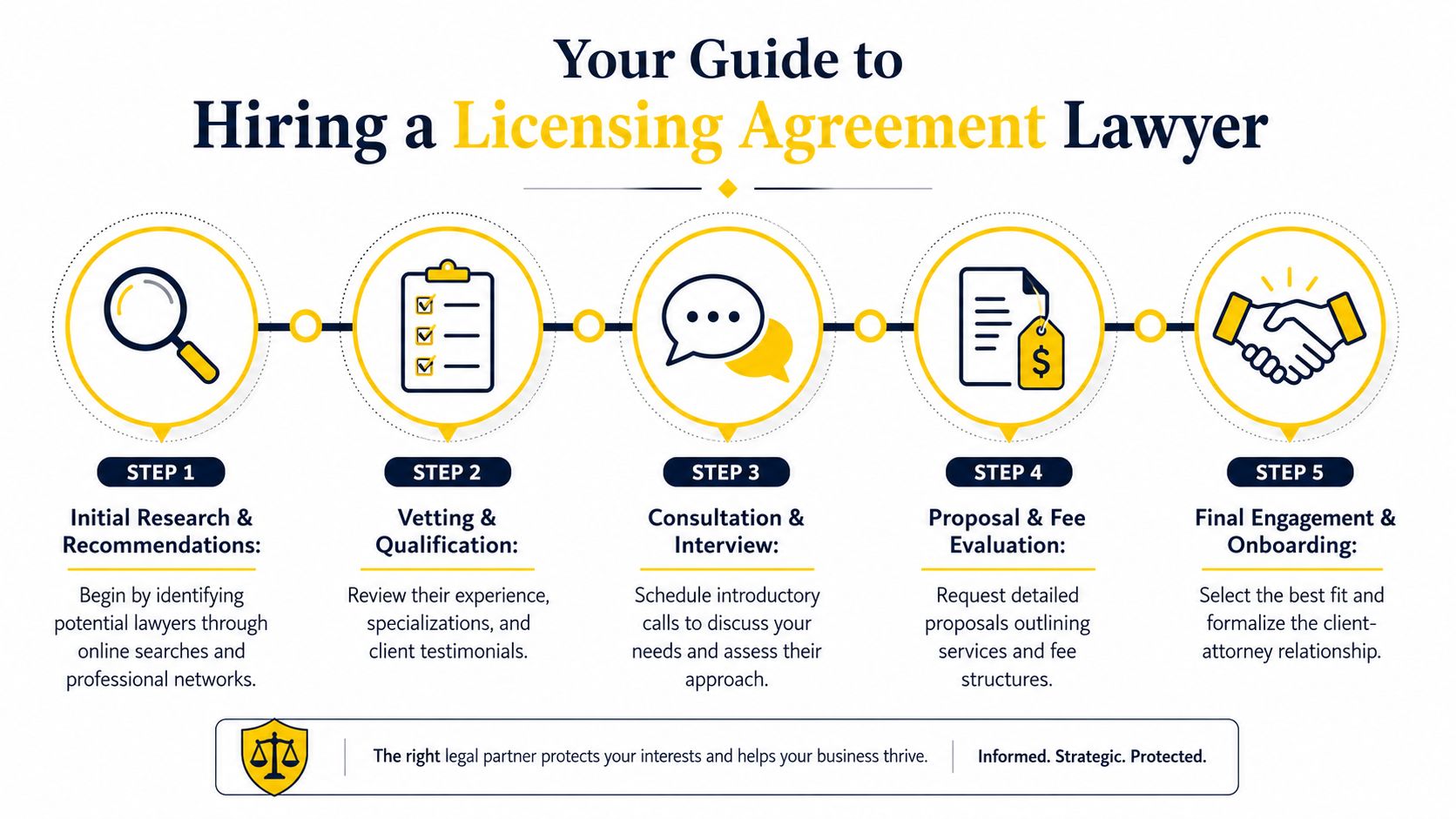
How to Find and Evaluate the Right Lawyer
Most founders don't hire a licensing agreement lawyer often. They compare websites, schedule a few calls, and hear the same broad assurances from everyone. That's not enough for a U.S.-Canada license where one weak clause can create tax, enforcement, and ownership problems later.
Start with fit, not slogans. You want someone who handles licensing as a business tool, understands how cross-border deals behave in practice, and can explain trade-offs in plain English. If your company is based in Ontario and the counterparty is in the U.S., licensing in one relevant jurisdiction and practical familiarity with the other can reduce the friction that comes from splitting the work between multiple firms.
Look for process, not just credentials
A capable lawyer usually has a method. One strong approach is to begin with a detailed term sheet that separates required terms from preferred terms. That kind of front-end discipline helps manage expectations and reduces later disputes. It also helps ensure both parties have “skin in the game,” whether through upfront payments, diligence obligations, or both (Corporate Counsel term sheet guidance).
Ask how the lawyer handles the first two weeks of the matter. If the answer is vague, that's a warning sign.
Good signs include:
- A structured kickoff: They ask for the business model, product map, sales channel, and deal objectives.
- A written issues list: They identify pressure points before redlining starts.
- A negotiation plan: They know which clauses are must-haves and which are bargaining chips.
- A realistic staffing model: You know who does the drafting and who joins negotiations.
Questions worth asking on the first call
Don't ask whether they can “help with licensing.” Ask questions that force specifics.
-
How many cross-border licensing matters like this have you handled?
You're testing relevance, not volume. A trademark license, SaaS reseller license, and patent field-of-use license are different jobs. -
Where do deals like mine usually break down?
A practical lawyer should quickly mention scope, payment mechanics, exclusivity, termination, and dispute forum. -
How do you handle term sheets and business issues before drafting?
If they jump straight to document markup, they may be reacting instead of leading. -
Do you expect this to be flat fee, hourly, or hybrid? Why?
The answer should match the uncertainty level of the negotiation. -
What happens if U.S. and Canadian issues overlap?
In such situations, coordination matters. Cross-border work gets expensive when no one owns the whole picture.
Watch how they explain risk
The best test is whether the lawyer can translate legal language into business consequences. For example, if the other side asks for an exclusive license, can the lawyer explain whether that blocks your future direct sales, channel partnerships, or new verticals? If they can't explain it, they may not be thinking commercially enough.
One founder I've seen in practice brought in counsel only after accepting a “friendly” exclusivity clause in an email. The clause wasn't limited by product line, geography, or minimum performance. Undoing that informal promise was harder than negotiating it correctly the first time.
For companies comparing counsel for drafting and negotiations, this broader contract negotiation attorney perspective is often the right lens.
Negotiating Key Clauses in Your Licensing Agreement
A licensing deal usually turns on a handful of clauses. Most disputes don't come from obscure legal theory. They come from vague business terms that looked harmless when everyone was optimistic.
One useful warning from contract practice is that common pitfalls include failing to define the precise scope of the license, overlooking royalty structures and payment terms, and ignoring exit mechanisms (common licensing negotiation pitfalls). Those are exactly the points founders tend to underweight on the first deal.
Scope of the license
This is the grant clause. It answers the basic question: what can the other side do?
A weak grant says the licensee may “use the technology in connection with its business.” A better grant says whether the right is internal, commercial, sublicensable, exclusive or non-exclusive, limited to object code or source code, tied to specific products, or restricted to named channels.
What works
- Specific products or IP identified by schedule
- Clear use case and field-of-use limits
- Express ban on unapproved sublicensing
- Reserved rights clause for everything not granted
What doesn't
- Broad language that gives away future business lines
- Undefined “affiliate” access
- Silence on modifications, improvements, or derivative works
Territory and channel rights
Cross-border deals often fail here because the business people say “North America” when they really mean something narrower. Territory should answer whether rights are limited to Canada, the U.S., both, or something broader. Channel should answer whether the licensee can sell directly, through distributors, on marketplaces, or only to named customers.
An anonymized example: a Canadian software company licensed a platform to a U.S. partner for sales “in North America.” The company assumed that meant the partner would handle U.S. enterprise accounts. The partner later argued it could pursue Canadian clients too. The dispute wasn't really about software. It was about a loose territory clause.
Royalties and payment terms
Royalty language should do more than state a percentage or fee. It should define the base, timing, currency, deductions, audit rights, late payment consequences, reporting format, and what happens on refunds, bundles, or reseller arrangements.
If you can't explain the royalty formula to your finance lead in one minute, it probably isn't drafted tightly enough.
For pre-revenue startups, this gets harder. Many guides assume there's an established sales history to justify rates. Founders with no sales often need a different framework based on future potential, milestones, minimum commitments, and where the commercial risk really sits. That gap shows up often in early-stage cross-border deals.
Term and termination
Term tells you how long rights last. Termination tells you how you get out.
A strong clause doesn't rely only on material breach after a long cure period. It also addresses recurring underperformance, failure to meet diligence obligations, missed reporting, non-payment, misuse of IP, and what happens after termination. If the other side keeps customer relationships or embedded software access, the unwind mechanics matter just as much as the trigger.
Ownership, warranties, and indemnity
These clauses decide who bears hidden risk.
Ownership:
Make clear that the license transfers use rights, not title, unless an assignment is intended. Address feedback, customizations, and improvements separately.
Warranties:
Be realistic. Overpromising on non-infringement, functionality, or compliance can create avoidable exposure.
Indemnity:
This is risk transfer, not boilerplate. In trademark and technology licensing, indemnity should connect to actual financial capacity, insurance expectations where appropriate, and chain-of-title concerns.
Mayo Law works with founders, investors, and businesses across the GTA and on cross-border matters. Joseph Mayo is licensed in Ontario and New York, so clients with U.S. ties coordinate their legal work in one place rather than juggling two firms.
If you expect a forum fight later, the choice of court or arbitration seat deserves separate attention. Businesses dealing with dispute venue issues often look closely at a forum selection clause before the agreement is signed.
Managing Cross-Border IP, Tax, and Enforcement Risks
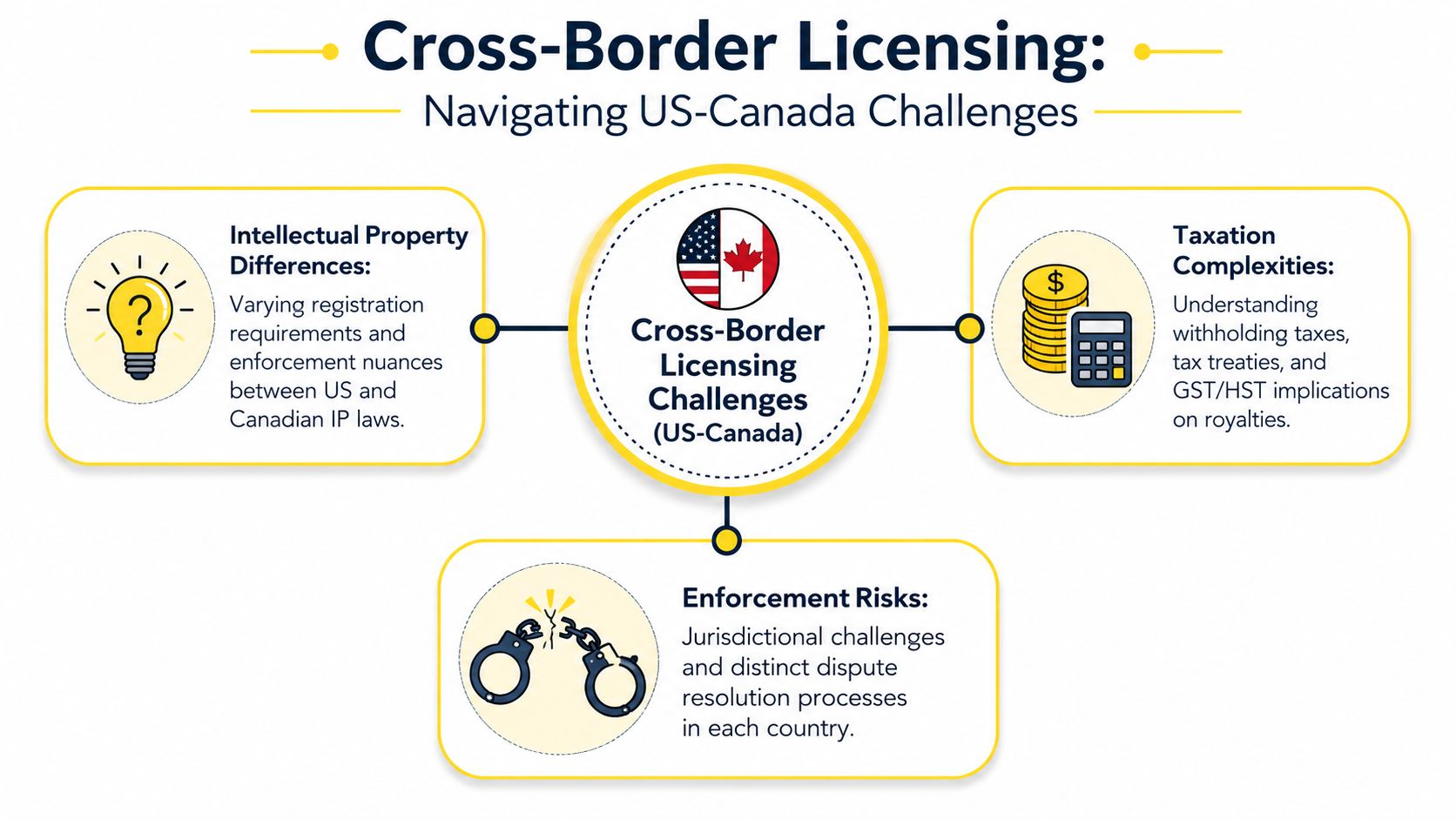
A founder signs a U.S. licensing deal, starts collecting royalties, and assumes the hard part is over. Then the first payment arrives short because of withholding tax, the product is being sold into Canada through a website the agreement never addressed, and a dispute has to be enforced where the other side holds assets. That is a common U.S.-Canada problem. A domestic template rarely covers it well.
Geographic scope is not a drafting detail
Cross-border licenses need precise answers on territory, channels, and spillover. If the license grants U.S. rights only, say whether that includes online sales into Canada, Canadian customer support, French-language marketing, Amazon storefronts, or app downloads available in both countries. If you leave those points vague, the parties will fill the gap with whatever helps them later.
In practice, a significant share of cross-border licensing disputes starts there. The parties agree on growth, but not on borders.
The U.S.-Canada wrinkle is that IP rights do not map perfectly from one country to the other. A Canadian trademark strategy does not automatically solve U.S. use issues. A U.S. registration does not answer what happens if the brand is promoted, warehoused, or fulfilled in Canada. The contract should define where the rights can be used, where goods can be shipped, and who bears the risk if sales cross the line.
IP rights do not line up perfectly across borders
Founders often focus on whether the IP is registered. The harder question is whether the rights are documented well enough to survive a dispute in both countries.
Trademark licensing is a good example. Quality control still matters, but the evidence you need to prove ownership, licensed use, and goodwill may look different depending on which side of the border the fight lands on. Common law rights can matter in the U.S. in ways Canadian parties sometimes underestimate. Canada has its own recordkeeping and use issues that U.S. counsel may not prioritize if they are drafting from a U.S. form.
Software and content licenses raise a different set of problems. User data, hosting, and product support often cross the border even when the parties say the license does not. If the agreement is silent, you can end up with a license that works commercially only by breaching its own territorial limits or by ignoring privacy and data-handling obligations that sit outside the IP clause.
Small wording choices matter here. Define licensed IP, improvements, sublicensing rights, and permitted technical access with both jurisdictions in mind.
Cross-border risk often sits in the so-called miscellaneous clauses. Governing law, notice mechanics, audit rights, tax cooperation, recordkeeping, and post-termination obligations often decide who has practical power in a dispute.
Tax and enforcement need early planning
Royalty clauses in U.S.-Canada deals should be reviewed with tax treatment in mind before anyone signs. Withholding tax, treaty relief, residency certificates, and reporting obligations can all affect what gets paid and when. If the agreement says the licensor receives a fixed royalty but does not say who bears withholding, the business term you negotiated may not be the business result you get. Government guidance is the right place to start for procedural tax questions, including IRS business and international tax resources and Government of Canada tax guidance.
Enforcement needs the same level of planning. A New York governing law clause may be fine. It does not solve the practical question of how quickly you can stop misuse in Canada, collect against assets in Ontario, or compel records held by a Canadian affiliate. The best forum on paper is sometimes the wrong forum for the actual remedy you are likely to need.
I often tell founders to test the dispute clause against a simple question: if the other side stops paying, overuses the IP, or keeps selling after termination, where do you need relief first, and where are the money and records? If the agreement does not line up with those answers, revise it before signature.
How Much Does a Licensing Agreement Lawyer Cost?
Legal fees matter because founders often compare the price of counsel to the price of a template. That's the wrong comparison. A better comparison is the cost of targeted drafting now versus renegotiation, payment disputes, or enforcement problems later.
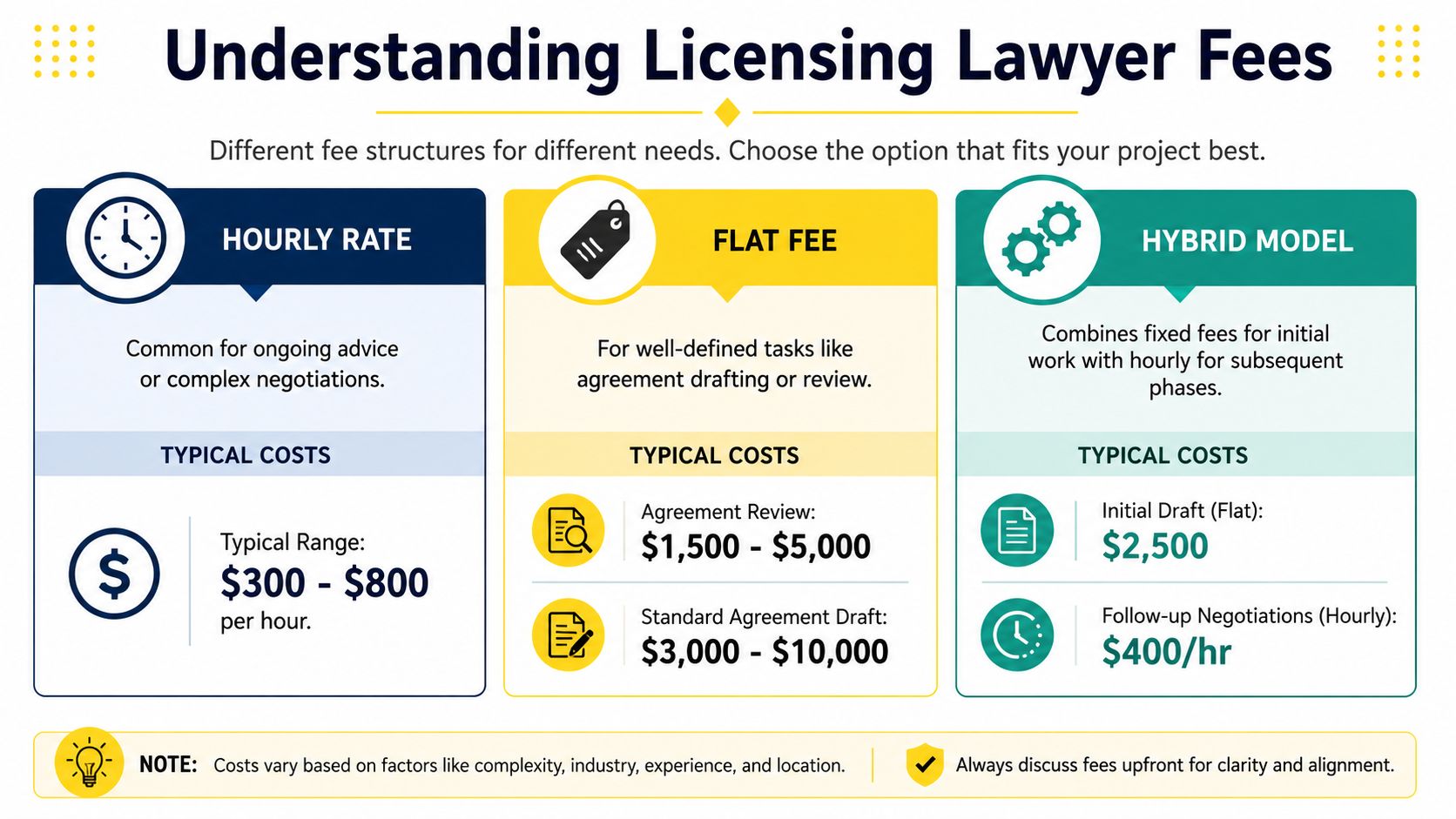
ContractsCounsel's marketplace data reports that the average flat-fee cost to draft a licensing agreement is $1,060, the average cost to review one is $730, and the overall average market cost is $920. The same source states that the typical hourly rate for an intellectual property lawyer handling licensing agreements ranges from $250 to $350 per hour (licensing agreement cost data).
Which billing model fits which matter
Flat fee works best when the task is defined. For example, first-pass review of the other side's draft, or preparing a clean draft from an agreed term sheet.
Hourly billing usually fits active negotiations, multiple markups, side letters, tax coordination, or disputes over exclusivity and territory.
Hybrid pricing can make sense where the front-end work is predictable but the negotiation phase is not.
A cross-border license often costs more than a domestic one because the agreement needs tighter treatment on territory, tax cooperation, governing law, and enforcement mechanics. Startups also need to ask what is included. Drafting only? Negotiation calls? Term sheet work? Follow-on amendments? Fee clarity matters as much as the sticker price.
For founders budgeting broader growth-stage legal work, this startup business attorney perspective can help frame where licensing fits in the legal budget.
Frequently Asked Questions
What are the biggest risks of using a template licensing agreement?
Templates usually fail at the exact points that matter most in a live deal. They don't reflect your product, sales channel, territory, payment logic, or enforcement strategy. In cross-border work, they also tend to ignore tax cooperation, governing law choices, and differences in IP rights between jurisdictions. A template can help you spot issues, but it shouldn't decide them.
How long does it typically take to negotiate a cross-border licensing agreement?
There isn't one reliable timeline that fits every matter. A simple review can move quickly if the business terms are already aligned. A first-time international deal often takes longer because the parties still need to settle territory, exclusivity, reporting, compliance, and termination rights. The primary driver is usually decision speed on business points, not document markup alone.
What happens if the other party violates the agreement?
That depends on the contract. The agreement should spell out notice, cure rights, suspension options, termination triggers, and what happens to inventory, customer relationships, and confidential information after termination. If those provisions are weak, enforcement becomes harder and more expensive. In practice, a well-drafted exit clause often prevents litigation because each side knows the consequences early.
Are verbal licensing agreements enforceable?
Sometimes, but relying on one is risky. Even where an oral agreement may have some legal effect, proving scope, duration, exclusivity, payment terms, and ownership boundaries becomes difficult fast. Cross-border deals make that worse because evidence, governing law, and enforcement can differ. If IP and future revenue matter, put the deal in writing with clear definitions and signatures.
What is the difference between an exclusive and non-exclusive license?
An exclusive license gives one party rights that the licensor usually cannot grant to others within the defined scope. A non-exclusive license allows the licensor to keep licensing the same IP to others. The fundamental issue is scope. Exclusive for what product, what channel, what territory, and for how long? Without those limits, exclusivity can block future growth.
Conclusion
If you're holding a draft from a U.S. counterparty and trying to decide whether to sign, revise, or push back, the safest move is to slow the deal down long enough to get the structure right. A cross-border license can open a market, but it can also lock up your IP, margin, and future options if the paper is loose. Good legal work doesn't just reduce risk. It helps you keep the upside you're trying to build.
Footer
Cross-border licensing problems rarely start with a clear breach. They start with small assumptions, a U.S. template used in Canada, a royalty clause that ignores withholding tax, or an enforcement provision that works cleanly in one country and poorly in the other. If this article helped you spot those issues earlier, it has done its job.
How Mayo Law Can Help
Mayo Law serves clients across Toronto, the GTA, and on cross-border matters. If your licensing deal touches the U.S. and Canada, the legal work should match the business reality on both sides of the border. To discuss your matter, visit international business counsel.
Disclaimer
This article is for informational purposes only and does not constitute legal advice. Every situation is different. Consult a licensed lawyer about your specific circumstances. Mayo Law provides legal services through Mayo Law PC in Ontario and Joseph Mayo PLLC in New York.
Related Articles
- Business immigration services
- Regulatory compliance services
- Notary services for cross-border documents
If you're weighing a licensing deal, restructuring one, or trying to fix a draft before it becomes a business problem, Mayo Law advises on cross-border contracts, IP, compliance, and related U.S.-Canada matters.


