


A deal is ready to close. An executive is ready to relocate. A foreign bank is ready to open the account. Then a counterparty asks for an apostille or an authenticated corporate document, and the timeline slips.
Business owners usually do not get stuck because the underlying document is unusual. The problem is the approval chain. A signature may need to be notarized in the correct form, issued in the correct jurisdiction, sent to the correct authority, and, for some countries, legalized by a consulate after authentication. One mismatch can send the package back to the start.
The cross-border piece makes this worse. New York and Ontario clients often assume the systems are close enough that the same document package will work on both sides of the border. In practice, that assumption causes delays. The U.S. process depends heavily on the state where the document was notarized or issued. Canada uses a different federal and provincial framework, and the treatment of notarizations, corporate records, and public documents is not identical.
I see the same frustration on repeat with companies operating in both jurisdictions. A New York document may be perfectly acceptable for a U.S. apostille request and still tell you nothing about what an Ontario recipient, a Canadian authority, or a foreign consulate will require for the related Canadian paperwork. The reverse is also true. If your transaction touches both NY and ON, the work is not just administrative. It is a sequencing problem, and timing usually breaks down at the handoff points.
Apostille vs Authentication What's the Difference
| Criterion | Apostille | Authentication & Legalization |
|---|---|---|
| Governing framework | Hague Convention process | Domestic authentication plus embassy or consulate legalization |
| Destination countries | Hague Convention member countries | Non-member countries |
| Core steps | One certificate from the competent authority | Authentication first, legalization second |
| Typical workflow | Shorter and more direct | More documents, more handoffs |
| Business impact | Fewer moving parts | More delay risk if one step is missed |
An apostille is a simplified certificate used for documents going to Hague Convention countries. Authentication and legalization is the longer route used for non-member countries. According to the Hague Conference apostille materials, an apostille can reduce processing time and cost by up to 60% compared with the multi-step process for non-member countries.
What this means in practice
If your document is going to France, Italy, Mexico, or another Hague member, you're usually looking for an apostille. If it's going to a non-member country, the certificate from the state or federal authority is often only the first half of the job. The second half is legalization by that country's embassy or consulate.
That distinction matters because many businesses stop too early. They get the state authentication certificate, assume they're done, then learn the destination country still requires consular legalization.
Practical rule: Ask the receiving party one direct question: "Is an apostille enough, or do you also require embassy legalization?"
For a broader legal overview of the convention itself, see this guide on the Hague Apostille Convention.
What is the difference between an apostille and notarization?
A notarization is not the same thing as an apostille. A notary verifies the signature or administers the oath on the underlying document. An apostille or authentication certificate is the government-issued cross-border verification that comes later. In other words, notarization is often an early step, not the final international-use certificate.
How to Get a U.S. Apostille or Authentication Certificate
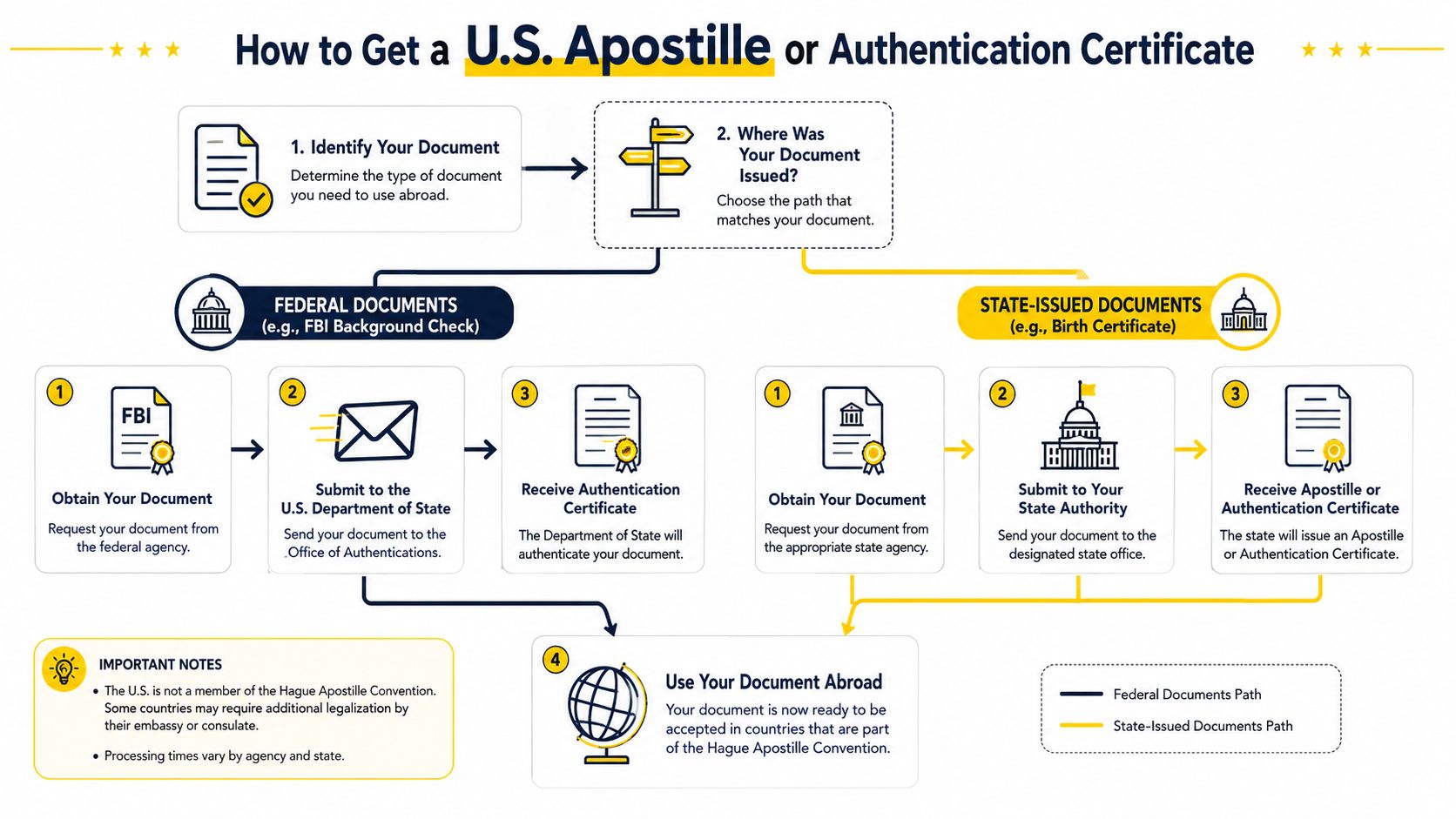
In the United States, the first question isn't what the document says. It's who issued it. That determines where it must go.
A state-issued or state-notarized document usually goes to that state's Secretary of State. A federal document goes to the U.S. Department of State. If you mix those paths up, the file gets delayed or rejected.
Start with the document category
Here is the cleanest way to sort U.S. documents:
- State vital records such as birth, marriage, or death records
- Corporate records such as certificates of incorporation or good standing
- Notarized private documents such as powers of attorney or resolutions
- Federal documents such as FBI background checks or federal agency records
If the document was issued under New York authority, New York usually handles the apostille or authentication certificate. If it was issued by a federal agency, the U.S. Department of State handles it.
New York documents need New York handling
For New York, the New York Department of State apostille and authentication page states that the fee is $10.00 per apostille or certificate of authentication. That is separate from federal processing.
A common business example is a New York startup opening a European subsidiary. The bank abroad may ask for the New York certificate of incorporation, a certificate of good standing, and a board resolution. If those are New York records or New York notarized documents, the Secretary of State is usually the right starting point.
For a process-focused local guide, see how to get an apostille in New York.
How much does document authentication cost?
At the federal level, the U.S. Department of State's Office of Authentications charges $8.00 per document, and state fees vary by jurisdiction. The Hague Conference authority listing notes a state-level range of $3.00 to $20.00, and gives Pennsylvania as an example at $15.00 per document, with mail processing typically taking 2 to 3 weeks for that state process in the example listed on the U.S. authorities page.
The federal route is separate
Federal documents don't go to Albany just because you're in New York. They go through the federal system.
The U.S. Department of State Office of Authentications handles federal documents, and verified guidance states that walk-in acceptance at its Washington location is limited to 7:30 to 9:00 AM on Mondays through Thursdays for federal submissions. That office handles federal records such as powers of attorney and corporate resolutions when they fall within federal processing requirements, while state-level documents are routed to the relevant Secretary of State office.
If the document started with a state officer or state notary, don't send it to the federal office first.
What works and what doesn't
What works
- Check the destination country first: Hague member and non-member countries follow different routes.
- Match the issuing authority: New York records go to New York. Federal records go federal.
- Confirm whether the recipient wants an original or certified copy: Some recipients are strict about this.
What doesn't
- Assuming notarization finishes the job: It usually doesn't.
- Submitting a copy with no proper certification: That often fails before review gets very far.
- Treating "authentication" and "legalization" as the same thing: They aren't.
A business scenario
A Toronto founder buying a U.S. target company may need New York corporate records for a lender in Europe. If the receiving country is a Hague member, the New York apostille path is usually straightforward once the underlying records are correct. If the country is not a Hague member, the same founder may need state authentication first and then embassy legalization, which means the timing assumptions from the first deal no longer apply.
Do I need a state or federal apostille?
You need the authority that matches the origin of the document. State-issued or state-notarized documents go to the relevant state authority. Federal documents go to the U.S. Department of State. The content of the document matters less than the authority behind the signature or seal being certified.
How to Authenticate Documents in Canada
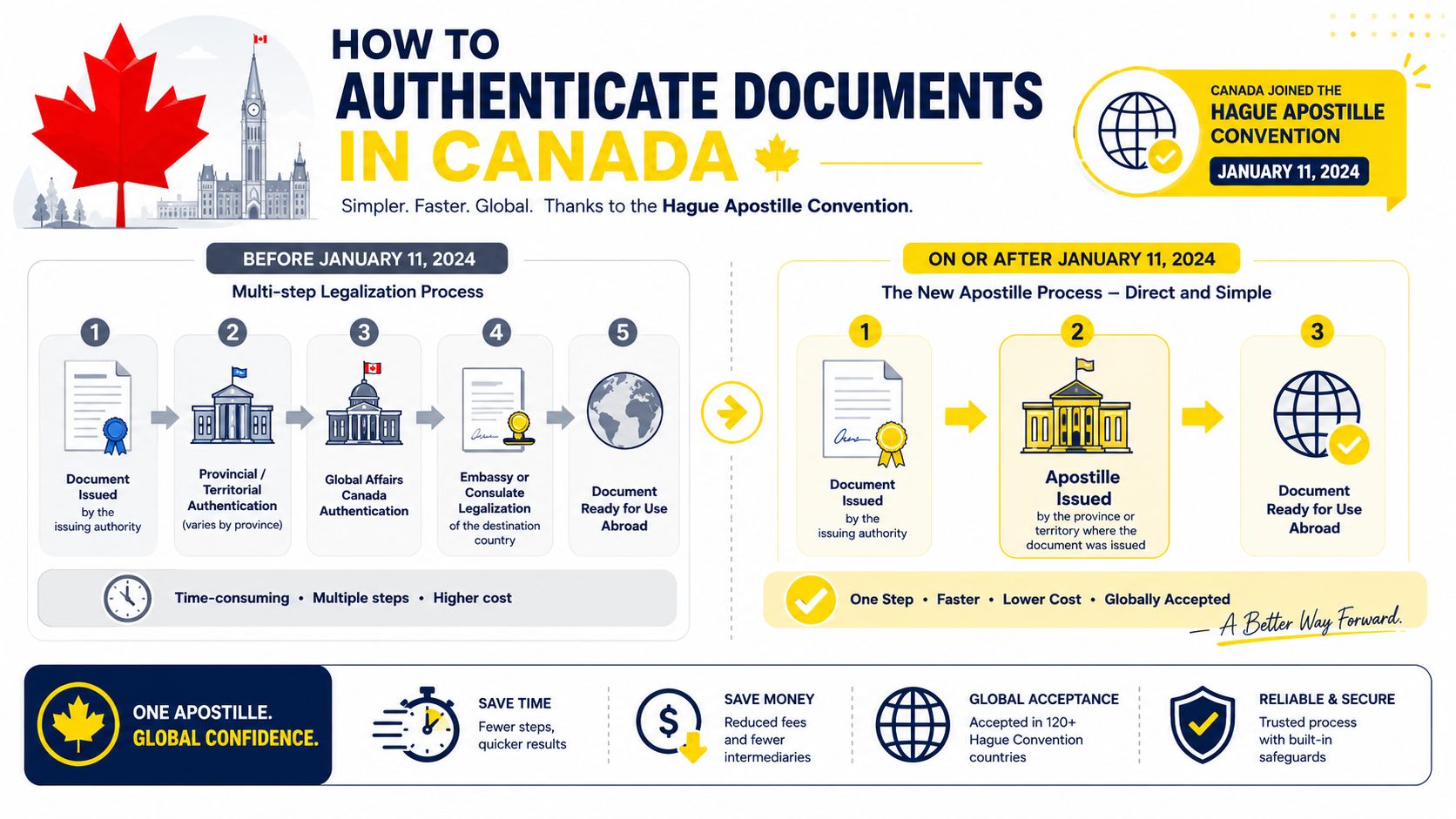
Canada changed materially in this area after joining the Hague Apostille Convention. Global Affairs Canada announced improved authentication services designed to make document verification faster and simpler for documents used outside Canada, effective January 11, 2024, in its announcement on improving authentication services in Canada.
For many businesses, that change removed steps that used to be routine. But it didn't remove the need to choose the correct path based on the destination country.
Ontario now has a clearer Hague-country route
For documents going to Hague Convention countries, Ontario Official Documents Services issues apostilles. The Ontario document authentication page states the process takes exactly 15 business days after receipt and the fee is $16 per document.
That makes planning easier for Ontario businesses, but only if the document is ready before it gets submitted. The timing listed by Ontario doesn't fix an underlying notarization or translation problem.
For Ontario-specific preparation help, see notary public Ontario Canada.
How long does it take to get a document authenticated in Canada?
In Ontario, Official Documents Services states that apostilles are issued within 15 business days after receiving the document, and the fee is $16 per document. That timeline is useful, but it starts only after the document arrives in acceptable form.
Canada still has a non-Hague route
If the destination country is not a Hague member, the process is not just "get an apostille." It is closer to the older authentication and legalization model. The Canadian authority authenticates the document, and then the foreign embassy or consulate may need to legalize it.
Canadian and U.S. clients often make the same mistake for different reasons. They hear that Canada has modernized its process and assume every destination country now accepts a single certificate. That's not true.
Physical documents still matter
For Canada, the physical presence of the document matters because the authority verifies the official signature against its registry. Verified guidance states that digital scans or photocopies lack the original signature required for authentication, as explained by Global Document Solutions' explanation of Global Affairs Canada practice.
That point surprises people who are used to digital closings and electronic signatures. International document recognition still often depends on the original signed instrument or a proper certified copy.
Send the document you can prove, not the document that's easiest to email.
A practical Ontario example
Consider a professional in Toronto who needs a degree document for work in a non-Hague country. If the document is in another language or needs a supporting translation, that work must be done correctly before the authentication stage. If the destination country is non-Hague, the person also needs to plan for embassy legalization after the Canadian authority's step.
Can I use one Canadian process for every country?
No. The correct process depends on whether the destination country is a Hague Convention member. For Hague countries, the apostille route is available through the proper Canadian authority. For non-Hague countries, you may still need authentication followed by embassy or consulate legalization. That's the point where delay risk rises.
Key Requirements and Common Mistakes to Avoid
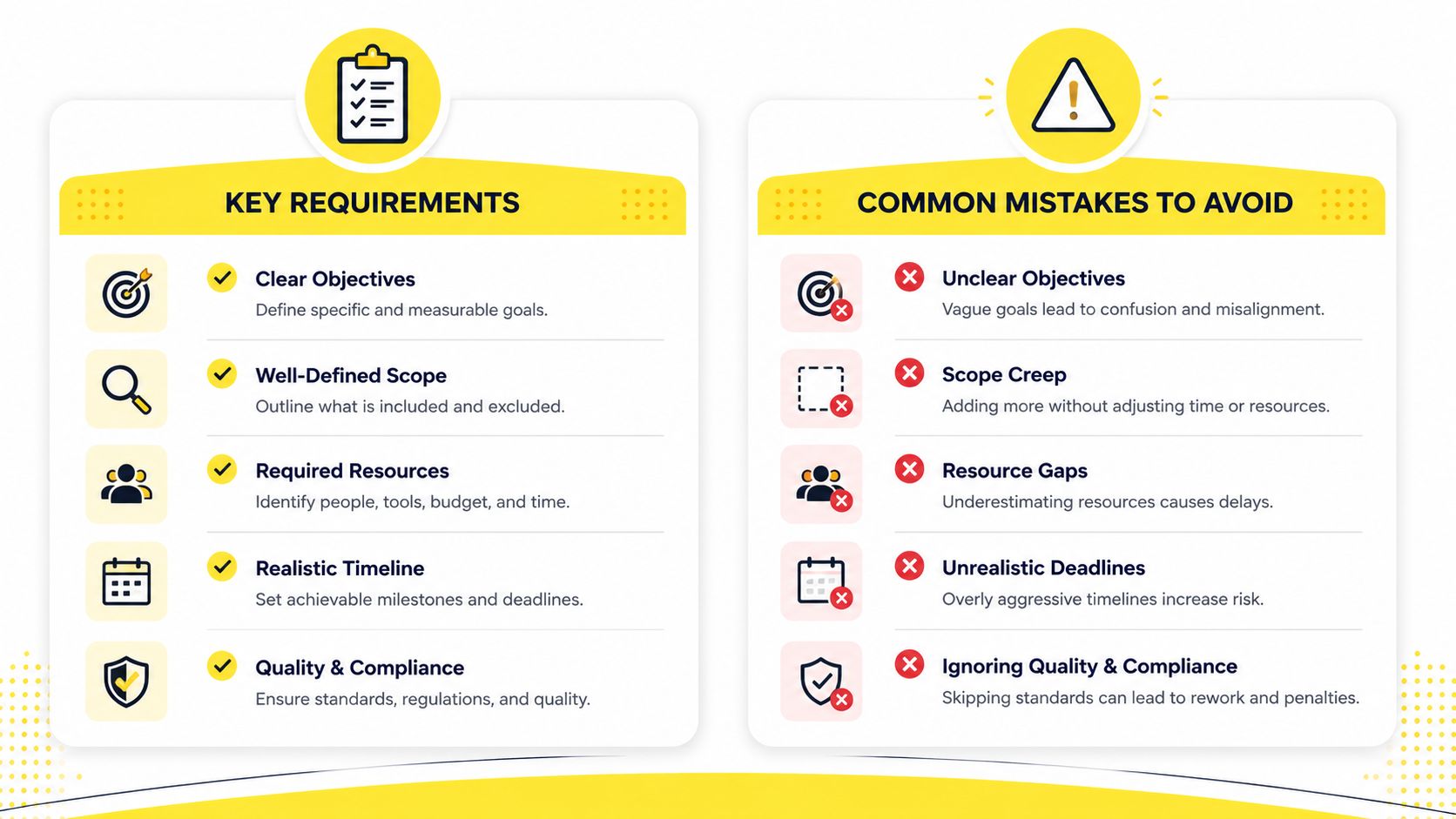
A file can look complete and still be rejected. In cross-border matters, the problem usually starts before the government office sees it.
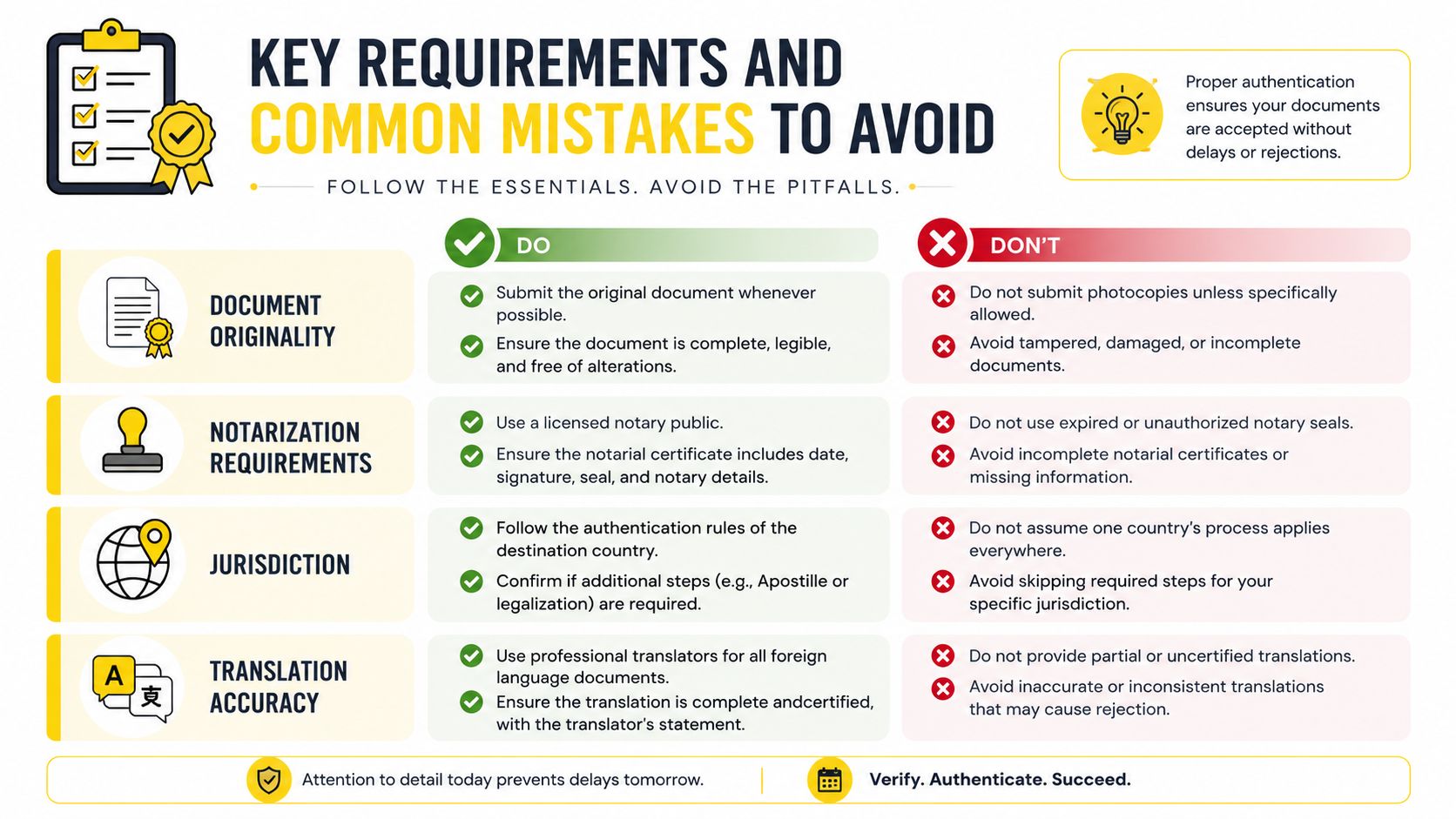
What matters is the certification chain. New York and Ontario both care about who signed, who notarized, and whether the next office in the sequence is authorized to rely on that prior step. If the wrong person notarized the document, if a certified copy was required but a scan was sent, or if a translation was prepared in the wrong form, the later certificate does not fix the defect. It just delays the rejection until a more expensive stage.
Improper notarization causes a large share of avoidable rejections
The National Association of Secretaries of State notes in its apostilles and document authentication services guidance that applications are often rejected because the pre-submission certification chain was not followed correctly, including problems with the underlying notarization.
I see that in practice with powers of attorney, board resolutions, and consent documents signed in one jurisdiction for use in the other. A client signs in Toronto, someone assumes any notary format will do for New York use, and the issue only surfaces after courier fees, filing fees, and a missed closing date.
Documents that need closer review before submission
- Corporate documents: Board resolutions, certificates of incumbency, bylaws extracts, and powers of attorney often need the right officer signature and the right notarial wording
- Academic records: Diplomas and transcripts may need issuance by the school, registrar certification, or notarization in a specific sequence
- Vital records: Birth, marriage, and death certificates usually must be official government-issued copies, not photocopies or commemorative versions
- Criminal record and regulatory documents: FBI background checks and similar records can have office-specific submission rules that differ from ordinary notarized documents
Digital copies create problems faster on cross-border files
Businesses are used to PDF closings. Authentication offices are often not.
Do not assume a scanned signature page, an electronically issued corporate document, or a remotely notarized PDF will be accepted for foreign use. The answer depends on the document type, the issuing authority, and the country where the document will be used. That is where New York and Ontario files often diverge. A version that is acceptable for one side of the border may not satisfy the authority or end user on the other side.
Translation errors are often formatting errors
A translation can be accurate and still fail.
The usual problem is not the language itself. The problem is that the translation, affidavit, notarization, and source document were not assembled in the form required by the receiving authority. That comes up often with Ontario companies sending bilingual records abroad and with New York documents that need certified translation for use in a non-English process. The file is substantively correct, but the package does not support the certificate the next office is being asked to issue.
Do not stop at the government certificate if the destination country is non-Hague
For non-Hague countries, the government certificate is often only one stage. The destination country's embassy or consulate may still require legalization, and its rules on fees, translations, appointment booking, and document formatting can be stricter than clients expect. If you need a quick explanation of the consular role, see this guide on what an embassy does in document legalization.
The practical mistake is treating apostille, authentication, and legalization as interchangeable terms. They are not. In a NY/ON cross-border file, that misunderstanding is one of the fastest ways to lose a week or two.
For help with the cross-border contracts and transactions that often require these documents, contact our international business team.
Frequently Asked Questions
What does the Hague Convention change for document authentication services?
It changes whether you can use an apostille instead of the older authentication-plus-legalization route. If the destination country is a Hague member, the process is usually shorter and more direct. If it isn't, you often still need the government certificate and then embassy or consulate legalization. That single distinction controls most timeline and planning issues.
What if the country I need to send my document to isn't a Hague member?
Assume there may be two stages. First, you obtain the authentication certificate from the proper government authority. Second, you take the document to the destination country's embassy or consulate for legalization if required. Don't stop after the first certificate. That's one of the most common reasons a file gets returned by the foreign recipient.
How should I budget for costs?
Budget by counting documents, not by guessing at one flat fee. In the U.S., fees can apply at the federal and state level, depending on the document type and route. In Ontario, there is a per-document government fee. You may also face notarization, courier, translation, and consular charges depending on the file.
How much time should I allow?
Build in more time than you think you need, especially if the matter involves a non-Hague country or a document that needs upstream correction. Government processing time only starts once the file is acceptable. If a board resolution needs re-notarization or a translation needs to be redone, your internal delay begins before the official clock starts running.
Is it risky to use a generic online service?
It can be. The risk isn't always fraud. Often it's oversimplification. Generic services may not spot that your New York corporate record, Ontario notarization, and foreign recipient are pulling you into different legal systems with different rules. If the document issue sits inside an immigration or mobility matter, speaking with immigration attorneys near me can also help coordinate the document side with the filing strategy.
Conclusion
If you're stuck because a foreign buyer, bank, employer, or government agency wants an apostilled or authenticated document, the problem is usually procedural, not mysterious. The solution is to identify the issuing authority, confirm whether the destination country is Hague or non-Hague, and prepare the document correctly before it goes out. That's especially important when New York and Ontario are both involved. Document authentication services are manageable when the sequence is right. They become expensive when the first step is wrong.
How Mayo Law Can Help
Cross-border authentication problems rarely fail because the rule is hard to find. They fail because the document was prepared for the wrong system, signed in the wrong place, or sent out in the wrong order.
Mayo Law assists clients dealing with Ontario, New York, and U.S./Canada document use. That includes reviewing whether a document should start with a New York notarization, an Ontario notarization, a county or state-level certification step, or a Global Affairs Canada process before anything is sent abroad. In practice, that early review is what avoids the expensive version of this problem: missed closing dates, rejected powers of attorney, and corporate documents that have to be re-signed because one jurisdiction's formalities do not satisfy the other.
We also help clients sort out a point many general guides skip. A document that is acceptable for domestic use in New York may still be rejected for use in Ontario, and the reverse is just as common. The issue is usually not the substance of the document. It is the authentication path.
Disclaimer
This article is for informational purposes only and does not constitute legal advice. Every situation is different. Consult a licensed lawyer about your specific circumstances. Mayo Law provides legal services through Mayo Law PC in Ontario and Joseph Mayo PLLC in New York.
Related Articles
If you need help with cross-border documents, notarization, apostille coordination, or related U.S.-Canada legal issues, contact Mayo Law.


