


Published: July 2, 2026
Updated: July 2, 2026
Read time: 11 minutes
You’re about to launch in both the U.S. and Canada. The product name looks available. The code is built. Investors are asking who owns the IP. Then the problems start. A contractor wrote key parts of the software, your U.S. trademark search didn’t cover Canada, and no one has checked whether your licensing terms protect your know-how.
An intellectual property lawyer helps fix those issues before they become expensive disputes. At Mayo Law’s international business practice, we help founders in Toronto, the GTA, and across the border handle business risk that often spans Ontario and New York. For startups, the hard part usually isn’t filing one application. It’s building a protection plan that still works when you hire, fundraise, license, and expand.
What Is an Intellectual Property Lawyer
An intellectual property lawyer is a lawyer who helps businesses create, protect, use, and enforce legal rights in valuable intangible assets. The core practice centers on patents, trademarks, and copyright, which distinguishes IP work from general business advice or ordinary litigation, as noted by Best Lawyers Canada’s description of intellectual property law.

The assets an IP lawyer deals with
A patent protects an invention. That might be a hardware component, a chemical process, or a software-related innovation, depending on what the law allows and how the claims are drafted.
A trademark protects the commercial identity customers use to recognize your business. Think brand name, product name, logo, or slogan.
Copyright protects original works of authorship. For a startup, that often means website copy, software code with human authorship elements, product manuals, pitch materials, graphics, and marketing content.
Trade secrets matter too, even though they work differently. The value comes from keeping information confidential. Examples include customer lists, pricing logic, source code, formulas, internal processes, or a product roadmap that gives you an edge.
What the lawyer actually does
A good IP lawyer doesn’t just fill out forms. The job often includes:
- Ownership cleanup: Making sure founders, employees, and contractors assign IP properly
- Protection planning: Deciding what should be patented, registered, licensed, or kept secret
- Risk review: Checking whether your name, product, or content may infringe someone else’s rights
- Enforcement work: Sending demand letters, responding to claims, and preparing for opposition or litigation
Practical rule: Registration is only one part of protection. If ownership, confidentiality, and cross-border rights aren’t aligned, the filing alone won’t save you.
Why startups need a business view, not just a filing view
Founders often ask whether they “need IP.” The better question is which assets drive revenue or valuation. A consumer brand may care most about trademark clearance and enforcement. A deep-tech startup may focus on patent strategy, confidential know-how, and invention assignment language in employment documents.
That’s why an IP lawyer often works closely with corporate counsel. If you’re raising money, selling into the U.S. from Canada, or licensing technology, your IP plan needs to match your contracts, cap table, and expansion strategy. Otherwise, the legal rights exist on paper but fail when you need to rely on them.
The Different Types of IP Lawyers and What They Do
A founder selling software in both the U.S. and Canada can clear a name in one country, file a patent application in another, and still end up with a gap that hurts valuation or blocks expansion. That usually happens because “IP lawyer” is treated as one job title when it is really a set of different practices with different risk points.
The right specialist depends on the asset, the stage of the company, and the countries involved.
IP Lawyer Specializations at a Glance
| Specialist | Primary Focus | Key Services |
|---|---|---|
| Patent attorney | Inventions and technical innovation | Prior art review, patent drafting, prosecution, and infringement analysis |
| Trademark attorney | Brand identity | Clearance searches, filing strategy, office action responses, opposition support |
| Copyright lawyer | Original creative works | Registration, licensing, ownership review, enforcement |
| Trade secret counsel | Confidential business information | NDA structure, employee restrictions, access controls, misappropriation claims |
Why specialization matters
Patent, trademark, copyright, and trade secret work may sit under the same IP label, but they solve different business problems. As explained in Heimlich Law's overview of IP attorney specializations, patent lawyers focus on inventions and patentability, while trademark lawyers focus on clearance and registrability.
For startups, the practical issue is fit. A lawyer who is strong on trademark filing may not be the right person to structure invention assignments, assess open-source exposure, or coordinate a cross-border patent position. In U.S.-Canada matters, that distinction gets more expensive because rights, filing strategy, and enforcement posture do not line up perfectly across both countries.
Patent attorneys
Patent work is technical and procedural. To practice before the USPTO in patent matters, a lawyer needs a qualifying technical background and must pass the Patent Bar. BARBRI's explanation of how to become a patent lawyer outlines that path.
That background matters because patent claims define the legal boundary of the invention. Weak drafting can leave room for design-arounds, limit enforcement options, or create problems during prosecution. For companies operating across the U.S. and Canada, patent counsel also needs to think beyond filing. Public disclosure timing, inventor paperwork, and ownership chains need to be clean in both jurisdictions.
Trademark attorneys
Trademark counsel protects the part of the business customers remember. The job is not just filing an application. It includes clearance, registrability, use strategy, opposition risk, enforcement, and licensing terms.
Cross-border businesses need more than a quick database search. A mark that looks available in the U.S. may still create exposure in Canada because of prior use, filing history, or a confusingly similar mark in a related class. I often see founders spend on domains, design, and launch materials before anyone checks whether the brand can survive in both markets.
That is where rebrands start.
Copyright lawyers
Copyright lawyers deal with ownership and use rights around code, content, design, training materials, photos, videos, and other original works. For startups, the first problem is often chain of title. If a contractor built the product interface or an agency created core marketing assets, the company needs contracts that clearly assign rights.
Licensing is the second problem. A business may have permission to use content in one territory, for one channel, or for one term, but not more broadly. That matters when a Canadian company starts selling into the U.S., or a U.S. company expands north and assumes existing permissions carry over without review.
Trade secret counsel
Trade secret counsel helps protect information that creates a real business edge but should not be publicly disclosed. That includes source code, pricing logic, customer data, internal methods, product roadmaps, manufacturing know-how, and similar confidential assets.
The legal work is operational. Counsel reviews NDAs, confidentiality clauses, employee and contractor agreements, access controls, exit procedures, and internal documentation practices. If those measures are weak, a company may have valuable know-how but a poor legal record when a dispute starts.
Why dual-licensed coordination matters
Startups with U.S. and Canadian exposure often hire separate lawyers for separate filings. That can work, but it also creates blind spots. One lawyer handles the U.S. trademark. Another files in Canada. Patent counsel is elsewhere. No one is looking at ownership language, licensing terms, enforcement posture, and market-entry timing as one system.
Integrated, dual-licensed counsel closes that gap. The benefit is not just convenience. It is strategy that holds together across both countries, with fewer handoff errors and fewer surprises when diligence, disputes, or expansion plans force the company to rely on its IP rights.
When Should a Startup Hire an IP Lawyer
A founder launches in the U.S. under a name that cleared a quick online search, signs a freelance developer, and closes a first enterprise pilot. Then a Canadian distributor asks for exclusivity, diligence starts, and the problems surface at once. The contractor agreement does not clearly assign IP. The brand has issues in Canada. The pilot customer wants rights the founder never meant to give.
That is when legal cleanup gets expensive.
In practice, startups should bring in IP counsel before the company starts creating value that depends on brand, code, content, product design, data rights, or confidential know-how. Waiting until a dispute, financing round, or cross-border expansion usually means paying more to fix ownership, filing, and contract problems that were preventable at the start. As the U.S. Commercial Service guide to protecting intellectual property in Canada explains, rights holders are responsible for protecting and enforcing their own IP. No regulator will build that record for you.

The moments that justify legal spend
The right time is usually tied to a business event, not a company age.
- Before launch: Clear the name, confirm who owns the logo, code, and content, and decide what should be filed versus kept confidential.
- Before fundraising: Investors and buyer-side counsel will ask for clean chain of title, filing status, and signed invention assignment documents.
- Before hiring employees or contractors: IP ownership is easiest to document before work begins. Fixing it later often requires chasing signatures from people who have lost interest or gained an advantage.
- Before signing licensing or distribution deals: Terms about scope, exclusivity, improvements, sublicensing, and termination can weaken core IP if they are negotiated as pure revenue terms.
- Before expanding between the U.S. and Canada: Brand clearance, filing strategy, contract language, and enforcement planning should line up in both countries from the outset.
Cross-border companies feel this earlier than domestic ones. A startup can survive some local informality for a while. It has much less room for error once it sells, hires, or licenses across the border.
Where founders get into trouble
DIY filing is rarely the only problem. The bigger issue is fragmented planning.
A common pattern looks like this: the founder files a trademark application alone, uses a template contractor agreement, stores code in a company GitHub account, and assumes that means the company owns everything. Then U.S. and Canadian counsel review the file later and find inconsistent names, missing assignment language, loose confidentiality terms, and a brand strategy that works in one country but creates risk in the other.
At that point, legal advice is no longer preventive. It is damage control.
What early counsel actually helps you do
Good IP counsel does more than file applications. Counsel helps decide what is worth protecting, where to file first, what to keep as a trade secret, how to document ownership, and how commercial agreements should support the company's long-term position.
For software and product companies, that also means connecting protection strategy to revenue strategy. A startup can lose control of valuable rights through a badly scoped reseller, development, or SaaS agreement long before anyone files a lawsuit. That is why startups often need advice that connects IP protection with technology licensing strategy.
For founders operating between the U.S. and Canada, the strategic advantage is coordination. One integrated plan reduces the risk that trademark filings, contractor agreements, licensing terms, and enforcement positions point in different directions. That is the kind of gap separate, country-by-country advice often misses until the company is already exposed.
Navigating US and Canadian IP Law
A founder clears a brand in the U.S., signs a Canadian distributor, and starts printing packaging for both markets. Two weeks later, Canadian review raises problems with the mark, the goods description does not match the U.S. filing, and the distributor agreement says too little about who controls local marketing assets. The business is already committed on spend, timing, and inventory.

That is a common cross-border IP problem. Rights are territorial, but business decisions rarely are. Founders sell, hire, contract, and launch across both countries long before they appreciate how easily U.S. and Canadian filings, ownership records, and contract terms can drift apart.
The real problem is inconsistency
The legal issue is not just filing in two countries. The harder issue is keeping the strategy consistent across two systems with different procedures, standards, and commercial risks.
A U.S. application may be drafted around one product roadmap, while the Canadian application is filed later by different counsel using different assumptions. A parent company may appear as owner in one country while an operating entity appears in the other. A demand letter sent in one jurisdiction may take a position that weakens settlement or enforcement in the other.
That mismatch creates cost. It also creates avoidable risk.
Where cross-border gaps usually appear
Founders usually see problems in the same pressure points:
- Trademark clearance and filing scope: A mark may be usable in one country and exposed in the other
- Ownership chain: Contractor, founder, and affiliate assignments do not line up across U.S. and Canadian records
- Licensing language: Territory, sublicensing, improvement rights, and tax-sensitive royalty terms are drafted for one market only
- Trade secrets and employee exits: Confidentiality rules exist on paper, but access controls, onboarding documents, and exit steps are not coordinated across borders
- Enforcement posture: Early cease and desist tactics can create admissions, timing issues, or practical business problems in the companion market
For companies protecting code, datasets, formulas, pricing methods, or internal processes, the weak point is often not registration. It is poor documentation and inconsistent safeguards. In those cases, the legal work often overlaps with trade secret misappropriation claims and prevention steps.
Why integrated U.S. and Canadian counsel matters
Separate country-by-country advice can work. It often does for mature companies with in-house legal teams, clear reporting lines, and time to coordinate strategy. Startups usually do not have that buffer.
An integrated, dual-licensed approach closes the gaps earlier. It helps keep trademark specifications aligned, assignment language consistent, licensing terms commercially usable in both markets, and enforcement decisions tied to one business objective instead of two fragmented legal files.
That matters because cross-border IP questions rarely stay inside an IP silo. They connect to reseller agreements, software development terms, privacy commitments, employment onboarding, and corporate structure. If those pieces are handled in isolation, the company can end up owning less than it thought, or paying to fix records that should have been correct from the start.
Two examples founders run into
A Toronto software company expands into the U.S. through channel partners. The reseller contract gives broad rights to localize training materials and customer-facing content, but it says nothing clear about derivative works, feedback, or product improvements. Revenue arrives first. The ownership dispute shows up later.
A New York consumer brand enters Canada after production begins. U.S. clearance was done first and treated as the main decision point. Canadian review comes after packaging, ad spend, and retail commitments are in motion. At that stage, legal options still exist, but the business has far less room to choose the best one.
In both cases, early cross-border planning would have been cheaper than cleanup. More important, it would have given the company better choices before contracts were signed, inventory was ordered, and rights became harder to enforce consistently.
How Much Does an Intellectual Property Lawyer Cost
A founder often asks about price after the first problem appears. A competitor files first, a contractor claims ownership, or U.S. and Canadian filings were started on different assumptions. At that point, the legal bill is no longer just a filing cost. It includes cleanup, delay, and lost negotiating room.
IP fees depend less on the label of the matter and more on what the business is trying to protect, where it operates, and how much uncertainty already exists. A straightforward trademark filing usually costs far less than a cross-border clearance review, a disputed ownership analysis, or a patent strategy that has to stay coordinated in both the U.S. and Canada.
The fee structures you'll usually see
Most IP work is billed in one of three ways:
- Flat fees: Common for defined tasks such as a trademark application or copyright registration
- Hourly rates: Common for clearance analysis, office action responses, disputes, negotiations, and strategic advice
- Retainers: Useful for startups that need regular IP review, contract input, and portfolio maintenance over time
The billing model matters because it affects budgeting discipline. Flat fees help with predictable filings. Hourly work is usually the right fit where facts may change, third parties may object, or the company needs advice tied to product launches, hiring, licensing, or expansion timing.
What changes the cost
Scope is the first driver. Friction is the second.
For example, a single-country trademark application for a distinctive mark with a narrow goods description is usually manageable. Costs rise if the mark is descriptive, the goods and services are drafted too broadly, prior rights need review, or the company wants a filing plan that works in both countries without creating gaps.
Patent work is usually more expensive because drafting, prior art review, and prosecution require more time and technical precision. Cross-border planning adds another layer. Filing dates, public disclosure risk, inventorship, and assignment documents all need to line up. If they do not, the company can spend more later fixing a problem that should have been addressed before the first application was filed.
Use the official fee schedules
Government fees change. They also vary by filing type, entity status, and office. Check the current official schedules before setting a budget:
- USPTO fees and payments
- CIPO patents, trademarks, and other IP fees
For early-stage companies, phased work often makes more sense than asking for one all-in quote. Start with the decision that reduces the most risk. That may be clearance before launch, ownership cleanup before fundraising, or a first filing in the market that matters most commercially.
Some businesses also pair IP strategy with broader startup counsel through a startup business attorney relationship, which can reduce duplication across formation, contracts, founder ownership, and IP protection. That approach is especially useful for companies selling across the U.S. and Canada, where legal work can become more expensive if corporate, commercial, and IP decisions are handled in separate silos.
Your IP Lawyer Engagement Process
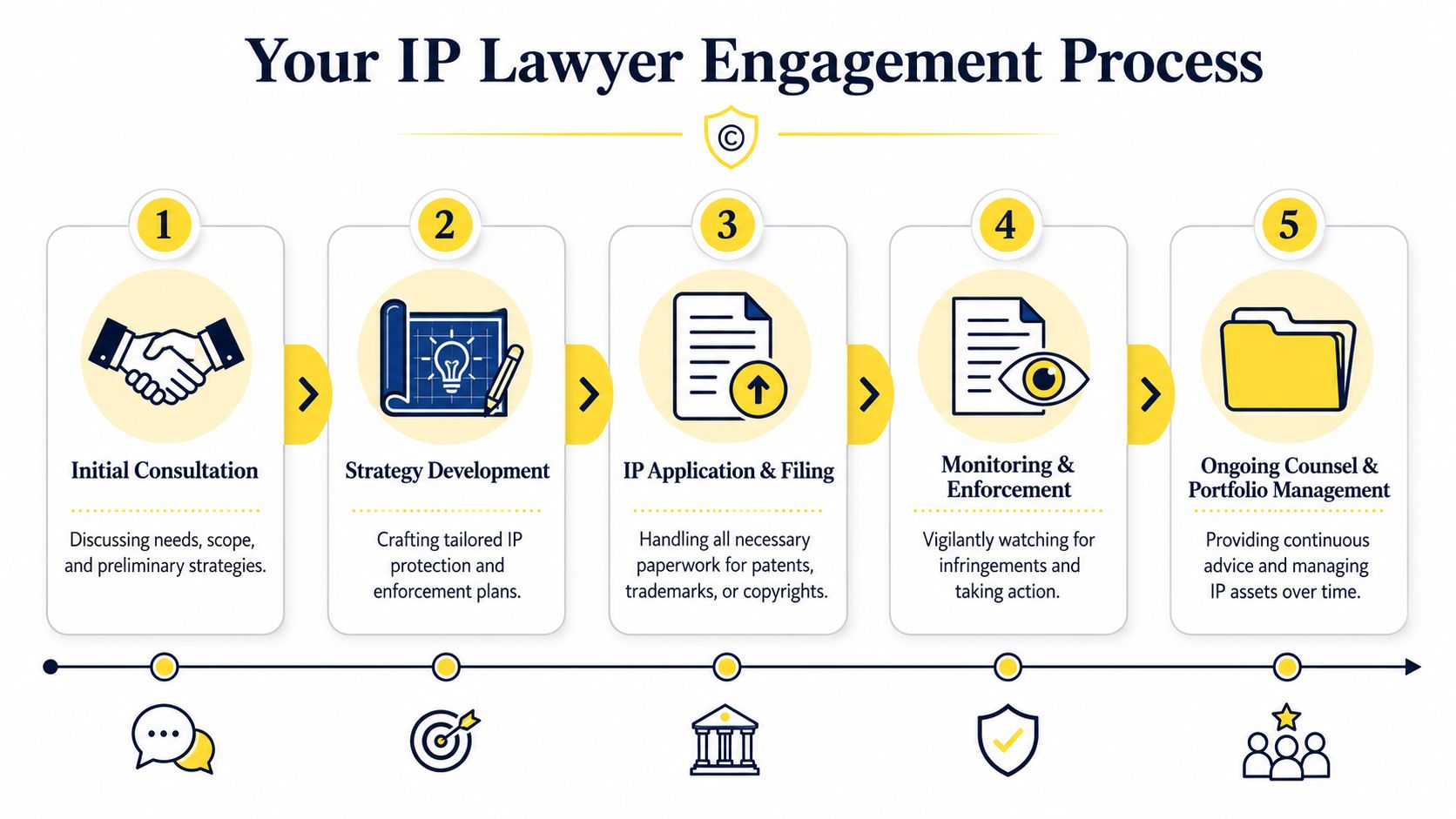
A founder usually reaches out after a trigger event. A product launch is close, an investor asks who owns the code, a U.S. filing is underway while Canada has been left for later, or a contractor relationship starts to look unstable. At that point, the engagement process matters because the first few decisions often set the cost and risk profile for everything that follows.
What the first steps usually look like
The process usually starts with a conflict check, then an initial call focused on business facts, not abstract legal theory. Counsel should identify what the company is trying to protect, where it is selling or planning to sell, who created the relevant assets, and which deadlines could create avoidable problems.
The next step should be a written scope of work. For a startup operating in both the U.S. and Canada, that scope should do more than list filings. It should separate immediate action from lower-priority work, flag where the two legal systems create different risks, and make clear who is responsible for each part of the strategy. If that is not spelled out early, founders often end up paying twice to fix a gap between jurisdictions.
What you should bring to the first meeting
Bring documents that let counsel test ownership, clearance, and exposure quickly.
- Ownership documents: Founder agreements, employee and contractor agreements, assignment clauses, IP schedules
- Brand materials: Proposed names, logos, packaging, taglines, domain names, app store branding
- Product details: What the company built, who contributed to it, what has been disclosed, and what still needs confidentiality protection
- Commercial plans: Current markets, target launch dates, licensing deals, distributor relationships, fundraising activity
A short summary of what has already been filed also helps. Many cross-border problems start with an application submitted in one country before anyone checked whether the same facts, ownership chain, and disclosure history support the position in the other.
Questions to ask a potential IP lawyer
Good questions expose whether you are hiring strategic counsel or a filing service with better branding.
- How do you coordinate U.S. and Canadian protection without creating gaps: The answer should address timing, ownership, clearance, and enforcement, not just where forms get filed
- What should we do first, and what can wait: Startups need sequencing, not a long wish list
- What assumptions are you making about ownership and prior use: Those assumptions often control the quality of the advice
- Which tasks are predictable enough for a fixed fee, and which are not: That is how you budget realistically
- Who inside our company needs to be involved: Product, marketing, finance, and technical leadership often hold facts legal needs
Ask for the likely order of operations. Price without sequence is not very useful.
What a good engagement should produce
The first phase should end with a practical roadmap. That may include filing decisions, assignment fixes, trade secret controls, clearance work, contract revisions, and a plan for handling the U.S. and Canada as one business strategy instead of two isolated legal projects.
For software companies, operational control often sits beside registration as a core IP issue. If a key codebase is maintained by an outside developer, a reseller, or a founder who may leave, the legal question is not limited to ownership on paper. The company also needs a reliable path to access, continuity, and release conditions if the relationship breaks down. In those situations, tools such as software escrow planning for business continuity can support the broader IP strategy.
A good engagement should leave the founder with clear priorities, clear documents to collect, and clear reasons for each legal step. That is especially important for companies operating across the border, where a small mistake in one country can weaken their position, delay a deal, or force a costly cleanup in the other.
Frequently Asked Questions
Can an idea be patented
Usually, not by itself. The legal question is whether the idea has developed into a protectable invention and whether it can be claimed properly under applicable law. Founders often confuse a concept with a patentable asset. The critical work is in the technical details, the claims, and the prior art analysis.
How long does trademark protection work take
The timeline depends on jurisdiction, filing basis, examiner review, and whether anyone objects. A straightforward application moves differently from a filing that gets an office action or opposition. If you're launching in both countries, the key point is to start early enough that business decisions don't outrun the legal process.
What is the difference between a patent and a trade secret
A patent gives public, registered protection for a qualifying invention. A trade secret protects information by keeping it confidential. If the information can be reverse engineered once your product is on the market, trade secret protection may be weak. If disclosure would destroy your advantage, secrecy controls may matter more than filing.
Is an online filing service enough
Sometimes for a very narrow task, but often not for a growing business. Filing services usually don't give legal judgment on ownership gaps, infringement risk, cross-border conflicts, licensing traps, or enforcement strategy. That's where many “cheap” filings become expensive later, especially once investors, distributors, or a competitor start asking harder questions.
If your company is growing across the U.S. and Canada, the legal risk usually isn't a missing form. It's the gap between your business plan and your protection plan. Mayo Law helps founders and companies coordinate cross-border business, IP, compliance, and related risk in a practical way.
Your product, brand, and confidential know-how can become some of the most valuable assets in the business. They can also become the source of your most expensive mistakes if you protect them too late or only in one jurisdiction. The founders who handle IP well usually do one thing differently. They treat it as part of operating the company, not as paperwork after launch.
How Mayo Law Can Help
A startup can look protected on paper and still have a serious IP problem. I often see the same pattern in cross-border companies. The U.S. trademark application is filed, the Canadian position is unclear, the software was built by a contractor, and no one signed a proper assignment. The issue usually surfaces at the worst time: fundraising, expansion, or a dispute with a former partner.
Mayo Law helps businesses align U.S. and Canadian legal work so ownership, registrations, contracts, and enforcement strategy support the same commercial plan. That work can include trademark and brand strategy, IP ownership reviews, contractor and employee assignment terms, licensing, distribution agreements, market-entry documents, and risk assessment before a launch or deal. For founders, the benefit is practical. Problems get identified early, priorities get set, and protection is built around how the business sells, licenses, and grows.
Cross-border gaps are expensive. A filing in one country does not fix a chain-of-title problem in the other. A contract drafted for one market can leave disclosure, ownership, or enforcement issues exposed across the border. Integrated advice from dual-licensed counsel reduces that split between jurisdictions and gives founders one coordinated view of the risk.
Mayo Law advises clients in Toronto, the GTA, and on U.S.-Canada cross-border matters.
Disclaimer
This article is for informational purposes only and does not constitute legal advice. Every situation is different. Consult a licensed lawyer about your specific circumstances. Mayo Law provides legal services through Mayo Law PC in Ontario and Joseph Mayo PLLC in New York.
Related Articles
Founders dealing with U.S. and Canadian legal exposure usually need more than a single IP answer. They also need to address investigations, licensing risk, customs issues, product claims, and regulatory filings that can affect how IP is used, enforced, or defended across both markets.


