
Contents
- What Is the Hague Apostille Convention?
- Hague Apostille Convention Member Countries (2026)
- Apostille vs Consular Legalization A Clear Comparison
- How to Get an Apostille in the United States
- How to Get an Apostille in Canada
- Canada Joins the Apostille Convention What It Means for Cross-Border Business
- Common Documents and Crucial Limitations
- Frequently Asked Questions
- Conclusion and Next Steps
- How Mayo Law Can Help
- Disclaimer
- Related Articles
The Hague Apostille Convention (Convention of 5 October 1961) is an international treaty under which its 130 contracting parties, per the HCCH status table as of July 2026, accept a single apostille certificate in place of multi-step consular legalization. One certificate from a designated competent authority makes a public document valid in every other member country.
A deal is ready to sign. Your team has the board resolution, the notarized power of attorney, and the corporate records. Then the foreign bank, registry, or counterparty says the documents aren’t properly authenticated for use abroad. That’s when a routine closing turns into a delay, and delay turns into cost.
The Hague Apostille Convention matters in real business life. It’s often treated like back-office paperwork, but it can affect financing, immigration filings, incorporations, real estate closings, and overseas hiring. At Mayo Law, we help clients in Toronto, the GTA, and across the border with document authentication issues that often touch both Canada and the United States. For businesses and individuals dealing with relocation or U.S. expansion, related cross-border planning often overlaps with immigration steps like a move from Canada to USA.
What Is the Hague Apostille Convention?
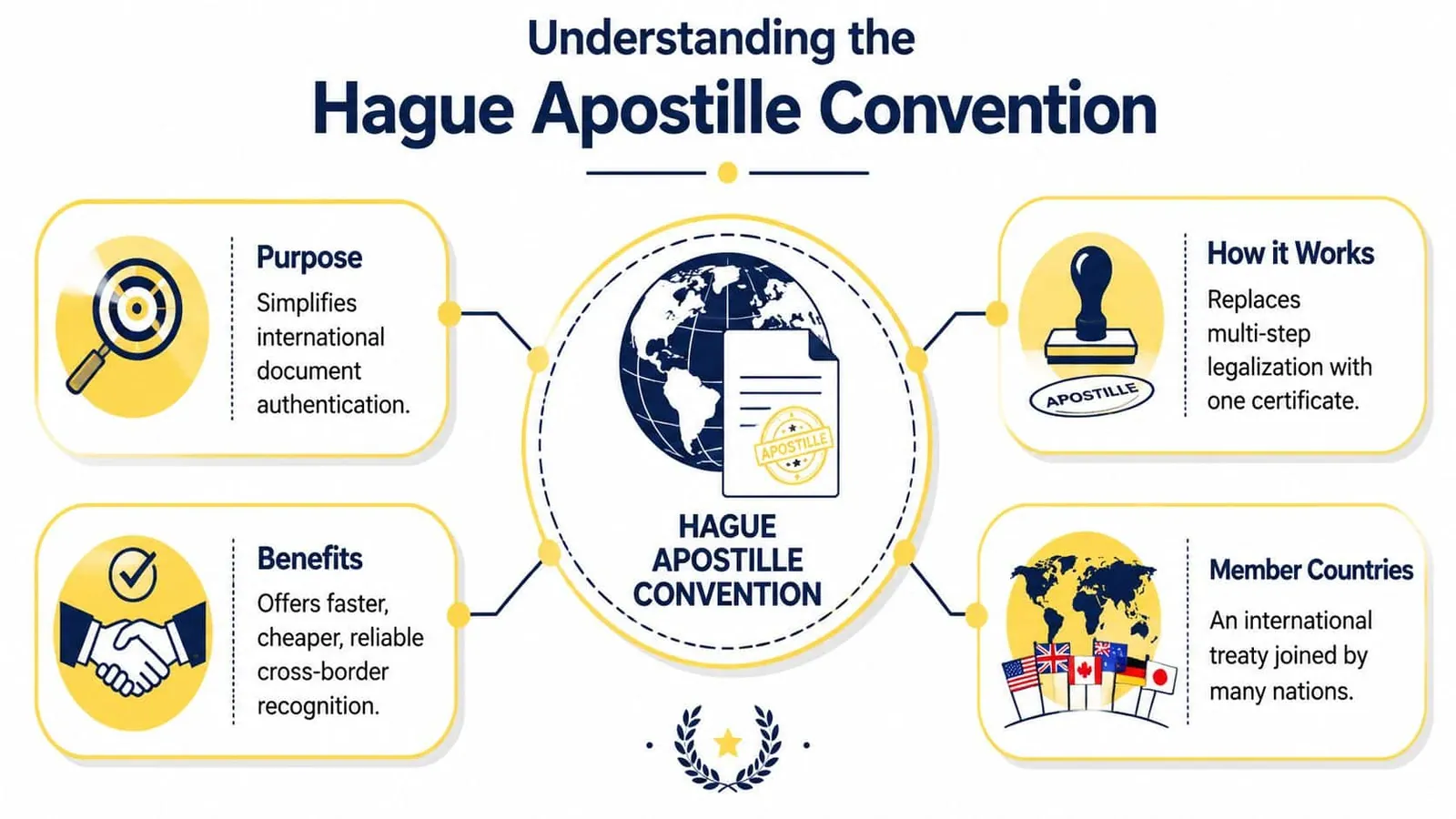
The Hague Apostille Convention is an international treaty that simplifies the use of public documents across borders. Instead of requiring a multi-step embassy legalization process, it allows a document’s country of origin to issue a single apostille certificate that other member countries accept.
The treaty’s full name is the Convention of 5 October 1961 Abolishing the Requirement of Legalisation for Foreign Public Documents. It was signed in The Hague, Netherlands, on October 5, 1961, and as of July 2026 it has 130 contracting parties, making it one of the most widely adopted multilateral treaties in this area of legal cooperation, according to the Apostille Convention overview.
What the Convention actually changes
Before this system, a business often had to move a document through several hands. A notary might sign it. A state or provincial office might authenticate it. Then a foreign embassy or consulate would legalize it. That sequence created friction, especially where deals ran on short deadlines.
Under the Convention, the process is much narrower:
- One certificate replaces the traditional embassy legalization chain
- One competent authority in the origin country issues the apostille
- One member-country framework governs recognition abroad
Practical rule: An apostille helps only when the destination country is also part of the Convention.
Which documents are in scope
The Convention applies to public documents. In practice, that usually includes government-issued records and documents notarized by licensed professionals. Common examples include birth certificates, marriage certificates, academic records, court documents, and notarized corporate instruments.
That doesn’t mean every paper in your deal room qualifies automatically. A private contract with no notarization, for example, may need a preliminary step before it can be apostilled. The usual mistake is assuming the commercial importance of a document determines eligibility. It doesn’t. The document’s legal form does.
Hague Apostille Convention Member Countries (2026)
The Convention has 130 contracting parties as of July 2026, per the HCCH status table. That number keeps moving as new countries accede, so treat any printed list as a snapshot rather than the final word.
The authoritative source is the HCCH status table, maintained by the Hague Conference on Private International Law. It lists every contracting party together with the date the Convention entered into force for that country. Before you send anything abroad, check two things on that table. First, that the destination country appears on it. Second, that the Convention is actually in force there, because accession and entry into force are separate dates.
Notable member countries
- United States
- Canada, where the Convention entered into force on January 11, 2024
- United Kingdom
- All European Union member states
- Mexico
- India
- Japan
Notable non-members
A number of significant destinations remain outside the Convention, including several countries in the Middle East, Africa, and Southeast Asia. Documents headed to a non-member country cannot use an apostille at all. They go through the authentication and consular legalization chain described in the comparison section below, which routes the document through government authentication and then the destination country’s embassy or consulate.
Apostille vs Consular Legalization A Clear Comparison
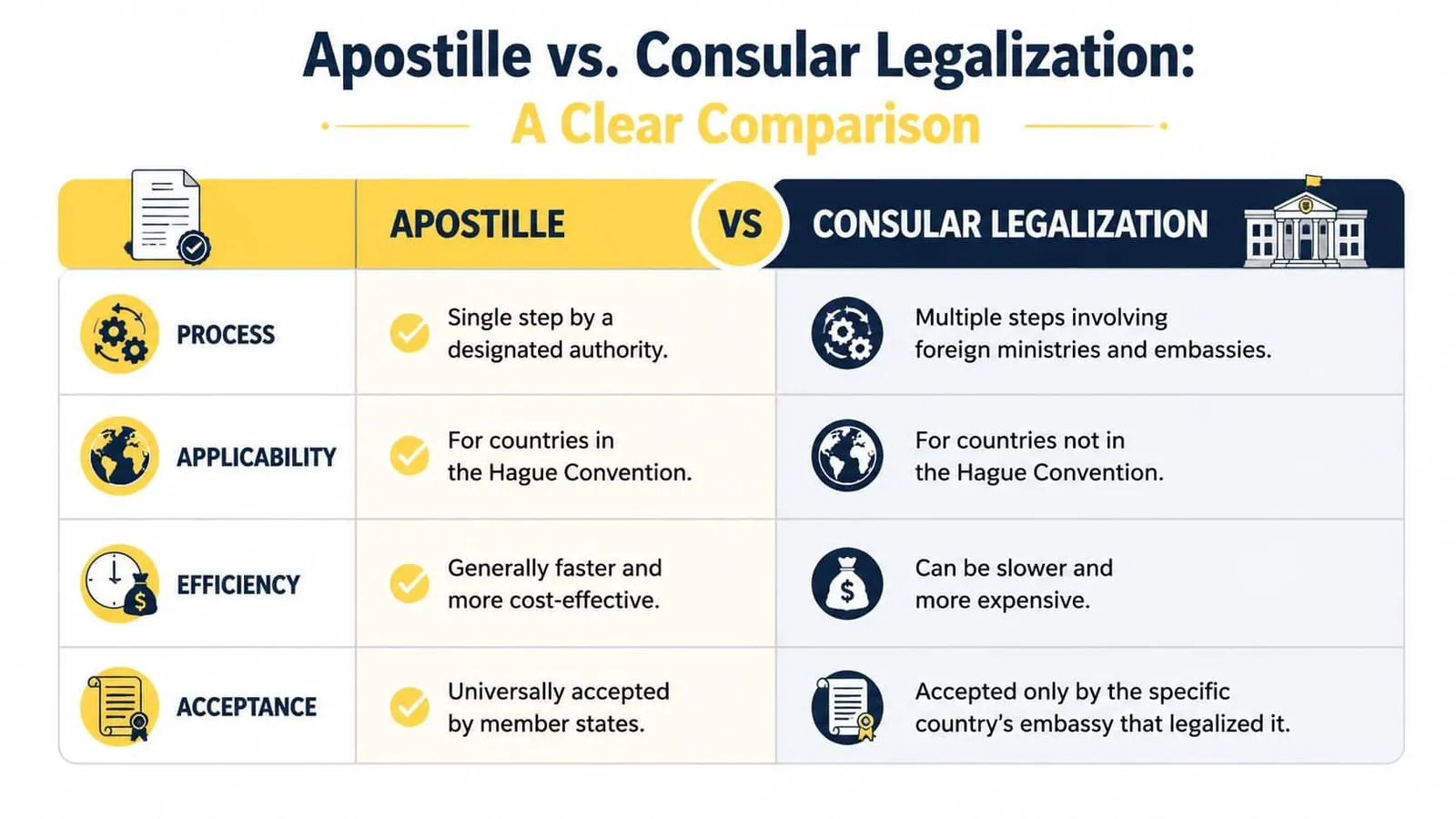
If your team confuses apostille with legalization, documents get routed to the wrong office and timelines slip. The difference matters most at the start. If both countries are within the Convention system, apostille is the right path. If not, you’re usually looking at authentication and consular legalization.
According to the HCCH Apostille section, the Convention replaces the “often long and costly legalisation process” with a single Apostille certificate issued by a competent authority. How quickly that certificate arrives is set by each issuing office, so check its published processing time before planning a closing.
Side by side comparison
| Issue | Apostille | Consular legalization |
|---|---|---|
| Who uses it | Countries that are parties to the Convention | Countries outside the Convention system |
| Process | Single certificate from a competent authority | Multi-step chain involving government authentication and embassy or consulate legalization |
| Typical timing | Set by each issuing office | Often takes weeks or months |
| Cost profile | Lower overall administrative burden | Multiple fees and more courier handling |
| Geographic effect | Accepted across Convention member countries | Usually valid only for the specific country whose consulate legalized it |
What works in practice
For a U.S. company opening an office in Spain, apostille is usually straightforward if the underlying documents were prepared properly. For a company sending papers to a non-member country, trying to force an apostille onto the file wastes time because the receiving authority may refuse it outright.
A related problem is role confusion inside legal and operations teams. Someone hears “authentication” and assumes that means apostille. Sometimes it does in casual speech. Legally, those are different routes. If your team needs a plain-language refresher on embassy functions, this overview of document authentication and legalization helps explain why consular legalization is a different layer.
Don't decide the process based on habit. Decide it based on the destination country and the document's origin.
A common business scenario
Consider an Ontario founder raising money from a European investor while a Delaware affiliate signs related documents in New York. One side may need an Ontario-issued apostille, while the U.S. side needs state-level apostille treatment. Treating it as one filing package often creates mismatch. The better approach is to break the project down by document origin, not by transaction name.
How to Get an Apostille in the United States
A common cross-border mistake looks small at first. A Canadian company asks its U.S. affiliate to apostille a signed power of attorney for use in Europe, the document goes to the wrong office, and a closing date starts to slip because the papers were classified by signer location instead of document origin.
In the United States, the issuing authority controls the process. The key question is who issued or notarized the document.
State-issued or state-notarized documents
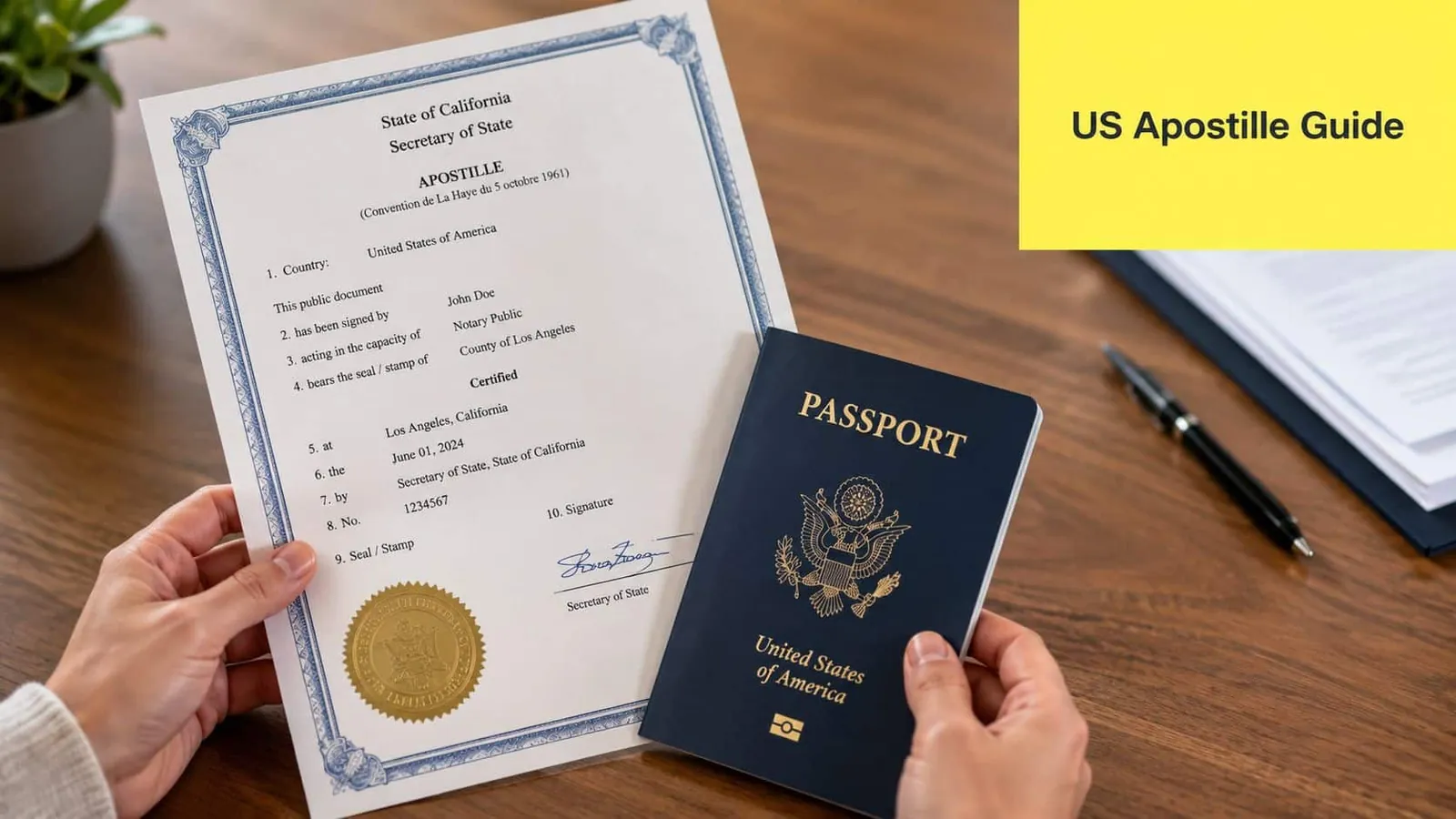
If a document was issued by a state agency, or notarized under state law, the apostille usually comes from that state's competent authority, often the Secretary of State. This is the route for many business and personal records that circulate in cross-border matters.
Examples include:
- Birth certificates
- Marriage certificates
- School records
- Notarized affidavits or powers of attorney
The practical risk is simple. A document can be perfectly valid for the transaction and still be rejected for apostille if the notarization block is incomplete, the notary commission cannot be verified, or the wrong version of a certified record was ordered.
Federal documents
Federal documents follow a separate path. If the record was issued by a U.S. federal agency, the apostille generally must go through the federal authentication channel rather than a state office.
Typical examples are:
- FBI background checks
- Federal court documents
- Agency-issued records
This distinction matters more than clients expect. A federal document does not become a state document just because it was signed, printed, or couriered from a particular state. We see this issue often in U.S.-Canada files where a team assumes all U.S. papers can move through one state-level process. They cannot.
A practical filing sequence
For most U.S. matters, the workflow is straightforward if the file is organized early:
- Confirm the destination country accepts apostilles
- Identify whether each document is state or federal
- Check whether the receiving authority wants an original, a certified copy, or a notarized copy
- Verify that the notarization or certification is in the correct form
- Submit the document to the correct competent authority
- Review the apostille carefully before sending it abroad
The trade-off is speed versus rework. Some businesses rush to file and hope the office will sort out minor defects. In practice, apostille offices do not fix a bad notarization or convert an informal copy into an acceptable certified record. They reject it, or the document comes back unusable for the foreign filing.
The fastest apostille is usually the one prepared correctly the first time.
New York issues come up often
New York documents appear regularly in U.S.-Canada transactions, especially for Delaware or New York entities doing business with Canadian parents, investors, or counterparties. Corporate resolutions, certificates of incumbency, and powers of attorney often need closer review before submission because the apostille authority is checking the signature chain, not the business deal behind it.
For a state-specific guide, see how to get an apostille in New York.
For Canadian businesses dealing with U.S. documents after Canada's 2024 accession, this U.S. state-versus-federal split is still the point that causes the most avoidable delay.
How to Get an Apostille in Canada
Canada’s accession to the Apostille Convention entered into force on January 11, 2024. Since that date, Canadian public documents bound for member countries can carry a single apostille instead of going through the old authentication and legalization chain.
The Canadian system splits along federal and provincial lines, much like the state and federal split in the United States. Getting the split right is most of the battle. Send an Ontario document to the federal authority, or a federal document to a provincial office, and the file comes back unprocessed.
Federal documents
Global Affairs Canada is the competent authority for documents issued by the federal government. That covers RCMP criminal record checks, corporate records from Corporations Canada, and documents issued by federal departments and agencies. Global Affairs Canada also handles documents from provinces and territories that have not designated their own competent authority.
Provincial documents in Ontario
Ontario designated Official Documents Services as its competent authority. It issues apostilles for Ontario documents, including Ontario birth and marriage certificates, documents notarized by an Ontario notary public, and Ontario corporate records. Other provinces that designated their own competent authorities follow the same logic for their own documents.
As of October 2026, Ontario’s authentication page lists $16 per notarized legal document and $32 per Ontario government, court or public postsecondary document, payable in Canadian dollars. Official Documents Services issues mail-in apostilles within 15 business days of receipt and serves in-person clients at 777 Bay Street in Toronto. If the document is going to a US recipient, our guide to a US notary in Toronto explains when an Ontario apostille is needed at all.
A practical filing sequence
- Confirm the destination country is on the HCCH status table and that the Convention is in force there.
- Sort each document: federal or provincial. A single transaction often produces both.
- Ask the receiving authority whether it wants the original, a certified copy, or a notarized copy.
- Make sure the notarization or certification is in the correct form. An Ontario document should be notarized by an Ontario notary before it goes to Official Documents Services.
- Submit each document to its correct competent authority: Global Affairs Canada for federal documents, Official Documents Services for Ontario documents.
Check current fees and processing times directly with the competent authority before filing, since both change. We see mixed packages often in cross-border files. An Ontario power of attorney travels to Official Documents Services while an RCMP check goes to Global Affairs Canada, and the two certificates rarely arrive on the same day. Build that into your closing timeline.
Canada Joins the Apostille Convention What It Means for Cross-Border Business
For Canadian businesses, the biggest recent shift is simple. Canada joined the Hague Apostille Convention on January 11, 2024. Before that date, Canadian public documents generally had to go through a two-step process of authentication and consular legalization. Since then, eligible Canadian documents can move under a single apostille framework, aligning Canada's process with the United States, as described in this summary of Canada's 2024 accession.

Why this matters to U.S.-Canada operations
This change is more important than it may look on paper. U.S.-Canada business often depends on documents that need to move quickly across borders and then onward to third countries. Think of:
- Corporate records for a foreign subsidiary or bank account
- Academic credentials for an employee transfer
- Birth or marriage certificates for immigration-related filings
- Powers of attorney for property or commercial closings abroad
Before 2024, Canadian-origin documents could create an extra layer of timing uncertainty. Now the framework is more consistent with U.S. expectations, which reduces one common source of cross-border friction.
What changed in day-to-day practice
The practical improvement is consistency. A business with a Toronto parent and a U.S. affiliate can now build one internal playbook for many outbound document needs, rather than teaching staff two very different systems.
That doesn't mean every file is easy. Canada still requires attention to issuing authority, document type, and whether the document is a public document fit for apostille treatment. But the framework is cleaner than it used to be.
Mayo Law works with founders, investors, and operating companies across the GTA and on cross-border matters. Joseph Mayo is licensed in Ontario and New York, so clients with U.S. ties coordinate their legal work in one place rather than juggling two firms.
An example that comes up often
A Canadian startup hiring into Europe may need apostilled incorporation records, director resolutions, and notarized identity documents for banking and registration. Before Canada's accession, each step had more room for delay because embassy legalization remained in the chain. Today, the process is usually easier to plan for, especially when teams start with proper notarization. For Ontario-side signing support, many businesses begin with a notary public in Ontario.
Common Documents and Crucial Limitations
The most useful way to think about apostilles is not by treaty language, but by transaction type. If a document has to prove official origin in another country, apostille issues may show up early.
Documents businesses and individuals commonly use
In practice, common categories include:
- Corporate documents such as articles, bylaws, resolutions, and certificates
- Personal status documents such as birth and marriage certificates
- Academic records for licensing, study, or work abroad
- Powers of attorney for real estate, litigation, or banking
- Notarized instruments used in financing, compliance, or international contracting
One anonymized example involves a founder buying property overseas through a local representative. The foreign lawyer asked for a power of attorney, but only after notarization and apostille. Without both steps, the representative couldn't sign at closing.
Another common scenario arises in hiring. An employee relocating for a regulated role may need apostilled degree records or civil-status records before a visa or registration authority will process the file.
The limitation many people miss
This point matters a lot. An apostille does not confirm that the document's contents are true. Its legal function is limited to certifying the authenticity of the public official's signature, the official's capacity and authority when signing, and the authenticity of any government seal or stamp, as Article 5 of the Convention sets out.
A forged statement inside a properly notarized document does not become true because an apostille was attached.
That distinction matters in corporate and compliance work. If a bank asks for beneficial ownership support, the apostille may validate the formal signature chain, but it doesn't replace substantive review of the underlying corporate facts.
What doesn't work
Apostilles don't fix bad drafting. They don't cure missing attachments. They don't solve a mismatch between the corporate name on the resolution and the name on the registry extract. They also don't override destination-country rules on translation, local form, or document age.
If you're coordinating several documents at once, keep a simple checklist:
- Match names exactly across all records
- Confirm document age if the recipient wants recent originals
- Check translation rules before filing
- Separate public documents from private ones that first need notarization
The cleanest apostille file is usually the one assembled slowly enough to avoid rework.
Frequently Asked Questions
What is an apostille in plain English?
For a U.S. or Canadian business, an apostille is the certificate that lets a public document travel across borders within the Convention system without going through consular legalization. It confirms the official signature, the signer's authority, and the seal or stamp on the document. It does not verify the truth of the document itself.
How much does an apostille cost?
Cost usually turns on four things: the issuing authority's fee, whether the document first needs notarization or a certified copy, shipping speed, and whether someone is handling the filing for you.
The practical cost difference in U.S.-Canada matters is often not the government fee. It is the rework cost if the wrong version of the document gets submitted, or if a state-level document is sent to a federal office, or vice versa. For Canadian public authentication information, check Global Affairs Canada information on authentication services.
How long does it take to get an apostille?
There is no single timeline. Processing depends on the jurisdiction, the type of document, the filing method, and whether the package is clean on the first submission.
In cross-border files, the delay usually starts before the apostille office sees the document. Common problems include an incomplete notarial certificate, a mismatch between the legal name on the document and the supporting records, or filing with the wrong competent authority. If timing matters for a bank onboarding, closing, or immigration deadline, build in extra time for corrections.
Which countries are not part of the Apostille Convention?
Any country that does not appear on the HCCH status table is outside the Apostille Convention, which means documents bound for it need consular legalization rather than an apostille. Several destinations in the Middle East, Africa, and Southeast Asia remain outside the treaty, and membership changes as new countries accede, so check the live table before you start. For non-member countries, use the authentication and consular legalization route described in the comparison section above: government authentication first, then legalization by the destination country’s embassy or consulate.
What if the destination country is not part of the Convention?
Then the apostille route does not solve the problem. The document usually has to go through authentication and consular legalization instead.
That distinction still matters for U.S.-Canada businesses because many companies operate in both countries and assume the same process applies everywhere else. It does not. Canada's 2024 accession simplified document use between Convention countries, including the United States and Canada, but it did not eliminate the older legalization path for non-member countries.
Can an apostilled document still be rejected?
Yes. That happens more often than clients expect.
A recipient may reject the document because it wants a recent original, a certified translation, a different form of corporate proof, or a document issued by a different authority. Banks, registries, and foreign counsel also look at the underlying business requirement, not just whether the apostille is formally valid. In other words, a proper apostille can still sit on top of the wrong document for the job.
Conclusion and Next Steps
If you're trying to close a transaction, open an account, move an employee, or file documents abroad, apostille issues can feel bigger than they are. Usually, the problem is not the treaty. It's choosing the wrong path, using the wrong authority, or misunderstanding what the certificate does. The Hague Apostille Convention makes cross-border document use much easier when the file is prepared properly. For businesses with U.S. and Canadian touchpoints, that matters more now that Canada is inside the same framework. For broader cross-border transaction planning, it also helps to align document strategy with your international business lawyer.
If you need help sorting out notarization, apostille readiness, or cross-border document strategy, Mayo Law works with businesses and individuals handling U.S.-Canada matters where timing and jurisdiction both matter.
How Mayo Law Can Help
Apostille problems usually show up at the worst point in the file. A bank is waiting, closing is near, or a Canadian document now needs to work in the United States, or the reverse, under rules that changed with Canada's 2024 accession.
Mayo Law helps clients sort that out early. We advise on whether the document should be notarized first, which authority should issue the apostille, and whether the receiving party is asking for more than an apostille can provide. That matters in U.S.-Canada work because the process is simpler than it used to be, but only if the document was prepared for the right jurisdiction from the start.
Our work often involves business records, powers of attorney, corporate documents, compliance filings, and supporting documents tied to cross-border hiring or mobility. The practical goal is straightforward: avoid rejected documents, duplicate notarizations, and timing problems that interfere with the underlying transaction.
If Mayo Law is already advising on the broader cross-border matter, we can align the document process with the business objective instead of treating apostille as a last-minute admin task.
Disclaimer
This article is for informational purposes only and does not constitute legal advice. Every situation is different. Consult a licensed lawyer about your specific circumstances. Mayo Law provides legal services in Ontario and New York.