


Published: July 10, 2026
Updated: July 10, 2026
Read time: 11 minutes
You’re in Toronto. The document is governed by New York law. Closing counsel, a bank, an immigration filing, or a family estate matter needs a notarized signature quickly, and you’re trying to work out whether you can sign from Canada without flying to Manhattan.
That’s a frequent sticking point. The problem usually isn’t the signature itself. It’s whether the notary, the platform, the ID check, and the receiving institution will all accept what you did.
At Mayo Law, we help clients in Toronto, the GTA, and across the border handle cross-border document issues that often touch both Ontario and New York. If you also need post-notarization legalization, review our guide to the Hague Apostille Convention.
How to Get a Document Remotely Notarized in New York
-
Find a registered New York electronic notary. The notary must be authorized for remote electronic notarization in New York.
-
Confirm your document can be signed electronically. Most sessions use a PDF or platform-hosted electronic document.
-
Check whether the receiving party accepts remote notarization. This matters most for court filings, land records, estate documents, and foreign use.
-
Prepare valid government ID. The platform will usually require identity proofing and credential analysis before the live session.
-
Use the notary’s state-compliant platform. In New York, the technology matters. Random video tools and generic e-sign apps often aren’t enough.
-
Join the live video session from a quiet, private place. The notary will confirm identity, willingness, and awareness.
-
Electronically sign during the session. The notary then applies the electronic notarial certificate and seal.
-
Save the final document and ask what comes next. If the document will be used abroad, you may need authentication or apostille follow-up.

Practical rule: Before you book, ask two questions: “Will you accept a New York remote electronic notarization?” and “Will you need an apostille, authentication, or a paper certificate afterward?”
Is Remote Notarization Legal and Valid in New York?
Yes. Remote online notarization is permanently authorized in New York. On January 31, 2023, New York Executive Law 135-c became permanently effective, formally authorizing electronic notarizations and requiring notaries who want to offer them to register as Electronic Notaries with the New York Department of State and pay a $60.00 registration fee, as summarized by Barclay Damon’s discussion of Executive Law 135-c.
That matters because many people still assume remote notarization in New York was only a pandemic workaround. It wasn’t left there. The temporary COVID-era remote ink procedures ended earlier, and the state moved to a permanent statutory framework.

What makes the notarization legally valid
A valid New York remote notarization depends on compliance, not just convenience. The notary has to be properly registered. The session has to use compliant communications technology. Identity has to be verified through the required process. The electronic record has to be the same record the signer signs.
If any of those pieces are wrong, the practical problem isn’t abstract. A bank may refuse the document. Recording staff may reject it. Opposing counsel may challenge it. A court may scrutinize it more closely than you expected.
For documents that may need to travel between jurisdictions, post-signing authentication can matter as much as the notarization itself. That’s why some clients also need document authentication services.
What validity does and does not mean
Legal authorization doesn’t mean every recipient will react the same way. In practice, there are two separate questions:
- Was the notarization valid under New York law
- Will the receiving person or institution accept it for this specific use
Those aren’t always the same question.
A valid notarization can still run into an acceptance problem if the receiving office expects a paper counterpart, a certificate of authenticity, or additional legalization.
A Toronto signer example
A Toronto founder signing a New York shareholder affidavit can often complete the notarization remotely if the New York notary handles it properly. A Toronto family member signing a New York estate document may face a harder review, not because remote notarization is illegal, but because estates and powers of attorney tend to attract more scrutiny if capacity, undue influence, or location become disputed later.
That’s why the legal answer is “yes, remote notarization is allowed,” but the practical answer is “yes, if the document, platform, and end use are all checked in advance.”
For government procedure background on New York notary commissioning and licensing, readers should also review the New York Department of State and the New York Business Express portal.
Preparing for Your NY Remote Notarization Session
Preparation is where most failed sessions are avoided. If you’re signing from Toronto, think in three buckets. Your document, your identity, and your tech setup.
Your document
The document should be final before the session starts. Don’t treat the remote session like a live drafting meeting. If pages are still changing, names are inconsistent, or signature blocks are wrong, the notary may stop the process and ask you to reschedule.
Usually, the safest format is a clean PDF. If the document will later be filed, recorded, or sent abroad, check whether the recipient wants a paper printout, a separate certificate, or any special wording.
A common example is a New York real estate or financing package where one form can be e-signed, but another document in the same package may have its own execution rule. That isn’t unusual. It just means someone should review the signing set before the appointment.
Your identity
New York remote notarization relies on more than “show your passport on camera.” The notary’s platform and process need to support identity verification that satisfies New York requirements. As the National Notary Association’s New York RON guidance explains, the notary must register with the state, provide an exemplar of the electronic signature, and identify the specific state-compliant technology platform used.
For you as signer, that means:
- Bring current ID: Expired ID can derail the session quickly.
- Use the name shown on the document: Even small mismatches create delays.
- Expect layered verification: You may need more than a visual ID check.
If your matter will need foreign recognition after notarization, review the process for how to get an apostille in New York.
Your technology
Don’t try this from a noisy café near Union Station with unstable Wi-Fi. You need a device with a camera, microphone, and enough bandwidth for uninterrupted video. Headphones help if the document is sensitive.
The platform matters too. In practice, people often assume DocuSign, Zoom, or a generic signing tool is enough by itself. It usually isn’t. The notary has to use technology tied to New York’s rules, and that choice is part of the notary’s registration framework.
If the notary can’t clearly tell you what platform they use and how identity is verified, that’s a warning sign.
A short prep checklist
| Item | What to confirm |
|---|---|
| Document | Final version, correct names, correct notarial block |
| ID | Government-issued, current, readable on camera |
| Device | Camera, microphone, stable internet |
| Setting | Private, quiet, well-lit |
| End use | Court, recording, immigration, estate, or foreign use |
The Step-by-Step Remote Notarization Process
When the process is done properly, the signing itself is usually straightforward. The stress comes from not knowing what will happen on screen.
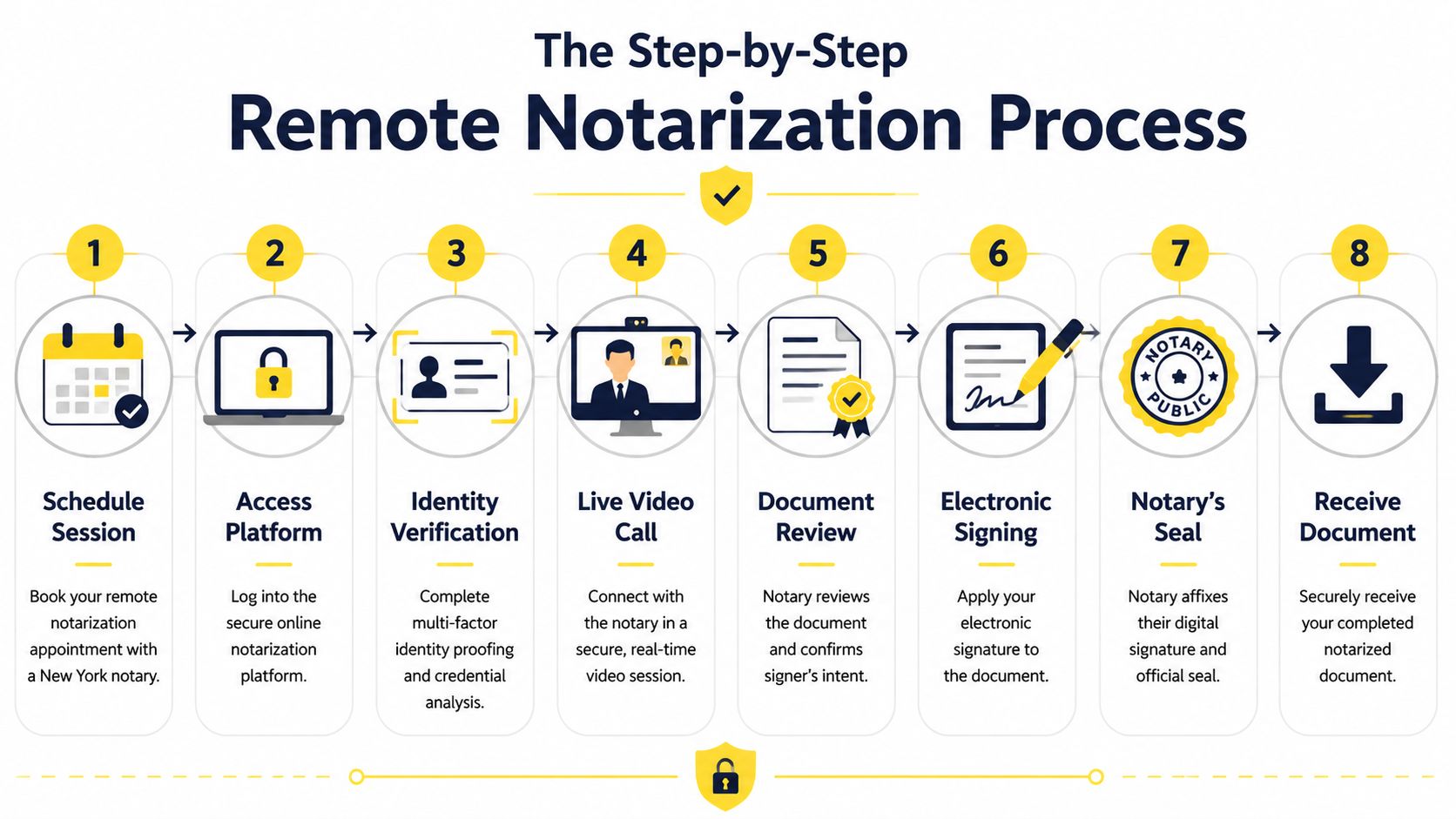
What you'll usually see first
You receive a secure link from the notary or platform. After logging in, you may be prompted to upload or scan your ID and complete identity-proofing steps before the live call starts. That pre-call stage often takes longer than clients expect.
Then you enter the live audio-video session. The notary confirms who you are, checks that you appear willing and aware, and confirms that the document in front of everyone is the document being signed.
New York requires a durable record of what happened. The state's framework requires electronic notaries to keep a complete, uninterrupted audio and video recording of the entire notarial act for at least ten years, including identity verification procedures, signatures, and a verbal description of the identification used. I've already linked the governing source above, and that recording requirement is one of the reasons a casual video call won't do.
What the notary is looking for
The notary is not just there to watch you click a button. The notary is checking legal basics in real time:
- Identity
- Willingness
- Awareness
- Consistency between the person, the ID, and the document
If the signer appears confused, coached off camera, or unable to communicate clearly, a careful notary may stop the session. That can feel inconvenient, but it's usually the right call.
A rushed session is where many avoidable problems start. The notary should be methodical, not fast for the sake of being fast.
A Toronto business example
A Toronto director signing a New York board consent will often move through the session smoothly. The identity check clears, the notary confirms the director understands the document, the signature is applied electronically, and the notary completes the electronic certificate.
A different result can happen with a New York power of attorney sent to an elderly family member in Toronto. If the signer struggles with the platform, hesitates on basic questions, or keeps looking to someone else for direction, the notary may pause. That isn't necessarily a rejection. Sometimes the answer is better scheduling, a clearer document review beforehand, or deciding that in-person execution is safer.
What happens after signing
Once you sign electronically, the notary applies the electronic signature and seal. You should then receive the completed notarized document through the platform or secure delivery method the notary uses.
Before you log off, ask three things:
- Will I receive a PDF only, or a printable paper version too
- Does this document need any certificate for recording or filing
- If it's for use outside the U.S., what legalization step follows
That last question matters more than most guides admit.
Cross-Border Notarization for Canadians and Apostille Needs
A common cross-border problem looks like this. You are in Toronto, the document is for New York, and the receiving party assumes a local Canadian notarization will do the job. Often it will not. For a New York remote notarization, the notary must be physically in New York at the time of the act, even if the signer is in Ontario, elsewhere in Canada, or another country.
That point matters most for clients handling U.S. real estate, shareholder documents, immigration filings, or family estate planning while living in Canada. The notarization may be valid under New York law, but acceptance still depends on what the bank, court, land records office, consulate, or foreign authority expects to receive.

Documents that usually travel well across the border
Remote New York notarization is often a good fit for commercial and administrative documents where the signer's identity and authority are easy to verify and the document is not likely to be attacked later on capacity grounds. That usually includes:
- Affidavits tied to a transaction
- Corporate resolutions and board consents
- Financing and closing documents
- Supporting documents for U.S. immigration filings
For a Toronto founder signing New York deal documents, remote notarization can save a trip without changing the legal effect of the document, provided the platform, identity proofing, and certificate are all done correctly.
Documents that call for more caution
Wills, powers of attorney, trusts, and estate documents need a more careful review before anyone schedules a remote session. The issue is not only whether a New York notary can complete the act. The issue is whether the document will hold up later if a family member, lender, title insurer, or court questions capacity, undue influence, witness compliance, or the signer's understanding.
This comes up often with Canadians who own New York property or have U.S. family ties. A New York statutory short form power of attorney may be notarizable remotely, but that does not answer whether witnesses are also needed, whether the receiving institution will accept an electronically notarized version, or whether an original paper document is still the safer choice. The same caution applies to wills. Notarization and valid execution are separate questions.
Apostille, authentication, and use outside the United States
A completed New York notarization is sometimes only the first step. If the document will be used outside the United States, you may need an apostille or another authentication step after notarization. The right path depends on where the document is going and what that office accepts.
For clients who also need Ontario-side execution help, local certification, or a commissioner for related papers, our guide to a notary public in Ontario, Canada explains the Canadian side of the process.
Before booking the session, confirm these points with the end user of the document:
- Will they accept an electronically notarized New York PDF
- Do they require a wet-ink printout or certified paper copy
- Is an apostille or other legalization step required after notarization
- Are witnesses required in addition to the notary
Cross-border files fail for practical reasons more often than legal ones. The notarization may be done properly, but the document is still rejected because nobody checked the receiving office's format, witness, or legalization requirements first.
Common Pitfalls and Pricing Expectations
The biggest mistake I see is assuming any platform that supports video and e-signing will work. In New York, the platform choice isn't cosmetic. It's part of compliance. If the notary's setup doesn't match New York's rules, the document may be valid in nobody's eyes except the people who signed it.
What commonly goes wrong
Here are the failures that create the most friction:
- Wrong platform: The technology may not support the required identity and recordkeeping functions.
- Bad ID match: The document name and ID name don't line up.
- Poor signing environment: Noise, weak internet, or poor lighting disrupt the session.
- Wrong document for the job: A signer assumes all New York documents can be handled the same way.
- No end-use check: The recipient needs a paper copy, certificate, or legalization step nobody planned for.
A separate practical issue is venue. If you're signing from Toronto for a New York transaction, remember that privacy matters. Don't do the call from an open office floor, airport gate, or shared boardroom unless the document is routine and non-sensitive.
What the notarization can cost
New York licensed electronic notaries may charge up to $25.00 per electronic notarial act, while the traditional in-person maximum is $2.00, according to Stavvy's summary of New York's permanent RON law. The same source notes that, for acceptance by recording officers, a tangible copy of an electronically notarized record must be accompanied by a Certificate of Authenticity.
That fee cap matters because clients often ask, “Is that $25 for the whole appointment?” Not always. The law allows the charge per notarial act. If your package contains multiple notarial certificates, the cost can change.
How to avoid surprises
Use this short decision list before you book:
- Ask for the per-act fee in writing
- Ask how many notarial acts your package contains
- Ask whether a paper certificate or authenticity certificate is extra
- Ask whether the document is intended for recording, court use, or foreign use
If the document is headed to a consulate or embassy workflow after notarization, it also helps to understand what an embassy does.
If you need a New York document notarized while you're in Toronto, the safest approach is to confirm the legal path before the appointment, not after a rejection. Mayo Law assists clients with cross-border notarization, document use in New York, and the follow-up steps that often matter just as much as the signature itself.
Frequently Asked Questions
What is a remote notary in New York?
A remote notary in New York is a New York notary who is authorized to perform electronic notarizations using compliant communications technology. The session happens by live audio-video connection rather than in person. The legal issue isn't just distance. The notary must be properly registered and use a compliant process for identity verification and recordkeeping.
How much does a New York remote notarization cost?
New York licensed electronic notaries may charge up to $25.00 per electronic notarial act. That doesn't always mean $25 for an entire file. If your signing package has multiple separate notarizations, the total may be higher. You should also ask whether any paper certification or post-notarization legalization step will be needed afterward.
Can I sign from Toronto if the document is for New York?
Yes, often you can. The critical location rule is the notary's location, not yours. The New York electronic notary must be physically in New York when performing the act. The signer may be elsewhere, including outside the United States. The harder question is whether the receiving institution will accept that document for the specific purpose you have in mind.
How long does the process take?
The live session itself is often the shortest part. Preparation usually takes longer than clients expect, especially if the document package needs review, the platform requires identity proofing steps, or the receiving party has special acceptance rules. If the document will later need apostille, authentication, or a certificate for recording, the overall timeline becomes longer.
Are wills and powers of attorney safe to sign this way?
Sometimes, but they need more caution than routine business papers. Estate documents and powers of attorney are more likely to be challenged if someone later questions capacity, undue influence, or proper execution. For cross-border family matters, the legal validity of the notarization is only part of the analysis. The litigation risk around the document also matters.
How Mayo Law Can Help
Mayo Law serves clients across Toronto, the GTA, and on cross-border matters. If you need a New York document notarized from Canada, the work often includes more than booking a notary. It may also involve checking the document type, confirming the receiving party's acceptance rules, and planning any authentication steps that follow. To discuss your situation, visit notary services at Mayo Law.
Disclaimer
This article is for informational purposes only and does not constitute legal advice. Every situation is different. Consult a licensed lawyer about your specific circumstances. Mayo Law provides legal services through Mayo Law PC in Ontario and Joseph Mayo PLLC in New York.
Related Articles
- Notary services at Mayo Law
- International business legal services
- Regulatory compliance legal services


