
Contents
- Embarking on a Joint Venture Your Blueprint for Success
- What Does a Joint Venture Lawyer Do?
- Key Legal Issues in a Joint Venture Agreement
- Special Considerations for U.S.–Canada Joint Ventures
- How to Evaluate and Hire the Right Joint Venture Lawyer
- Understanding Legal Fees and Project Timelines
- Frequently Asked Questions
- How Mayo Law Can Help
- Disclaimer
- Related Articles
A Toronto company wants market access in the United States. A New York company wants a faster route into Canada. On paper, a joint venture looks efficient. In practice, the deal can slow down fast once the parties ask harder questions about ownership of technology, board control, capital calls, regulatory filings, and who carries the risk if the venture underperforms.
Cross-border deals create a second layer of friction. U.S. and Canadian counsel may use similar language for governance, disclosure, competition review, and intellectual property, but the legal consequences are not always the same. A structure that works for U.S. tax or securities purposes may create problems in Canada. A management role that supports the business plan may also raise immigration questions, including whether an investor or founder needs to examine E-2 visa eligibility before operations begin.
A joint venture lawyer helps set up the deal so the commercial understanding survives first contact with real operating pressure. That includes defining decision rights, contribution obligations, transfer limits, confidentiality, IP ownership, and exit mechanics in terms the parties can effectively use when a dispute arises. In U.S.-Canada ventures, it also means checking for conflicts between regulatory regimes such as SEC requirements and Canadian competition review, instead of assuming one set of rules will carry the whole project.
Some industries add their own operational strain. Businesses exploring project-based partnerships may face many of the same control, liability, and scope issues discussed in this guide to construction joint ventures.
Embarking on a Joint Venture Your Blueprint for Success
The early stage of a joint venture often looks deceptively simple. Two businesses agree on the opportunity and assume the lawyers will “paper it up” later. That usually creates the problems that become expensive.
A useful starting point is to treat the venture as a business with its own pressure points, not as a side deal between friendly companies. If one party contributes cash and the other contributes know-how, someone has to value both. If both parties expect equal say, someone has to define what “equal” means when a budget overruns, a key executive leaves, or the venture needs more capital.
Practical rule: If the parties can't explain decision-making, deadlock, and exit in plain English, the draft isn't ready.
A good process usually starts with a short term sheet. It should cover the commercial deal before anyone spends weeks negotiating dense language. From there, counsel can test whether the proposed arrangement should be a separate entity or a contractual collaboration, whether the parties need competition review, and whether shared IP needs a license rather than a transfer.
Businesses considering sector-specific partnerships often also face operational issues unique to the project itself, as discussed in this guide to construction joint ventures.
What Does a Joint Venture Lawyer Do?
A joint venture lawyer designs the legal, governance, and risk framework for a business partnership. The job is not limited to drafting one agreement. It includes choosing the right structure, negotiating control and economics, documenting compliance obligations, and building dispute and exit mechanisms into the deal from the start.
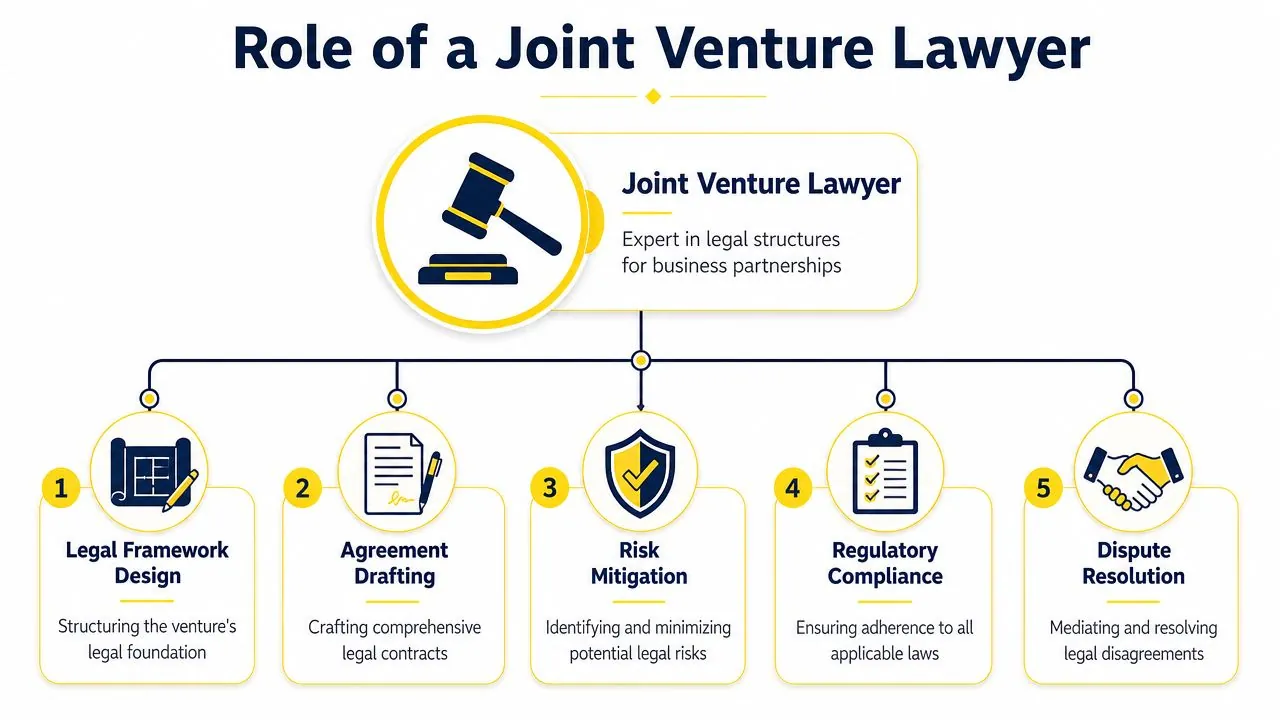
Joint ventures are not niche transactions anymore. According to a 2025 Boston Consulting Group survey, 60 percent of CEOs identify joint ventures and strategic partnerships as a core component of their future growth strategy, as noted in the Chambers Joint Ventures 2025 guide. That trend raises the stakes on getting the legal architecture right.
Strategic advisor
Before drafting starts, counsel should pressure-test the business model. Sometimes the right answer is a new entity. Sometimes it is a looser contractual arrangement. Sometimes it is not a joint venture at all, but a supply, license, or distribution deal.
That distinction matters because the wrong structure creates the wrong tax treatment, the wrong liability exposure, and the wrong approval process.
Drafter of the operating rules
The joint venture agreement is the operating manual. It should define who contributes what, who manages what, what decisions require unanimous approval, and what happens when one party misses its obligations.
A practical lawyer also drafts the supporting documents, not just the main agreement. That can include confidentiality agreements, IP licenses, services agreements, and governance policies.
Negotiator when interests diverge
Most parties agree in principle and disagree in detail. One side wants broad exclusivity. The other wants flexibility. One wants equal board seats. The other wants veto rights tied to capital at risk.
The lawyer's role is to convert those competing positions into workable compromises without leaving hidden gaps. Businesses that need broader transaction support often look at counsel with experience in international business law, especially where governance and market-entry questions overlap.
Risk manager with an exit plan
A joint venture succeeds when the parties can operate without re-trading the deal every month. That requires planning for underperformance, additional funding, ownership of jointly developed assets, and termination rights.
The best joint venture documents don't assume the relationship will fail. They assume pressure will arrive and give the parties a map for handling it.
Key Legal Issues in a Joint Venture Agreement
A well-drafted agreement does two things at once. It captures the business upside and limits the legal damage if the venture underperforms.
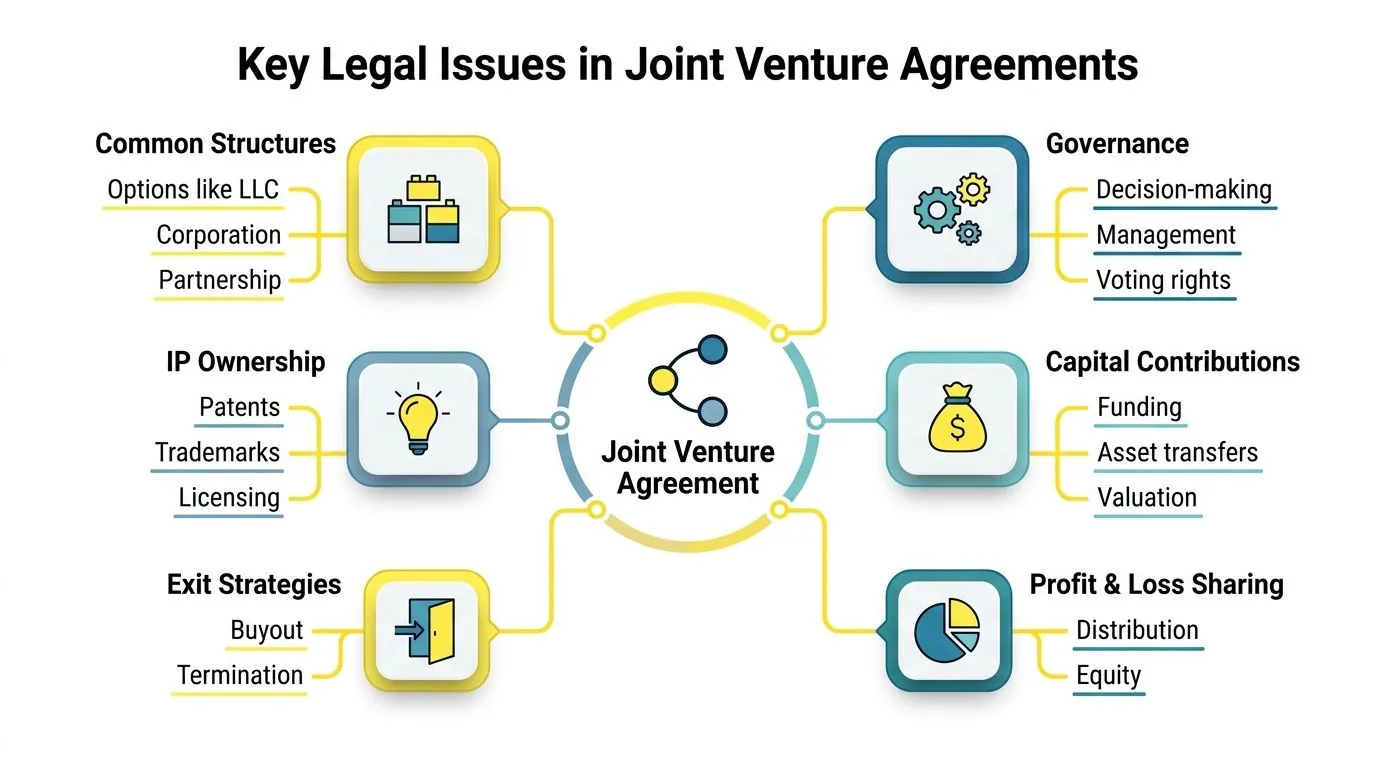
One of the clearest drafting rules is this: a joint venture lawyer must structure the agreement around four critical governance pillars: specific objectives, project scope, financial commitments, and explicit exit strategies, as outlined by Hatcher Legal. Those four points reduce avoidable disputes because they define what the venture is meant to do, how far it extends, what each side must put in, and how the relationship can end.
Choosing the structure
The legal form changes everything downstream. Here is a practical comparison:
| Structure | What usually works | What often goes wrong |
|---|---|---|
| Separate LLC or corporation | Clear asset ring-fencing, dedicated governance, easier accounting separation | More setup, added filings, more formal administration |
| Contractual joint venture | Faster to launch, fewer entity formalities, useful for a limited project | Liability can be less contained, governance can become vague |
| Partnership-style arrangement | Useful where parties truly co-manage operations | High risk of accidental obligations if terms are loose |
If you expect employees, external financing, owned IP, or a long operating life, a separate entity often gives cleaner lines. If the venture is narrow and time-limited, a contractual model may be enough. What does not work well is pretending a long-term operating business can run on a short memorandum drafted for convenience.
Clauses that cannot stay vague
The agreement should deal directly with the issues parties tend to postpone:
- Capital contributions. Cash, equipment, staff time, licenses, customer lists, or real property all need valuation and timing rules.
- Management authority. Day-to-day authority should be separated from reserved matters that need higher approval.
- Profit and loss allocation. Equal ownership does not always mean equal economics.
- IP ownership. Pre-existing IP and newly created IP should be treated differently.
- Confidentiality. Shared information needs ongoing protection even if the venture ends.
- Dispute procedures. Mediation, arbitration, court jurisdiction, and interim relief should be addressed before a conflict starts.
A common mistake is assuming generic templates cover these points well enough. They usually do not. Templates rarely reflect the actual commercial bargain, and they often fail on the interaction between tax, control, and exit rights.
What works in practice
An anonymized example helps. A software company entered a venture with a Canadian distributor using a short form agreement. The parties never distinguished background IP from new product improvements. Once sales began, both sides claimed ownership over customer-facing features. The dispute was not about coding. It was about drafting.
Another example appears in manufacturing. Two companies agreed to share costs “as needed,” but never defined funding calls or dilution consequences. When one side refused to contribute more capital, the other had no clear contractual remedy.
A contract should answer the question, “What happens next?” for the predictable problems, not just the optimistic plan.
If forum and governing law terms are being negotiated, businesses should think carefully about litigation posture and enforcement before signing. A focused discussion of that issue appears in this guide to the forum selection clause.
Special Considerations for U.S.–Canada Joint Ventures
Cross-border ventures add a second layer of friction. The parties are not just negotiating with each other. They are also working across two legal systems that approach disclosure, competition, privacy, immigration, and IP in different ways.

What regulatory review can apply
A U.S.-Canada venture may trigger review well beyond corporate law. The verified cross-border guidance here is practical: the U.S. Securities and Exchange Commission enforces disclosure and related rules in applicable cross-border transactions, while Canada's Competition Bureau has its own transparency and review concerns for larger deals, including transactions exceeding $90 million in asset value, as described in Baker Donelson's cross-border business discussion.
If the venture handles personal data, sector rules also matter. In healthcare, for example, parties may need to account for HIPAA on the U.S. side and PIPEDA in Canada. That is not a footnote. It affects data flows, vendor contracts, breach procedures, and internal access controls.
IP needs separate treatment in a cross-border deal
IP is one of the easiest places for a promising venture to break down. The verified data allows one useful benchmark here: WIPO reports that 40% of international business disputes involve IP infringement, as cited in Brooks Pierce's cross-border discussion. That is why the agreement should distinguish between:
- Background IP each party owned before the deal
- Licensed IP the venture can use during the relationship
- Developed IP created inside the venture
- Exit IP rights after termination or buyout
A Canadian founder joining a U.S. commercialization venture may assume joint development means shared ownership. That assumption can be wrong if the contract points the other way, or if local law treats authorship and assignment differently than expected.
Immigration can be part of the deal structure
Some U.S.-Canada ventures are built around the movement of a founder or principal operator. In those cases, immigration planning cannot be left until after signing.
For an investor to qualify for an E-2 visa through a U.S. joint venture, the source of funds must be meticulously documented to prove it was lawfully obtained, as required by USCIS. Investments typically range from $100,000 to $250,000, according to USCIS E-2 treaty investor guidance. If the funding trail is messy, the visa strategy can fail even if the business deal itself is sound.
That issue often overlaps with ownership reporting and transaction structuring questions, especially where multiple entities are involved. Businesses can also review related compliance concerns around beneficial ownership reporting requirements.
How to Evaluate and Hire the Right Joint Venture Lawyer
Hiring counsel for a joint venture is not just about credentials on paper. It is about fit for the transaction you are doing.
What to test in the first meeting
Use the first call to see whether the lawyer can isolate business risk fast. Useful questions include:
- How would you structure this deal and why?
- What are the first three failure points you see?
- How would you handle deadlock if both parties have equal control?
- Who should own new IP created in the venture?
- Which approvals or filings might apply in the U.S. and Canada?
- How do you budget drafting, diligence, and negotiation separately?
Good answers are specific. Weak answers stay abstract.
Watch for conflict issues
An overlooked problem is dual representation. If a parent company's lawyer is also expected to advise the joint venture itself, conflict rules can become serious quickly. The verified guidance here is clear: under ethics rules such as DR 1.06(c) in some jurisdictions, both entities must consent after full disclosure, and the lawyer must reasonably believe the representation will not be materially affected, as discussed in Texas Ethics Opinion 512.
That matters in practice because many founders assume “our company lawyer can just handle it.” Sometimes that is possible. Sometimes it creates exposure before the first contract is signed.
Practical hiring criteria
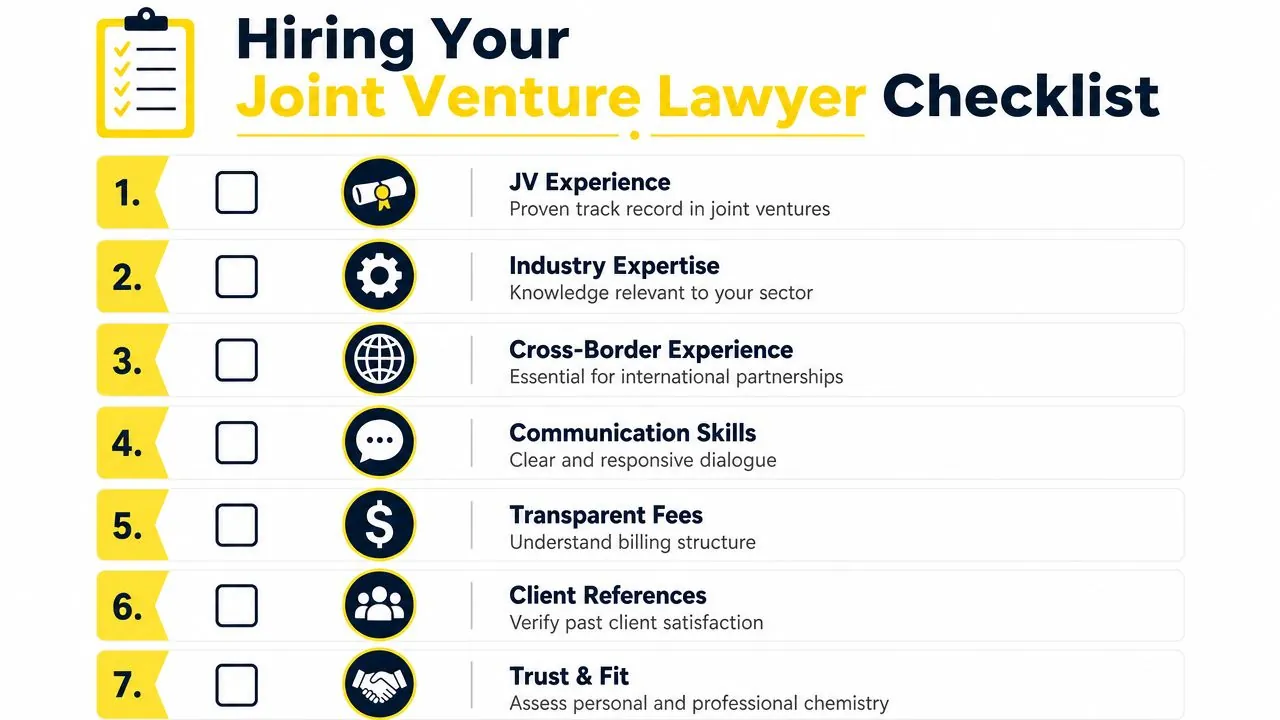
Look for a lawyer who can show these traits:
- Cross-border fluency. The venture touches more than one legal system.
- Drafting discipline. They should talk comfortably about reserved matters, funding calls, and IP schedules.
- Negotiation judgment. They should know when to push and when to solve.
- Fee transparency. You should understand what is included and what is not.
- Responsiveness under pressure. Deals do not pause because calendars are crowded.
If counsel cannot explain the structure to a non-lawyer board member, the transaction may become harder than it needs to be.
Mayo Law works with companies across the GTA and on cross-border matters. Joseph Mayo is licensed in Ontario and New York, so clients with U.S. ties coordinate their legal work in one place rather than juggling two firms. For businesses comparing counsel on drafting and deal execution, it also helps to understand how a contract negotiation attorney approaches strategic advantage, risk allocation, and fallback positions.
Understanding Legal Fees and Project Timelines
Legal fees are rarely the only cost in a joint venture. Filing fees, formation costs, due diligence expenses, and regulatory work can all affect the budget.
How much does a joint venture lawyer cost
Most lawyers charge one of three ways:
- Hourly billing for negotiation-heavy or uncertain matters
- Flat fees for defined deliverables such as a term sheet or first draft
- Hybrid billing where drafting is fixed and negotiation is hourly
What drives cost is not just deal size. Complexity matters more. A two-party domestic venture with clear roles is usually simpler than a cross-border venture with immigration, IP, and data-transfer issues.
Certain government costs are fixed even when legal fees vary. For example, Delaware publishes state filing costs on its Division of Corporations fee schedule. A lawyer's practical role is to separate those hard costs from professional fees so you can budget clearly.
How long does a joint venture take
There is no reliable single timeline for all ventures, and it is better not to pretend there is. In practice, timing depends on how quickly the parties can agree on business points, exchange diligence, and resolve control issues.
A workable timeline usually moves through these stages:
- Initial alignment with a term sheet
- Due diligence on financial, legal, and operational issues
- Drafting of the main agreement and side documents
- Negotiation of open points
- Closing and setup for accounts, governance, and compliance
The fastest deals are the ones where business principals answer hard questions early. The slowest are the ones where everyone avoids discussing control, money, and exit until the end.
Frequently Asked Questions
Is a joint venture the same as a partnership
Not always. Some joint ventures use a separate corporation or LLC. Others are purely contractual. The key difference is that a joint venture is usually tied to a specific business purpose, project, or market objective, while a broader partnership may govern an entire ongoing business relationship.
What is the biggest legal risk in a joint venture
In practice, the biggest risk is usually misalignment disguised as agreement. A founder says “we're fifty-fifty,” but the parties never define who controls hiring, future funding, customer ownership, or product direction. That gap becomes expensive when the first problem appears.
One anonymized tech matter shows the pattern. Two companies agreed to co-develop a platform, but they left IP ownership to “future discussion.” The product launched. Revenue started. Then each side claimed rights over the codebase and customer data. The practical next step in a situation like that is to freeze new use, preserve records, and negotiate an interim operating protocol while counsel sorts out ownership and license rights.
Can one lawyer represent both joint venture partners
Sometimes, but it is not always wise. If interests are likely to diverge, separate counsel may be the safer route. Even where one lawyer is permitted to act, the conflict analysis must be taken seriously and the scope of representation should be documented carefully.
A common SME example is a parent company that wants its longtime outside counsel to “cover the JV too.” That can work for narrow setup tasks, but once governance, funding defaults, or exit rights become contested, shared representation may stop being workable. The next step is often to define who the client is and bring in separate counsel before substantive negotiations continue.
How early should I involve a lawyer
Earlier than most businesses think. A lawyer adds the most value before the parties harden into positions on economics and control. By the time a draft is circulating with unresolved business assumptions buried inside legal language, negotiations are already harder.
For a manufacturing expansion, for example, the best moment to involve counsel is before signing exclusivity or sharing proprietary production methods. That allows the team to decide whether the deal should be a corporation, LLC, or contractual arrangement and to protect confidential information before momentum outruns judgment.
Do U.S.-Canada joint ventures need immigration planning
Often, yes. If a principal investor, founder, or manager needs to work in the United States as part of the venture, the deal structure and ownership chain can affect immigration options. E-2 issues, source-of-funds documentation, and operational control should be considered before closing rather than after.
A practical example is a Canadian entrepreneur joining a U.S. venture with plans to run U.S. operations personally. If that role is central, the next step is to map the ownership and investment trail alongside the corporate documents so the immigration file matches the business reality.
If you're weighing a U.S.-Canada venture and want practical legal guidance before terms harden, Mayo Law is one option to consider for cross-border business planning, agreement drafting, and related immigration or compliance issues.
In a cross-border joint venture, the legal work is not just paperwork. It is the structure that decides who controls the venture, who owns the value created, and how problems get resolved when the relationship is under strain.
Clarity at the start is cheaper than repair later. If your deal involves two jurisdictions, shared IP, investor movement, or regulatory exposure, careful drafting is not optional.
How Mayo Law Can Help
A U.S.-Canada joint venture can stall for reasons the term sheet never addressed. The U.S. entity may be set up in a way that undercuts an E-2 application, the parties may assume Canadian and U.S. regulators will view the deal the same way, or shared IP may be left in a contract clause that does not match how the business will operate in practice.
Mayo Law advises on cross-border joint ventures involving U.S.-Canada structuring, investor mobility, and allocation of operating risk. That work often requires one legal strategy across the corporate, commercial, and immigration pieces, especially where a founder or investor expects to work in the United States as part of the venture.
The goal is practical. Align the ownership structure, management rights, IP terms, and immigration record before signing documents that are expensive to amend later. Where E-2 planning is part of the deal, visit E-2 visa lawyer.
Disclaimer
This article is for informational purposes only and does not constitute legal advice. Every situation is different. Consult a licensed lawyer about your specific circumstances. Mayo Law provides legal services in Ontario and New York.
Related Articles
If your joint venture touches both sides of the border, the most useful follow-up reading usually falls into three buckets: immigration, regulatory compliance, and cross-border operating strategy. Those issues tend to create delays long before the parties argue over profit splits or board seats.
These topics matter in U.S.–Canada deals for practical reasons. An investor may need E-2 visa planning. A regulated business may face filings or review questions in more than one jurisdiction. A venture built around shared technology may need tighter rules on ownership, licensing, and post-exit use than a domestic deal would require.