

Contents
- How long does an E-2 visa take to process?
- Why does USCIS list 18.5 months for E-2 petitions?
- What does E-2 premium processing actually guarantee?
- Is there an official E-2 consular processing time?
- Where do Canadians apply, and why does Toronto matter?
- Does a USCIS change of status give you an E-2 visa?
- What makes an E-2 case take longer?
- Can you pay to speed up an E-2 visa at the consulate?
- Frequently asked questions
- Conclusion
- How Mayo Law can help
- Disclaimer
Every investor asks the same question before committing money to a United States business, and almost every answer online is a range someone made up. The honest position is that the E-2 visa processing time depends entirely on which of two routes you take, and only one of those routes has an official published number attached to it.
This guide uses figures read directly from United States government sources in August 2026: the USCIS processing times tool, the Department of State visa wait times table, and the E visa instructions published by the U.S. Mission to Canada. Where a number does not exist, this article says so instead of inventing one, because a made-up average is what sends investors into decisions they later regret.
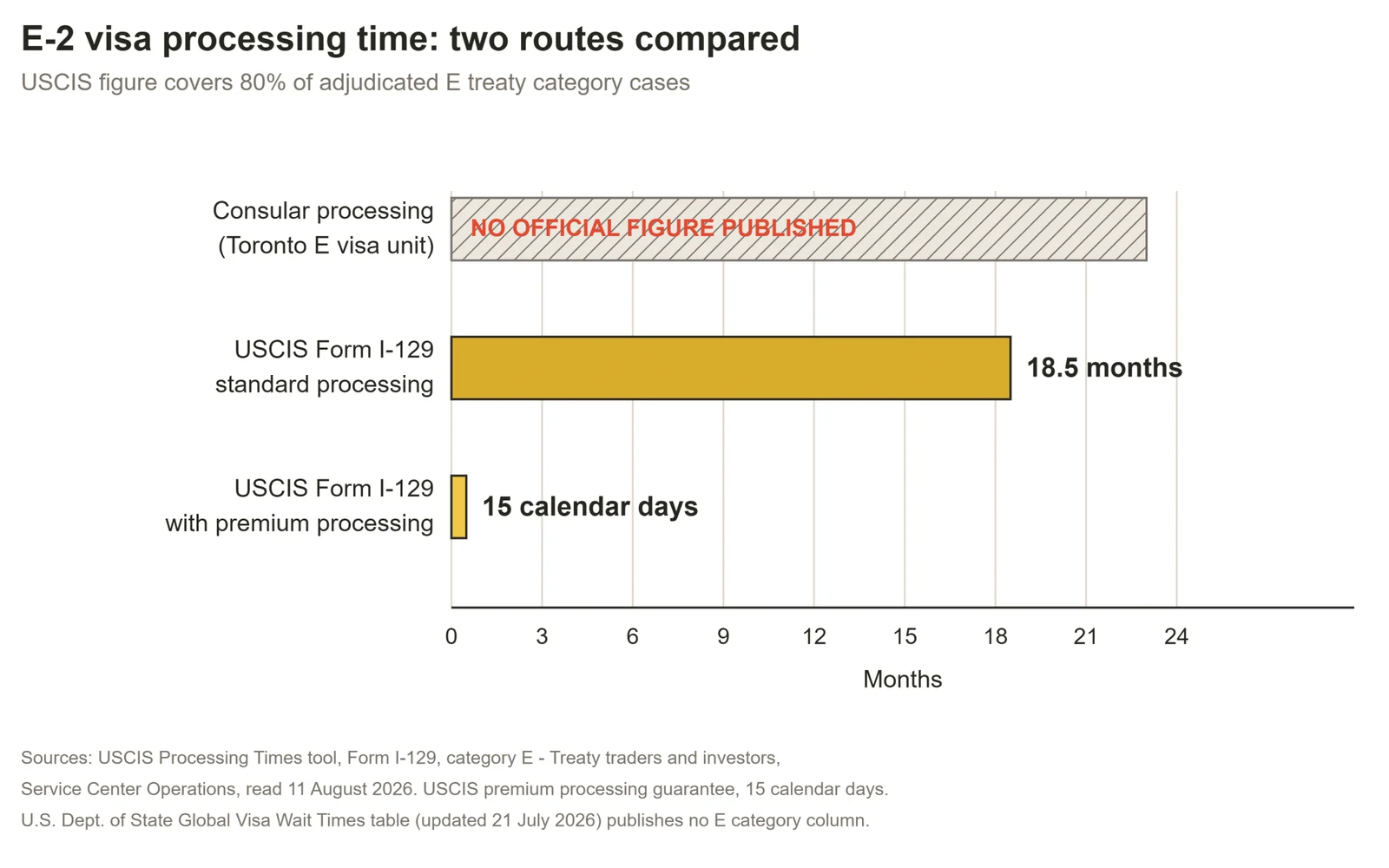
Quick answer: There is no single E-2 processing time. USCIS reports that 80% of Form I-129 petitions in the E treaty category finish within 18.5 months, and premium processing cuts that to a 15 business day response. The State Department publishes no E-2 consular wait time at all.
How long does an E-2 visa take to process?
The E-2 classification can be obtained two different ways, and the E-2 visa processing time is completely different for each. Both are set out in more detail in our guide to the E-2 visa application process.
The first route is consular processing. You apply to a U.S. consulate abroad, submit a document package, attend an interview in person, and receive a visa in your passport. For Canadians this route runs through the U.S. Consulate General in Toronto, a route we cover separately in our guide to applying for an E-2 visa from Canada. The Department of State does not publish an E-2 wait time, so nobody can quote you an official figure for this route.
The second route is a change of status inside the United States. Your U.S. company files Form I-129 with USCIS asking to place you in E-2 status. USCIS does publish a processing time for this, and as of August 2026 it reads 18.5 months for 80% of cases in the E treaty category. Premium processing brings that down to 15 business days for a fee.
Those two routes produce different things, which is the point most timeline articles miss entirely. A consulate issues a visa, which is travel permission. USCIS grants status, which is permission to remain. The section below on change of status explains why that difference can cost a Canadian investor an entire second application.
| Consular processing | Change of status (Form I-129) | |
|---|---|---|
| Decided by | U.S. consulate abroad | USCIS |
| What you receive | A visa in your passport | E-2 status inside the U.S. |
| Official published time | None published by the State Department | 80% within 18.5 months |
| Paid expedite available | No | Yes, 15 business days via Form I-907 |
| Lets you re-enter the U.S. | Yes | No, valid only while you remain in the U.S. |
| Where Canadians go | Toronto for first-time applicants | Filed by the U.S. company with USCIS |
Read that table carefully before you assume the faster number is the better route. Fifteen business days sounds decisive against a consular process with no published timeline, but the fifteen day route leaves a Canadian investor holding status and no visa.
Why does USCIS list 18.5 months for E-2 petitions?
The USCIS processing times tool reports by form and category. Selecting Form I-129 with the category “E – Treaty traders and investors” at Service Center Operations returns a single figure: 80% of cases are completed within 18.5 months. That number was read live from the USCIS tool on 11 August 2026.
USCIS explains its own methodology on the same page. The figure is based on how long it took the agency to complete 80% of adjudicated cases over the previous six months. It is a backward-looking measurement of completed work, not a forecast and not a promise about your file.
None of this speaks to whether your case qualifies in the first place, which turns on the E-2 visa requirements rather than on timing. Two things follow from that. The first is that 18.5 months is a real, sourced, current number, and it is dramatically longer than the three to six month ranges that circulate on immigration blogs. The second is that essentially nobody waits 18.5 months for an E-2 change of status in practice, because the premium processing service exists and most petitioners use it. The published figure describes the queue you are choosing to leave.
What does E-2 premium processing actually guarantee?
Premium processing is requested on Form I-907 and has been available for the E-2 treaty investor classification since 1 June 2001. USCIS guarantees that it will take “adjudicative action on the case” within 15 business days.
The precise wording matters more than most applicants realise. USCIS commits to act, not to approve. Within the 15 day window the agency may issue an approval notice, a denial notice, a notice of intent to deny, a request for evidence, or it may open an investigation for fraud or misrepresentation. Any one of those five outcomes satisfies the guarantee.
There is a second detail that reshapes planning. If USCIS issues a request for evidence or a notice of intent to deny, the 15 day clock stops. A completely new 15 day period begins only when the agency receives a complete response. A petition that draws a request for evidence therefore does not take 15 days. It takes 15 days, plus however long your side needs to assemble a response, plus another 15 days.
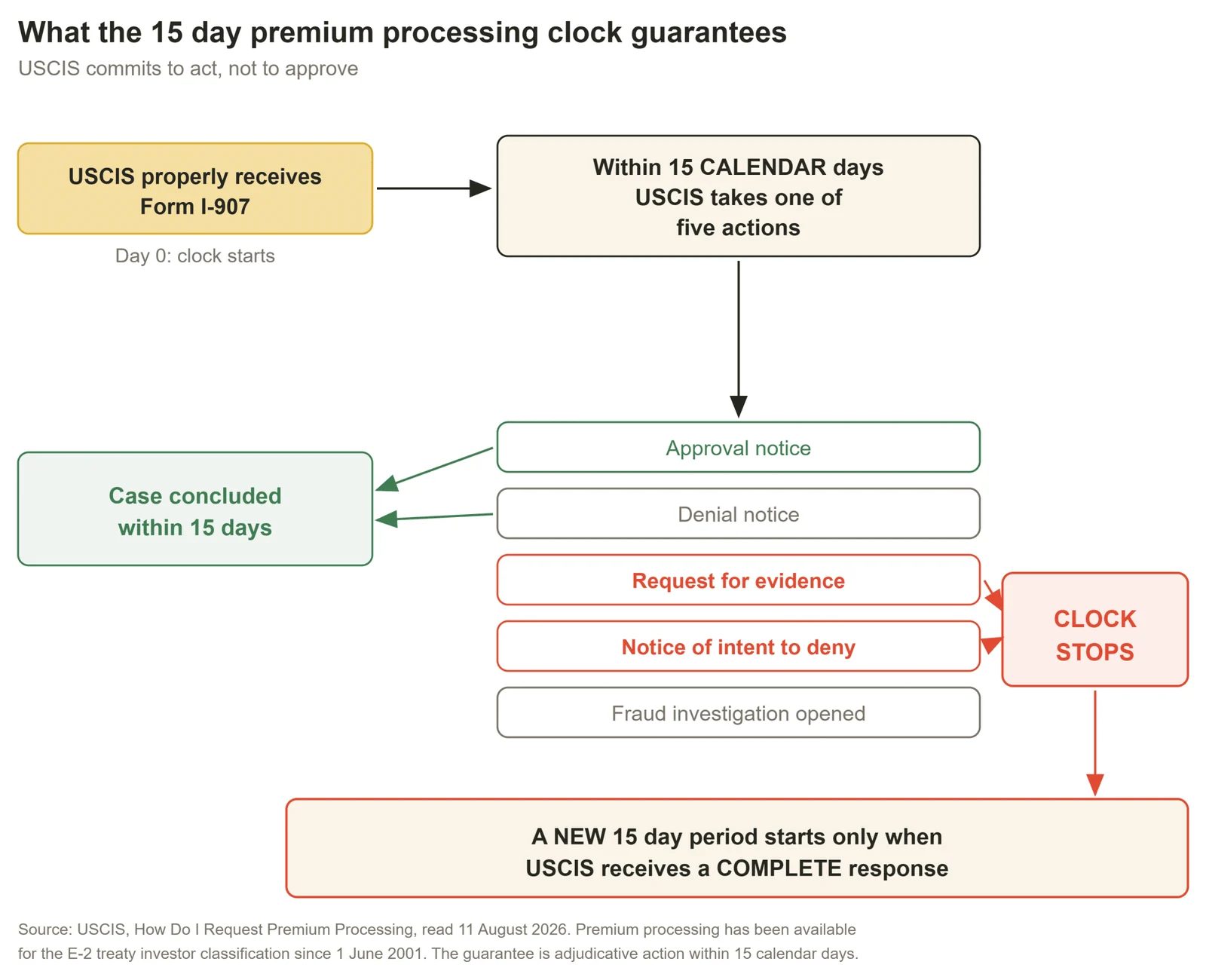
Note also that premium processing is measured in business days; weekends and federal holidays do not count toward the 15 days.
Premium processing is also a real line item in the budget, which we break down alongside the other costs in what an E-2 visa costs. USCIS changed its premium processing fees effective 1 March 2026, and the current fee schedule is Form G-1055. This article deliberately does not quote a dollar figure for the I-907 fee, because the amount could not be verified against the live USCIS fee schedule during research. Check the official schedule or the USCIS fee calculator rather than relying on a number republished by any law firm, including this one.
Is there an official E-2 consular processing time?
No, and this is the single most misreported fact about the E-2 visa.
The Department of State publishes a Global Visa Wait Times table showing the next available interview appointment at every post worldwide. That table was last updated on 21 July 2026. It has exactly five data columns: average wait times for B1/B2, next available appointment for B1/B2, next available for F, M and J students and exchange visitors, next available for petition-based categories H, L, O, P and Q, and next available for crew and transit categories C, D and C1/D.
There is no E column. Treaty trader and treaty investor visas do not appear in the table at all. That means any article quoting an official average E-2 consular processing time is quoting something the Department of State does not publish.
The structural reason is that E visa applications at most posts are handled by a dedicated E visa unit that runs its own document review before any interview is scheduled, rather than sitting in the general nonimmigrant visa appointment queue that the table measures. In Canada, first-time applicants email a complete document package to the E visa unit, and the interview follows the unit’s review of that package.
There is one officially stated consular timeframe worth knowing, and it applies after your interview rather than before it. The U.S. Mission to Canada states that most administrative processing is resolved within 60 days of the visa interview, while cautioning that timing varies with individual circumstances and that the consulate has no control over how long it takes.
Where do Canadians apply, and why does Toronto matter?
Canada is an E-2 treaty country, with the treaty in force since 1 January 1994. Canadian citizens qualify, but where they apply is not a free choice.
The U.S. Mission to Canada states that first-time E-1 and E-2 applicants, and any company renewing its E visa registration, must apply at the U.S. Consulate General in Toronto. Employees of already-registered E visa companies and qualifying family members of current E visa holders have more freedom: they may schedule the next available appointment in Calgary, Montreal, Ottawa, Vancouver or Toronto, provided they are a Canadian resident or national.
So the practical answer for a first-time Canadian investor is that the queue that matters is Toronto’s E visa unit, regardless of whether you live in Vancouver or Halifax.
A second rule now shapes where anyone can apply. Effective 6 September 2025, the Department of State instructs all visa applicants, including applicants residing in the United States, to submit their applications in their country of residence or nationality, and applicants must be able to demonstrate residence in the country where they apply. A Canadian living in the United States can no longer treat a convenient third-country post as an option.
One more piece of the Canadian timeline is worth planning around. E visa company registration is granted when a consular officer in Canada determines that a company meets E visa standards. Once a company is registered, later applicants from that company can focus on their own qualifications as owner, manager or essential employee rather than re-proving the whole enterprise. The first application from a company is therefore the slow one, and every subsequent employee benefits from it.
Does a USCIS change of status give you an E-2 visa?
It does not, and for Canadian investors this is the most expensive misunderstanding in the whole process.
A change of status approved by USCIS grants E-2 status, and the U.S. Mission to Canada states plainly that such a change of status remains valid only while the applicant remains in the United States. Once the applicant leaves the country, they need an E visa to return and resume running their business.
The consequence is set out just as plainly. Investors who have changed status inside the United States must follow the steps for all first-time investors. The change of status does not guarantee that a visa will be issued, and it does not exempt the investor from the normal process of filing documents in advance with the consulates in Toronto or Vancouver.
Anyone weighing a long uninterrupted stay in the United States should also look at the tax implications of moving from Canada to the U.S., because residency for tax purposes follows presence rather than visa category. Put that next to the geography. A Canadian investor typically has family, property and business ties on both sides of the border and will cross it. Choosing the 15 day premium processing route, then driving to Toronto for Thanksgiving, means re-entering as a first-time E visa applicant at the Toronto consulate with the full document package. The fast route did not remove the slow one. It added to it.
This is why the routes are not simply fast and slow. For an investor who genuinely will not leave the United States for a long stretch, the change of status route is quick. For a Canadian who will keep crossing the border, consular processing at Toronto is usually the route that actually finishes the job.
What makes an E-2 case take longer?
Several factors are documented in official sources rather than inferred.
Requests for evidence are the big one on the USCIS side, because they stop the premium processing clock entirely and start a fresh 15 day period once a complete response arrives. The quality of the initial filing is therefore the main lever an applicant controls over timing.
Administrative processing is the equivalent on the consular side. It happens after the interview, applicants are told at the interview that it is required, and the U.S. Mission to Canada states that most cases resolve within 60 days.
Prior visa ineligibility adds a separate and longer delay. Applicants who are ineligible due to criminal convictions, immigration violations, drug charges or similar reasons must appear to have the ineligibility and the likelihood of a waiver assessed, and the Mission warns of a likely wait of several months for a waiver to be processed by the Department of Homeland Security. Approval of the underlying E-2 case does not guarantee the waiver is granted.
The nature of the enterprise matters here too, since some sectors draw far more scrutiny than others, as we discuss in businesses that tend to win E-2 approval. Investment readiness affects timing before you even file. E-2 regulations require funds to be irrevocably committed before the visa may be issued, which can be satisfied by showing funds already at risk or held in escrow contingent only on issuance of the visa. An investor who has not committed funds cannot shorten the process by applying earlier.
Dependants add a sequencing constraint rather than a delay. Spouses and unmarried children under 21 may receive E visas, they do not need the principal applicant’s nationality, and they may apply at any post in Canada. They may only process, however, once the principal applicant’s visa has already been issued, and they must present a copy of it at their interview.
Can you pay to speed up an E-2 visa at the consulate?
No. The U.S. Mission to Canada states directly that the Department of State does not provide premium or expedited processing for an additional fee.
This is a genuine asymmetry between the two routes and it is worth stating clearly, because applicants who have read about premium processing often assume an equivalent option exists at the consulate. It does not. Premium processing is a USCIS service that applies to Form I-129. It has no consular counterpart.
Expedited appointments do exist, but the Mission describes them as generally reserved for cases with an acute humanitarian need for urgent travel, and notes that it receives many requests for expedited processing on business grounds. A commercial deadline is not the standard being applied.
The nonimmigrant visa application fee for the E treaty trader and treaty investor category is $315 USD. That is an application fee, not a speed option, and paying it does not affect where you sit in the queue.
Frequently asked questions
How long does an E-2 visa take in 2026?
The E-2 visa processing time depends on the route. USCIS reports that 80% of Form I-129 petitions in the E treaty category are completed within 18.5 months, and premium processing reduces that to a 15 business day response. For consular processing at a U.S. consulate, the Department of State publishes no E-2 wait time, so no official figure exists for that route.
Is E-2 premium processing 15 business days or 15 calendar days?
Fifteen business days. USCIS states that it will take adjudicative action within 15 business days for most Form I-129 classifications, including E-2 treaty investor. Weekends and federal holidays do not count toward the 15 days, so the guarantee is measured in working days.
Does premium processing guarantee my E-2 will be approved?
No. USCIS guarantees adjudicative action, not approval. Within the 15 day window it may issue an approval, a denial, a notice of intent to deny, a request for evidence, or open an investigation for fraud or misrepresentation. If a request for evidence or notice of intent to deny is issued, the clock stops and a new 15 day period starts when a complete response is received.
Where do Canadians apply for an E-2 visa?
First-time E-1 and E-2 applicants in Canada, and companies renewing their E visa registration, must apply at the U.S. Consulate General in Toronto. Employees of already-registered E visa companies and qualifying family members of current E visa holders may schedule at Calgary, Montreal, Ottawa, Vancouver or Toronto if they are a Canadian resident or national.
If I change status to E-2 inside the United States, do I still need a visa?
Yes, if you intend to leave the country. The U.S. Mission to Canada states that a change of status is valid only while you remain in the United States, and once you leave you need an E visa to return. You would then have to follow the full first-time investor process at the consulate, including filing documents in advance.
Can I pay to expedite my E-2 visa interview?
No. The Department of State does not provide premium or expedited processing for an additional fee for E visas. Expedited appointments are generally reserved for cases involving an acute humanitarian need for urgent travel, and business deadlines do not typically meet that standard.
How long does administrative processing take after an E-2 interview?
The U.S. Mission to Canada states that most administrative processing is resolved within 60 days of the visa interview. Timing varies with the circumstances of each case, applicants are told at the interview if it applies, and the consulate has no control over how long it takes.
Conclusion
The useful version of the E-2 visa processing time question is not “how many months”, it is “which route, and what does that route actually give me”. USCIS publishes 18.5 months for 80% of E category petitions and sells a 15 business day response on top of it. The Department of State publishes nothing for E-2 consular cases, and for Canadians the queue that matters is the Toronto E visa unit.
For a Canadian investor who will keep crossing the border, the route that produces a visa is usually the route worth planning around, even though it is the one without a published number. Timelines are also the part of an E-2 case an applicant has the most influence over, because a filing that avoids a request for evidence avoids the single largest source of delay in the system.
How Mayo Law can help
Mayo Law is a cross-border firm with offices in Toronto and New York. Joseph Mayo, the firm’s principal attorney, is licensed in both Ontario and New York, which means E-2 matters that involve a Canadian investor and a United States operating company can be handled without splitting the file between two firms.
For E-2 timing specifically, the work that matters is upfront: choosing between consular processing at Toronto and a change of status with USCIS based on how much you expect to travel, and preparing a document package complete enough that it does not draw a request for evidence. If you are weighing those choices, you can speak with an E-2 visa lawyer at the firm, or read more about our business immigration services.
Disclaimer
This article is provided for general information only and is not legal advice. Reading it does not create a solicitor-client or attorney-client relationship. Immigration rules, government fees and processing figures change, and the figures cited here were verified in August 2026 on the dates stated. You should obtain advice on your own circumstances before acting. Mayo Law provides legal services in Ontario and New York.