

Contents
- Quick Answer
- Shareholder agreement vs bylaws: what is the difference?
- What do corporate by-laws do?
- What does a shareholder agreement do?
- Who adopts each document, and who is bound by it?
- Can a shareholder agreement override the by-laws?
- How do Ontario and New York treat the two documents differently?
- What happens when the two documents conflict?
- Do you need both documents?
- Frequently asked questions
- Conclusion
- How Mayo Law Can Help
- Disclaimer
Corporate by-laws and shareholder agreements answer different questions, and most incorporated businesses eventually need both. By-laws set the internal operating rules of the corporation. A shareholder agreement is a private contract that governs the relationship between the owners. The shareholder agreement vs bylaws question matters because founders often adopt one document and neglect the other, then discover during a dispute, a financing, or a sale that the protection they assumed they had was never written down. This guide explains what each document does under Ontario and New York law, who is bound by each, which one prevails when they collide, and where the two jurisdictions differ. Statutory references are current as of August 2026.
Quick Answer
By-laws are the corporation’s internal rulebook, governing directors, officers, meetings, and corporate procedure. A shareholder agreement is a private contract among owners covering transfers, exits, and voting. In Ontario, a unanimous shareholder agreement can also take over the board’s powers by statute. New York reaches a similar result only through a provision in the certificate of incorporation.
Shareholder agreement vs bylaws: what is the difference?
The difference comes down to subject matter and parties. By-laws regulate the corporation as an institution: how directors act, how meetings are called, who holds which office, and who can sign for the company. They sit inside the corporation’s constitutional framework, below the articles of incorporation in Ontario and the certificate of incorporation in New York. A shareholder agreement regulates the shareholders as people. It deals with the questions owners care about that the corporate statute leaves open: who may buy shares, what happens when a shareholder dies or walks away, how shares are valued on an exit, and how a deadlock breaks.
A useful shorthand: by-laws answer “how does this corporation operate,” while a shareholder agreement answers “what deal have the owners made with each other.” Table 1 below puts the shareholder agreement vs bylaws comparison side by side, and the sections that follow add the statutory detail for each jurisdiction.
What do corporate by-laws do?
By-laws are the operating manual. Typical provisions cover board procedure, notice and quorum rules for meetings of directors and shareholders, the offices of president, secretary and treasurer, banking and signing authority, and the mechanics of issuing and transferring share certificates. Our guide to what the by-laws of a company cover walks through the standard contents in detail.
Two statutory anchors matter here. In New York, Business Corporation Law section 601 requires the incorporators to adopt the initial by-laws at the organization meeting, and permits the by-laws to contain any provision about the corporation’s business or affairs that is consistent with the statute and the certificate of incorporation. In Ontario, section 116 of the Business Corporations Act takes a different route: the directors may make, amend or repeal by-laws by resolution, and they must then submit each by-law to the shareholders at the next meeting, where an ordinary resolution confirms, amends or rejects it. The Ontario wording is permissive, so the statute does not itself force a corporation to adopt by-laws, but in practice nearly every Ontario corporation passes a general operating by-law, often called By-law No. 1, at organization. Federally incorporated companies follow the same director-first mechanics under section 103 of the Canada Business Corporations Act.
By-laws are internal documents in both jurisdictions. The public filing is the articles or certificate of incorporation; neither Ontario nor New York requires by-laws to be filed on the public record.
What does a shareholder agreement do?
A shareholder agreement is a contract, and contract law gives it its force. The core content is ownership mechanics: restrictions on transferring shares, a right of first offer or first refusal when a shareholder wants out, tag-along and drag-along rights on a sale, buy-sell triggers for death, disability or departure, a valuation method, dividend policy, confidentiality, and dispute resolution. Well-drafted agreements also protect minority shareholders with lists of decisions that need their consent, and protect the company itself with vesting and non-solicitation terms. Our article on the twelve clauses that prevent founder wars covers the substance clause by clause, and founder vesting deserves particular attention in any startup.
An ordinary shareholder agreement binds only the people who sign it. That is the sharpest legal contrast with by-laws, and it is also where Ontario and New York law diverge, because each jurisdiction has a statutory mechanism that upgrades certain shareholder arrangements into something stronger than an ordinary contract.
Who adopts each document, and who is bound by it?
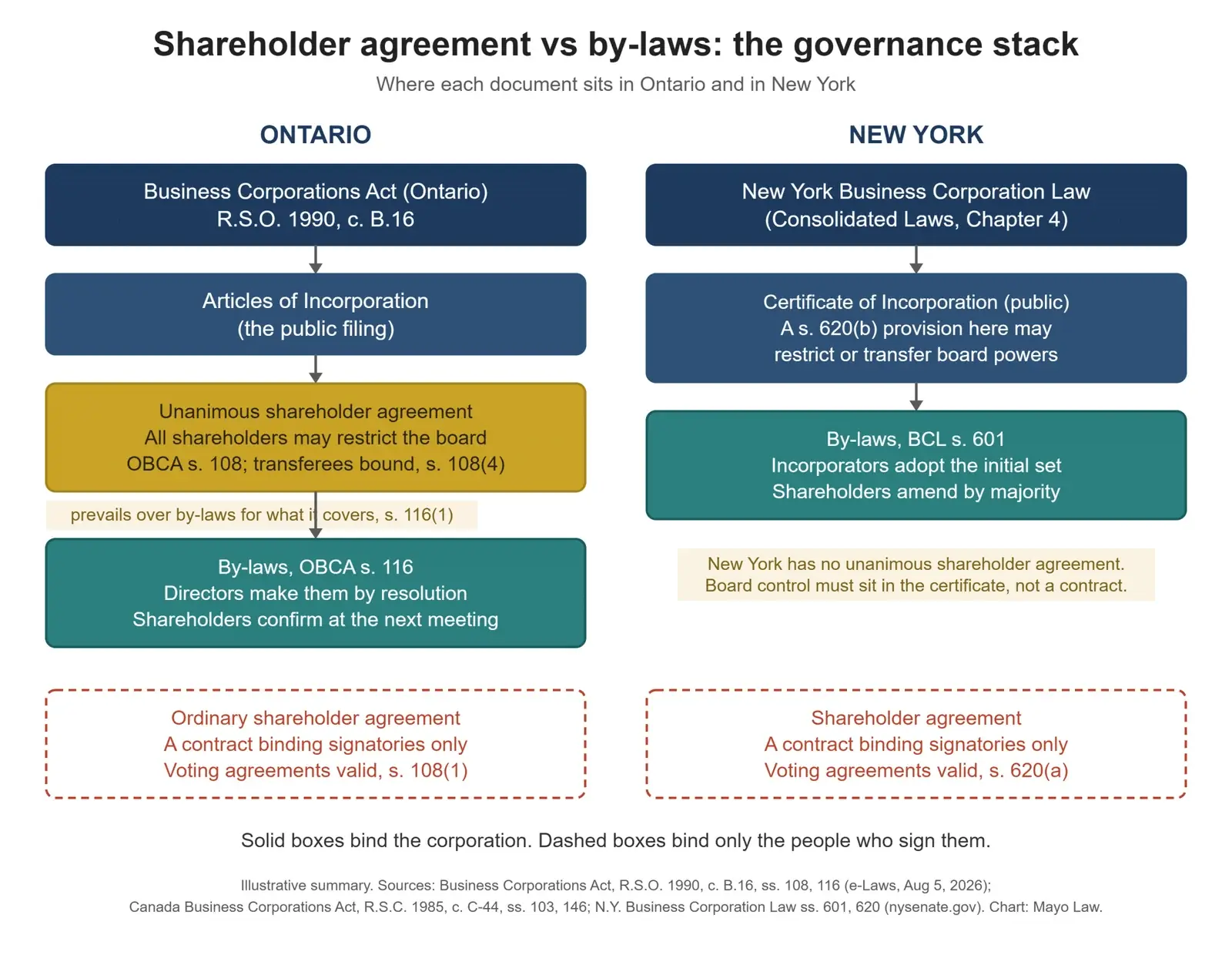
Table 1 summarizes the baseline rules before those statutory upgrades enter the picture.
| Feature | By-laws | Shareholder agreement |
|---|---|---|
| Purpose | Internal operating rules of the corporation | Private deal among the owners |
| Adopted by | New York: incorporators adopt, shareholders amend (BCL 601). Ontario and CBCA: directors adopt, shareholders confirm (OBCA s. 116; CBCA s. 103) | The shareholders who sign it |
| Binds | The corporation, its directors, officers and shareholders in matters of corporate procedure | Signatories only, unless statute upgrades it |
| Public record | Not filed publicly in Ontario or New York | Not filed publicly; a private contract |
| Amendment | Corporate procedure set by statute | Consent of the parties under its own terms |
| Can it restrict the board? | No; it must stay consistent with the statute and the articles or certificate | Ontario and CBCA: yes, if unanimous. New York: only through the certificate |
The transferee rules deserve a closer look. Under an ordinary shareholder agreement, a buyer of shares is not bound unless the buyer signs the agreement or a joinder, which is why transfer clauses insist on one. A unanimous shareholder agreement behaves differently: Ontario deems a transferee of shares to be a party to it under OBCA section 108(4), and CBCA section 146 does the same for federal corporations while adding an express escape hatch, a 30 day right to rescind the purchase for a transferee who was never given notice of the agreement. New York protects buyers through disclosure instead: a certificate provision that shifts board power is valid only where later shares go to people who had knowledge or notice of it or consented in writing, and its existence must be noted conspicuously on every share certificate the corporation issues.
Can a shareholder agreement override the by-laws?
The popular answer online is that the shareholder agreement always wins. Under Ontario and New York law the accurate answer is narrower, and it depends on what kind of agreement you have.
An ordinary shareholder agreement does not amend or override the by-laws. It binds its signatories in contract, including in how they vote their shares. Both jurisdictions expressly validate that much: OBCA section 108(1) upholds a written voting agreement between two or more shareholders, and New York BCL section 620(a) does the same. A shareholder who votes contrary to such an agreement faces a breach of contract claim, but the corporate vote itself generally stands.
A unanimous shareholder agreement is a different instrument. OBCA section 108(2) provides that a written agreement among all the shareholders may restrict, in whole or in part, the powers of the directors to manage or supervise the management of the corporation. CBCA section 146(1) says materially the same thing for federal corporations. The by-law power itself is subordinated to it: OBCA section 116(1) opens with the words “unless the articles, the by-laws or a unanimous shareholder agreement otherwise provide,” and CBCA section 103(1) opens nearly identically. Where a unanimous shareholder agreement takes a power away from the board, the statute moves the responsibility as well: the shareholders who receive the power take on the rights, powers, duties and liabilities of a director to the same extent, and the directors are relieved of theirs (OBCA s. 108(5); CBCA s. 146(5)). A sole shareholder can reach the same result by written declaration (OBCA s. 108(3); CBCA s. 146(2)).
New York has no unanimous shareholder agreement. A private contract cannot strip a New York board of its management authority. What New York offers instead is BCL section 620(b): a provision in the certificate of incorporation that restricts the board or transfers its authority is valid if every incorporator or every record holder of every outstanding share, voting or not, authorized it, and if shares afterward go only to holders with knowledge, notice or written consent. The provision stops being valid once the corporation’s shares are listed on a national securities exchange or regularly quoted over the counter, and section 620(f) shifts the managerial liability onto the controlling shareholders in much the same way the Canadian statutes do.
So the honest comparison is this: in Ontario, the owners’ private contract can outrank the by-laws if every shareholder signs it. In New York, the same power shift must be written into the public charter document, not into the private contract.
How do Ontario and New York treat the two documents differently?
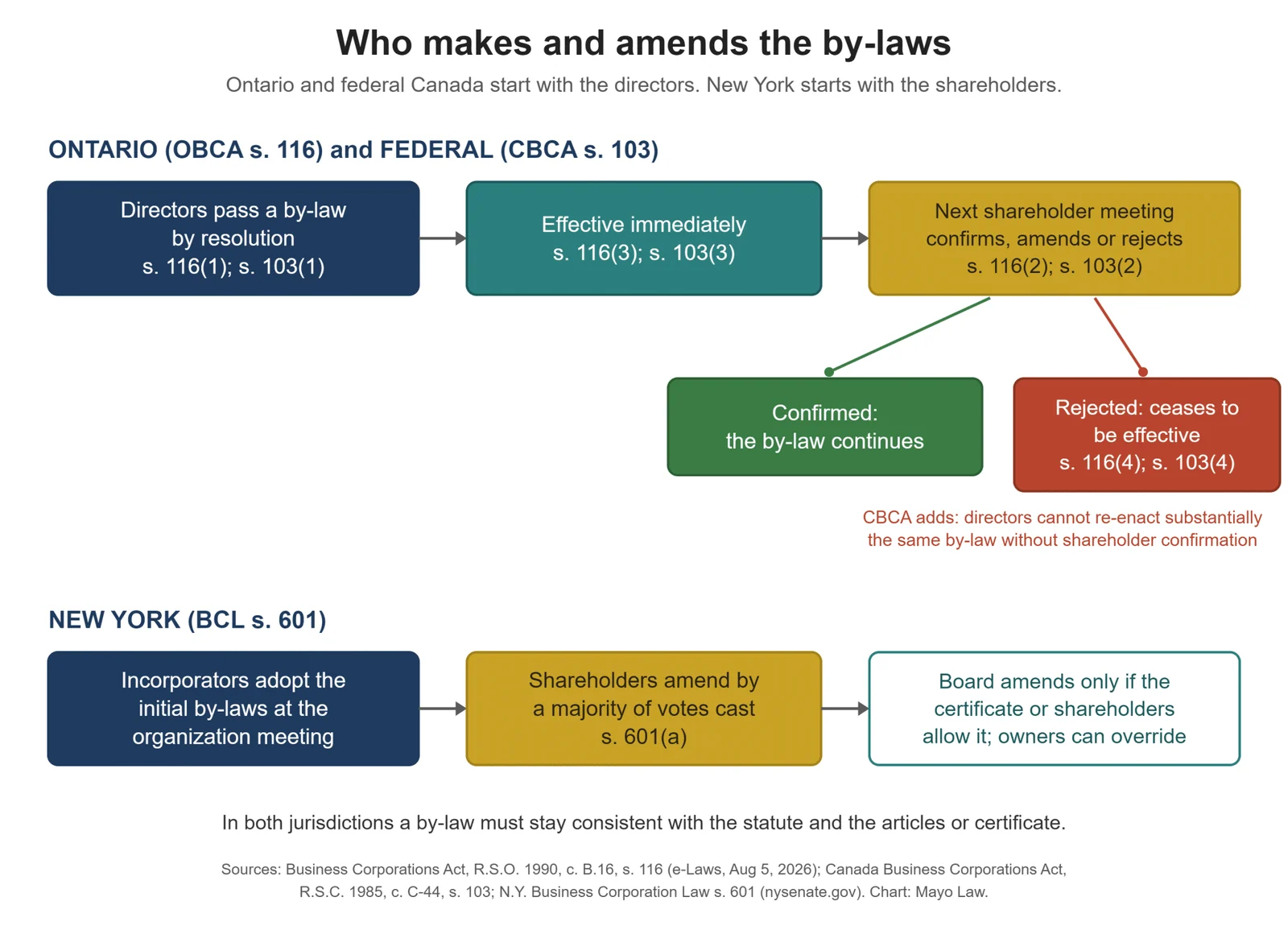
Three differences stand out for businesses operating on both sides of the border.
First, the by-law power runs in opposite directions. New York vests it in the shareholders: under BCL section 601(a) the board may adopt, amend or repeal by-laws only where the certificate or a shareholder-adopted by-law says so, and anything the board adopts remains open to shareholder amendment. Ontario and the CBCA vest the power in the directors first, with immediate effect, subject to a mandatory confirmation vote at the next shareholder meeting. If Ontario shareholders reject a by-law it ceases to be effective, and under CBCA section 103(4) the directors cannot re-enact substantially the same by-law without shareholder confirmation.
Second, the instrument that can control the board is a private contract in Canada and a public charter provision in New York. The practical consequence is confidentiality. An Ontario unanimous shareholder agreement keeps its terms private. A New York section 620(b) arrangement is visible in the certificate of incorporation and flagged on the share certificates themselves.
Third, the two systems bind incoming shareholders differently, as described above: Ontario and the CBCA bind transferees automatically, with a federal rescission right where notice failed, while New York conditions validity on the buyer’s knowledge, notice or written consent.
Table 2 compares the two board-control mechanisms directly.
| Feature | Ontario (OBCA s. 108) and federal (CBCA s. 146) | New York (BCL s. 620(b)) |
|---|---|---|
| Instrument | Written agreement among all shareholders, or a sole shareholder’s written declaration | Provision in the certificate of incorporation |
| Consent required | All shareholders | All incorporators or all record holders, voting and non-voting |
| Where it lives | Private contract | Public charter document, noted on share certificates |
| New shareholders | Deemed parties (OBCA s. 108(4); CBCA s. 146(3)); CBCA gives 30 days to rescind where no notice (s. 146(4)) | Shares must go to holders with knowledge, notice or written consent |
| Liability for board decisions | Follows the power to the shareholders (OBCA s. 108(5); CBCA s. 146(5)) | Follows the power to the shareholders (s. 620(f)) |
| Key limits | Void for an Ontario professional corporation unless every shareholder is a member of the profession (OBCA s. 3.2(5)) | Invalid once shares are listed on an exchange or regularly quoted over the counter (s. 620(c)) |
A corporation with an Ontario company on one side of the border and a New York entity on the other carries two governance stacks at once, and the documents need to be drafted in sight of each other. Our guide to Ontario business structures covers the entity-level choices that sit underneath these documents.
What happens when the two documents conflict?
The shareholder agreement vs bylaws conflict usually surfaces in three places: transfer restrictions that appear in both documents with different procedures, quorum or consent rules that disagree, and director-appointment rights promised in the agreement but never reflected in how the by-laws run elections.
The resolution framework is consistent in both jurisdictions. The statute sits on top. The articles or certificate come next, and the by-laws must be consistent with both; New York says so expressly in BCL section 601(b). An ordinary shareholder agreement does not displace any of those documents. It operates alongside them in contract, so a corporate act taken in breach of it may stand while the breaching shareholder answers for damages. A unanimous shareholder agreement in Ontario, and a section 620(b) certificate provision in New York, rank above the by-laws for the powers they cover, because the statutes make the by-law power subject to them.
The reliable fixes are drafting fixes. State in the shareholder agreement which document controls as between the parties. Mirror any governance commitments, such as board seats or supermajority approvals, in the by-laws so the corporate machinery matches the contract. And review the two documents together whenever shares change hands, new investors arrive, or the corporation reorganizes.
Do you need both documents?
For a corporation with two or more shareholders, the answer is almost always yes. By-laws exist from the start because statute or standard practice puts them there. The shareholder agreement is the document businesses postpone, and the postponement is the problem: the time to negotiate one is while the shareholders still agree with each other. Once a dispute, a death, or a surprise sale offer arrives, the bargaining power to negotiate fair exit terms is gone.
A sole-shareholder corporation can usually run on by-laws alone. Ontario and federal law also give a sole owner the option of a written declaration that takes over board powers, which some owners use to simplify governance and which becomes a ready-made unanimous shareholder agreement if a second shareholder ever buys in. When outside investors arrive, expect both documents to be rewritten as part of the financing.
Frequently asked questions
Are corporate by-laws mandatory in New York?
Yes. Business Corporation Law section 601(a) directs the incorporators to adopt the corporation’s initial by-laws at the organization meeting, so a New York corporation begins life with by-laws in place. After that, amendment and repeal belong to the shareholders by default, and the board can act only where the certificate of incorporation or a shareholder-adopted by-law authorizes it.
Are by-laws mandatory for Ontario corporations?
The Ontario statute is permissive rather than mandatory. Section 116(1) of the Business Corporations Act says the directors may make, amend or repeal by-laws, and no provision forces a corporation to have them. In practice, nearly every Ontario corporation adopts a general operating by-law, commonly called By-law No. 1, at organization, because running meetings and appointing officers without one is impractical.
What is a unanimous shareholder agreement?
A unanimous shareholder agreement is a written agreement among all of a corporation’s shareholders that restricts, in whole or in part, the directors’ power to manage or supervise the management of the corporation. It exists by statute in Ontario under OBCA section 108 and federally under CBCA section 146. Where it removes a power from the board, the shareholders who take that power also take on the directors’ duties and liabilities to the same extent.
Is a shareholder agreement filed on the public record?
No. In both Ontario and New York a shareholder agreement is a private contract and is not filed with any public registry. By-laws are also internal documents in both jurisdictions. The public constitutional document is the articles of incorporation in Ontario and the certificate of incorporation in New York, and a New York section 620(b) control provision appears there precisely because it must be public.
Does a buyer of shares automatically become bound by an existing shareholder agreement?
Under an ordinary shareholder agreement, no. A buyer is bound only by signing the agreement or a joinder, which is why transfer clauses require one. A unanimous shareholder agreement works differently. Ontario deems a transferee to be a party under OBCA section 108(4), and the federal Act does the same under CBCA section 146(3) while giving a transferee who received no notice 30 days to rescind the purchase under section 146(4).
Who can amend corporate by-laws?
In New York, shareholders amend by-laws by a majority of votes cast, and the board holds that power only if the certificate of incorporation or a shareholder-adopted by-law grants it. In Ontario and under the CBCA, the directors amend by-laws by resolution with immediate effect, then must submit the change to the shareholders at the next meeting, where it is confirmed, amended or rejected by ordinary resolution.
Do LLCs use by-laws or shareholder agreements?
Neither. By-laws and shareholder agreements belong to corporations. A New York LLC is governed by an operating agreement among its members, and Ontario has no domestic LLC at all, which surprises many US founders. Our comparison of the LLC and the corporation in New York explains how governance documents map between the two forms.
Conclusion
By-laws and shareholder agreements are complements, not substitutes. The by-laws keep the corporation itself running. The shareholder agreement records the deal between its owners. Ontario law lets a unanimous shareholder agreement reorder the entire governance stack in private, while New York requires the same reordering to appear in the public certificate. Whichever side of the border a corporation sits on, the shareholder agreement vs bylaws question resolves the same way: draft the two documents together, review them together, and update them together whenever ownership changes.
How Mayo Law Can Help
Mayo Law is a cross-border business law firm with offices in Toronto and New York. Joseph Mayo, the firm’s principal attorney, is licensed in both Ontario and New York, and the firm drafts and reviews by-laws, shareholder agreements and unanimous shareholder agreements for corporations operating on both sides of the border. If your business has shareholders in Canada and the United States, or an Ontario company alongside a New York entity, we can align the governance documents in both jurisdictions so they work as one system. Learn more about our corporate and international business law services, read about what a corporate lawyer in Toronto handles, or see what a dual licensed lawyer does for cross-border clients. Contact us to discuss your corporation’s documents.
Disclaimer
This article is for general information only. It is not legal advice, and reading it does not create a lawyer-client or attorney-client relationship. By-law and shareholder agreement questions turn on the specific facts, documents and jurisdictions involved, and statutory provisions current as of August 2026 may change. Mayo Law provides legal services in Ontario and New York.